Top dial (1), divided in 12 hours, shows local mean time - Central European time, the daily time 15° east of Greenwich in hours, minutes and seconds. The perpetual calendar consists of 5 dials, indicating: The Sunday letter (3), the epact (4), the sun circle (5), the indiction (6) and the moon circle (7). Furthermore, there is a calendar showing the 12 months of the year, the days and dates of the week, every moon phase as well as the calculated Easter Sunday - all other holidays according to Easter Sunday. The works of the perpetual calendar are automatically set in motion every New Years Eve at midnight, to calculate the calendar for the following year. It runs for the next 2500 years. |

 |  |  |  |
| Jens Olsen's World Clock |


| ********** |

 |  |  |  |


| Click here to see our reader's choice for Best Picture and the results of Survey #3, December 22, 2006. |
| See results of Survey #2 May 12-19, 2006 Click here. |
| See results of Survey #1 December 9-16, 2005 Click here. |
| Dead Horse Update Click HERE to read our analysis of the Dead Horse Picture from the Sheboygan Press. |

| ********** |
| Dials on Jens Olsen's World Clock http://www.ateliera.dk/olsenfacts.htm |
| Front of Clock |
| Click here to see our reader's choice for Best Picture and the results of Survey #4, August 12, 2007. |
| ********** |


| Back of Clock |
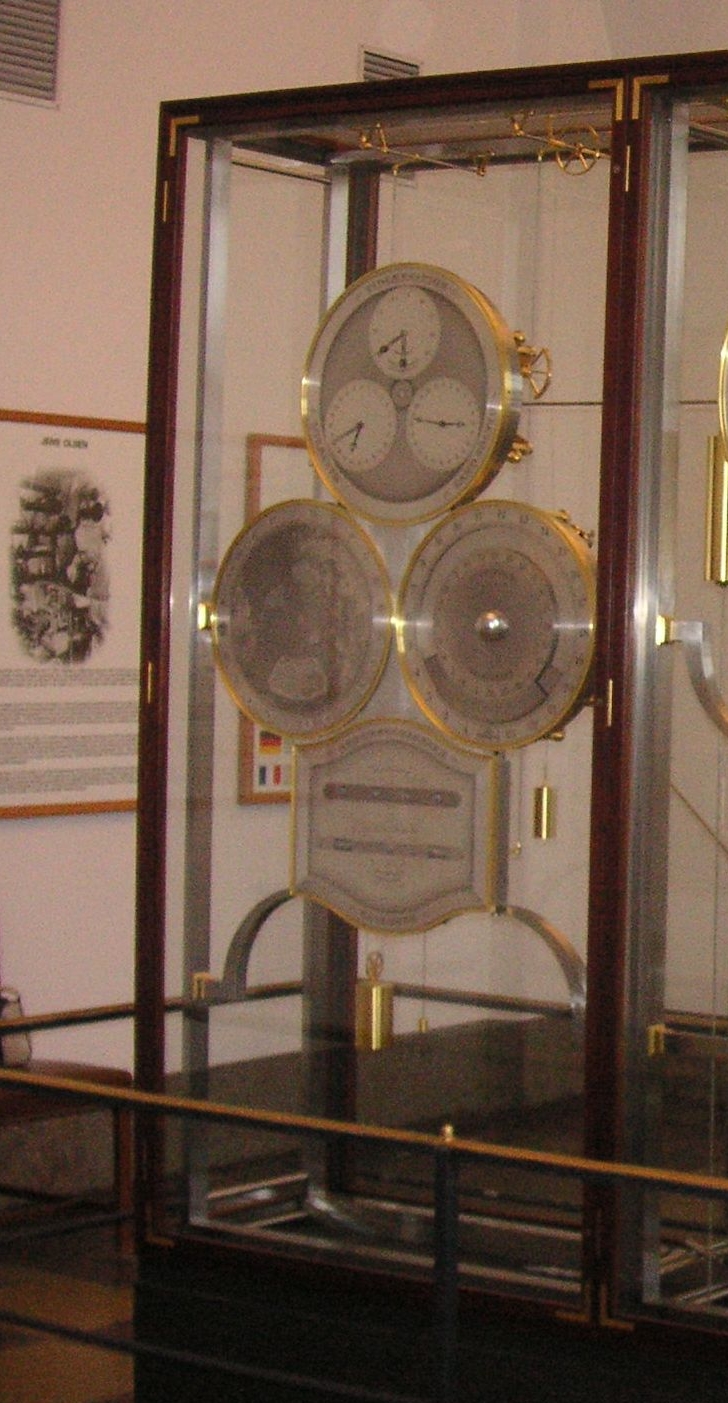
| Dials to Left |
The top dial shows the time equation
(1), local time in Copenhagen (2) and
actual solar time (3). The time
equation means the time difference
between local time and actual solar
time. Local actual time is the time
usually used. Actual solar time
expresses the earth's position
proportional to the sun. When the
hands of actual solar time show 12,
the sun is in meridian.
The dial to the left (4) shows the
time at any location on earth.
The dial to the right (5) shows the
time of sunrise and sunset both
according to local time and actual
solar time. The dial is equipped with
black and white arch-shaped pieces
to indicate the lengths of day and
night.
The Gregorian calendar shows the
year (6), the day of the week, date
and month (7). This perpetual
movement sets itself once every 24
hours at midnight.
(1), local time in Copenhagen (2) and
actual solar time (3). The time
equation means the time difference
between local time and actual solar
time. Local actual time is the time
usually used. Actual solar time
expresses the earth's position
proportional to the sun. When the
hands of actual solar time show 12,
the sun is in meridian.
The dial to the left (4) shows the
time at any location on earth.
The dial to the right (5) shows the
time of sunrise and sunset both
according to local time and actual
solar time. The dial is equipped with
black and white arch-shaped pieces
to indicate the lengths of day and
night.
The Gregorian calendar shows the
year (6), the day of the week, date
and month (7). This perpetual
movement sets itself once every 24
hours at midnight.
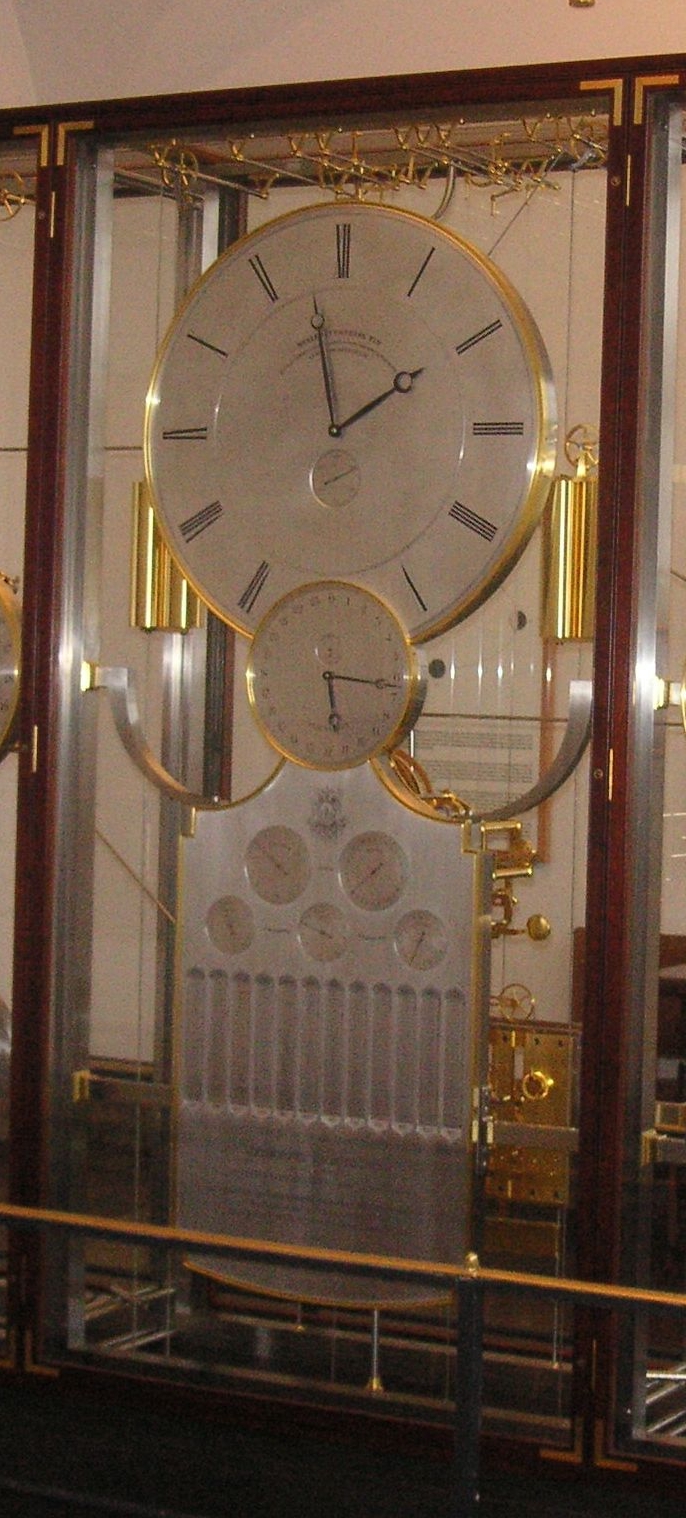
| Dials in Center |
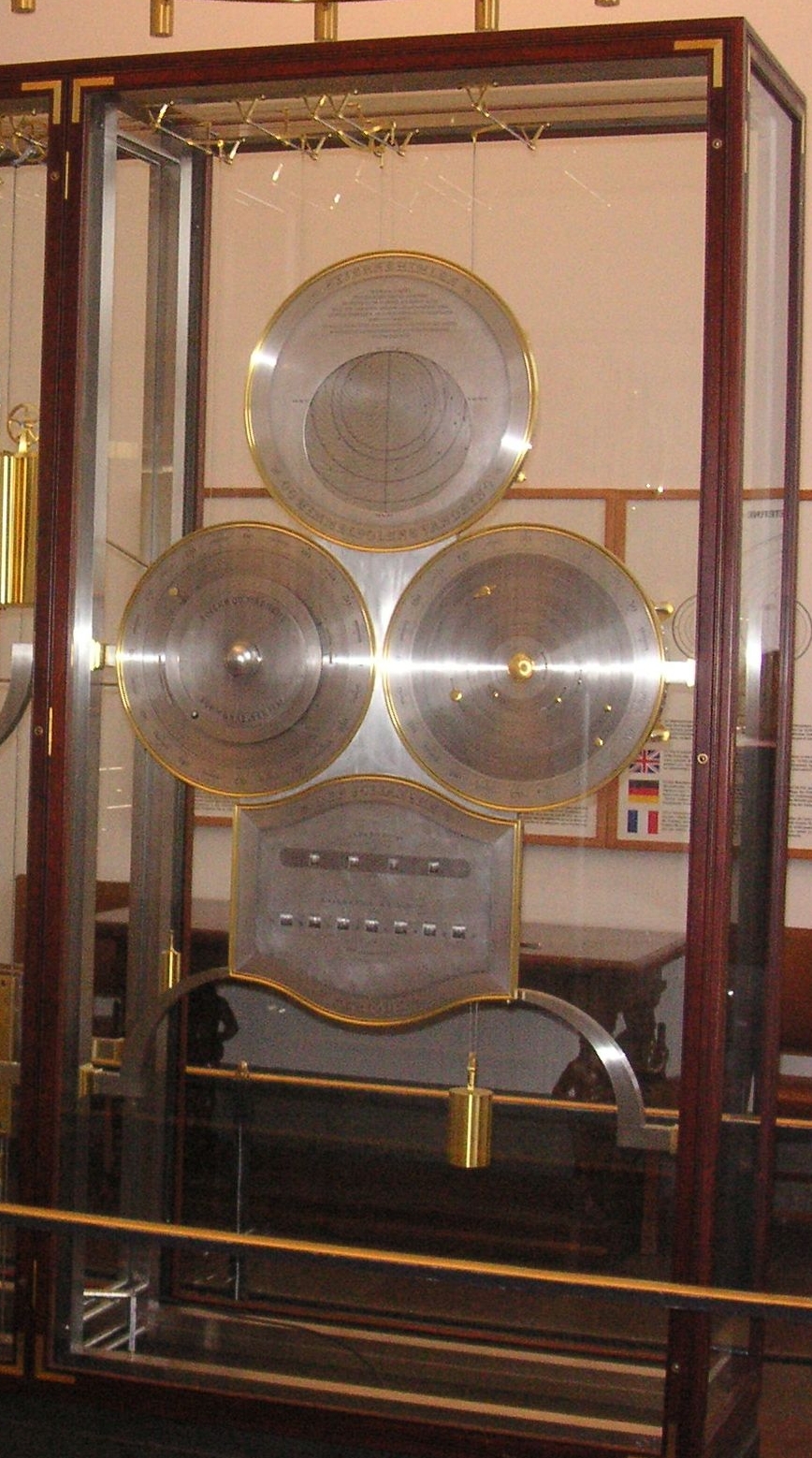
| Dials to Right |
The top dial (1) shows the present
star map over Denmark and the
slow precession of the motion of
the earth's axis over 25.753 years!
The left dial (2) shows the
geocentrical orbit with the Earth
as its centre. Here you can obtain
knowledge of the sun's and
moon's eclipses, the distance
between the Earth and the Moon
- the apse line and the knot line.
The right dial (3) shows our solar
system with the planets Mercury,
Venus, the Earth, Mars, Jupiter,
Saturn, Uranus and Neptune
around the Sun.
The bottom dial shows the year
(4) and number of days (5)
according to the Julian time
period which is 7,980 years.
Astronomers use the Julian Time
period to register astronomical
phenomena.
star map over Denmark and the
slow precession of the motion of
the earth's axis over 25.753 years!
The left dial (2) shows the
geocentrical orbit with the Earth
as its centre. Here you can obtain
knowledge of the sun's and
moon's eclipses, the distance
between the Earth and the Moon
- the apse line and the knot line.
The right dial (3) shows our solar
system with the planets Mercury,
Venus, the Earth, Mars, Jupiter,
Saturn, Uranus and Neptune
around the Sun.
The bottom dial shows the year
(4) and number of days (5)
according to the Julian time
period which is 7,980 years.
Astronomers use the Julian Time
period to register astronomical
phenomena.