
 |  |  |  |
| We salute Black History Month. Contest #50 - February 24, 2006 |
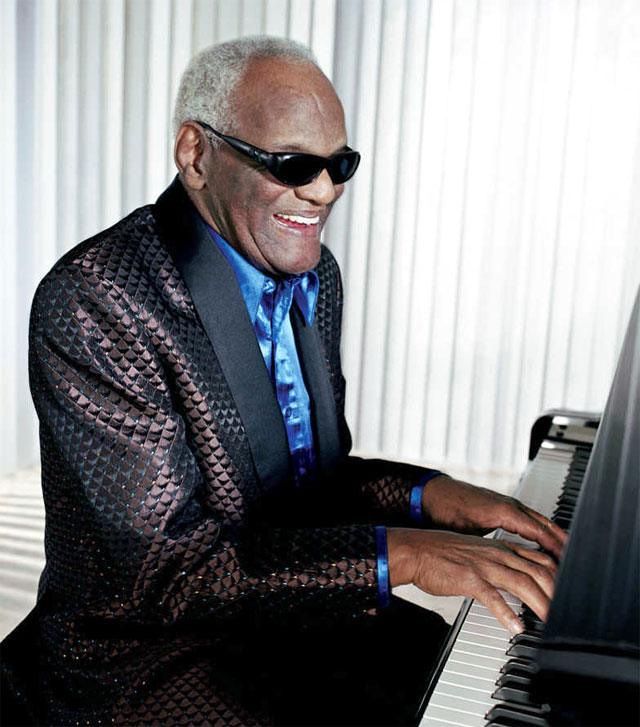
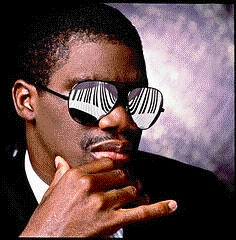
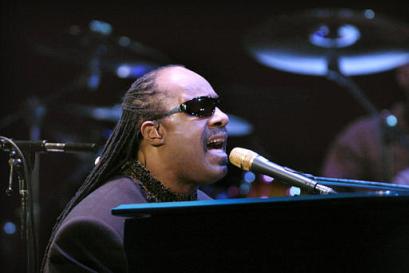
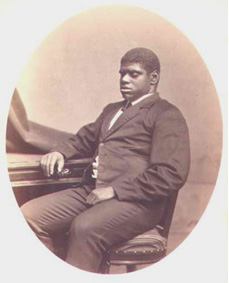

| 1. Who is this man? 2. What does he have in common with the three people above? 3. What is very different about him? |

| Thanks to Stan Read for suggesting this quiz. |
| ********** |
| 1) Tom Green Bethune ("Blind Tom") 2) All are blind, African-American, pianists. 3) Unlike the others, who studied and learned the piano, Tom was an autistic savant, completely uneducated, and with an amazing gift for playing any music he was exposed to. |

| ********** |
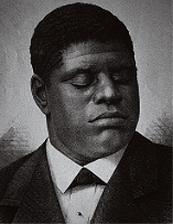
The three musicians pictured in this quiz are:
Ray Charles
http://www.history-of-rock.com/ray_charles.htm
Marcus Roberts
http://www.sonyclassical.com/artists/roberts/
Stevie Wonder
http://www.soulwalking.co.uk/Stevie%20Wonder.html
Ray Charles
http://www.history-of-rock.com/ray_charles.htm
Marcus Roberts
http://www.sonyclassical.com/artists/roberts/
Stevie Wonder
http://www.soulwalking.co.uk/Stevie%20Wonder.html

| ********** |
| For links to the biographies of these and many other blind musicians, see http://en.wikipedia.org/wiki/Category:Blind_musicians |

| ********** |
| BLIND TOM |
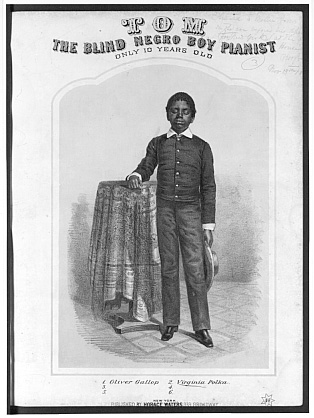
| Blind Tom: The Legacy of a Prodigy Lost in Mystery The New York Times May 5, 2000 http://www.nytimes.com/library/music/030500ms-blind-tom.html ARCHANGELS UNAWARE The Story of Thomas Bethune also known as Thomas Wiggins also known as "Blind Tom" (1849 - 1908) by Barbara Schmidt http://www.twainquotes.com/archangels.html: Early Life |
| Blind Tom |
Tom was born on May 25, 1849 with a condition that
today's doctors might diagnose with the politically
correct term "autistic savant"--one of only about 100
cases recorded in medical history. Tom's father
Domingo Wiggins, a field slave, and his mother Charity
Greene were purchased at auction by James Bethune
of Columbus, Georgia when Tom was an infant.
Domingo and Charity's former master thought the
blind sickly "pickaninny" had no labor potential and he
was thrown into the sale as a no cost extra. Although
Tom's parents were married, the prevailing custom of
the time dictated that female slaves and their children
retain the names of their owners. Following slavery
tradition, Tom received the name Thomas Greene
Bethune.
For the first several years of his life, Tom's only sign
of human intelligence was his interest in sounds--any
sound--and an uncanny ability to mimic them. Charity
was allowed to bring Tom with her to the main house
where she worked for the Bethune family--a family of
seven musically talented children who overflowed their
home with singing and piano playing. General Bethune
told Charity that her son had as much intelligence as
the family dog and he began teaching Tom to respond
to animal commands like "sit" and "stand." Members of
the Bethune family delighted in teaching their family pet
the names of objects that he could feel and smell.
Noting the infant's enthusiasm for musical sounds and
his prodigious ability to mimic what he had heard
played on the family piano, Bethune's wife and his
eldest daughter, Mary, fostered Tom's evident talent
and began teaching him regularly from the age of 4
By age of six Tom started improvising on the piano
and creating his own musical compositions. He
claimed the wind, or the rain, or the birds had taught
him the melody. Even though a local music teacher
told Bethune that Tom's musical abilities were beyond
comprehension and his best course of action was
simply to let him hear fine playing, Bethune provided
Tom with various music instructors. One of Tom's
music teachers later reported that Tom could learn
skills in a few hours that required other musicians
years to perfect. In October 1857, General Bethune
rented a concert hall in Columbus and for the first time
"Blind Tom" performed before a large audience that
had difficulty comprehending how a blind idiotic slave
child could master the piano keyboard.
Slaves with musical talent meant income for their
owners and in 1858 James Bethune "hired out" Tom to
concert promoter Perry Oliver for a period of several
years. It has been estimated that Bethune pocketed
$15,000 from the arrangement and that Perry Oliver
made profits amounting to $50,000. Tom, now age
nine, was separated from his family and exhibited
throughout hundreds of cities on a rigorous
four-shows-per-day schedule.
Under the direction of the impresario Oliver, young
Tom's act included far more than mere music. He sang
one song while playing a second with his right hand
today's doctors might diagnose with the politically
correct term "autistic savant"--one of only about 100
cases recorded in medical history. Tom's father
Domingo Wiggins, a field slave, and his mother Charity
Greene were purchased at auction by James Bethune
of Columbus, Georgia when Tom was an infant.
Domingo and Charity's former master thought the
blind sickly "pickaninny" had no labor potential and he
was thrown into the sale as a no cost extra. Although
Tom's parents were married, the prevailing custom of
the time dictated that female slaves and their children
retain the names of their owners. Following slavery
tradition, Tom received the name Thomas Greene
Bethune.
For the first several years of his life, Tom's only sign
of human intelligence was his interest in sounds--any
sound--and an uncanny ability to mimic them. Charity
was allowed to bring Tom with her to the main house
where she worked for the Bethune family--a family of
seven musically talented children who overflowed their
home with singing and piano playing. General Bethune
told Charity that her son had as much intelligence as
the family dog and he began teaching Tom to respond
to animal commands like "sit" and "stand." Members of
the Bethune family delighted in teaching their family pet
the names of objects that he could feel and smell.
Noting the infant's enthusiasm for musical sounds and
his prodigious ability to mimic what he had heard
played on the family piano, Bethune's wife and his
eldest daughter, Mary, fostered Tom's evident talent
and began teaching him regularly from the age of 4
By age of six Tom started improvising on the piano
and creating his own musical compositions. He
claimed the wind, or the rain, or the birds had taught
him the melody. Even though a local music teacher
told Bethune that Tom's musical abilities were beyond
comprehension and his best course of action was
simply to let him hear fine playing, Bethune provided
Tom with various music instructors. One of Tom's
music teachers later reported that Tom could learn
skills in a few hours that required other musicians
years to perfect. In October 1857, General Bethune
rented a concert hall in Columbus and for the first time
"Blind Tom" performed before a large audience that
had difficulty comprehending how a blind idiotic slave
child could master the piano keyboard.
Slaves with musical talent meant income for their
owners and in 1858 James Bethune "hired out" Tom to
concert promoter Perry Oliver for a period of several
years. It has been estimated that Bethune pocketed
$15,000 from the arrangement and that Perry Oliver
made profits amounting to $50,000. Tom, now age
nine, was separated from his family and exhibited
throughout hundreds of cities on a rigorous
four-shows-per-day schedule.
Under the direction of the impresario Oliver, young
Tom's act included far more than mere music. He sang
one song while playing a second with his right hand
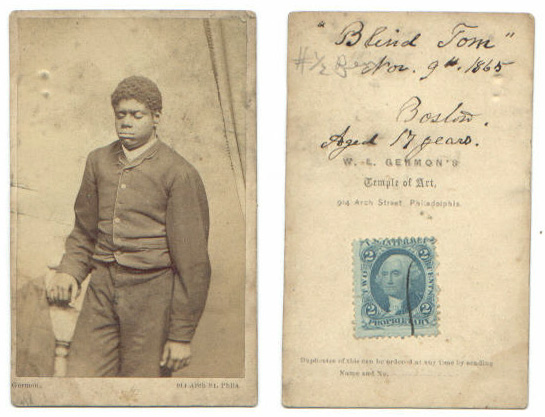
| Blind Tom, Age 17 http://www.twainquotes.com/blindtom.html |

| Blind Tom and General Bethune http://www.twainquotes.com/archangels.html |
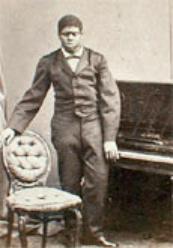
| Blind Tom from The Slave and the Doctor’s Son http://brownalumnimagazine. com/storydetail.cfm?ID=289 |
But Blind Tom's reputation soared, and,
despite his programmed display of bizarre
antics and noises, the core of his repertory
was substantial. It featured Bach fugues,
Beethoven sonatas and intricate fantasies
by Thalberg and Liszt, as well as dozens
of popular dances, songs and operatic
paraphrases; he also played solos of his
own composition. His most celebrated
titles included "The Rain Song," "The
Battle of Manassas" and "Sewing Song:
Imitation of the Sewing Machine." In 1860
he delivered a command performance in
the White House for President James
Buchanan and played shows for visiting

| Thomas Greene Wiggins, or Blind Tom, was widely promoted, in a Ladies' Home Journal in 1898. http://www.nytimes.com/library/music/030500ms-blind-tom.html |
| ********** |
For more information on Tom's life, including the custody battles over him between the
Bethune family, the Bethune in-laws, and his mother Charity Green, see
http://www.twainquotes.com/archangels.html
Mark Twain was an avid fan of Blind Tom. Twain wrote articles describing Tom's
performance and his uncanny auditory abilities. To read commentaries on Blind Tom by
Twain, see http://www.twainquotes.com/18690801.html and
http://www.twainquotes.com/archangels.html.
Bethune family, the Bethune in-laws, and his mother Charity Green, see
http://www.twainquotes.com/archangels.html
Mark Twain was an avid fan of Blind Tom. Twain wrote articles describing Tom's
performance and his uncanny auditory abilities. To read commentaries on Blind Tom by
Twain, see http://www.twainquotes.com/18690801.html and
http://www.twainquotes.com/archangels.html.
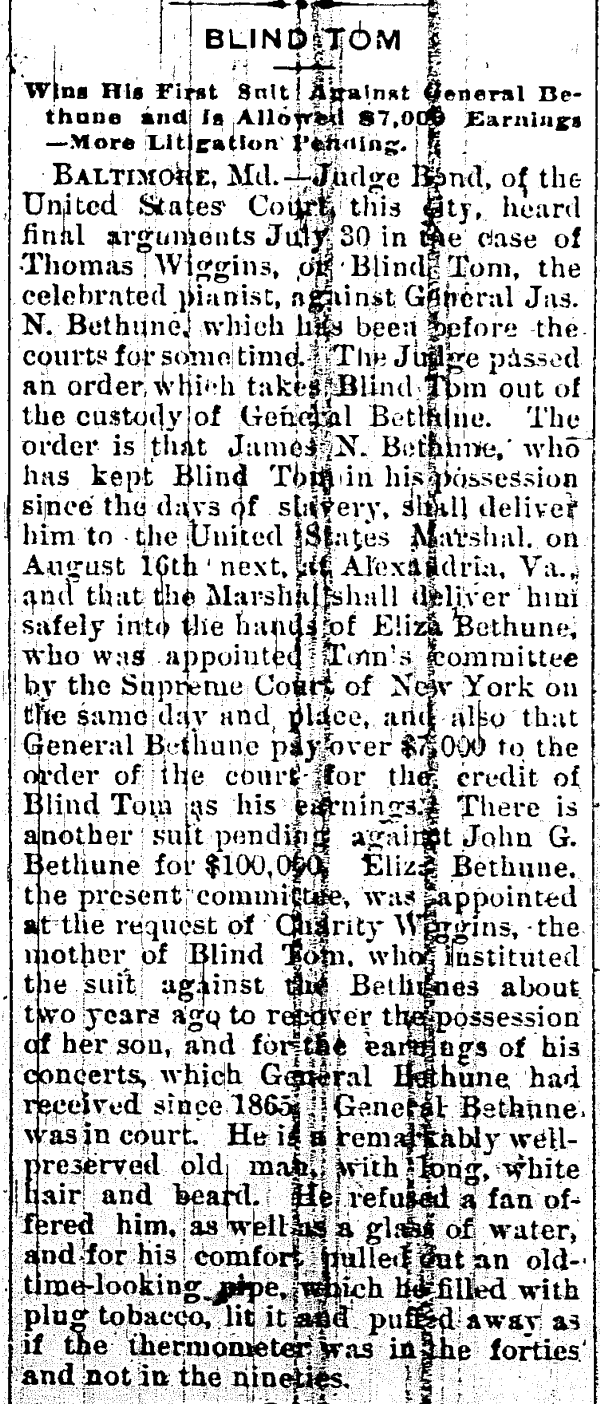
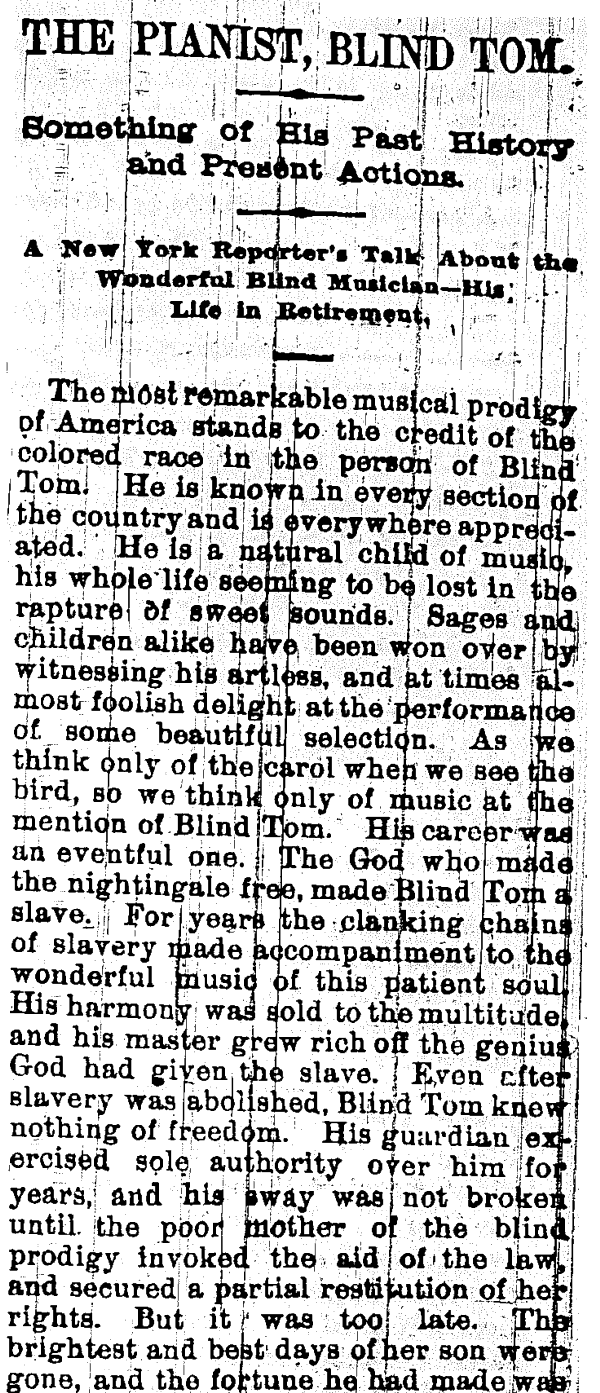
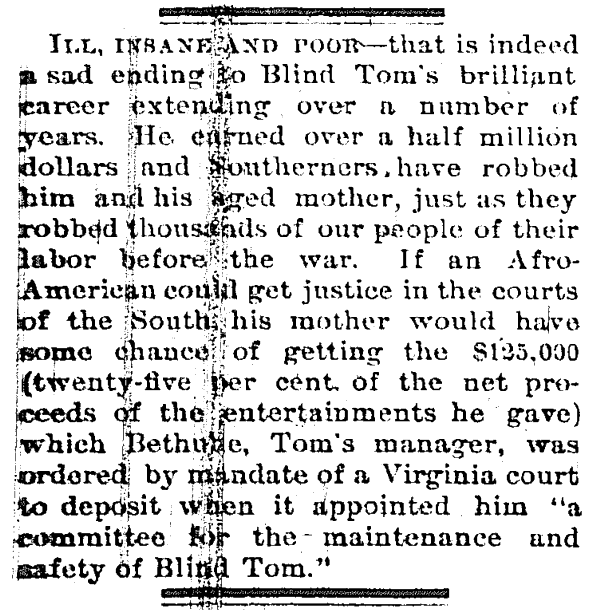
| Blind Tom, Robbed 1/31/1891 |
| Contempary Newspaper Articles about Blind Tom from the Cleveland Gazette Click on images to see larger versions. |
| The Pianist Blind Tom 8/4/1888 |
| Blind Tom 8/13/1887 |
| ********** |
| Hear compositions by Blind Tom played by John Davis |
The Rainstorm
Oliver Galop
The Battle of Manassas
| ********** |
For further information on Blind Tom:
Brown Alumni Magazine Online
The Slave and the Doctor’s Son
September/October 2001
http://brownalumnimagazine.com/storydetail.cfm?ID=289
National Public Radio
The Tale of 'Blind Tom' Wiggins
March 6, 2002
http://www.npr.org/programs/morning/features/2002/mar/blindtom/index.html#hear
The New York Times
Arts & Leisure
Blind Tom: The Legacy of a Prodigy Lost in Mystery
March 5, 2000
http://www.nytimes.com/library/music/030500ms-blind-tom.html
The African American Registry
"Blind Tom," the Mozart of his race!
http://www.aaregistry.
com/african_american_history/1246/Blind_Tom_the_Mozart_of_his_race
The Atlantic Monthly
Blind Tom
November 1862
http://cdl.library.cornell.edu/cgi-bin/moa/pageviewer?
coll=moa&root=/moa/atla/atla0010/&tif=00586.TIF&view=50&frames=1
Brown Alumni Magazine Online
The Slave and the Doctor’s Son
September/October 2001
http://brownalumnimagazine.com/storydetail.cfm?ID=289
National Public Radio
The Tale of 'Blind Tom' Wiggins
March 6, 2002
http://www.npr.org/programs/morning/features/2002/mar/blindtom/index.html#hear
The New York Times
Arts & Leisure
Blind Tom: The Legacy of a Prodigy Lost in Mystery
March 5, 2000
http://www.nytimes.com/library/music/030500ms-blind-tom.html
The African American Registry
"Blind Tom," the Mozart of his race!
http://www.aaregistry.
com/african_american_history/1246/Blind_Tom_the_Mozart_of_his_race
The Atlantic Monthly
Blind Tom
November 1862
http://cdl.library.cornell.edu/cgi-bin/moa/pageviewer?
coll=moa&root=/moa/atla/atla0010/&tif=00586.TIF&view=50&frames=1
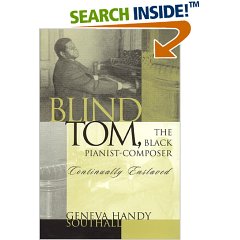
| Blind Tom by Geneva Handy Southall Click here. |
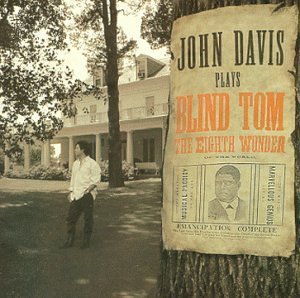
| John Davis Plays Blind Tom Click here. |
| ********** |
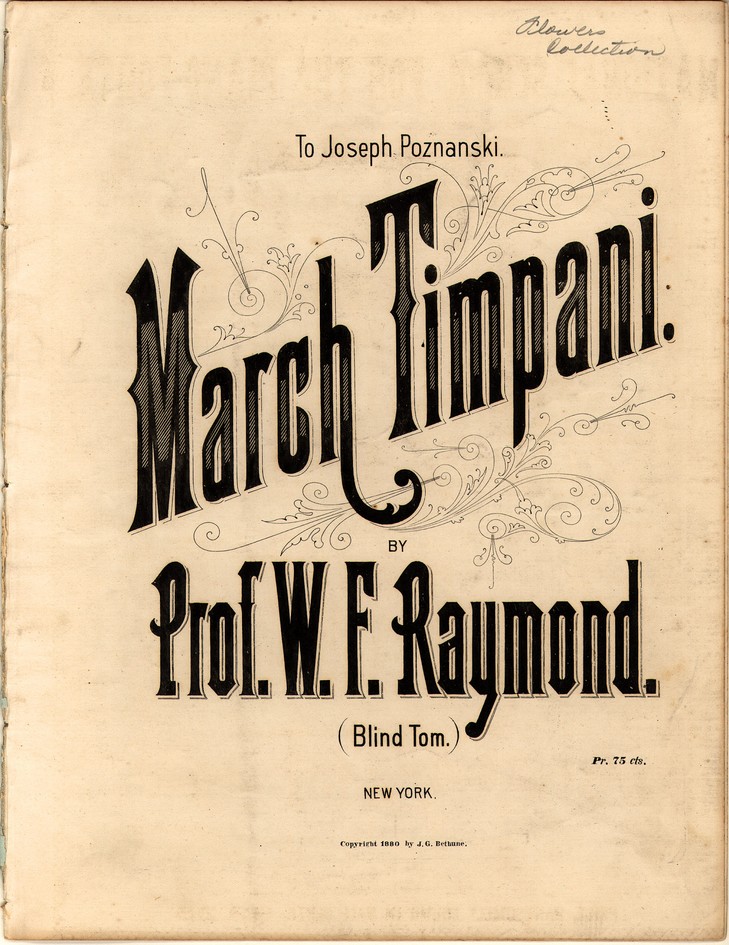
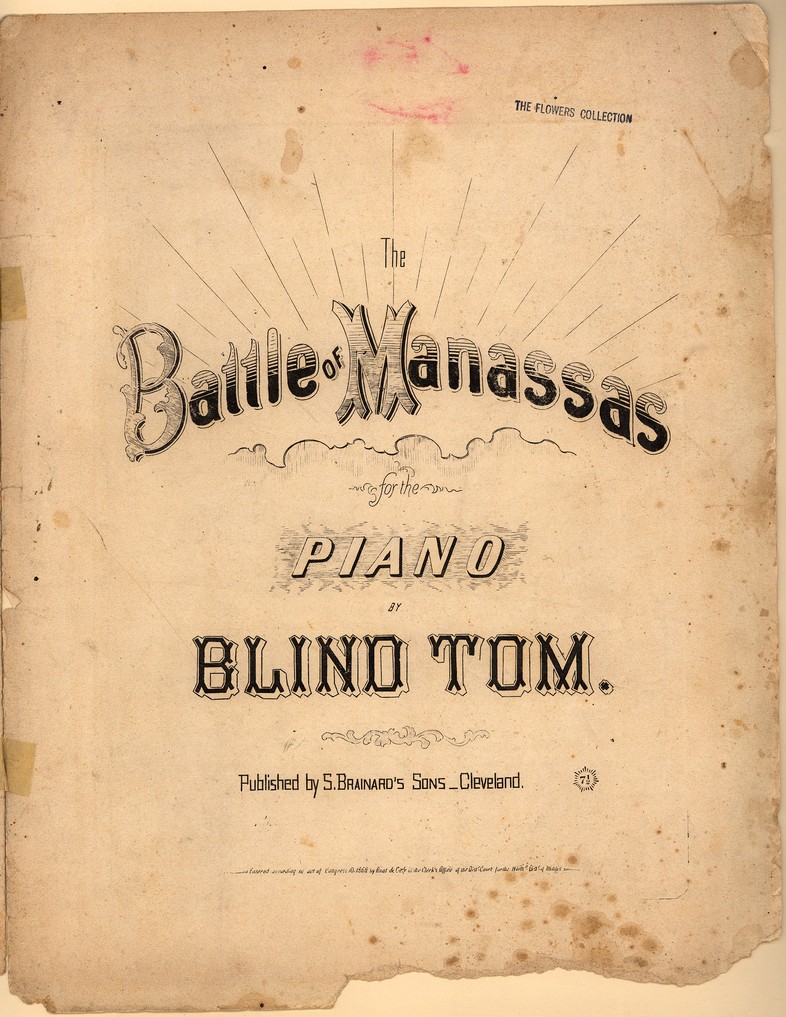
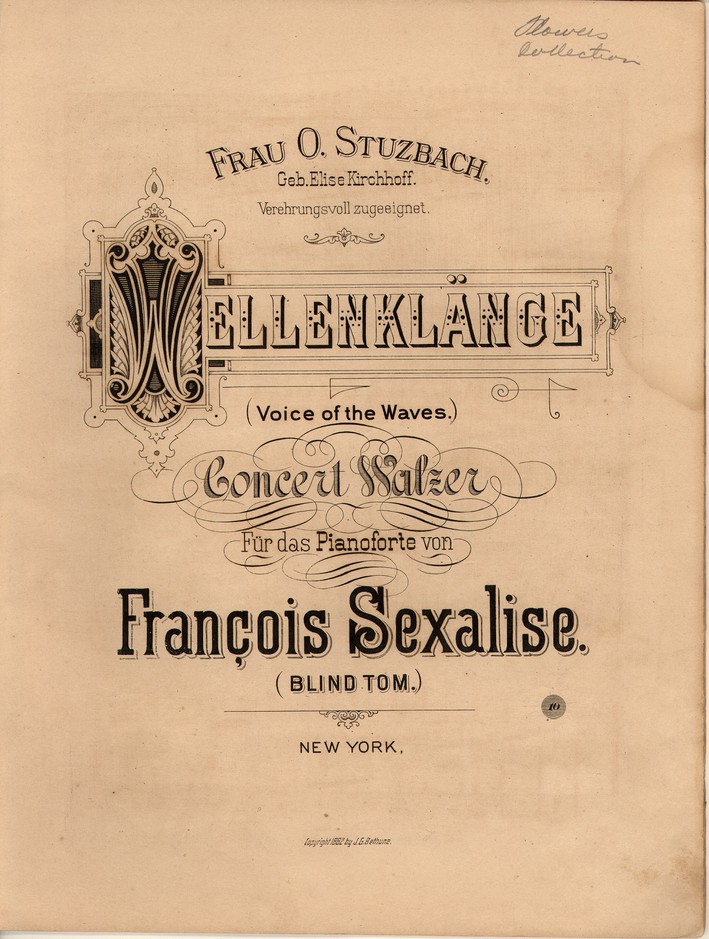
| Sheet Music by Blind Tom http://scriptorium.lib.duke.edu/sheetmusic/ |
| ********** |
| Blind Tom's Death and Burial |
Blind Tom died at age fifty-nine on June 13, 1908 in
Hoboken, New Jersey. A few days later The New
York Times headline read "BLIND TOM, PIANIST,
DIES OF A STROKE -- A CHILD ALL HIS LIFE."
Newspaper coverage reported that Tom was buried in
Evergreens Cemetery in Brooklyn, New York.
However, over the ensuing decades, controversy has
surrounded Blind Tom's final resting place.
Some historians related that in a final victory for
custody of Tom--twenty years after his death--Fannie
Bethune, the youngest surviving daughter of James
Bethune received permission to move Tom's body back
to his old home in Georgia. They give his final resting
place as the old Westmoreland Plantation just outside
of Columbus, Georgia where a historical marker was
erected in 1954.
The claim by Columbus, Georgia historians may be
based in part on an affidavit by Jack Moore dated 1949
detailing plans by Fannie Bethune to move a body she
believed to be that of Blind Tom from a cemetery at
Westmoreland to the Bethune family plot in Columbus,
Georgia. The contract was never consummated due to
the death of Fannie Bethune.
Hoboken, New Jersey. A few days later The New
York Times headline read "BLIND TOM, PIANIST,
DIES OF A STROKE -- A CHILD ALL HIS LIFE."
Newspaper coverage reported that Tom was buried in
Evergreens Cemetery in Brooklyn, New York.
However, over the ensuing decades, controversy has
surrounded Blind Tom's final resting place.
Some historians related that in a final victory for
custody of Tom--twenty years after his death--Fannie
Bethune, the youngest surviving daughter of James
Bethune received permission to move Tom's body back
to his old home in Georgia. They give his final resting
place as the old Westmoreland Plantation just outside
of Columbus, Georgia where a historical marker was
erected in 1954.
The claim by Columbus, Georgia historians may be
based in part on an affidavit by Jack Moore dated 1949
detailing plans by Fannie Bethune to move a body she
believed to be that of Blind Tom from a cemetery at
Westmoreland to the Bethune family plot in Columbus,
Georgia. The contract was never consummated due to
the death of Fannie Bethune.
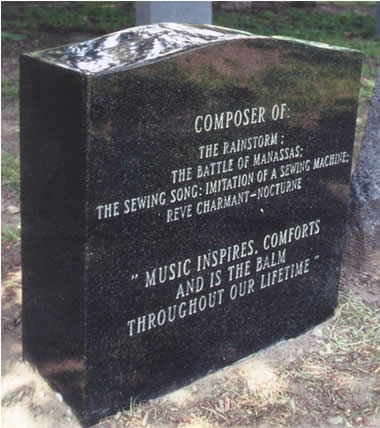
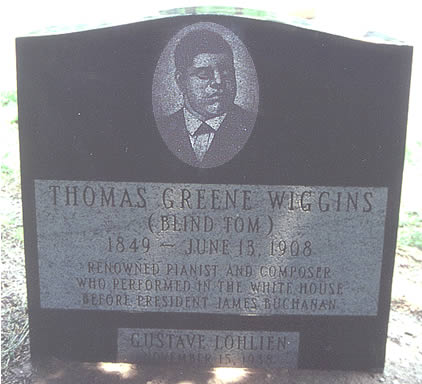
| Tom's Gravestone in Evergreens Cemetery in East New York |
The one missing link in the Fannie Bethune claim is documentation that Tom's body
was first removed from his initial resting place in Brooklyn, New York to the state of
Georgia.
In spite of additional concrete evidence that Tom's body had indeed been removed to
the state of Georgia, the Georgia Historical Commission erected a historical marker to
Tom in 1954 indicating the site of Tom's grave. The marker is located on Warm
Springs Road outside of Columbus, Georgia.
http://twainquotes.com/ArchangelsMystery.html
| New York Times Obituaries for Blind Tom BLIND TOM, PIANIST, DIES OF A STROKE June 15, 1908 DISPUTE OVER BLIND TOM June 16, 1908 http://twainquotes.com/TomObit.html |
| ********** |
| Savant Syndrome |
Excerpts from
Savant Syndrome: An Extraordinary Condition
A Synopsis: Past, Present, Future
by Darold A. Treffert, MD
http://www.wisconsinmedicalsociety.org/savant/synopsis_article.cfm#what
Abstract
Savant syndrome is a rare, but extraordinary, condition in which persons with serious
mental disabilities, including autistic disorder, have some 'island of genius' that stands in
marked, incongruous contrast to overall handicap. In fact as many as one in ten autistic
persons have such remarkable abilities in varying degrees, although savant syndrome
occurs in other developmental disabilities or CNS injury or disease as well. While J.
Landon Down included 10 such cases in his original description of this interesting
circumstance in 1887, and Kanner included some such cases in his first accounts of
early infantile autism in 1943, the 1989 movie Rain Man made "autistic savant" a
household term. While there is as yet no over-arching theory to explain all instances of
savant syndrome, more progress has been made in better understanding this condition
in the past 15 years, than in the prior 100.
Where We Have Been
Savant syndrome, with its "islands of genius," has a long history. Benjamin Rush
provided one of the earliest reports in 1789 when he described the lightning calculating
ability of Thomas Fuller "who could comprehend scarcely anything, either theoretical or
practical, more complex than counting."3 But when Fuller was asked how many
seconds a man had lived who was 70 years, 17 days and 12 hours old, he gave the
correct answer of 2,210,500,800 in 90 seconds, even correcting for the 17 leap years
included. However, the first description of savant syndrome in a scientific paper
appeared in the German psychology journal, Gnothi Sauton, in 1783, describing the
case of Jedediah Buxton, a lightning calculator with extraordinary memory.4
What We Do Know
1. The condition is rare, but one in 10 autistic persons show some savant skills.
2. Males outnumber females in autism and savant syndrome.
3. Savant skills typically occur in an intriguingly narrow range of special abilities.
4. There is a spectrum of savant skills.
5. The skills tend to be right hemisphere in type.
6. The special skills are always accompanied by prodigious memory.
7. Savant syndrome can be congenital, or it can be acquired following brain injury or
disease later in infancy, childhood, or adult life.
8. Savant skills characteristically continue, rather than disappear.
9. No single theory has emerged thus far that can explain all savants.
Savant Syndrome: An Extraordinary Condition
A Synopsis: Past, Present, Future
by Darold A. Treffert, MD
http://www.wisconsinmedicalsociety.org/savant/synopsis_article.cfm#what
Abstract
Savant syndrome is a rare, but extraordinary, condition in which persons with serious
mental disabilities, including autistic disorder, have some 'island of genius' that stands in
marked, incongruous contrast to overall handicap. In fact as many as one in ten autistic
persons have such remarkable abilities in varying degrees, although savant syndrome
occurs in other developmental disabilities or CNS injury or disease as well. While J.
Landon Down included 10 such cases in his original description of this interesting
circumstance in 1887, and Kanner included some such cases in his first accounts of
early infantile autism in 1943, the 1989 movie Rain Man made "autistic savant" a
household term. While there is as yet no over-arching theory to explain all instances of
savant syndrome, more progress has been made in better understanding this condition
in the past 15 years, than in the prior 100.
Where We Have Been
Savant syndrome, with its "islands of genius," has a long history. Benjamin Rush
provided one of the earliest reports in 1789 when he described the lightning calculating
ability of Thomas Fuller "who could comprehend scarcely anything, either theoretical or
practical, more complex than counting."3 But when Fuller was asked how many
seconds a man had lived who was 70 years, 17 days and 12 hours old, he gave the
correct answer of 2,210,500,800 in 90 seconds, even correcting for the 17 leap years
included. However, the first description of savant syndrome in a scientific paper
appeared in the German psychology journal, Gnothi Sauton, in 1783, describing the
case of Jedediah Buxton, a lightning calculator with extraordinary memory.4
What We Do Know
1. The condition is rare, but one in 10 autistic persons show some savant skills.
2. Males outnumber females in autism and savant syndrome.
3. Savant skills typically occur in an intriguingly narrow range of special abilities.
4. There is a spectrum of savant skills.
5. The skills tend to be right hemisphere in type.
6. The special skills are always accompanied by prodigious memory.
7. Savant syndrome can be congenital, or it can be acquired following brain injury or
disease later in infancy, childhood, or adult life.
8. Savant skills characteristically continue, rather than disappear.
9. No single theory has emerged thus far that can explain all savants.
| Musical Genius, Blindness and Mental Handicap: An Intriguing Triad Optic Nerve Hypoplasia, Retinopathy of Prematurity and musical savants http://www.wisconsinmedicalsociety.org/savant/music.cfm Savant Syndrome: Personal Profiles http://www.wisconsinmedicalsociety.org/savant/profiles.cfm |
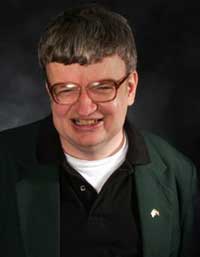
| Kim Peek The Original Rain Man http://www.wisconsinmedicalsociety.org/savant/kimpeek.cfm |
| ********** |
| Savant Academy, Los Angeles, CA |
The Savant Academy supports the education of people with Savant Syndrome,
including musical, linguistic, mathematical, and artistic savants. The organization also
encourages scientific research into and awareness of Savant Syndrome. Founded by
David Mehnert in Los Angeles in 2003, The Savant Academy is the first non-profit of
its kind in the USA.
The initial focus of the Savant Academy is on helping blind musical savants, and in
particular, on children with the Optic Nerve Hypoplasia (ONH) diagnosis. For unknown
reasons, Optic Nerve Hypoplasia (ONH) disposes to musical ability and in certain cases
to prodigious musical skills.
Following a hunch about Rex Lewis Clack’s form of blindness, Savant Academy
founder David Mehnert searched for other children with ONH who might be helped by
specialized teaching methods. In September 2003, he announced the discovery of three
prodigious musical savants in Southern California. As of July 2004, David Mehnert has
discovered 19 musical savants with Optic Nerve Hypoplasia (ONH), including six who
show signs of prodigious memory and musical skill.
Read more about the Savant Academy at http://www.savantacademy.org/.
including musical, linguistic, mathematical, and artistic savants. The organization also
encourages scientific research into and awareness of Savant Syndrome. Founded by
David Mehnert in Los Angeles in 2003, The Savant Academy is the first non-profit of
its kind in the USA.
The initial focus of the Savant Academy is on helping blind musical savants, and in
particular, on children with the Optic Nerve Hypoplasia (ONH) diagnosis. For unknown
reasons, Optic Nerve Hypoplasia (ONH) disposes to musical ability and in certain cases
to prodigious musical skills.
Following a hunch about Rex Lewis Clack’s form of blindness, Savant Academy
founder David Mehnert searched for other children with ONH who might be helped by
specialized teaching methods. In September 2003, he announced the discovery of three
prodigious musical savants in Southern California. As of July 2004, David Mehnert has
discovered 19 musical savants with Optic Nerve Hypoplasia (ONH), including six who
show signs of prodigious memory and musical skill.
Read more about the Savant Academy at http://www.savantacademy.org/.
| ********** |
| Congratulations to our winners! Jon Fox Peter St. Wecker Dale Niesen Deedee King E-Pop Nienhaus Marc Rudolph Jenko Brzys Judy Pfaff Grace Herz Edee Scott Bobbie Sims Mary Fraser Susan Edminster Carol Haueter Margaret Waterman Kelly Fetherlin Debbie Anderson Sterbinsky Eva Royal If your name has been omitted from our list of winners, it was unintentional. Please let me know. |
| If you enjoy our quizzes, don't forget to order our book! Click here. |
If you have a picture you'd like us to feature a picture in a future quiz, please
email it to us at CFitzp@aol.com. If we use it, you will receive a free analysis of
your picture. You will also receive a free Forensic Genealogy CD or a 10%
discount towards the purchase of the Forensic Genealogy book.
email it to us at CFitzp@aol.com. If we use it, you will receive a free analysis of
your picture. You will also receive a free Forensic Genealogy CD or a 10%
discount towards the purchase of the Forensic Genealogy book.

and yet a third with his left, performed complex classical favorites with hands reversed,
convincingly parroted the speeches of well-known politicians and orators in languages
that he did not otherwise speak (Greek, Latin, German and French) and made any
number of bodily sounds in imitation of familiar objects -- everything from banjos and
bagpipes to music boxes and locomotives. He freely improvised on melodies offered by
audience members. He even learned to announce his programs, speaking of himself and
his life in the third person.
Before and during the Civil War, Tom's concertizing was confined to Southern states,
although his itinerary in no way limited his owner's and manager's profits, which were
reported to have exceeded $100,000 annually in this period. An early Boston critic,
hearing that Tom was a product of the South, assumed that his fame rested on
Southern gullibility and dismissed him out of hand.
convincingly parroted the speeches of well-known politicians and orators in languages
that he did not otherwise speak (Greek, Latin, German and French) and made any
number of bodily sounds in imitation of familiar objects -- everything from banjos and
bagpipes to music boxes and locomotives. He freely improvised on melodies offered by
audience members. He even learned to announce his programs, speaking of himself and
his life in the third person.
Before and during the Civil War, Tom's concertizing was confined to Southern states,
although his itinerary in no way limited his owner's and manager's profits, which were
reported to have exceeded $100,000 annually in this period. An early Boston critic,
hearing that Tom was a product of the South, assumed that his fame rested on
Southern gullibility and dismissed him out of hand.
| Quiz #50 Results |


 |  |  |  |
dignitaries in Washington. In one of many ironies of Thomas Wiggins's career, James
Bethune arranged for him to play in benefit musicales for the Confederate war wounded.
Bethune arranged for him to play in benefit musicales for the Confederate war wounded.