| XXX |
| XXX |
| XXX |
NEVILLE CHAMBERLAIN
As you’ll recall, the New York Times’ preferred
explanation for why a man opened an umbrella on a
sunny day, just as JFK’s limousine passed—and just
as the bullets poured into the car— was an entirely
benign one. Strange, but benign.
As you’ll recall, the New York Times’ preferred
explanation for why a man opened an umbrella on a
sunny day, just as JFK’s limousine passed—and just
as the bullets poured into the car— was an entirely
benign one. Strange, but benign.
| XXXXX |
The umbrella man is a lot more interesting. He did not know that Kennedy had been
assassinated just a few feet away because he was preoccupied with opening his
umbrella. That adds another element to the "wrong place, wrong time, doing the wrong
thing" statement he made at the Congressional Hearing.
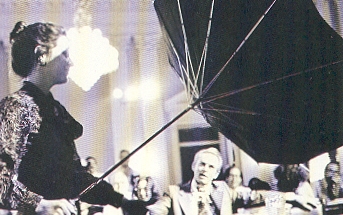
Another astute comment was made by the Chairman of the Committee. When the clerk
went to open the umbrella at the hearing, he said, "Could you point that thing in another
direction?"
We had a neighbor Mr Kyame who lived across from us when I was growing up in
New Orleans . He was a teacher who had had Lee Harvey Oswald in his class when he
taught high school. Mr Kyame went on to have three children named John, Faith, and
Karen (JFK). There's got to be some way we can work that into a conspiracy.
I can’t think of anything in my lifetime that has had more conspiracy theories attached
to it than the assassination of JFK. With that said…
It is absolutely clear to me that Mr. K** had a gut feeling that Joseph Kennedy’s money
was going to get his son elected President. Mr. K** did not like the Kennedys. As a
teacher, Mr. K** was probably very good at reading his students. He saw in Lee
Harvey Oswald a young, angry man who was really open to the power of suggestion.
By naming his children as he did, he could convey the name of a man he wanted
targeted to Oswald and Oswald picked up on the suggestion. Mr. K** taught American
History. To make sure Oswald got the picture, Mr. K** spent an inordinate amount of
time on John Wilkes Booth and Abraham Lincoln. Oswald put two and two together
and then just waited for the right time. [** Name omitted to protect his descendants.]
I’m usually very good at making up a conspiracy theory. But, in the case of JFK, all of
the good conspiracy theories have been taken. Mr. K**’s kids probably came later and
were named as they were in memory of JFK.
Carol Farrant
assassinated just a few feet away because he was preoccupied with opening his
umbrella. That adds another element to the "wrong place, wrong time, doing the wrong
thing" statement he made at the Congressional Hearing.
Another astute comment was made by the Chairman of the Committee. When the clerk
went to open the umbrella at the hearing, he said, "Could you point that thing in another
direction?"
We had a neighbor Mr Kyame who lived across from us when I was growing up in
New Orleans . He was a teacher who had had Lee Harvey Oswald in his class when he
taught high school. Mr Kyame went on to have three children named John, Faith, and
Karen (JFK). There's got to be some way we can work that into a conspiracy.
I can’t think of anything in my lifetime that has had more conspiracy theories attached
to it than the assassination of JFK. With that said…
It is absolutely clear to me that Mr. K** had a gut feeling that Joseph Kennedy’s money
was going to get his son elected President. Mr. K** did not like the Kennedys. As a
teacher, Mr. K** was probably very good at reading his students. He saw in Lee
Harvey Oswald a young, angry man who was really open to the power of suggestion.
By naming his children as he did, he could convey the name of a man he wanted
targeted to Oswald and Oswald picked up on the suggestion. Mr. K** taught American
History. To make sure Oswald got the picture, Mr. K** spent an inordinate amount of
time on John Wilkes Booth and Abraham Lincoln. Oswald put two and two together
and then just waited for the right time. [** Name omitted to protect his descendants.]
I’m usually very good at making up a conspiracy theory. But, in the case of JFK, all of
the good conspiracy theories have been taken. Mr. K**’s kids probably came later and
were named as they were in memory of JFK.
Carol Farrant
The inspiration for this quiz was a recent late night TV
program on JFK conspiracies. One of the conspiracies was
based on the belief that the military had just made contact
with aliens from outer space. JFK was going to announce it
the following week against their wishes, so they killed him.
According to the TV poll, about 2% of conspiracy theorists
believe this. The response from one of the government
officials who was interviewed for the program was
something like "Oh come on".
program on JFK conspiracies. One of the conspiracies was
based on the belief that the military had just made contact
with aliens from outer space. JFK was going to announce it
the following week against their wishes, so they killed him.
According to the TV poll, about 2% of conspiracy theorists
believe this. The response from one of the government
officials who was interviewed for the program was
something like "Oh come on".
| XXX |
| Astute Observations from Beth Long |
| XXX |
| Remark from the Quizmaster General |
| ********** |
| ********** |

 |  |  |  |


 |  |  |  |
| Quiz #445 Results |

| Answers to Quiz #445 - August 24, 2014 |
| ********** |
|
| ********** |

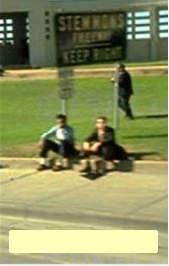
| TinEye Advisory You can find this photo on TinEye.com, but the quiz will be a lot more fun if you solve the puzzle on your own. |

|
Congratulations to Our Winners! Marcelle Comeau Janice Sellers Ida Sanchez Margaret Paxton Carol Stansell Catherine Bence Rick Fogerty Collier Smith Beth Long Betty Chambers Carol Farrant Edna Cardinal Cynthia Costigan Timothy Fitzpatrick Tynan Peterson Rebecca Bare The Fabulous Fletchers! Grace Hertz and Mary Turner |
| ********** |
| ********** |
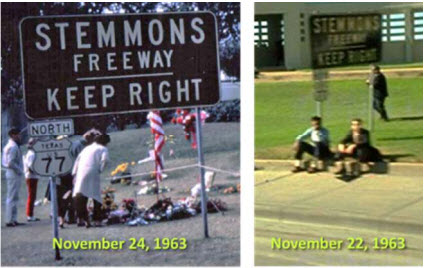
| How Marcelle Solved the Puzzle |
| This was an interesting quiz. The photo was a bit blurry so it was difficult for me to make out the wording on the sign (I was determined to solve it without resorting to TinEye). I tried Stemmons and searched using the keywords “Stemmons Freeway two men on curb”. Being from Canada, the words Stemmons Fwy meant nothing to me. The search popped all sorts of references to the Kennedy Assassination so I thought AH-HA! I now have my topic. Further research led me to what I believe is the correct story. Of course we were all glued to our TV's in the days following the assassination but I am not sure if many people outside the U.S. followed all the conspiracy theories afterwards. The "Umbrella Man" was certainly an interesting story! And that is a cute story about Mr. Kyame and his three kids. Marcelle Comeau Canada |
| If you read Witt's full testimony, to me these items stick out: Who uses the word "flechette" or commonly knows it's meaning Who in the crowd would say "they shot those people" - "those people"?? Not "the president"? who uses the word "clouted"???? That's the most suspicious to me. He didn't know they were looking for him for all of these years? Under what rock have you been hiding? He still has the actual umbrella? Yeah, sure he does. He didn't look at the man who sat next to him. Everyone looks at who sits next to them, no matter what the situation. He doesn't come off as being your common prankster. Last, why come forward after 15 years? Not 7, not 12, but 15? Is there some kind of statute that he thinks ran out regarding prosecution? Everyone can doubt everything including me, and I think some people drive themselves crazy over this and it becomes an obsession. Enjoy your life in the here and now. PS - I am also sick to death of hearing about the Titanic and "new information" never discovered before - please stop the ride, I want to get of!! ;) Beth Long |
| Response from Quizmaster Emeritus Carol Farrant |
| To see the trailer for History Channel program about Kennedy assassination conspiracies click here. |
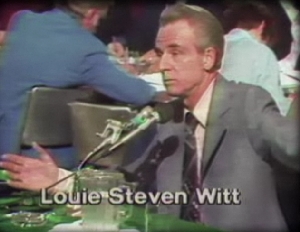
| An excerpt from Louie Steven Witt's testimony before the US House Select Committee: Mr. GENZMAN. Why were you carrying an umbrella that day? Mr. WITT. Actually, I was going to use this umbrella to heckle the President's motorcade. Mr. GENZMAN. How had you gotten this idea? Mr. WITT. In a coffee break conversation someone had mentioned that the umbrella was a sore spot with the Kennedy family. Being a conservative-type fellow, I sort of placed him in the liberal camp and I was just going to kind of do a little heckling. Mr. GENZMAN. Are you saying you were going to use the umbrella as a symbol for the purpose of heckling? Mr. WITT. I think that would cover it. . . Mr. GENZMAN. You testified that you were opening the umbrella to use it as a symbol hoping to catch the President's eye? Mr. WITT. Yes, sir. Mr. GENZMAN. Could you elaborate further as to the type of symbol you thought you were applying? Mr. WITT. . . . I just knew the vague generalities of it. It had something to do with something that happened years ago with the senior Joe Kennedy when he was Ambassador to England. . . .(3) Mr. GENZMAN. Mr. Witt, some assassination critics have alleged your actions with your umbrella were a signal to an assassin or to assassins to fire or a signal that the President had in fact been hit. Were you signaling to anyone besides the President? Mr. WITT. No; no one. . . .(4) Mr. FAUNTROY. I wonder if you would care to tell us a little more about your understanding of the significance of the umbrella, and why you felt that it would heckle the president to raise the umbrella? Mr. WITT. . . . It had something to do with . . . when the senior Mr. Kennedy was Ambassador to England, and the Prime Minister [Neville Chamberlain], some activity they had had in appeasing Hitler. The umbrella that the Prime Minister of England came back with got to be a symbol in some manner with the British people. By association, it got transferred ot the Kennedy family, and, as I |
| The Umbrella Man en.wikipedia.org/wiki/Umbrella_Man_(JFK_assassination) |
The "umbrella man", identified in 1978 as
Louie Steven Witt, is a man who appears
in the Zapruder film, and several other
films and photographs, near the
Stemmons Freeway sign within Dealey
Plaza during the JFK assassination.
The "umbrella man" is the subject of a
2011 documentary short by Errol Morris,
for The New York Times.
Conspiracy Theory
Louie Steven Witt, is a man who appears
in the Zapruder film, and several other
films and photographs, near the
Stemmons Freeway sign within Dealey
Plaza during the JFK assassination.
The "umbrella man" is the subject of a
2011 documentary short by Errol Morris,
for The New York Times.
Conspiracy Theory
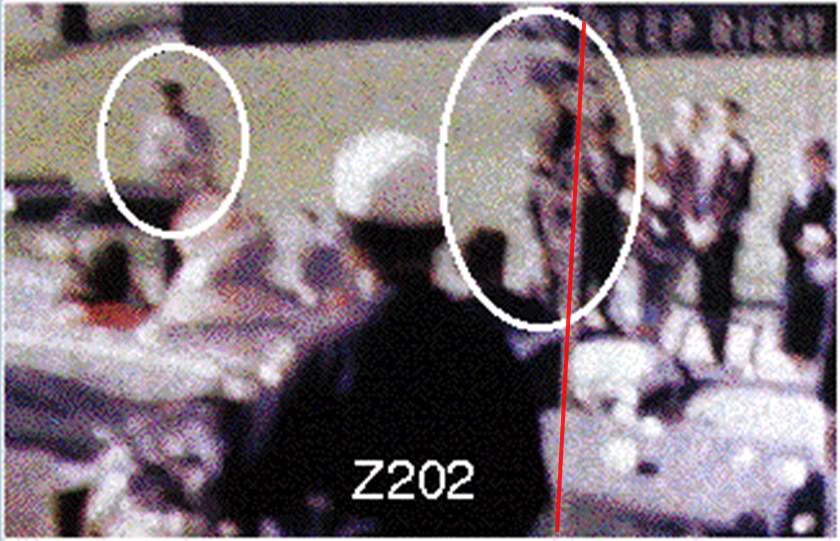
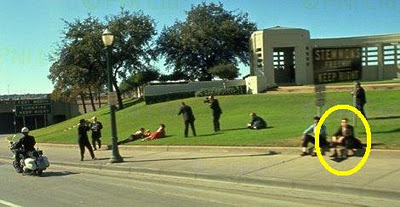
A person popularly dubbed the "umbrella man" has been the object of much speculation,
as he was the only person seen carrying and opening an umbrella on that sunny day. He
was also one of the closest bystanders to President John F. Kennedy when Kennedy
was first struck by a bullet. As Kennedy's limousine approached, the man opened up
and lifted the umbrella high above his head, then spun or panned the umbrella from east
to west (clockwise) as the president passed by him. In the aftermath of the
assassination, the "umbrella man" sat down on the sidewalk next to another man before
getting up and walking towards the Texas School Book Depository.
Early speculation came from assassination researchers Josiah Thompson and Richard
Sprague who noticed the open umbrella in a series of photographs. Thompson and
Sprague suggested that the "umbrella man" may have been acting as a signaler of some
kind, opening his umbrella to signal "go ahead" and then raising it to communicate "fire
a second round".
The "umbrella man" is depicted as performing such a role in Oliver Stone's film JFK.
Another theory proposed by Robert Cutler and endorsed by Colonel L. Fletcher Prouty
is that the umbrella may have been used to fire a dart with a paralyzing agent at
Kennedy to immobilize his muscles and make him a "sitting duck" for an assassination.
(Charles Senseney, who developed weaponry for the CIA at Fort Detrick, Maryland,
told the Senate Intelligence Committee, in 1975, that such an umbrella weapon was in
the hands of the CIA in 1963.)
Identification
After an appeal to the public by the United States House Select Committee on
Assassinations, Louie Steven Witt came forward in 1978 and claimed to be the
"umbrella man". He claimed to still have the umbrella and did not know he had been the
subject of controversy. He said that he brought the umbrella to simply heckle Kennedy
whose father had been a supporter of the Nazi-appeasing British Prime Minister Neville
Chamberlain. By waving a black umbrella, Chamberlain's trademark fashion accessory,
Witt said he was protesting the Kennedy family appeasing Adolf Hitler before World
War II. An umbrella had been used in cartoons in the 1930s to symbolize such
appeasement, and Chamberlain often carried an umbrella. Kennedy, who wrote a thesis
on appeasement while at Harvard, Why England Slept, might have recognized the
symbolism of the umbrella. Black umbrellas had been used in connection with protests
against the President before; at the time of the construction of the Berlin Wall, a group
as he was the only person seen carrying and opening an umbrella on that sunny day. He
was also one of the closest bystanders to President John F. Kennedy when Kennedy
was first struck by a bullet. As Kennedy's limousine approached, the man opened up
and lifted the umbrella high above his head, then spun or panned the umbrella from east
to west (clockwise) as the president passed by him. In the aftermath of the
assassination, the "umbrella man" sat down on the sidewalk next to another man before
getting up and walking towards the Texas School Book Depository.
Early speculation came from assassination researchers Josiah Thompson and Richard
Sprague who noticed the open umbrella in a series of photographs. Thompson and
Sprague suggested that the "umbrella man" may have been acting as a signaler of some
kind, opening his umbrella to signal "go ahead" and then raising it to communicate "fire
a second round".
The "umbrella man" is depicted as performing such a role in Oliver Stone's film JFK.
Another theory proposed by Robert Cutler and endorsed by Colonel L. Fletcher Prouty
is that the umbrella may have been used to fire a dart with a paralyzing agent at
Kennedy to immobilize his muscles and make him a "sitting duck" for an assassination.
(Charles Senseney, who developed weaponry for the CIA at Fort Detrick, Maryland,
told the Senate Intelligence Committee, in 1975, that such an umbrella weapon was in
the hands of the CIA in 1963.)
Identification
After an appeal to the public by the United States House Select Committee on
Assassinations, Louie Steven Witt came forward in 1978 and claimed to be the
"umbrella man". He claimed to still have the umbrella and did not know he had been the
subject of controversy. He said that he brought the umbrella to simply heckle Kennedy
whose father had been a supporter of the Nazi-appeasing British Prime Minister Neville
Chamberlain. By waving a black umbrella, Chamberlain's trademark fashion accessory,
Witt said he was protesting the Kennedy family appeasing Adolf Hitler before World
War II. An umbrella had been used in cartoons in the 1930s to symbolize such
appeasement, and Chamberlain often carried an umbrella. Kennedy, who wrote a thesis
on appeasement while at Harvard, Why England Slept, might have recognized the
symbolism of the umbrella. Black umbrellas had been used in connection with protests
against the President before; at the time of the construction of the Berlin Wall, a group
of schoolchildren from Bonn the White House an
umbrella labeled Chamberlain.
Testifying before the HSCA, Witt said "I think if
the Guinness Book of World Records had a
category for people who were at the wrong place
at the wrong time, doing the wrong thing, I would
be No. 1 in that position, without even a close
runner-up."
umbrella labeled Chamberlain.
Testifying before the HSCA, Witt said "I think if
the Guinness Book of World Records had a
category for people who were at the wrong place
at the wrong time, doing the wrong thing, I would
be No. 1 in that position, without even a close
runner-up."
| ********** |
| If you have a picture you'd like us to feature a picture in a future quiz, please email it to us at CFitzp@aol.com. If we use it, you will receive a free analysis of your picture. You will also receive a free Forensic Genealogy CD or a 10% discount towards the purchase of the Forensic Genealogy book. |
| If you enjoy our quizzes, don't forget to order our books! Click here. |
!-- Start Quantcast tag -->

| Excerpt from Umbrella Man - More Doubts by Russ Baker December 5, 2011 whowhatwhy.com/2011/12/05/jfk-umbrella-man%E2%80%94more-doubts/ |
Recap: Fifteen years after the assassination, as the special House Select Committee on
Assassinations was taking the first serious look at the death of JFK (and others), a man
came forward to identify himself as the so-called “Umbrella Man” and to explain his
bizarre behavior.
The man, Steven Louie Witt, said that, no, it was not someone signaling the shooters,
and no, it had nothing at all to do with the assassination. Instead, he said, it was a
message against appeasement of enemies. He hoped to signal his disapproval of what he
considered JFK’s forbearance of America’s enemies.
How to signal that? Here’s where it gets complicated. Witt claimed he held up the
umbrella as an icon symbolizing the treachery of Neville Chamberlain, the 1930s British
prime minister. Chamberlain, who tried to preserve peace with Hitler by ceding him a
part of Czechoslovakia (the Sudetenland), became a reviled symbol of appeasement.
The self-described Umbrella Man said that he had been identifying appeasement with
Chamberlain’s trademark umbrella. The connection to JFK came via his father, Joseph
P. Kennedy, ambassador to Britain at the time and an anti-war isolationist.
Only a very unusual 15-year-old American (Witt’s approximate age in 1938) would
have strong feelings about a British prime minister’s behavior, and still harbor those
feelings a quarter century later. It is even harder to accept that he could believe JFK,
Assassinations was taking the first serious look at the death of JFK (and others), a man
came forward to identify himself as the so-called “Umbrella Man” and to explain his
bizarre behavior.
The man, Steven Louie Witt, said that, no, it was not someone signaling the shooters,
and no, it had nothing at all to do with the assassination. Instead, he said, it was a
message against appeasement of enemies. He hoped to signal his disapproval of what he
considered JFK’s forbearance of America’s enemies.
How to signal that? Here’s where it gets complicated. Witt claimed he held up the
umbrella as an icon symbolizing the treachery of Neville Chamberlain, the 1930s British
prime minister. Chamberlain, who tried to preserve peace with Hitler by ceding him a
part of Czechoslovakia (the Sudetenland), became a reviled symbol of appeasement.
The self-described Umbrella Man said that he had been identifying appeasement with
Chamberlain’s trademark umbrella. The connection to JFK came via his father, Joseph
P. Kennedy, ambassador to Britain at the time and an anti-war isolationist.
Only a very unusual 15-year-old American (Witt’s approximate age in 1938) would
have strong feelings about a British prime minister’s behavior, and still harbor those
feelings a quarter century later. It is even harder to accept that he could believe JFK,
himself a young man in 1938, might “get”
the message somehow via the umbrella.
Even if we are to accept that Witt really
was the man pumping the umbrella on the
Grassy Knoll, and even if he was
cognizant of Chamberlain, and even if he
did think he could get a message to JFK
the message somehow via the umbrella.
Even if we are to accept that Witt really
was the man pumping the umbrella on the
Grassy Knoll, and even if he was
cognizant of Chamberlain, and even if he
did think he could get a message to JFK
via the Chamberlain affair, we still have a big problem with this claim.
According to John Simkin, a retired British history teacher and textbook author who
runs the historical website Spartacus Educational, the umbrella was never the symbol of
Chamberlain that the “umbrella man” claimed it was.
“In Britain, there was never any association with an umbrella at all,” Simkin told me.
“Everyone had umbrellas and bowlers in those days.” According to Simkin, the only
proper symbol for Chamberlain and appeasement was a piece of paper. That was the
document he held aloft, with Hitler’s signature to the so-called Munich Agreement—in
which Hitler agreed not to seek any further territorial gains in Europe—as Chamberlain
According to John Simkin, a retired British history teacher and textbook author who
runs the historical website Spartacus Educational, the umbrella was never the symbol of
Chamberlain that the “umbrella man” claimed it was.
“In Britain, there was never any association with an umbrella at all,” Simkin told me.
“Everyone had umbrellas and bowlers in those days.” According to Simkin, the only
proper symbol for Chamberlain and appeasement was a piece of paper. That was the
document he held aloft, with Hitler’s signature to the so-called Munich Agreement—in
which Hitler agreed not to seek any further territorial gains in Europe—as Chamberlain
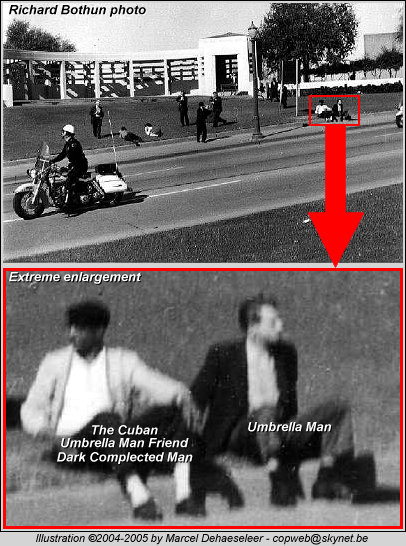
famously declared that he had secured “peace in our
time.” (In this old newsreel, you can see Chamberlain
hold aloft that document.)
Simkin finds the New York Times video’s assertion
that the purpose of opening the umbrella and pumping
it in the air to signal Munich simply laughable.
More likely, it was exactly what it appeared to be: a
method of signaling shooters, perhaps that JFK had
been hit, perhaps that he still seemed to be alive,
perhaps to keep shooting. Although it was a sunny
day, it had rained the night before, and there was a
wind, so it would not have been operationally illogical
to move forward with using an umbrella. The fact
that the New York Times and the establishment in
time.” (In this old newsreel, you can see Chamberlain
hold aloft that document.)
Simkin finds the New York Times video’s assertion
that the purpose of opening the umbrella and pumping
it in the air to signal Munich simply laughable.
More likely, it was exactly what it appeared to be: a
method of signaling shooters, perhaps that JFK had
been hit, perhaps that he still seemed to be alive,
perhaps to keep shooting. Although it was a sunny
day, it had rained the night before, and there was a
wind, so it would not have been operationally illogical
to move forward with using an umbrella. The fact
that the New York Times and the establishment in
general have never considered the umbrella worthy of real, serious inquiry, tells us that
if the umbrella was part of a plot, it was not so bad a choice.
RIO GRANDE BUILDING
In the last article, I mentioned that Witt, the self-proclaimed “Umbrella Man,” worked
for Rio Grande National Life Insurance in the Rio Grande building. I mentioned that the
same building housed the Immigration office frequented by Lee Harvey Oswald, and the
local office of the highly negligent Secret Service. I mentioned that Rio Grande wrote a
lot of insurance for the military. And, separately, I noted the strong military intelligence
connections to key figures connected with 11/22/63.
One thing I did not mention, but should have, was that Military Intelligence itself had
offices in that Rio Grande building.
Now, all of that could be coincidence. But there’s a reason certain entities signed leases
with particular landlords and not others—especially so in Dallas circa 1963 (more on
this in Family of Secrets.)
DARK COMPLECTED MAN
Some of our readers wondered why I did not mention another figure who acted
if the umbrella was part of a plot, it was not so bad a choice.
RIO GRANDE BUILDING
In the last article, I mentioned that Witt, the self-proclaimed “Umbrella Man,” worked
for Rio Grande National Life Insurance in the Rio Grande building. I mentioned that the
same building housed the Immigration office frequented by Lee Harvey Oswald, and the
local office of the highly negligent Secret Service. I mentioned that Rio Grande wrote a
lot of insurance for the military. And, separately, I noted the strong military intelligence
connections to key figures connected with 11/22/63.
One thing I did not mention, but should have, was that Military Intelligence itself had
offices in that Rio Grande building.
Now, all of that could be coincidence. But there’s a reason certain entities signed leases
with particular landlords and not others—especially so in Dallas circa 1963 (more on
this in Family of Secrets.)
DARK COMPLECTED MAN
Some of our readers wondered why I did not mention another figure who acted
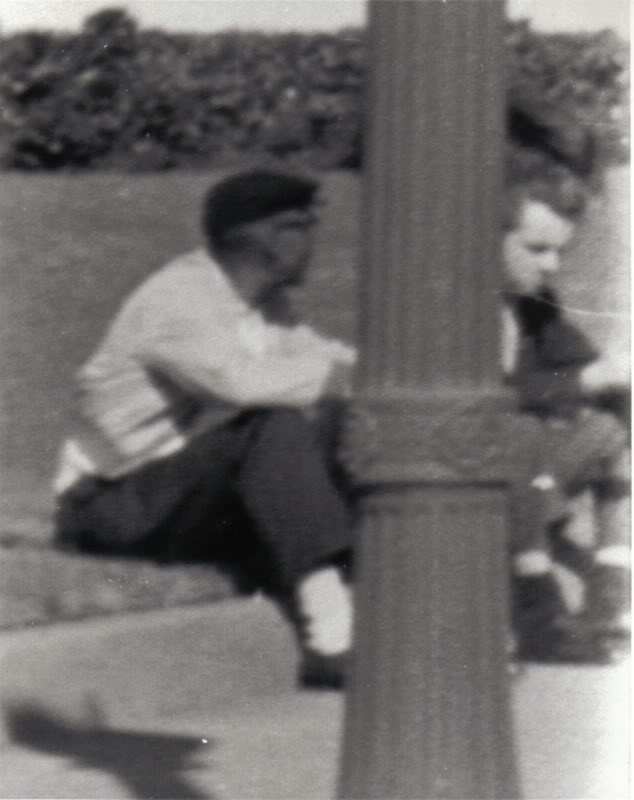
strangely as Kennedy’s limo passed. This was the so-called
“Dark Complected Man”—so named because his complexion
was his most readily identifiable feature in photos from
November 22.
I left him out of the initial piece because I wanted to focus solely
on Umbrella Man, who, after all, was the sole subject of that
New York Times video I was considering.
Nevertheless, Dark Complected Man is without question an
“Dark Complected Man”—so named because his complexion
was his most readily identifiable feature in photos from
November 22.
I left him out of the initial piece because I wanted to focus solely
on Umbrella Man, who, after all, was the sole subject of that
New York Times video I was considering.
Nevertheless, Dark Complected Man is without question an
extremely important character. Maybe even more deserving of scrutiny than Umbrella
Man.
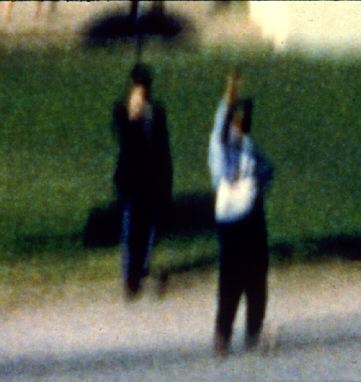
Dark Complected Man (DCM), like Umbrella Man, was on the Grassy Knoll, and, like
Umbrella Man, appears to reasonable observers to have been signaling. At the precise
moment that JFK’s car passed, as Umbrella Man opened and pumped his umbrella
repeatedly, Dark Complected Man shot his fist up into the air. To some, DCM seemed
to be calling for a halt to the presidential limo, which did in fact either come to a
complete halt or slowed down to a crawl.
It’s not just their actions at the moment that Kennedy’s head is blown apart. It’s how
they behave afterwards.
Instead of reacting with horror and springing into action, these two purported strangers
sit down together, on the curb, and calmly survey the chaos. In their icy nonchalance,
they exhibit an almost professional detachment.
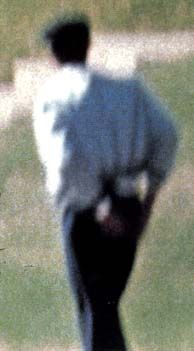
Another intriguing thing about DCM is that in photos, something that looks like a radio
or walkie-talkie appears to be protruding from his back pocket.
Man.
Dark Complected Man (DCM), like Umbrella Man, was on the Grassy Knoll, and, like
Umbrella Man, appears to reasonable observers to have been signaling. At the precise
moment that JFK’s car passed, as Umbrella Man opened and pumped his umbrella
repeatedly, Dark Complected Man shot his fist up into the air. To some, DCM seemed
to be calling for a halt to the presidential limo, which did in fact either come to a
complete halt or slowed down to a crawl.
It’s not just their actions at the moment that Kennedy’s head is blown apart. It’s how
they behave afterwards.
Instead of reacting with horror and springing into action, these two purported strangers
sit down together, on the curb, and calmly survey the chaos. In their icy nonchalance,
they exhibit an almost professional detachment.
Another intriguing thing about DCM is that in photos, something that looks like a radio
or walkie-talkie appears to be protruding from his back pocket.
Taken together, Dark Complected Man and Umbrella Man add real bulk
to the mountain of circumstantial evidence for a conspiracy in the death
of JFK.
Maybe we do have The Times to thank, after all. Although that
whimsical video was intended to discourage inquiry, it has had exactly
the opposite effect. It goads us to focus diligently on long-ago events
that “the paper of record” will not scrutinize—and that cast a shadow
over democracy to the present moment.
See more at: whowhatwhy.com/2011/12/05/jfk-umbrella-man%E2%80%94more-doubts/#sthash.l0gaOOwJ.dpuf
to the mountain of circumstantial evidence for a conspiracy in the death
of JFK.
Maybe we do have The Times to thank, after all. Although that
whimsical video was intended to discourage inquiry, it has had exactly
the opposite effect. It goads us to focus diligently on long-ago events
that “the paper of record” will not scrutinize—and that cast a shadow
over democracy to the present moment.
See more at: whowhatwhy.com/2011/12/05/jfk-umbrella-man%E2%80%94more-doubts/#sthash.l0gaOOwJ.dpuf
| ********** |
| understood, it was a sore spot with the Kennedy family, like I said, in coffee break conversations someone had mentioned, I think it is one of the towns in Arizona, it is Tucson or Phoenix, that someone had been out at the |
| airport or some place where some members of the Kennedy family came through and they were rather irritated by the fact that they were brandishing the umbrellas. This is how the idea sort of got stuck in my mind. . . . This was in a conversation somewhere at work. I wish that I could remember now who brought the subject up and put this idea in my head. I am sure that I would have taken that umbrella and clouted him over the head somewhere in this last 2 or 3 weeks.(5) Mr. WITT. [After the assassination occurred] I was somewhat stunned . . . Once the realization . . . [that something terrible had happened] . . . I was stunned. . . . I think one [of] my reactions was knowing that I was there with this stupid umbrella and heckling the President and -- of course, I didn't know that the President had been killed. As a matter of fact, I didn't know he had been shot. I just knew that something had happened by the activity and what seemed to be in the air around me. But I think my own thinking may have been at the time that -- I would have to describe it as a -- kind of like a bad joke that had gone sour, or a practical joke you pulled on someone that had gone sour, since I was there with this thing, and for that purpose. Mr. FAUNTROY. Mr. Witt, is it your testimony that at no time did the Dallas police or the FBI contact you about your presence at Dealey Court Plaza at this time? Mr. WITT. No. . . . I have always wondered why they didn't, but . . . so far as I know, no one ever made any attempt to find out who I was or why I was there. Mr. FAUNTROY. When did you find out that you were a subject of suspicion; that is, that the umbrella man was somehow involved in the assassination? Mr. WITT. When the committee sent these things to the newspapers, and it was printed in the local papers, in the Dallas paper there. . . . Mr. FAUNTROY. So . . . is it your testimony that you did not learn that somebody was concerned about the umbrella man until 10 or 15 years after, until 1978 -- only in 1978 were you aware? Mr. WITT. Well, as far as I know, no one was concerned with me. Mr. FAUNTROY. So that explains, therefore, why you did not yourself contact the FBI or the police . . . because . . . you were not aware that someone with an umbrella in Dealey Plaza was an object of interest? Mr. WITT. No. As a matter of fact, I wasn't aware that I was an |
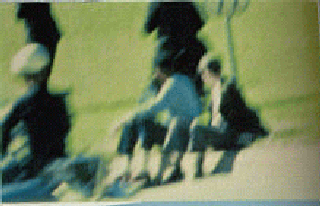
| object of interest. As a matter of fact, I have found out since -- within the last few weeks, that there have been countless numbers of books and all sorts of controversies over this thing. But I drifted along all of these years and I have never seen one of these books because I have |
| never been a fan of this assassination thing. I don't go out of my way to read anything about it. So it sort of all has gone over my head up until the last few weeks. Mr. FAUNTROY. Now, is it your testimony that you did in fact see this picture in the papers in July of this year? Mr. WITT. I saw this picture right here, the blurred picture in the lower right-hand corner. Mr. FAUNTROY. And did you recognize it as yourself? Mr. WITT. After I read it, yes. Read more. |