| XXX |
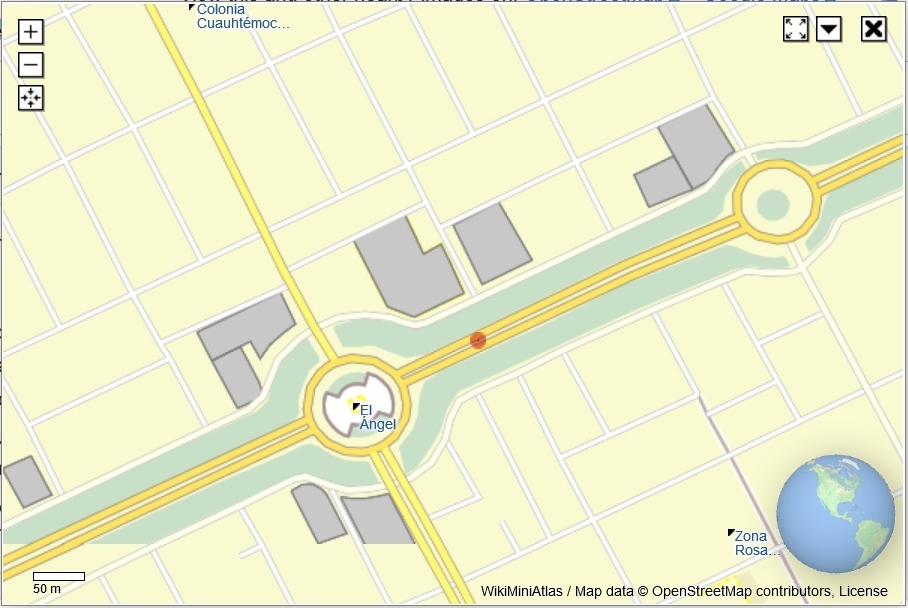
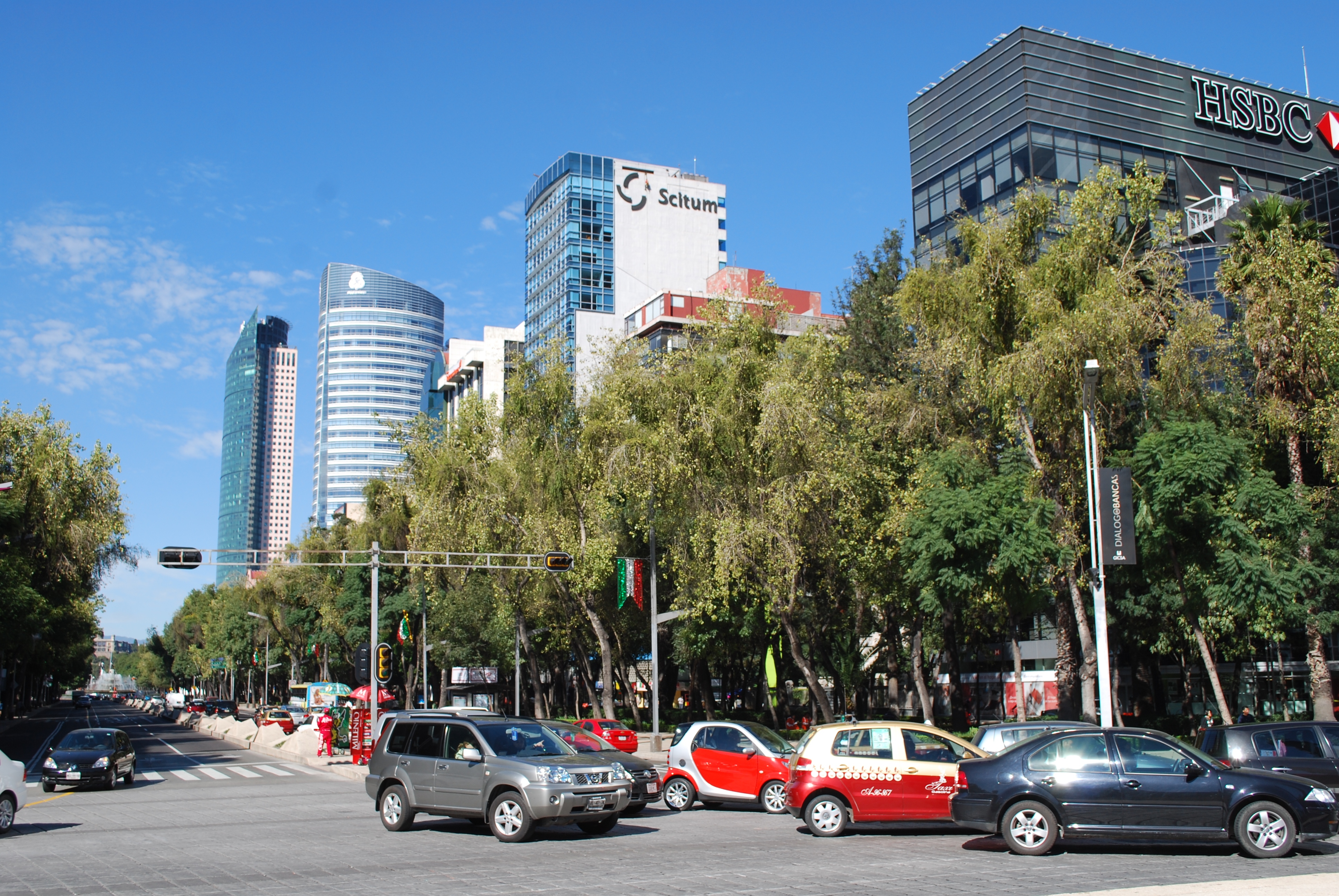
| Top: Position of photographer Bottom: Skyscrapers to SW of Angel Submitted by Marcelle Comeau |
| XXX |
| XXX |
| XXX |
| XXXXX |
| A Conversation with Tynan Peterson |
| To |
| How Marcelle and Carol Solved the Puzzle |

 |  |  |  |


 |  |  |  |
| Quiz #435 Results |

| Answers to Quiz #435 - April 6, 2014 |
| ********** |
|
| ********** |

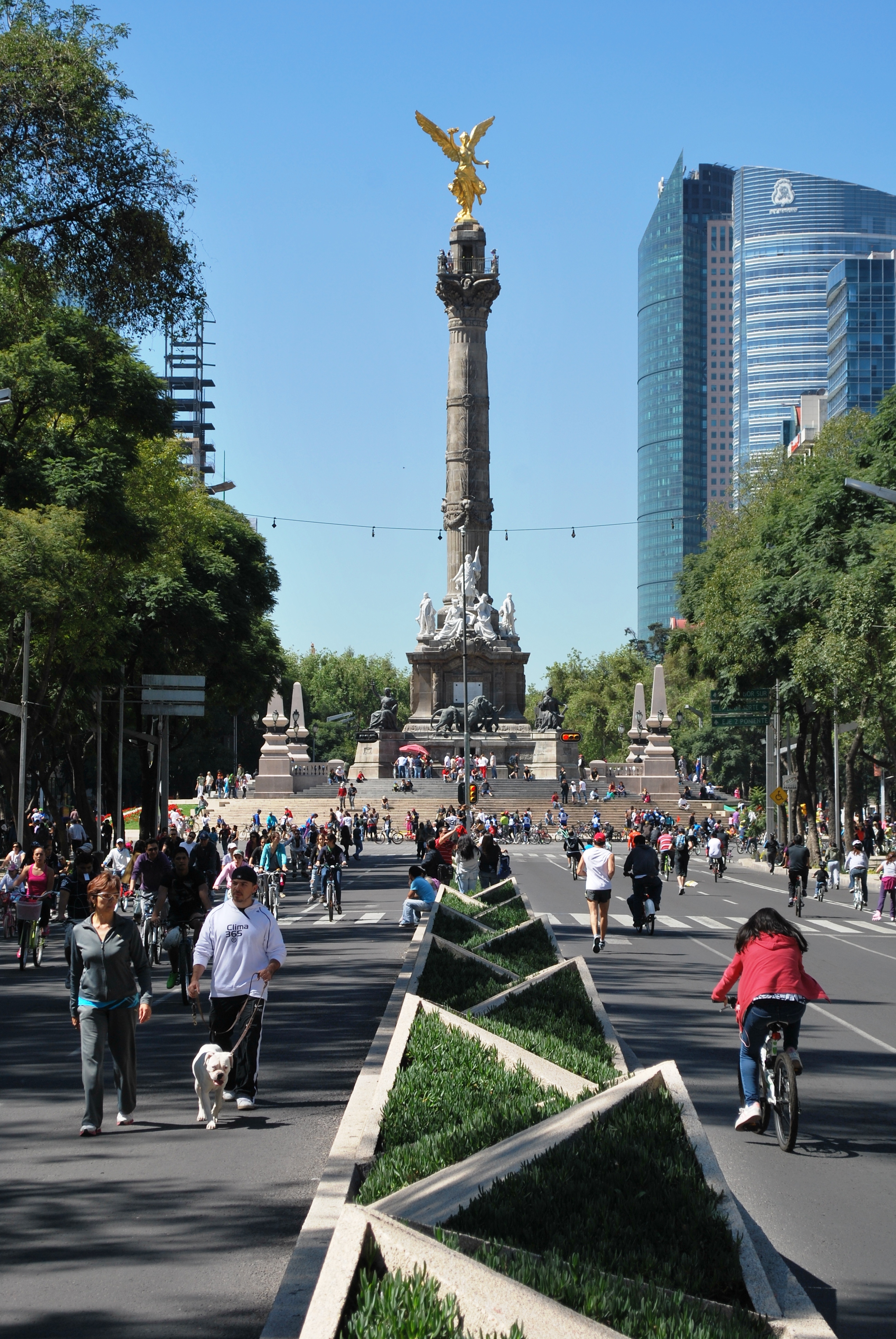
| Thanks for Quizmaster Ida Sanchez for submitting this photo. |
| TinEye Advisory You can find this photo on TinEye.com, but the quiz will be a lot more fun if you solve the puzzle on your own. |

| If you have a picture you'd like us to feature a picture in a future quiz, please email it to us at CFitzp@aol.com. If we use it, you will receive a free analysis of your picture. You will also receive a free Forensic Genealogy CD or a 10% discount towards the purchase of the Forensic Genealogy book. |
| If you enjoy our quizzes, don't forget to order our books! Click here. |
!-- Start Quantcast tag -->

|
| Congratulations to Our Winners! Marcelle Comeau Margaret Paxton Kim Richardson Peter Norton Carol Stansell Tynan Peterson Sharon M Levy John Thatcher Arthur Hartwell Carol Gene Farrant Rebecca Bare Ruth Brannigan Edna Cardinal Nelsen Spickard Sally Garrison Cindy Costigan Elaine C Hebert Collier Smith Roger Lipsett Mike Dalton Joshua Kreitzer Beth Long Collier Smith Gus Marsh Margaret Wetherford Dianne Abbott Grace Hertz and Mary Turner Team Fletcher! |
| ********** |
| ********** |
|
| ********** |
| Remarks from Ida Sanchez and the Quizmaster General Time of Day |
This puzzle has a puzzle within it.It relates to the time of day the photo was taken.
This week's photo can be found on Wikipedia at en.wikipedia.org/wiki/El_%C3%81ngel
This week's photo can be found on Wikipedia at en.wikipedia.org/wiki/El_%C3%81ngel
| To solve the quiz, I googled "Gold angels on top of monuments". Got a number of hits, the first one being in Berlin. Eventually got a hit to this one in Mexico City which led me to the actual photo in the Wikipedia article. Marcelle Comeau ***** No matter how many different ways I described the monument in Google Search, I kept winding up in Berlin. Their monument is quite similar, but obviously not an exact match. So, there had to be another clue in the photo, otherwise Id be stuck in Berlin. There was. There is a street sign in the photo that reads EJE 2 PONIENTE. Searching that took me right to Mexico City. Carol Farrant |
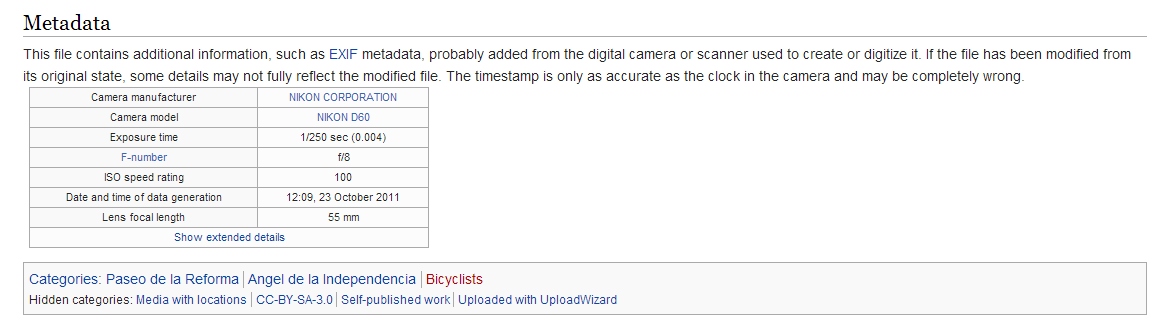
| The photo was taken between 1:PM and 3:. Tynan Peterson ***** Ida and I are having a discussion about the time - but have another look because it's in the morning, not the afternoon. Q. Gen. ***** I guessed based on aiming noon at north, but that's not right, is it? I didn't use the global solar calculator nor your formula because I don't know how to determine the elevation and the angle of the sun. This is great--I want to learn how to do this! Your photo example of the dead horse is a start...I know the coordinates of the statue: Coordinates: 19°25′37.1994″N 99°10′03.7554″W And I know which direction the statue is facing and the photographer is facing. But how do I figure out the angle of the sun and the elevation of the sun? Thanks, teacher! Tynan Peterson ***** You don't need the elevation because I did't ask the date. To determine the time, all you need is the angle east-west of the sun. Look at the direction the street runs, and then the crosswalk is perpendicular to that. The shadows are about parallel to the crosswalk. Get that far and I'll tell you something really interesting about this. Q. Gen. ***** OK, so baby steps. I've mapped true north (according to Google earth) and the angle of Paseo de la Reforma. The photographer is standing on the "X". If I map the sun's trajectory (it is limited to east to west, right?), and I stand where the photographer stood, I can see for sure that it's before noon. Can I demarkate the east-west trajectory with six hours on each side of "overhead", ie, noon? The photo is hitting the front of the woman's white shirt, and the front of the white dog's face. The shadows do look more perpendicular. How do I map the sun's trajectory onto the Paseo? Judging by the number of people, I'd say it's after nine AM. Thank you for including this in the quiz!! I feel like a total idiot, but I also feel like I'm about to learn something. Tynan Peterson ***** You have to do it by angles, not along a line like that. The sun travels 360 degrees per day, so 15 degrees per hour. So for every 15 degrees the sun is east of south in the sky (with shadows pointing north), that's one hour before noon. Take your sketch, mark where the crosswalk points (perpendicular to the street) and figure out how many units of 15 degrees that line is off from the north-south vertical on your diagram. (The shadows are parallel to the crosswalk). Then download Irfanview. It is a great little photo-program. It's freeware from www.irfanview.com. This is what I use and will be important later. Q. Gen. ***** OK, so south is 90 degrees, and the shadow line is about 25 or 30 degrees east of south. So does that make it between 10 and 10:30? I can also measure the length of a shadow of an object and compare that to the angle of the object, right? So if I create an angle between the white dog's head (not a bulldog, more of a boxer and/or mastiff) and the far edge of his shadow, that's about 25 to 30 degrees, too, right? I'm not an idiot, it's just that it's been actually more than 30 years since I've used a protractor. I had to print one out. (I took Geometry in eigth grade.) Irfanview doesn't appear to have a version for Mac. Now you know I'm not a scientist--I go for the aesthetics every time! Tynan Peterson ***** Actually I already figured out the back story about the protractor.... The lengths of the shadow don't matter for calculating the time of day. Just the east-west part. The lengths are related to the day of the year. You did good with the east-west angle. That's part of the story - about 10:30 am. Now the next question. The time stamp on the camera (which you can get from Irfanview and other photo programs), says the picture was taken October 23, 2011 at 12:09 am. Assuming this is correct, why isn't the sun just about due south? Good job for dragging out the protractor and reliving those experiences from 8th grade. That would scare the bejesus out of me. Q. Gen |
Assuming the time stamp is correct, the puzzle is why the shadows are parallel to the
crosswalk. At just after noon, the sun should be close to due south, with the shadows
pointing north. But in the photo, they are parallel to the crosswalk. According to the
map submitted by Marcelle Comeau, the street runs northeast to southwest, with the
crosswalk perpendicular to this, running from southeast to nothwest.
crosswalk. At just after noon, the sun should be close to due south, with the shadows
pointing north. But in the photo, they are parallel to the crosswalk. According to the
map submitted by Marcelle Comeau, the street runs northeast to southwest, with the
crosswalk perpendicular to this, running from southeast to nothwest.

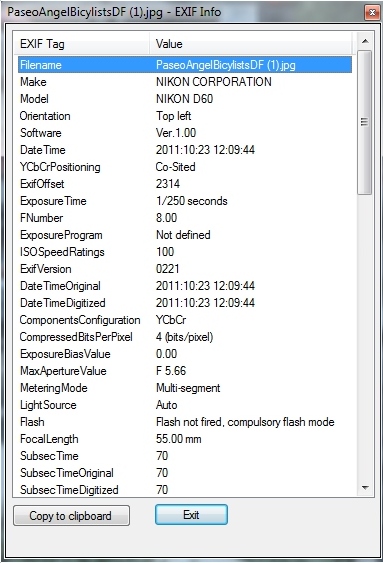
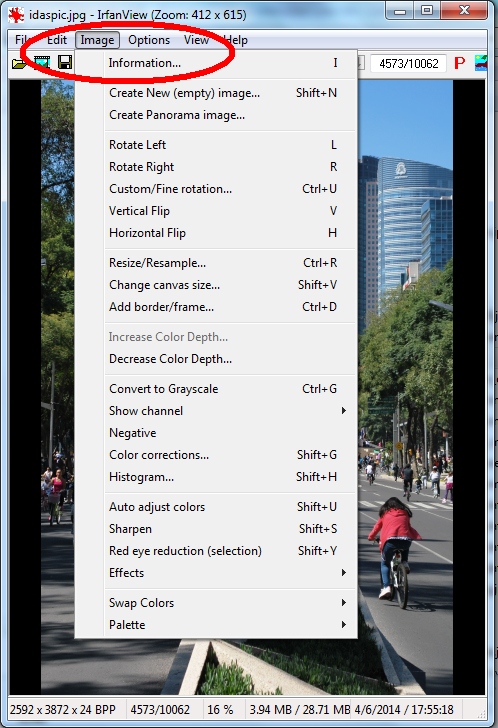
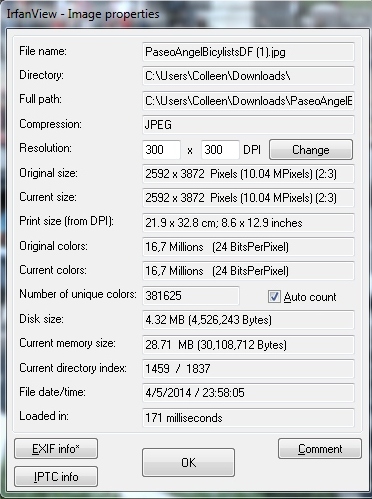
Many photo programs also provide this information. I use
Irfanview (freeware available at www.irfanview.com).
When you click on Information on the toolbar (see the
image to the right), you will see a screen come up with
information about the physical attributes of the picture, that
is, the compression, the number of colors, the resolution,
the original size, and other parameters. Clicking on
EXIFInfo, you will get a second screen with information
about the camera - what kind of camera, the exposure
time, the focal length of the lens, whether the flash is on
and so on. This second screen will also give the time of
day and day of the year - 12:09:44 pm, October 23, 2011.
(See images below).
Irfanview (freeware available at www.irfanview.com).
When you click on Information on the toolbar (see the
image to the right), you will see a screen come up with
information about the physical attributes of the picture, that
is, the compression, the number of colors, the resolution,
the original size, and other parameters. Clicking on
EXIFInfo, you will get a second screen with information
about the camera - what kind of camera, the exposure
time, the focal length of the lens, whether the flash is on
and so on. This second screen will also give the time of
day and day of the year - 12:09:44 pm, October 23, 2011.
(See images below).
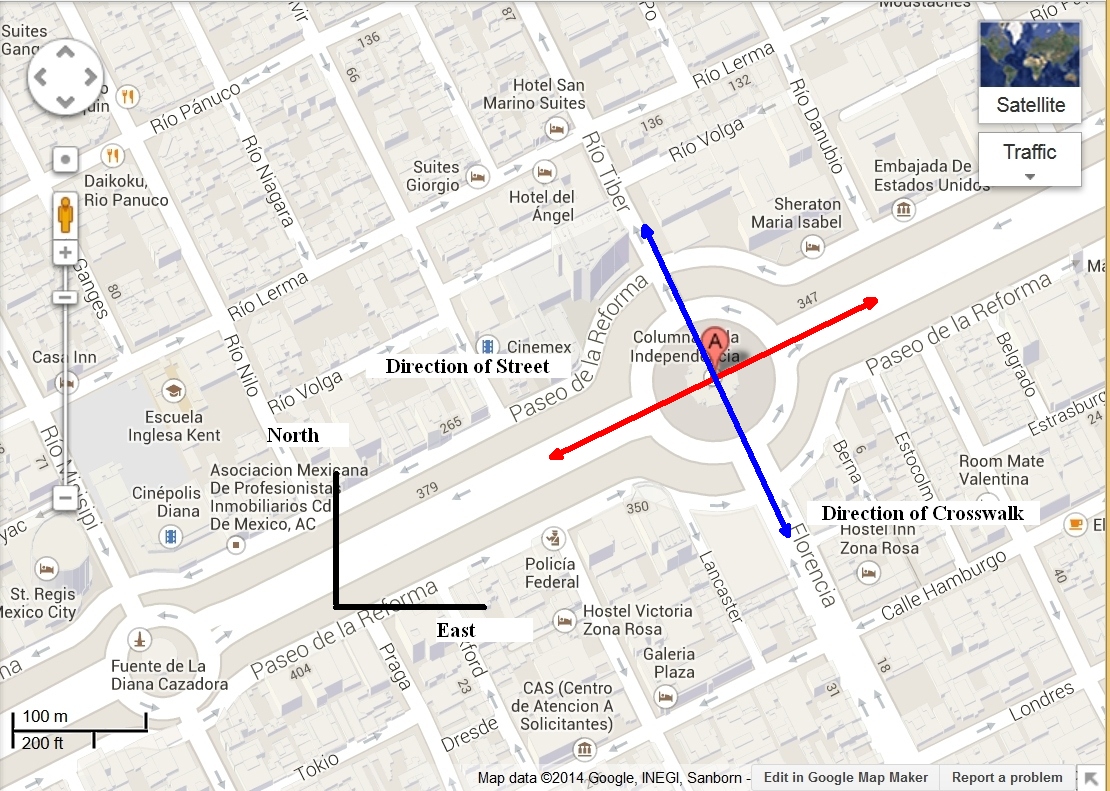
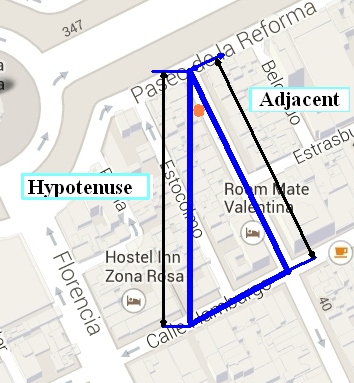
We can figure out what time it "ought" to be using a little trigonometry, or by using a
protractor to measure the angles of the shadows. As shown in the figure to the right,
the cosine of the angle of the crosswalk with respect to north-south is given by the
(length of the side of the triangle along the direction of the shadows) divided by (the
length of the side of the triangle along the north-south direction), or cosine theta =
adjacent/hypotenuse. You can measure these lengths with a ruler directly from your
computer screen. The angle theta is the arc cosine of adjacent/hypotenuse.
protractor to measure the angles of the shadows. As shown in the figure to the right,
the cosine of the angle of the crosswalk with respect to north-south is given by the
(length of the side of the triangle along the direction of the shadows) divided by (the
length of the side of the triangle along the north-south direction), or cosine theta =
adjacent/hypotenuse. You can measure these lengths with a ruler directly from your
computer screen. The angle theta is the arc cosine of adjacent/hypotenuse.
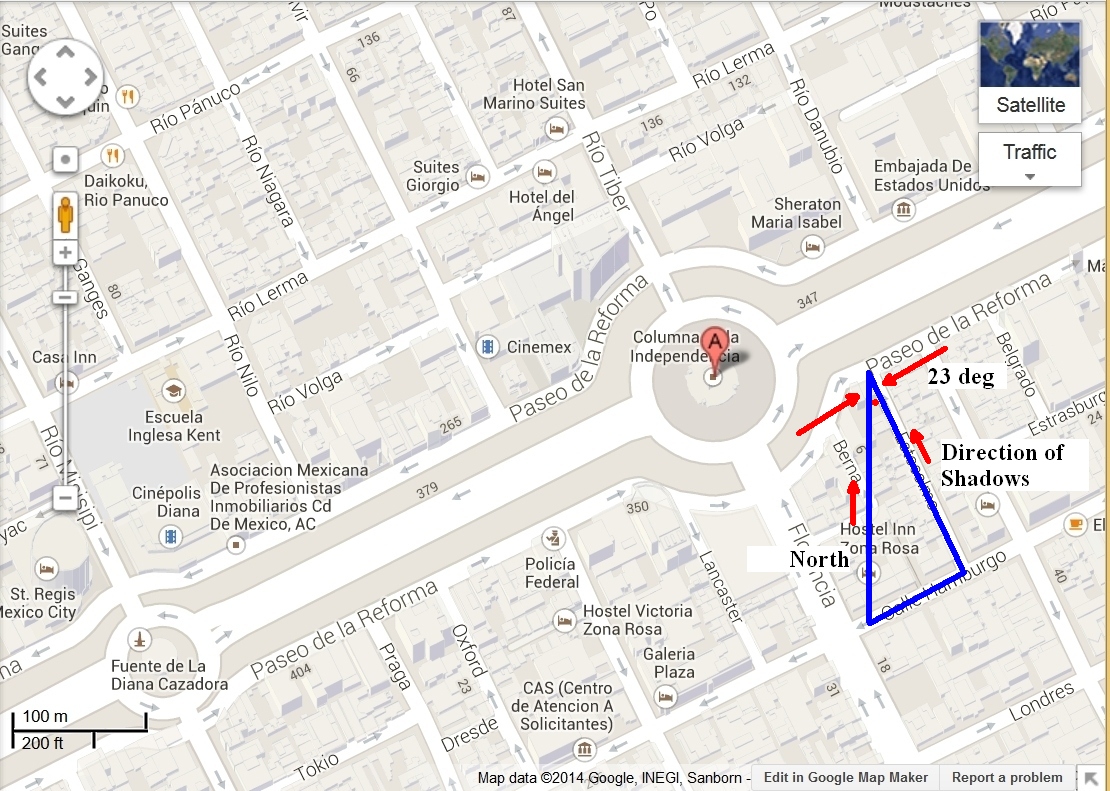
The earth turns on its axis 360 degrees every 24 hours, or 15 degrees an hour. If the
sun is 23 degrees away from due south in the sky, the time must be 23/15 = 1.5 hours
before noon, or around 10:30.
How can we account for the discrepancy?
In 2001, Mexico was on Daylight Savings Time until October 30, 2011. So on October
23, 2011, the day the picture was taken, DST was still in effect, and the clocks in
Mexico were one hour ahead of the time of day given by the position of the sun. If the
time stamp said 12:09, the sun should have said 11:09 if this were the only factor to
consider.
The remaining ~1/2 hour discrepancy comes from the fact that Mexico City is located
about halfway between two time zones. The solar time at Mexico City is about a half
hour earlier than its Daylight Standard Time.
Add that up, and you have a discrepancy of 1 1/2 hours between the time stamp on the
picture (12:09) and solar time (about 10:39) - one hour due to Daylight Savings Time,
and about an additional half hour due to the location of Mexico City between two time
zones.
sun is 23 degrees away from due south in the sky, the time must be 23/15 = 1.5 hours
before noon, or around 10:30.
How can we account for the discrepancy?
In 2001, Mexico was on Daylight Savings Time until October 30, 2011. So on October
23, 2011, the day the picture was taken, DST was still in effect, and the clocks in
Mexico were one hour ahead of the time of day given by the position of the sun. If the
time stamp said 12:09, the sun should have said 11:09 if this were the only factor to
consider.
The remaining ~1/2 hour discrepancy comes from the fact that Mexico City is located
about halfway between two time zones. The solar time at Mexico City is about a half
hour earlier than its Daylight Standard Time.
Add that up, and you have a discrepancy of 1 1/2 hours between the time stamp on the
picture (12:09) and solar time (about 10:39) - one hour due to Daylight Savings Time,
and about an additional half hour due to the location of Mexico City between two time
zones.
| EXIF Format |
| Short for Exchangeable Image File, a format that is a standard for storing interchange information in digital photography image files using JPEG compression. Almost all new digital cameras use the EXIF annotation, storing information on the image such as shutter speed, exposure compensation, F number, what metering system was used, if a flash was used, ISO number, date and time the image was taken, whitebalance, auxiliary lenses that were used and resolution. EXIF files use the JPEG DCT format, so the image data can be read by any application supporting JPEG, including essentially all Web browsers and image editing, desktop presentation and document creation applications. |
If you click on the photo of the Angel in the article and scroll down, you will discover
the metadata associated with it that gives a time stamp indicating the photo was taken at
12:09:44 pm, October 23, 2011.
the metadata associated with it that gives a time stamp indicating the photo was taken at
12:09:44 pm, October 23, 2011.
| Cosine Theta = Adjacent Hypotenuse Theta = ArcCos Adjacent Hypotenuse |

Still another way of understanding this is that Mexico City lies at -99.15 degrees
longitude, or 99.15 degrees west of Greenwich Mean Time. 99.15 degrees/15 degrees
per hour = 6 hours (90 degrees) earlier than GMT, plus an additional 9.15/15 hours =
36 min 40 secs earlier than that. Since standard time is calculated according to the time
zone line on the eastern border of the zone, by solar time is calculated according to
longitude, whatever the standard time in Mexico City, solar time is 36 mins 40 secs
earlier. 12:09 - 1 hour for DST - 37 minutes for geography = 10:34 a.m. solar time.
You should still figure in the one hour time shift for Daylight's Saving Time.
longitude, or 99.15 degrees west of Greenwich Mean Time. 99.15 degrees/15 degrees
per hour = 6 hours (90 degrees) earlier than GMT, plus an additional 9.15/15 hours =
36 min 40 secs earlier than that. Since standard time is calculated according to the time
zone line on the eastern border of the zone, by solar time is calculated according to
longitude, whatever the standard time in Mexico City, solar time is 36 mins 40 secs
earlier. 12:09 - 1 hour for DST - 37 minutes for geography = 10:34 a.m. solar time.
You should still figure in the one hour time shift for Daylight's Saving Time.
| ********** |
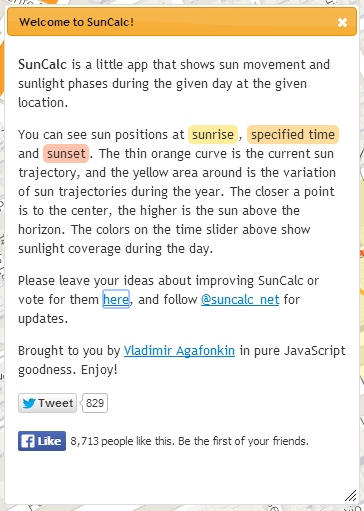
Suncalc.net allows you to calculate the
movement and position of the sun for any
day of the year, at any location.
movement and position of the sun for any
day of the year, at any location.
| ********** |
Read More El Angel en.wikipedia.org/wiki/El_%C3%81ngel Paseo de la Reforma en.wikipedia.org/wiki/Paseo_de_la_Reforma |
| ********** |