
 |  |  |  |
| Quiz #41 Results - December 23, 2005 |
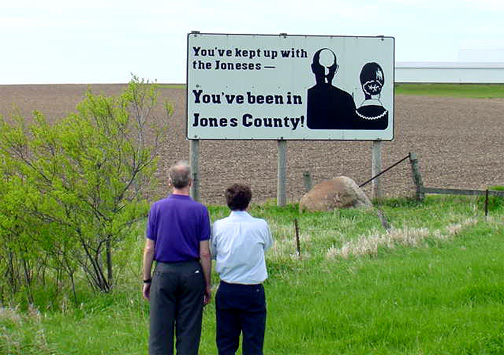
| The man on the right in the picture is Dr. Byron McKeeby, D.D.S. |

| 1. Who is the woman on the left in the picture? 2. Why are they so frequently seen together in public? |
| ********** |
| Answers: 1. Nan Grant Wood 2. They were the models for Grant Wood's famous painting American Gothic. |

| See below for an interesting interpretation of American Gothic by the American photo journalist Gordon Parks. |
| ********** |
| The Story of American Gothic www.arts.ufl.edu/art/rt_room/wood/gothic.html and www.slate.com/id/2120494/ |
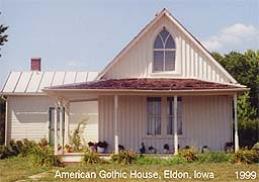
In August of 1930, Grant Wood was visiting the town of Eldon in the southern part of
Iowa when he came upon a house that would eventually make him famous. This
five-room structure was built in the 1880s in a style known as Carpenter Gothic. Wood
was very impressed with its compactness and strong design, particularly the Gothic
Window placed in the gable.
Iowa when he came upon a house that would eventually make him famous. This
five-room structure was built in the 1880s in a style known as Carpenter Gothic. Wood
was very impressed with its compactness and strong design, particularly the Gothic
Window placed in the gable.
Wood imagined a farmer and his
daughter standing in front of the house.
He immediately did a small sketch of his
idea on brown paper and had someone
take a photograph of the house so that
he could work out his idea when he
returned home.
Back in his studio, Wood used old
Victorian photographs and 19th century
portrait paintings to plan the scene he
was to paint. His sister, Nan, and his
daughter standing in front of the house.
He immediately did a small sketch of his
idea on brown paper and had someone
take a photograph of the house so that
he could work out his idea when he
returned home.
Back in his studio, Wood used old
Victorian photographs and 19th century
portrait paintings to plan the scene he
was to paint. His sister, Nan, and his
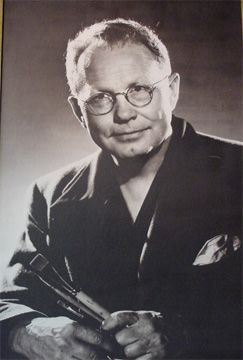
dentist, Dr. Byron McKeeby, served as models and were dressed in the period clothes
they are seen wearing. Even though they are seen standing together in the painting, each
was painted during separate sittings.
The man was given a pitchfork to hold because Wood wanted him to be associated
with haying in the 19th century rather than the more common farming practice of
gardening in the 20th century. The pitchfork also symbolized masculinity, the devil and
farming; and served as a compositional device to echo the ovalness of the people's
faces and the repeated lines of the Gothic Window. Wood worked on the painting for
two months and finished it in time to enter it into a juried exhibition at the Art Institute
of Chicago.
they are seen wearing. Even though they are seen standing together in the painting, each
was painted during separate sittings.
The man was given a pitchfork to hold because Wood wanted him to be associated
with haying in the 19th century rather than the more common farming practice of
gardening in the 20th century. The pitchfork also symbolized masculinity, the devil and
farming; and served as a compositional device to echo the ovalness of the people's
faces and the repeated lines of the Gothic Window. Wood worked on the painting for
two months and finished it in time to enter it into a juried exhibition at the Art Institute
of Chicago.
Although the jurors were at first divided over whether to
accept the painting, it eventually got into the show and
even received a bronze medal and a $300.00 prize. At the
time it aroused great controversy and was called by one
art critic "an insulting caricature of plain country
people." When the picture finally appeared in the Cedar
Rapids Gazette, real Iowa farmers and their wives were
not amused. To them, the painting looked like a nasty
caricature, portraying Midwestern farmers as pinched,
grim-faced, puritanical Bible-thumpers. One Iowa
farmwife told Wood he should have his "head bashed
in." Another threatened to bite off his ear. Stung by the
criticism, Wood declared himself a "loyal Iowan" and
insisted that the figures were not intended to be farmers
but small-town folk, not Iowans but generic Americans.
His sister Nan, perhaps embarrassed about being
To listen to Melissa Gray's report on National Public radio from Nov. 18, 2002, visit
www.npr.org/programs/morning/features/patc/americangothic/
www.npr.org/programs/morning/features/patc/americangothic/
For a biography of Grant Wood, see www.crma.org/collection/wood/wood.htm
| Check out American Gothic by Steven Biel www.amazon.com/gp/product/039305912X/102-2122711-6359333?n=283155 |
| ********** |
There have probably been thousands of parodies of American Gothic. Here are just a
few that I found interesting.
few that I found interesting.

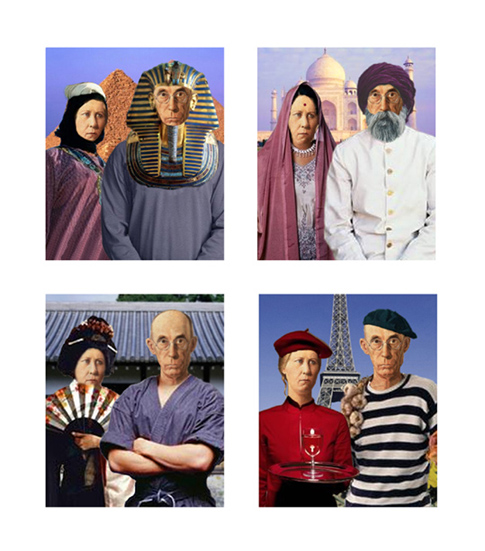
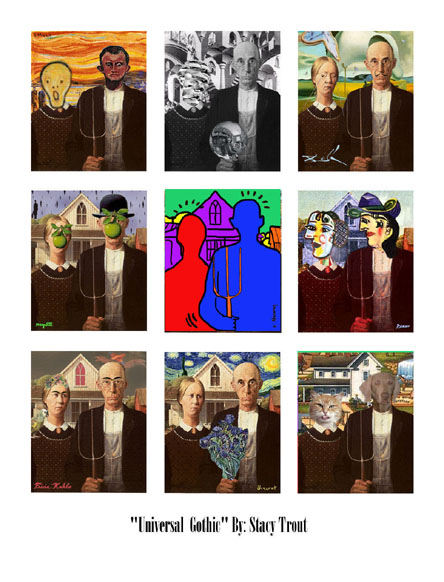
| These and other parodies can be found at: lfa.atu.edu/art/2-d_design_amgoth.html |
| Parodies based on the styles of other well known artists. How many can you identify? |
| ********** |
| American Gothic, Washington D.C. |
"American Gothic," considered to be [Gordon]
Parks's signature image, was taken in Washington,
D.C., in 1942, during the photographer's fellowship
with the Farm Security Administration, a
government agency set up by President Roosevelt to
aid farmers in despair. "It's the first professional
image I ever made," Parks says, "created on my first
day in Washington." Roy Stryker, who led the FSA's
very best documentary photographers—Dorothea
Lange, Walker Evans, Carl Mydans, etc.—told
Parks to go out and get acquainted with the city.
Parks was amazed by the amount of bigotry and
discrimination he encountered on his very first day.
"White restaurants made me enter through the back
door, white theaters wouldn't even let me in the
door, and as the day went on things just went from
bad to worse." Stryker told Parks to go talk with
Parks's signature image, was taken in Washington,
D.C., in 1942, during the photographer's fellowship
with the Farm Security Administration, a
government agency set up by President Roosevelt to
aid farmers in despair. "It's the first professional
image I ever made," Parks says, "created on my first
day in Washington." Roy Stryker, who led the FSA's
very best documentary photographers—Dorothea
Lange, Walker Evans, Carl Mydans, etc.—told
Parks to go out and get acquainted with the city.
Parks was amazed by the amount of bigotry and
discrimination he encountered on his very first day.
"White restaurants made me enter through the back
door, white theaters wouldn't even let me in the
door, and as the day went on things just went from
bad to worse." Stryker told Parks to go talk with
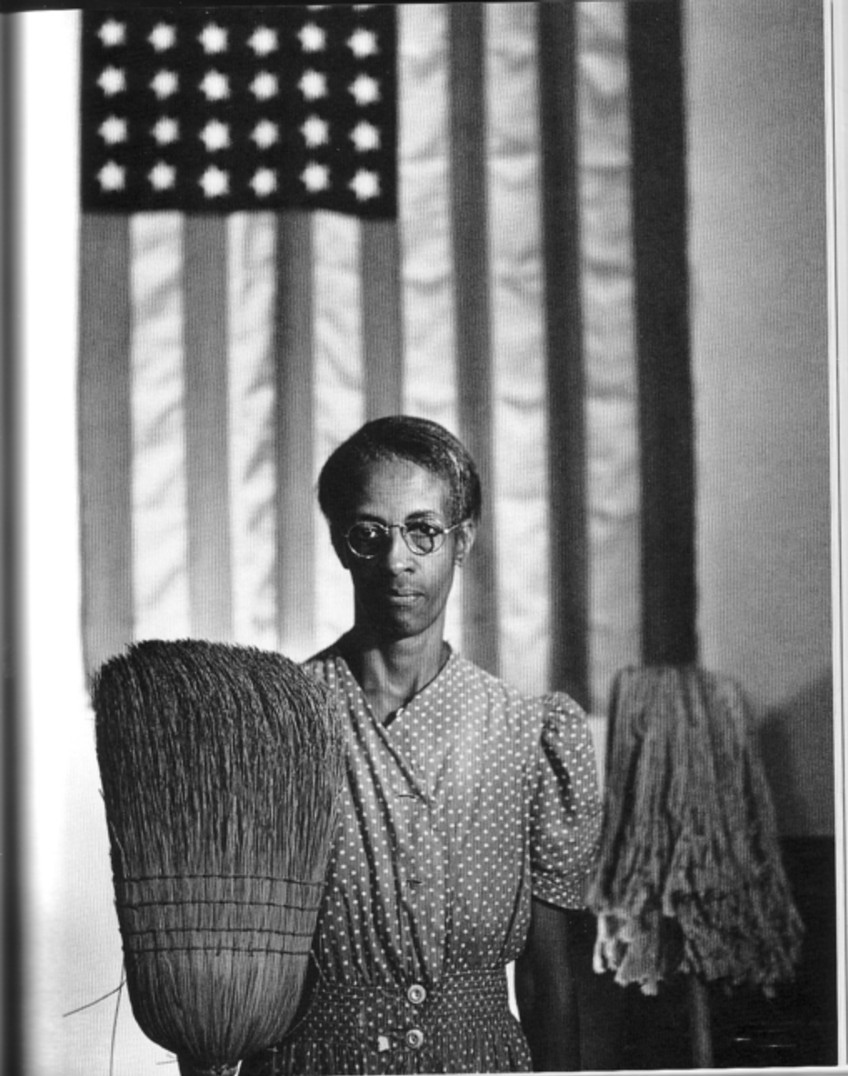
| American Gothic, Washington D.C. Gordon Parks, 1942 |
some older black people who had lived their entire lives in Washington and see how
they had coped. "That's how I met Ella," Parks explains.
Ella Watson was a black charwoman who mopped floors in the FSA building. Parks
asked her about her life, which she divulged as having been full of misery, bigotry and
despair. Parks's simple question, "Would you let me photograph you?" and Ella's
affirmative response, led to the photographer's most recognizable image of all time.
"Two days later Stryker saw the image and told me I'd gotten the right idea but was
going to get all the FSA photogs fired, that my image of Ella was 'an indictment of
America.' I thought the image had been killed but one day there it was, on the front
page of The Washington Post ." At the time, Parks couldn't have realized that the image
would go on to become the symbol of the pre-civil rights era's treatment of minorities.
Source: Info on Parks and his image from
www.pdn-pix.com/legends/parks/intro_set.shtml
From cc.ysu.edu/~satingle/AmSt%202601/interpretations.htm.
they had coped. "That's how I met Ella," Parks explains.
Ella Watson was a black charwoman who mopped floors in the FSA building. Parks
asked her about her life, which she divulged as having been full of misery, bigotry and
despair. Parks's simple question, "Would you let me photograph you?" and Ella's
affirmative response, led to the photographer's most recognizable image of all time.
"Two days later Stryker saw the image and told me I'd gotten the right idea but was
going to get all the FSA photogs fired, that my image of Ella was 'an indictment of
America.' I thought the image had been killed but one day there it was, on the front
page of The Washington Post ." At the time, Parks couldn't have realized that the image
would go on to become the symbol of the pre-civil rights era's treatment of minorities.
Source: Info on Parks and his image from
www.pdn-pix.com/legends/parks/intro_set.shtml
From cc.ysu.edu/~satingle/AmSt%202601/interpretations.htm.
| Gordon Parks |
Gordon Roger Alexander Buchanan Parks
Nov. 30, 1912 -
Fort Scott, Kansas, United States
Nationality: American
Occupation: photographer
Occupation: movie director
Occupation: writer
Occupation: composer
Awards: Julius Rosenwald Fellowship, 1941; Notable Book Award, American Library
Association for A Choice of Weapons, 1966; Emmy Award for documentary, Diary of
a Harlem Family, 1968; Spingarn Award, 1972; Christopher Award for Flavio, 1978;
National Medal of the Arts, 1988; Library of Congress National Film Registry Classics
film honor for The Learning Tree, 1989; honorary Doctor of Letters, Universityof the
District of Columbia, 1996; induction into the International Photography Hall of Fame
and Museum, 2002; Jackie Robinson Foundation Lifetime Achievement Award, 2002.
In 2002, at the age of 90, Gordon Parks received the Jackie Robinson Foundation
Lifetime Achievement Award and was inducted into the International Photography Hall
of Fame and Museum. These honors were only the two latest tributes bestowed on a
man whose achievements in photography, literature, film, and ballet have earned him
more than twenty doctorates and numerous awards. When asked why he undertook so
many professions, Parks told Black Enterprise "At first I wasn't sure that I had the
talent, but I did know I had a fear of failure, and that fear compelled me to fight off
anything that might abet it. I suffered evils, but without allowing them to rob me of the
freedom to expand."
Driven by this determination to "drive failure from my dreams and to push on," Parks
became the first black photographer to work at magazines like Life and Vogue, and the
first black to work for the Office of War Information and the Farm Security
Administration. Parks achieved these milestones in the 1940s. Later, in the 1960s, he
helped break racial barriers in Hollywood as the first black director for a major studio.
He co-produced, directed, wrote the screenplay, and composed the musical score for
the film based on his 1963 novel, The Learning Tree. The film was later placed on the
National Film Register by the Library of Congress.
Read more about Gordon Parks at:
www.gale.com/free_resources/bhm/bio/parks_g.htm
Nov. 30, 1912 -
Fort Scott, Kansas, United States
Nationality: American
Occupation: photographer
Occupation: movie director
Occupation: writer
Occupation: composer
Awards: Julius Rosenwald Fellowship, 1941; Notable Book Award, American Library
Association for A Choice of Weapons, 1966; Emmy Award for documentary, Diary of
a Harlem Family, 1968; Spingarn Award, 1972; Christopher Award for Flavio, 1978;
National Medal of the Arts, 1988; Library of Congress National Film Registry Classics
film honor for The Learning Tree, 1989; honorary Doctor of Letters, Universityof the
District of Columbia, 1996; induction into the International Photography Hall of Fame
and Museum, 2002; Jackie Robinson Foundation Lifetime Achievement Award, 2002.
In 2002, at the age of 90, Gordon Parks received the Jackie Robinson Foundation
Lifetime Achievement Award and was inducted into the International Photography Hall
of Fame and Museum. These honors were only the two latest tributes bestowed on a
man whose achievements in photography, literature, film, and ballet have earned him
more than twenty doctorates and numerous awards. When asked why he undertook so
many professions, Parks told Black Enterprise "At first I wasn't sure that I had the
talent, but I did know I had a fear of failure, and that fear compelled me to fight off
anything that might abet it. I suffered evils, but without allowing them to rob me of the
freedom to expand."
Driven by this determination to "drive failure from my dreams and to push on," Parks
became the first black photographer to work at magazines like Life and Vogue, and the
first black to work for the Office of War Information and the Farm Security
Administration. Parks achieved these milestones in the 1940s. Later, in the 1960s, he
helped break racial barriers in Hollywood as the first black director for a major studio.
He co-produced, directed, wrote the screenplay, and composed the musical score for
the film based on his 1963 novel, The Learning Tree. The film was later placed on the
National Film Register by the Library of Congress.
Read more about Gordon Parks at:
www.gale.com/free_resources/bhm/bio/parks_g.htm
| ********** |
| Congratulations to our winners! Lincoln Mulkey Kenneth Smith Bill Burrows Suzan Farris Debbie McCoy Sue Edminster Dale Niesen Christine Gregg Gwen Upton Raymond F. Cathcart Rich MacKinney Carol Haueter Lisa Stahlberg Jon Fox Joel Amos Gordon Bobbie Sims Emily Wise Bill Burrows Linda Palmer Lisa Brzys John Chulick Mike Pfister Pay Snyder Mary E. South Gus Janssen Jim Turner Mary Fraser Charles E. Nienhaus Judy Peterson Walter Wood Gary Lee Robert McKenna Don Schulteis Ardie Grimes Carol Epp Lean Mangue Linda Dean Jackie Torrance Edee Scott Maureen O'Connor |
| If you enjoy our quizzes, don't forget to order our book! Click here. |
If you have a picture you'd like us to feature a picture in a future quiz, please
email it to us at CFitzp@aol.com. If we use it, you will receive a free analysis of
your picture. You will also receive a free Forensic Genealogy CD or a 10%
discount towards the purchase of the Forensic Genealogy book.
email it to us at CFitzp@aol.com. If we use it, you will receive a free analysis of
your picture. You will also receive a free Forensic Genealogy CD or a 10%
discount towards the purchase of the Forensic Genealogy book.

| Quiz #41 Results |


 |  |  |  |
depicted as the wife of a man twice her age, started telling people that Wood had
envisioned the couple as father and daughter, not husband and wife. (Wood himself
remained vague on this point.)
American Gothic gradually gained acceptance and has since become one of the most
popular and widely recognized paintings in America.
The original American Gothic hangs today in the Art Institute of Chicago. You can read
more about this famous painting on the Art Institute's website at
www.onlineuniversity.net/art/guide-to-american-gothic-by-grant-wood/
envisioned the couple as father and daughter, not husband and wife. (Wood himself
remained vague on this point.)
American Gothic gradually gained acceptance and has since become one of the most
popular and widely recognized paintings in America.
The original American Gothic hangs today in the Art Institute of Chicago. You can read
more about this famous painting on the Art Institute's website at
www.onlineuniversity.net/art/guide-to-american-gothic-by-grant-wood/