| XXX |
| XXXXX |
| XXX |
| XXXXX |
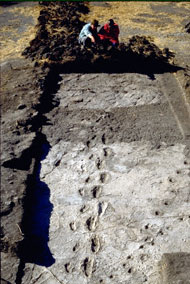
The prints are classified as belonging to Australopithecus afarensis.
Some analysts have noted in their interpretations that the smaller trail bears "telltale
signs that suggest whoever left the prints was burdened on one side." This may suggest
that a female was carrying an infant on her hip but this cannot be proven for certain.
The footprints themselves were an unlikely discovery because they are almost
indistinguishable from modern human footprints, even being almost 4 million years old.
It is noted that the toe pattern is much the same as the human foot, which is much
different than the feet of chimpanzees and other non bipedal beings. The footprint
impression has been interpreted as the same as the modern human stride, with the heel
striking first and then a weight transfer to the ball of the foot before pushing off the
toes.
Based on stratigraphic analysis, the findings also provide insight into the climate at the
time of the making of the footprints. Pliocene sediments show that the environment
was more moist and productive than now. Climate changes that caused a shift from
forest to grassland environments has a strong correlation with upright posture and
bipedalism in humans. This could have initiated the evolution to bipedalism of the
hominids found at Laetoli.
Preservation and Consevation
In 1979, after observations from the Laetoli footprints were recorded, the footprints
were re-buried as a then-novel way of preservation. After re-burial, the site was
revegetated by acacia trees. It was feared that the track might have been deteriorating
Some analysts have noted in their interpretations that the smaller trail bears "telltale
signs that suggest whoever left the prints was burdened on one side." This may suggest
that a female was carrying an infant on her hip but this cannot be proven for certain.
The footprints themselves were an unlikely discovery because they are almost
indistinguishable from modern human footprints, even being almost 4 million years old.
It is noted that the toe pattern is much the same as the human foot, which is much
different than the feet of chimpanzees and other non bipedal beings. The footprint
impression has been interpreted as the same as the modern human stride, with the heel
striking first and then a weight transfer to the ball of the foot before pushing off the
toes.
Based on stratigraphic analysis, the findings also provide insight into the climate at the
time of the making of the footprints. Pliocene sediments show that the environment
was more moist and productive than now. Climate changes that caused a shift from
forest to grassland environments has a strong correlation with upright posture and
bipedalism in humans. This could have initiated the evolution to bipedalism of the
hominids found at Laetoli.
Preservation and Consevation
In 1979, after observations from the Laetoli footprints were recorded, the footprints
were re-buried as a then-novel way of preservation. After re-burial, the site was
revegetated by acacia trees. It was feared that the track might have been deteriorating
also the oldest known evidence of bipedalism at the time they were found, although
now older evidence has been found such as the Ardipithecus ramidus fossils. The
footprints and skeletal structure excavated at Laetoli showed clear evidence that
bipedalism preceded enlarged brains in hominids. Although it is highly debated, it is
believed the three individuals who made these footprints belonged to the species
Australopithecus afarensis. Along with footprints were other discoveries including
hominin and animal skeletal remains and Acheulean artifacts.
Discovery
The principal discovery is an 80-foot (24-meter) line of hominid fossil footprints,
discovered by Mary Leakey and her team in 1976 (and fully excavated by 1978),
preserved in powdery volcanic ash originally thought to have been from an eruption of
the 20 km distant Sadiman volcano. However, recent study of the Sadiman volcano has
shown that it is not a source for the Laetoli Footprints Tuff (Zaitsev et al. 2011). Soft
rain cemented the ash-layer (15 cm thick) to tuff without destroying the prints. In time,
they were covered by other ash deposits.
The hominid prints were produced by three individuals, one walking in the footprints of
the other, making the original tracks difficult to discover. As the tracks lead in the same
direction, they might have been produced by a group visiting a waterhole together—but
there is nothing to support the common assumption of a nuclear family.
The footprints demonstrate that the hominids habitually walked upright as there are no
knuckle-impressions. The feet do not have the mobile big toe of apes; instead, they
have an arch (the bending of the sole of the foot) typical of modern humans. The
hominins seem to have moved in a leisurely stroll.
Computer simulations based on information from A. afarensis fossil skeletons and the
spacing of the footprints indicate that the hominids were walking at 1.0 m/s or above,
which matches human walking speeds.The results of other studies have also supported
the theory of a human-like gait.
now older evidence has been found such as the Ardipithecus ramidus fossils. The
footprints and skeletal structure excavated at Laetoli showed clear evidence that
bipedalism preceded enlarged brains in hominids. Although it is highly debated, it is
believed the three individuals who made these footprints belonged to the species
Australopithecus afarensis. Along with footprints were other discoveries including
hominin and animal skeletal remains and Acheulean artifacts.
Discovery
The principal discovery is an 80-foot (24-meter) line of hominid fossil footprints,
discovered by Mary Leakey and her team in 1976 (and fully excavated by 1978),
preserved in powdery volcanic ash originally thought to have been from an eruption of
the 20 km distant Sadiman volcano. However, recent study of the Sadiman volcano has
shown that it is not a source for the Laetoli Footprints Tuff (Zaitsev et al. 2011). Soft
rain cemented the ash-layer (15 cm thick) to tuff without destroying the prints. In time,
they were covered by other ash deposits.
The hominid prints were produced by three individuals, one walking in the footprints of
the other, making the original tracks difficult to discover. As the tracks lead in the same
direction, they might have been produced by a group visiting a waterhole together—but
there is nothing to support the common assumption of a nuclear family.
The footprints demonstrate that the hominids habitually walked upright as there are no
knuckle-impressions. The feet do not have the mobile big toe of apes; instead, they
have an arch (the bending of the sole of the foot) typical of modern humans. The
hominins seem to have moved in a leisurely stroll.
Computer simulations based on information from A. afarensis fossil skeletons and the
spacing of the footprints indicate that the hominids were walking at 1.0 m/s or above,
which matches human walking speeds.The results of other studies have also supported
the theory of a human-like gait.
Laetoli is a site in Tanzania, dated to the
Plio-Pleistocene and famous for its
hominin footprints, preserved in volcanic
ash (Site G). The site of the Laetoli
footprints is located 45 km south of
Olduvai gorge. The location was
excavated by archaeologist Mary Leakey
in 1978. “The Laetoli Footprints” received
significant recognition by the public,
providing convincing evidence of
bipedalism in Pliocene hominids based on
analysis of the impressions.
Dated to 3.6 million years ago they were
Plio-Pleistocene and famous for its
hominin footprints, preserved in volcanic
ash (Site G). The site of the Laetoli
footprints is located 45 km south of
Olduvai gorge. The location was
excavated by archaeologist Mary Leakey
in 1978. “The Laetoli Footprints” received
significant recognition by the public,
providing convincing evidence of
bipedalism in Pliocene hominids based on
analysis of the impressions.
Dated to 3.6 million years ago they were
| XXXX |
| A Significant Contribution to Mankind's IQ? |
| XXX |
| How Arthur Solved the Puzzle |
| The Laetoli Footprints en.wikipedia.org/wiki/Laetoli www.getty.edu/conservation/our_projects... |
| ********** |

 |  |  |  |
| If you have a picture you'd like us to feature a picture in a future quiz, please email it to us at CFitzp@aol.com. If we use it, you will receive a free analysis of your picture. You will also receive a free Forensic Genealogy CD or a 10% discount towards the purchase of the Forensic Genealogy book. |


 |  |  |  |

| If you enjoy our quizzes, don't forget to order our books! Click here. |
!-- Start Quantcast tag -->

| Quiz #409 Results |

| Answers to Quiz #409 - September 1, 2013 |
| ********** |
|
|
| Congratulations to Our Winners! Grace Hertz and Mary Turner - Team Fletcher Marcelle Comeau Catherine Bence Traci Thompson Nelsen Spickard Arthur Hartwell Rebecca Bare Maureen DeHaan Traci Thompson Cynthia Costigan Jim Kiser Gus Marsh Patty Kaliher Joe Ruffner Elaine C. Hebert Jillian Stokes Tom Collins Tynan Peterson |
| These footprints predated our brains becoming larger--proof that walking is good for your brain? Tynan Peterson ***** Yes, but look how far you have to walk for each point of IQ you gain. In 1 million years - say a caveman lived to be 30 years old and was able to walk on his own for 25 of those (and not be carried all the time by his cave-mom). Say he walked 1 mile an hour on the average taking into account time to stop at MacDonald's and eat and use the bathroom. No need to buy gas since they didn't have cars back then. Let's assume he walked five hours a day, so that's five miles a day, except on Sunday, and for a two week break at Christmas time. 5 miles/day * 6 days/week * 50 weeks a year * 25 years = 37,500 miles in his lifetime. Assume he passes down his increase in IQ intact to his children who are born when he is 20 years old. This means that the last five years of his walking life can be ignored in the equation and that the total IQ-miles walked in a lifetime is 5*6*50*20 = 30,000 miles per generation 3.6 million years/20 years per walking generation = 180,000 generations 180,000 generations * 30,000 miles/generation = 5.4* 10^9 miles walked during the 3.6 million years. Say cave people had average IQ's of 75 compared to modern Homo Sapiens. The increase you expect is 25 IQ points over 3.6 M years. 25 IQ points/(5.4* 10^9 miles) = 4.6 * 10-9 IQ points/mile = 4.6 nano-IQ points per mile. 4.6 nano-IQ points per mile is not a lot, but over time, you can see how that could accumulate, kind of like IQ-stalactites and stalagmites. Colleen Fitzpatrick PhD Quizmaster General |
|
| Man and woman footprints gave me an image that identified what they were. Laetoli tracks located the image, and gave me much information about the significance and protection. Interesting that these old footprints could be found. Most footprints last only to the next rain, if that long. Arthur Hartwell |
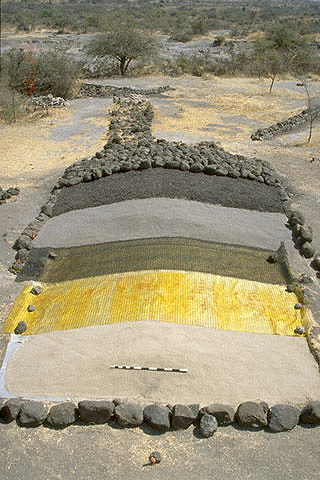
| A cross section of the Laetoli trackway reburial stratigraphy, including layers of geotextiles, with lava boulders at the top. Photo: Neville Agnew. |
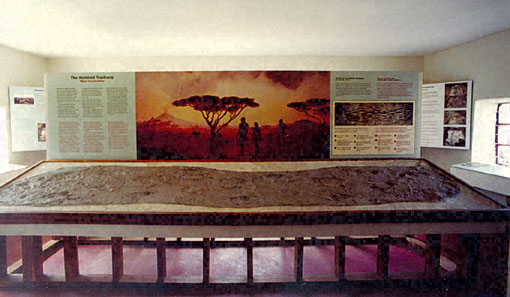
An exhibition cast of the Laetoli
trackway with a mural re-creating the
making of the footprints. The cast is
the centerpiece of the Laetoli Room.
Photo: Daniel Koch.
trackway with a mural re-creating the
making of the footprints. The cast is
the centerpiece of the Laetoli Room.
Photo: Daniel Koch.
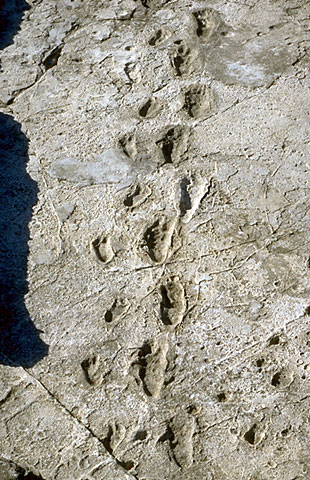
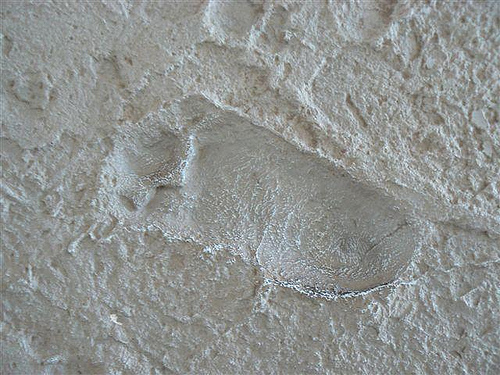
A close view of
3.6-million-year-old hominid
footprints at Laetoli in
Tanzania. Photo: Tom Moon.
3.6-million-year-old hominid
footprints at Laetoli in
Tanzania. Photo: Tom Moon.
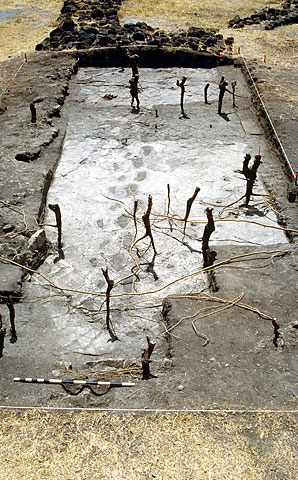
| Southern portion of the Laetoli hominid trackway, looking north, prior to the removal of the acacia tree roots in 1995. Photo: Neville Agnew. |
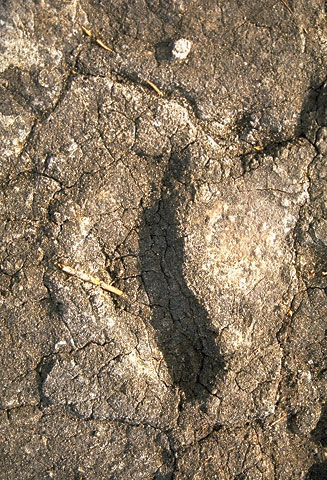
| Hominid Trackway at Laetoli (1992–1998) A project of the Getty Conservation Institute A detailed view of print G1- 19 in the northern trackway showing penetration of footprint by root. Photo: John C. Lewis. |
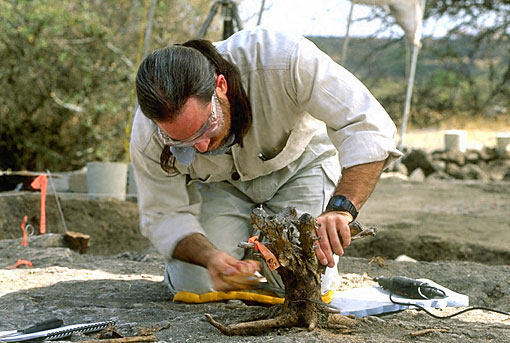
Eduardo Sanchez of the Getty Museum
removes an acacia tree stump in the
middle of the trackway. Photo: John C.
Lewis.
removes an acacia tree stump in the
middle of the trackway. Photo: John C.
Lewis.
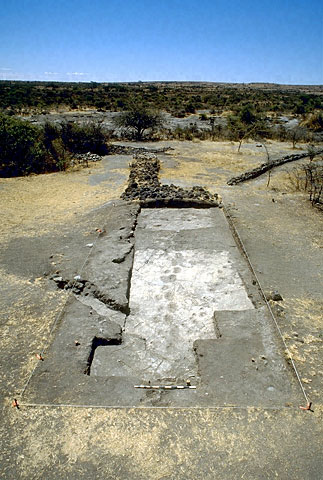
| The southern portion of the trackway at the end of the 1995 conservation campaign, prior to reburial. Photo: Tom Moon |
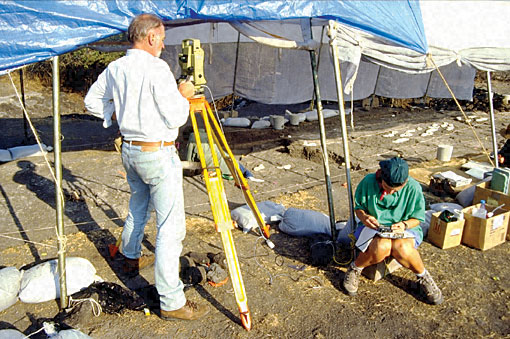
Heinz Rüther and Ulrike Brussler of
the University of Cape Town survey the
site using a total station. The survey
data was used, along with
photogrammetry, to create a
three-dimensional model of portions of
the trackway. Photo: Frank Long.
the University of Cape Town survey the
site using a total station. The survey
data was used, along with
photogrammetry, to create a
three-dimensional model of portions of
the trackway. Photo: Frank Long.
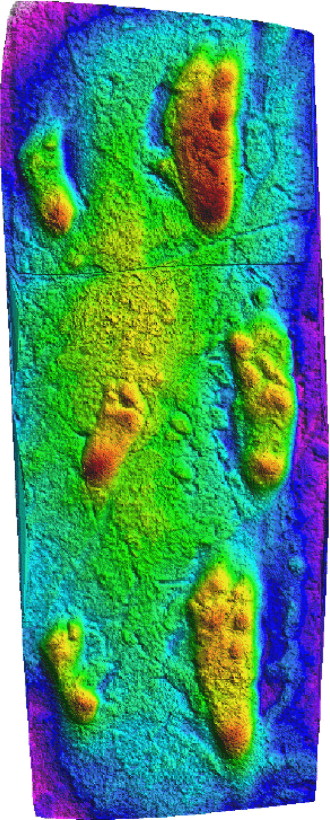
| A contour scan of the Laeoti footprints. marshall-shredding.com/languages/laetoli-trackway |
|
Signficance
Before the discovery of the Laetoli
footprints, there was much debate as to
what developed first in the evolutionary
time line: a larger brain or bipedalism. The
discovery of these footprints therefore
settled the issue proving that the hominids
found at Laetoli were fully bipedal before
the evolution of the modern human brain,
and were even bipedal close to a million
years before the earliest known stone tools.
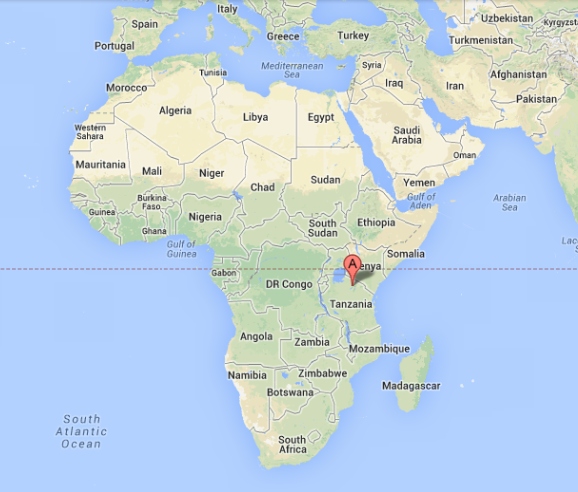
| Laoeti, Tanzania |
| ********** |
because of root growth. In mid-1992, a GCI-Tanzanian
team investigated this by opening a three-by-three meter
trench which showed that root growth had in fact done
damage to the footprints. However, the part of the
trackway that had not been affected by root growth
showed exceptional preservation. The success of the
experiment led to an increased practice in reburials for
preserving excavated sites.
In 1993, measures were taken to prevent erosion. The
original trackway was remolded and new casts were
made. Since the trackway is too fragile to be remolded,
the new replica cast was used to guide re-excavation in
the field. A team of specialists re-excavated half of the
trackway to record its condition, stabilize the surface,
extract dead roots and rebury it with synthetic geotextile
materials. This allows the trackway surface to breath,
and protects it against root growth.
Proposals for lifting the track and moving it to an
enclosed site have been suggested, but the cost is viewed
team investigated this by opening a three-by-three meter
trench which showed that root growth had in fact done
damage to the footprints. However, the part of the
trackway that had not been affected by root growth
showed exceptional preservation. The success of the
experiment led to an increased practice in reburials for
preserving excavated sites.
In 1993, measures were taken to prevent erosion. The
original trackway was remolded and new casts were
made. Since the trackway is too fragile to be remolded,
the new replica cast was used to guide re-excavation in
the field. A team of specialists re-excavated half of the
trackway to record its condition, stabilize the surface,
extract dead roots and rebury it with synthetic geotextile
materials. This allows the trackway surface to breath,
and protects it against root growth.
Proposals for lifting the track and moving it to an
enclosed site have been suggested, but the cost is viewed
as outweighing the benefits: the process would require much research, a large amount
of money, and there is a risk of loss or damage. Thus, burial seems to be the most
effective method of preservation.
of money, and there is a risk of loss or damage. Thus, burial seems to be the most
effective method of preservation.
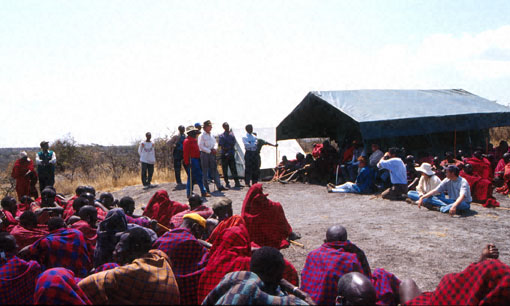
Members of local Masai tribe and the
project team gather prior to a ceremony
of August 1996 that included a tribal
blessing of the Laetoli trackway. Photo:
John C. Lewis.
project team gather prior to a ceremony
of August 1996 that included a tribal
blessing of the Laetoli trackway. Photo:
John C. Lewis.
| ********** |
| ********** |
| ********** |
| XXX |
| See YouTube video about the Laetoli footprints by clicking here. |