Though it may not garner the same level of tourism,
MIT's own version of Stonehenge still manages to
draw a crowd.
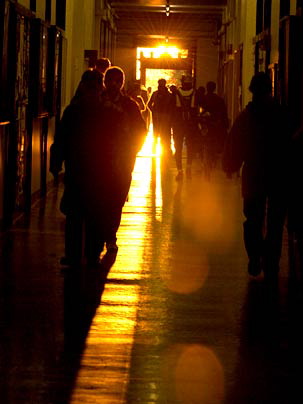
The view from the third floor of Building 8 is said to
be best when, for a moment each year, the Infinite
Corridor captures the light from the setting sun to
create a phenomenon called "MIThenge." Named
after prehistoric Stonehenge in England, the effect
happens on just a few afternoons each year.
Barring a cloudy day, the effect will be visible this
week, on Jan. 27 at approximately 4:50 p.m. and
again the next day at 4:49 p.m. It will be visible one
final time this winter, on Jan. 29 at 4:48 p.m. The
next appearance will be in November.
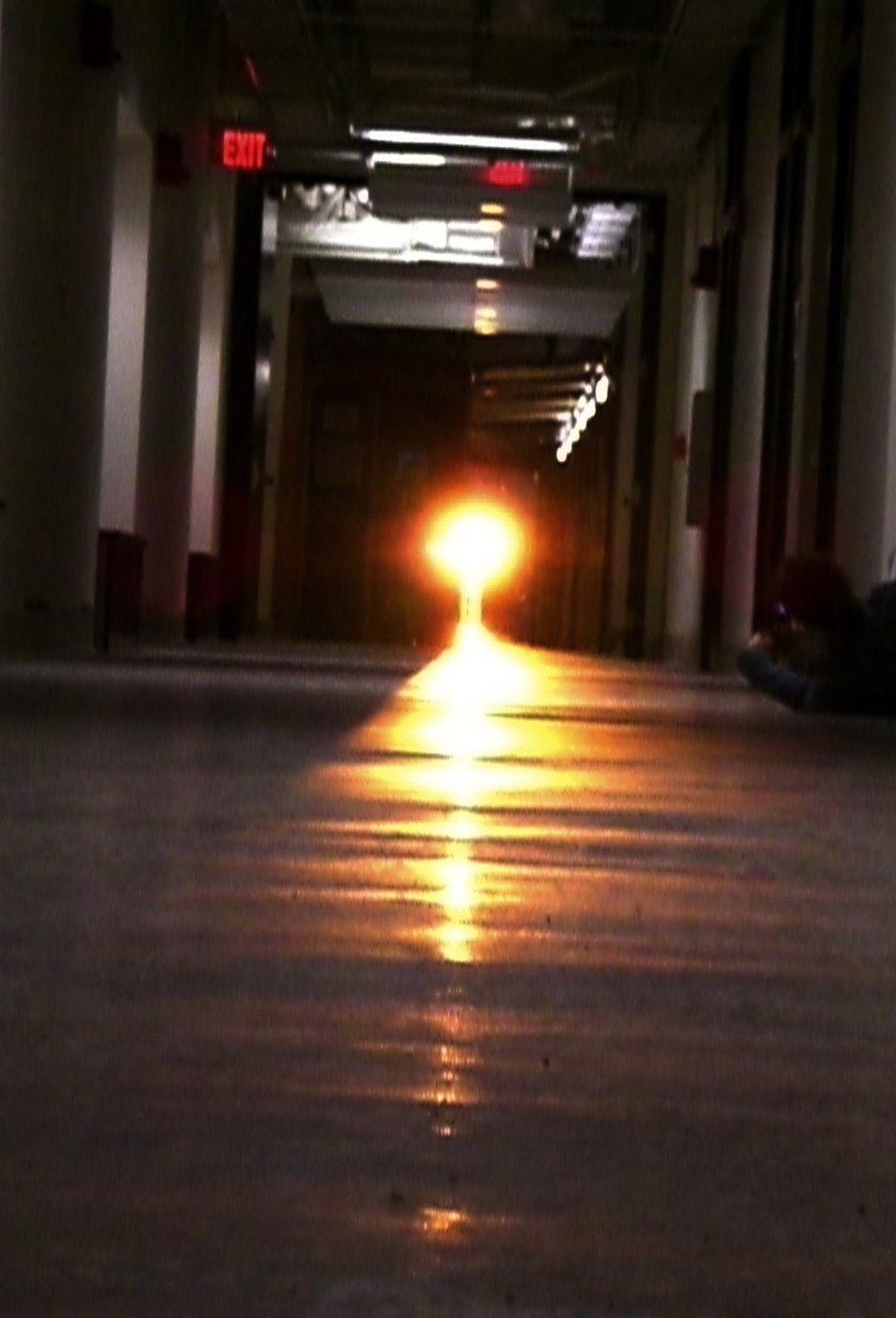
MIThenge occurs when the path of the sun crosses
the axis of the Infinite Corridor in late January and
mid-November every year. As the sun aligns, the
marble floor is illuminated and the reflection can be
seen far down the hall. "The orange light reflected
off the ceiling is often striking," according to the
website dedicated to the marvel.
For the past 30 years, people have gathered to
witness the event, but those who do are cautioned
not to stare directly at the sun. Additional spots for
viewing are just beneath the stairwell in Building 8 at
the end of the Infinite Corridor and looking out the
windows of Building 18 and in through the window
of Building 8 at the end of the corridor.
MIT's own version of Stonehenge still manages to
draw a crowd.
The view from the third floor of Building 8 is said to
be best when, for a moment each year, the Infinite
Corridor captures the light from the setting sun to
create a phenomenon called "MIThenge." Named
after prehistoric Stonehenge in England, the effect
happens on just a few afternoons each year.
Barring a cloudy day, the effect will be visible this
week, on Jan. 27 at approximately 4:50 p.m. and
again the next day at 4:49 p.m. It will be visible one
final time this winter, on Jan. 29 at 4:48 p.m. The
next appearance will be in November.
MIThenge occurs when the path of the sun crosses
the axis of the Infinite Corridor in late January and
mid-November every year. As the sun aligns, the
marble floor is illuminated and the reflection can be
seen far down the hall. "The orange light reflected
off the ceiling is often striking," according to the
website dedicated to the marvel.
For the past 30 years, people have gathered to
witness the event, but those who do are cautioned
not to stare directly at the sun. Additional spots for
viewing are just beneath the stairwell in Building 8 at
the end of the Infinite Corridor and looking out the
windows of Building 18 and in through the window
of Building 8 at the end of the corridor.
| XXX |
| XXX |
| XXX |
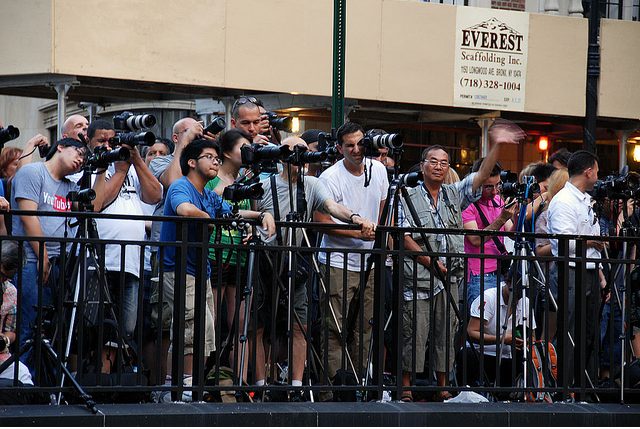
| Crowds at Manhattanhenge July 2012 gothamist.com/2011/07/12/reminder_july_manhattanhenge_change.php |
Plain of England. For Stonehenge, the special day is the summer solstice, when the Sun
rises in perfect alignment with several of the stones, signaling the change of season.
For Manhattan, a place where evening matters more than morning, that special day
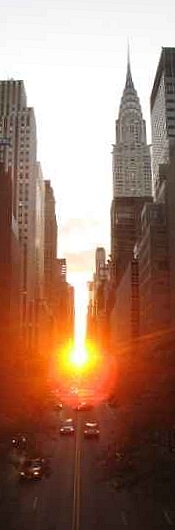
comes twice a year. For 2011 they fall on May 30th, and July 13th, when the setting
Sun aligns precisely with the Manhattan street grid, creating a radiant glow of light
across Manhattan's brick and steel canyons, simultaneously illuminating both the north
and south sides of every cross street of the borough's grid. A rare and beautiful sight.
These two days happen to correspond with Memorial Day and Baseball's All Star break.
Future anthropologists might conclude that, via the Sun, the people who called
themselves Americans worshiped War and Baseball.
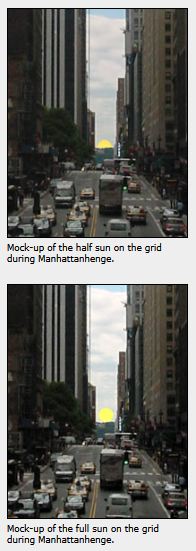
For these two days, as the Sun sets on the grid, half the disk sits above and half below
the horizon. My personal preference for photographs. But the day after May 30th (May
rises in perfect alignment with several of the stones, signaling the change of season.
For Manhattan, a place where evening matters more than morning, that special day
comes twice a year. For 2011 they fall on May 30th, and July 13th, when the setting
Sun aligns precisely with the Manhattan street grid, creating a radiant glow of light
across Manhattan's brick and steel canyons, simultaneously illuminating both the north
and south sides of every cross street of the borough's grid. A rare and beautiful sight.
These two days happen to correspond with Memorial Day and Baseball's All Star break.
Future anthropologists might conclude that, via the Sun, the people who called
themselves Americans worshiped War and Baseball.
For these two days, as the Sun sets on the grid, half the disk sits above and half below
the horizon. My personal preference for photographs. But the day after May 30th (May
Sunset on the Manhattan Grid
by Neil deGrasse Tyson, © 2001-2011
What will future civilizations think of
Manhattan Island when they dig it up and
find a carefully laid out network of streets
and avenues? Surely the grid would be
presumed to have astronomical
significance, just as we have found for the
pre-historic circle of large vertical rocks
known as Stonehenge, in the Salisbury
by Neil deGrasse Tyson, © 2001-2011
What will future civilizations think of
Manhattan Island when they dig it up and
find a carefully laid out network of streets
and avenues? Surely the grid would be
presumed to have astronomical
significance, just as we have found for the
pre-historic circle of large vertical rocks
known as Stonehenge, in the Salisbury
| XXX |

 |  |  |  |
| If you have a picture you'd like us to feature a picture in a future quiz, please email it to us at CFitzp@aol.com. If we use it, you will receive a free analysis of your picture. You will also receive a free Forensic Genealogy CD or a 10% discount towards the purchase of the Forensic Genealogy book. |


 |  |  |  |
| ********** |

| If you enjoy our quizzes, don't forget to order our books! Click here. |

| Quiz #339 Results |

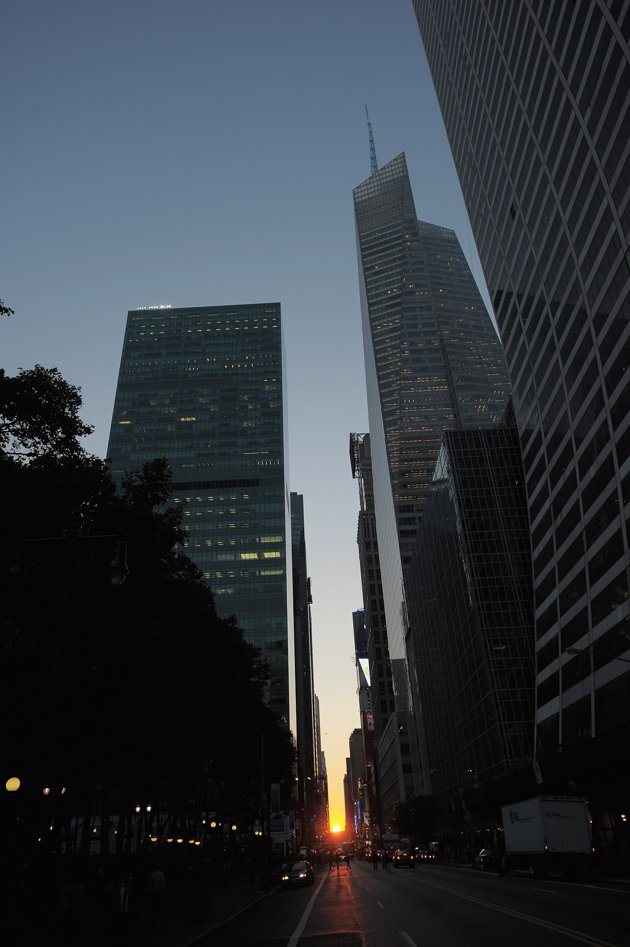
Answers: This is a photo qo "Mahattanhenge", where the sun rises and sets directly down the east-west street grid of the town. 1. May 31 and July 12 (This is a sunset, facing northwest.) (January 8 and December 5 for sunrise.) 2. Similar solar events occur in Baltimore and at MIT MIT: Sunset November 11 & January 30 Baltimore : March 25 & September 18 (sunrise), May 31 & July 12 (sunset). 3. A similar phenomenon happens each Winter Solstice at Newgrange, Co. Meath, Ireland, the subject of Quiz #335. |
| Answer to Quiz #339 January 15, 2012 |
| 1. What days of the year could this photo have been taken on? 2. What does this have in common with Baltimore and MIT? 3. How does it relate to a recent quiz? |
| ********** |
| ********** |
| Suggested by Quizmaster Emeritus Milene Rawlinson. |
| Congratulations to Our Winners! Shirley Hamblin Arthur Hartwell Daniel Jolley Peter Norton Barbara Mroz Angel Esparza Jim Baker Margaret Paxton |
| ********** |
| ********** |
| Comments from Our Readers |
Once again I would be remiss and embarrassed in front of my colleagues if I failed to
get this one right. Loved by tourists & locals alike, this phenomenon has taken on
mythic proportions for fans. Some have patio parties in their apartments &
'Manhattanhenge' is the cause for celebration (i.e. excuse to drink) for many NYer's.
One of the coolest things is to go into Central Park and find the iron surveying rods
embedded in bedrock that are left over from when the street grid (Commissioner's Plan
of 1811) was laid down in the early 1800's.
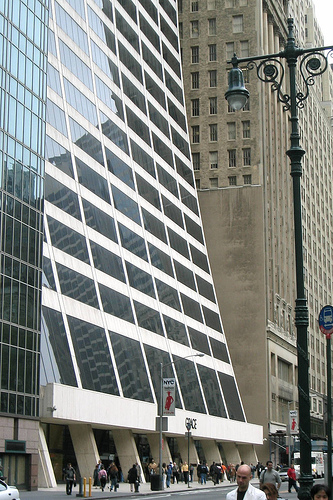
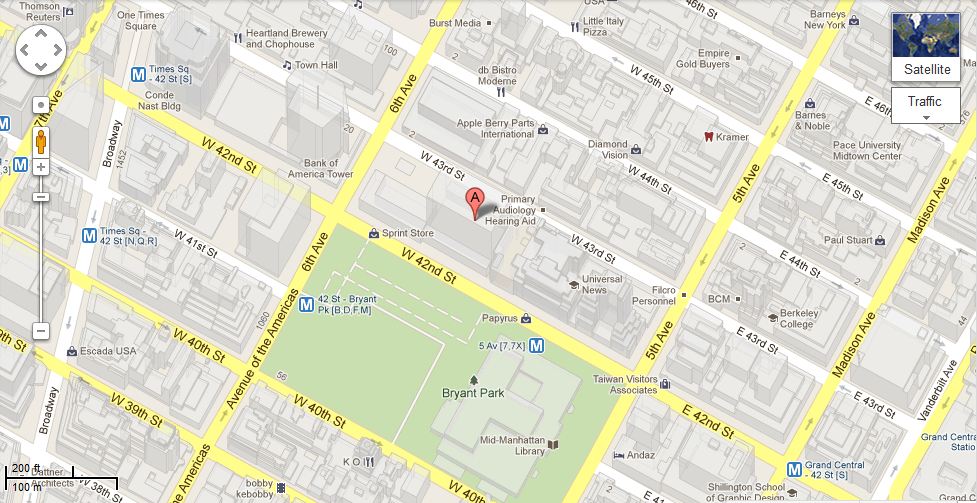
BTW, this photo was taken on 42nd street between Fifth Avenue & 6th Avenue (The
Avenue of the Americas), looking west approaching 6th Avenue beside Bryant Park
(formerly called 'Needle Park' due to the proliferation of IV heroin abusers who used to
frequent the park in the 1960's-1980's). The park includes the grand New York Public
Library-(NYPL), a mecca for people like us. In the distance, is Times Square, to the
right of the photo is the sloping Grace Chemical Building, and to the left is the ladies
public lavatory, at the rear of NYPL. The Park is really nice now, a pedestrian mall with
some seasonal shops, seasonal ice skating, seasonal HBO outdoor film festivals or NYC
Fashion Week. The park is actually the sight of NYC's first major water reservoir,
when NYC was a city only up to 42nd Street, north being all farmland, pasture, &
wilderness. Cool quiz! Have a great week! Robert W. Steinmann Jr.
*****
Similar Phenomenon happens in Ciudad Delicias, Chihuahua (Diagonal Streets) during
the equinoxes and in Mexico City (historic Center) on April 9, September 2, March 4,
and October 9. Angel Esparza
*****
get this one right. Loved by tourists & locals alike, this phenomenon has taken on
mythic proportions for fans. Some have patio parties in their apartments &
'Manhattanhenge' is the cause for celebration (i.e. excuse to drink) for many NYer's.
One of the coolest things is to go into Central Park and find the iron surveying rods
embedded in bedrock that are left over from when the street grid (Commissioner's Plan
of 1811) was laid down in the early 1800's.
BTW, this photo was taken on 42nd street between Fifth Avenue & 6th Avenue (The
Avenue of the Americas), looking west approaching 6th Avenue beside Bryant Park
(formerly called 'Needle Park' due to the proliferation of IV heroin abusers who used to
frequent the park in the 1960's-1980's). The park includes the grand New York Public
Library-(NYPL), a mecca for people like us. In the distance, is Times Square, to the
right of the photo is the sloping Grace Chemical Building, and to the left is the ladies
public lavatory, at the rear of NYPL. The Park is really nice now, a pedestrian mall with
some seasonal shops, seasonal ice skating, seasonal HBO outdoor film festivals or NYC
Fashion Week. The park is actually the sight of NYC's first major water reservoir,
when NYC was a city only up to 42nd Street, north being all farmland, pasture, &
wilderness. Cool quiz! Have a great week! Robert W. Steinmann Jr.
*****
Similar Phenomenon happens in Ciudad Delicias, Chihuahua (Diagonal Streets) during
the equinoxes and in Mexico City (historic Center) on April 9, September 2, March 4,
and October 9. Angel Esparza
*****
| How Arthur Solved the Puzzle |
| The quiz may be hard because your exact image is hard to find, I never did. I assumed it was sunset Manhattanhenge because most of the pictures I found were of that. I added sunrise to CMA. Question 3 told me we were looking at a sun solstice type image. I don't remember exactly what I did, but probably queried Hoogle images for "sun shining down street". I found an image similar to yours laid horizontally. Clicking on it brouht up Manhattanhenge and some explanation. Wikipedia gave me much info on Manhattanhenge, Baltimorehenge, and MIThenge verified their events. Googling Manhattanhenge images gave me many pictures and interesting shots of people recording the event. But nowhere did I find your image. I waited a couple days before sending my answer. Arthur Hartwell |
| Clues from the Picture |
| ********** |
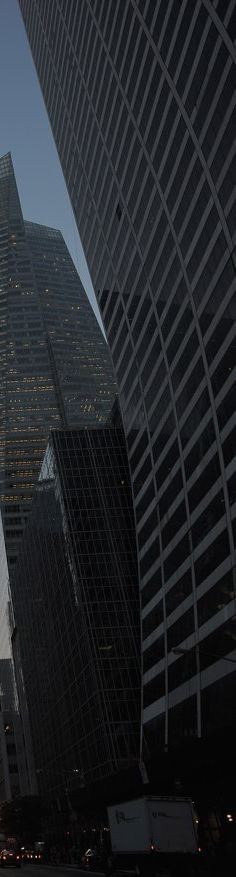
| Bank of America Tower One Bryant Park New York, New York archrecord.construction.com/news/daily/archives/2010/100525nyc_leed_platinum.asp |
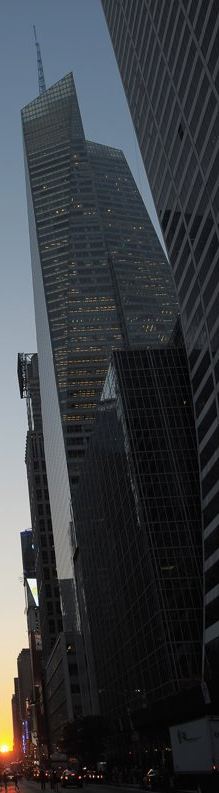
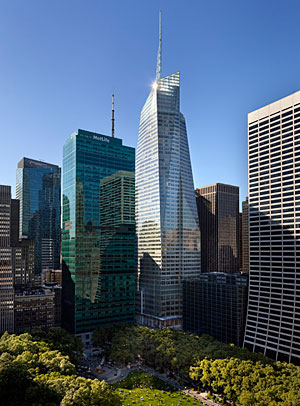
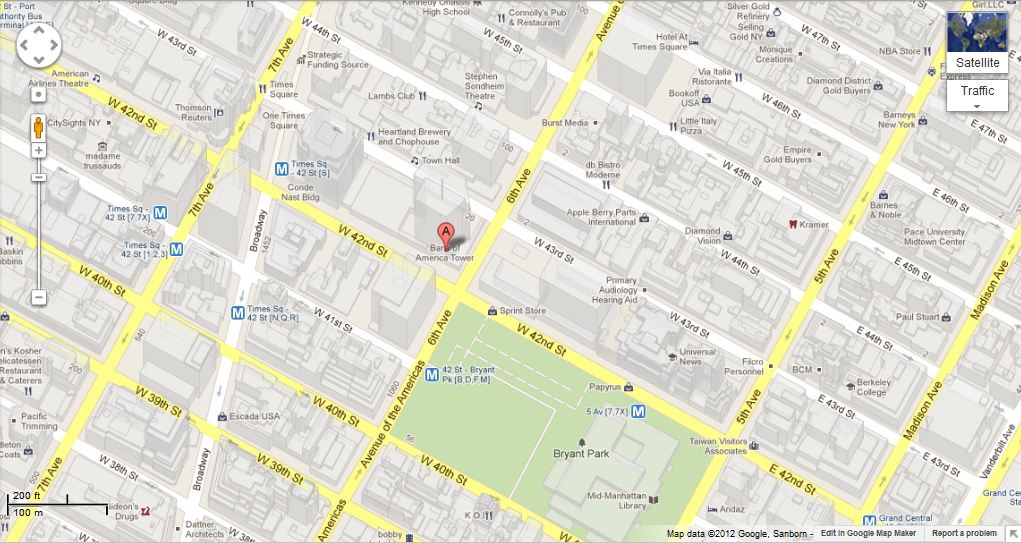
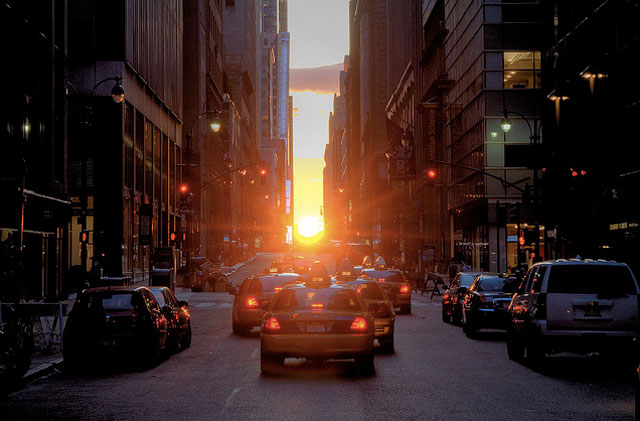
With the Bank of America Tower
pictured on the right side of the street,
the camera must be pointing northwest.
Therefore, this is a picture of the sun
setting directly along 42nd St.
pictured on the right side of the street,
the camera must be pointing northwest.
Therefore, this is a picture of the sun
setting directly along 42nd St.
Surfing on keywords and phrases such as "sun setting down 42nd St." or similar,
you will find reference to "Manhattanhenge".
you will find reference to "Manhattanhenge".
| ********** |
| Manhattanhenge en.wikipedia.org/wiki/Manhattanhenge |
Manhattanhenge – sometimes referred to as the Manhattan Solstice – is
a semiannual occurrence in which the setting sun aligns with the east–
west streets of the main street grid in the borough of Manhattan in New
York City. The term is derived from Stonehenge, at which the sun
aligns with the stones on the solstices. It was popularized in 2002 by
Neil deGrasse Tyson, an astrophysicist at the American Museum of
Natural History. It applies to those streets that follow the
Commissioners' Plan of 1811, which are laid out in a grid offset 29.0
degrees from true east–west. (The 29.0 degrees should be added to
true east and west, making the western bearing approximately 299.0
degrees.) During Manhattanhenge, an observer on one of the gridded
east-west streets will see the sun setting over New Jersey directly
opposite from the street, along its centerline.
The dates of Manhattanhenge are usually around May 28 and July 12 or
a semiannual occurrence in which the setting sun aligns with the east–
west streets of the main street grid in the borough of Manhattan in New
York City. The term is derived from Stonehenge, at which the sun
aligns with the stones on the solstices. It was popularized in 2002 by
Neil deGrasse Tyson, an astrophysicist at the American Museum of
Natural History. It applies to those streets that follow the
Commissioners' Plan of 1811, which are laid out in a grid offset 29.0
degrees from true east–west. (The 29.0 degrees should be added to
true east and west, making the western bearing approximately 299.0
degrees.) During Manhattanhenge, an observer on one of the gridded
east-west streets will see the sun setting over New Jersey directly
opposite from the street, along its centerline.
The dates of Manhattanhenge are usually around May 28 and July 12 or
| W. R. Grace Chemical Building 1144 Avenue of the Americas (6th Ave.) New York, New York www.nysonglines.com/42st.htm |
| ********** |
| ********** |
| ********** |
July 13 – spaced evenly around summer solstice. In 2011, Manhattanhenge occurred
on May 31 at 8:17 p.m., and on July 12 (full sun) and 13 (half sun), both at 8:25 p.m.
The two corresponding mornings of sunrise right on the center lines of the Manhattan
grid are approximately December 5 and January 8 – spaced evenly around winter
solstice. As with the solstices and equinoxes, the dates vary somewhat from year to
year.
*****
on May 31 at 8:17 p.m., and on July 12 (full sun) and 13 (half sun), both at 8:25 p.m.
The two corresponding mornings of sunrise right on the center lines of the Manhattan
grid are approximately December 5 and January 8 – spaced evenly around winter
solstice. As with the solstices and equinoxes, the dates vary somewhat from year to
year.
*****
SUNSET ON THE MANHATTAN GRID
by Neil deGrasse Tyson, © 2001-2011
What will future civilizations think of Manhattan Island
when they dig it up and find a carefully laid out
network of streets and avenues? Surely the grid would
be presumed to have astronomical significance, just as
we have found for the pre-historic circle of large
vertical rocks known as Stonehenge, in the Salisbury
Plain of England. For Stonehenge, the special day is the
summer solstice, when the Sun rises in perfect
alignment with several of the stones, signaling the
change of season.
For Manhattan, a place where evening matters more
than morning, that special day comes twice a year. For
2011 they fall on May 30th, and July 13th, when the
setting Sun aligns precisely with the Manhattan street
grid, creating a radiant glow of light across
Manhattan's brick and steel canyons, simultaneously
illuminating both the north and south sides of every
cross street of the borough's grid. A rare and beautiful
sight. These two days happen to correspond with
Memorial Day and Baseball's All Star break. Future
anthropologists might conclude that, via the Sun, the
people who called themselves Americans worshiped
War and Baseball.
For these two days, as the Sun sets on the grid, half
the disk sits above and half below the horizon. My
personal preference for photographs. But the day after
May 30th (May 31), and the day before July 13 (July
by Neil deGrasse Tyson, © 2001-2011
What will future civilizations think of Manhattan Island
when they dig it up and find a carefully laid out
network of streets and avenues? Surely the grid would
be presumed to have astronomical significance, just as
we have found for the pre-historic circle of large
vertical rocks known as Stonehenge, in the Salisbury
Plain of England. For Stonehenge, the special day is the
summer solstice, when the Sun rises in perfect
alignment with several of the stones, signaling the
change of season.
For Manhattan, a place where evening matters more
than morning, that special day comes twice a year. For
2011 they fall on May 30th, and July 13th, when the
setting Sun aligns precisely with the Manhattan street
grid, creating a radiant glow of light across
Manhattan's brick and steel canyons, simultaneously
illuminating both the north and south sides of every
cross street of the borough's grid. A rare and beautiful
sight. These two days happen to correspond with
Memorial Day and Baseball's All Star break. Future
anthropologists might conclude that, via the Sun, the
people who called themselves Americans worshiped
War and Baseball.
For these two days, as the Sun sets on the grid, half
the disk sits above and half below the horizon. My
personal preference for photographs. But the day after
May 30th (May 31), and the day before July 13 (July
| Manhattanhenge Half and Full Sun Mock-up |
12) also offer Manhattanhenge moments, but at sunset, you instead will find the entire
ball of the Sun on the horizon.
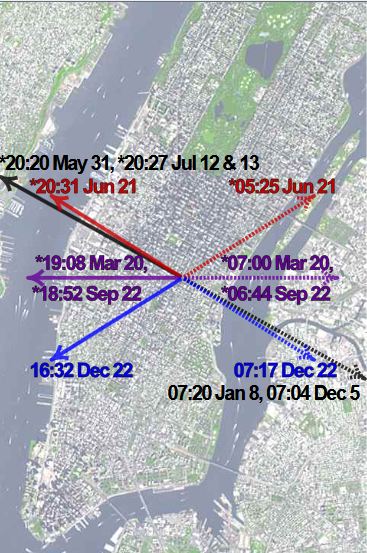
Unnoticed by many, the sunset point actually creeps day to day along the horizon:
northward until the first day of summer, then returning southward until the first day of
winter. In spite of what pop-culture tells you, the Sun rises due east and sets due west
only twice per year. On the equinoxes: the first day of spring and of autumn. Every
other day, the Sun rises and sets elsewhere on the horizon. Had Manhattan's grid been
perfectly aligned with the geographic north-south line, then the days of Manhattanhenge
would coincide with the equinoxes. But Manhattan's street grid is rotated 30 degrees
east from geographic north, shifting the days of alignment elsewhere into the calendar.
Note that any city crossed by a rectangular grid can identify days where the setting Sun
ball of the Sun on the horizon.
Unnoticed by many, the sunset point actually creeps day to day along the horizon:
northward until the first day of summer, then returning southward until the first day of
winter. In spite of what pop-culture tells you, the Sun rises due east and sets due west
only twice per year. On the equinoxes: the first day of spring and of autumn. Every
other day, the Sun rises and sets elsewhere on the horizon. Had Manhattan's grid been
perfectly aligned with the geographic north-south line, then the days of Manhattanhenge
would coincide with the equinoxes. But Manhattan's street grid is rotated 30 degrees
east from geographic north, shifting the days of alignment elsewhere into the calendar.
Note that any city crossed by a rectangular grid can identify days where the setting Sun
aligns with their streets. But a closer look at such cities
around the world shows them to be less than ideal for
this purpose. Beyond the grid you need a clear view to
the horizon, as Manhattan has across the Hudson River to
New Jersey. And tall buildings that line the streets create
a vertical channel to frame the setting Sun, creating a
striking photographic opportunity.
True, some municipalities have streets named for the
Sun, like Sunrise Highway on Long Island and the Sunset
Strip in Los Angeles. But these roads are not perfectly
straight. And the few times a year when the Sun aligns
with one of their stretches of road, all you get is stalled
traffic solar glare temporarily blinds drivers.
So Manhattanhenge may just be a unique urban
phenomenon in the world, if not the universe.
Note that several years ago, an article in the New York
Times identified this annual event as the “Manhattan
Solstice.” But of course, the word “solstice” translates
from the Latin solstitium, meaning “stopped sun,” in
around the world shows them to be less than ideal for
this purpose. Beyond the grid you need a clear view to
the horizon, as Manhattan has across the Hudson River to
New Jersey. And tall buildings that line the streets create
a vertical channel to frame the setting Sun, creating a
striking photographic opportunity.
True, some municipalities have streets named for the
Sun, like Sunrise Highway on Long Island and the Sunset
Strip in Los Angeles. But these roads are not perfectly
straight. And the few times a year when the Sun aligns
with one of their stretches of road, all you get is stalled
traffic solar glare temporarily blinds drivers.
So Manhattanhenge may just be a unique urban
phenomenon in the world, if not the universe.
Note that several years ago, an article in the New York
Times identified this annual event as the “Manhattan
Solstice.” But of course, the word “solstice” translates
from the Latin solstitium, meaning “stopped sun,” in
| Map showing positions of sunrise and sunset on the equinox and summer and winter solstices, compared to positions at Manhattanhenge. |
reference to the winter and summer solstices where the Sun's daily arc across the sky
reaches its extreme southerly and northerly limits. Manhattanhenge comes about
because the Sun's arc has not yet reached these limits, and is on route to them, as we
catch a brief glimpse of the setting Sun along the canyons of our narrow streets.
While we are on the subject, when viewed from all latitudes north of the Tropic of
Cancer (23.5 degrees north latitude), the Sun always rises at an angle up and to the
right, and sets and an angle down and to the right. That's how you can spot a faked
sunrise in a movie: it moves up and to the left. Filmmakers are not typically awake in
the morning hours to film an actual sunrise, so they film a sunset instead, and then
time-reverse it, thinking nobody will notice.
www.haydenplanetarium.org/resources/starstruck/manhattanhenge
reaches its extreme southerly and northerly limits. Manhattanhenge comes about
because the Sun's arc has not yet reached these limits, and is on route to them, as we
catch a brief glimpse of the setting Sun along the canyons of our narrow streets.
While we are on the subject, when viewed from all latitudes north of the Tropic of
Cancer (23.5 degrees north latitude), the Sun always rises at an angle up and to the
right, and sets and an angle down and to the right. That's how you can spot a faked
sunrise in a movie: it moves up and to the left. Filmmakers are not typically awake in
the morning hours to film an actual sunrise, so they film a sunset instead, and then
time-reverse it, thinking nobody will notice.
www.haydenplanetarium.org/resources/starstruck/manhattanhenge
| MIT Henge January 25, 2005 web.mit.edu/newsoffice/2005/iap-mithenge-0126.html |
| ********** |