3. Many reasons: The picture is one of the earliest, high quality,
photographic depictions of emerging urban culure in America. Most
clearly shown are very clear images of what steamboats looked like.
Wired mag. mentions how it shows free black citizens at work in Ohio
whereas those in Kentucky would more likely be slaves. In photographic
history this was one of a group of a group of very early and very best
daguerreotype plates giving a panorama of the Cinncinati landscape.
photographic depictions of emerging urban culure in America. Most
clearly shown are very clear images of what steamboats looked like.
Wired mag. mentions how it shows free black citizens at work in Ohio
whereas those in Kentucky would more likely be slaves. In photographic
history this was one of a group of a group of very early and very best
daguerreotype plates giving a panorama of the Cinncinati landscape.
| ZZZZZ |
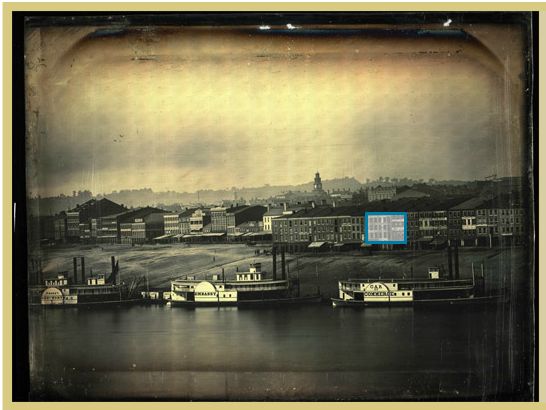
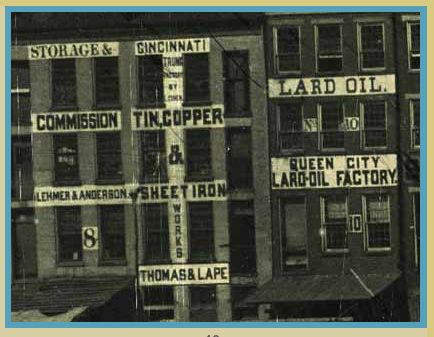
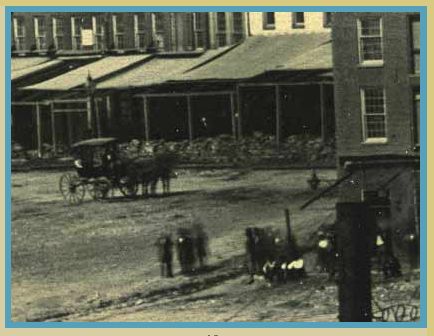
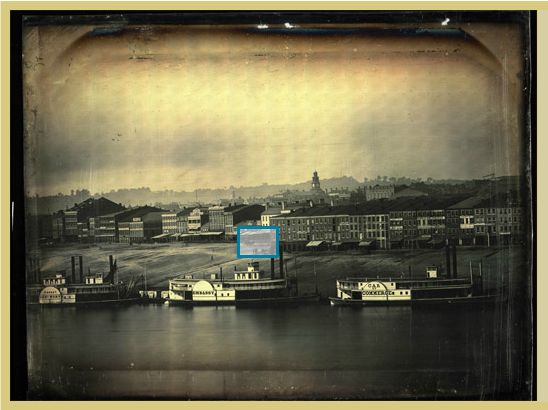
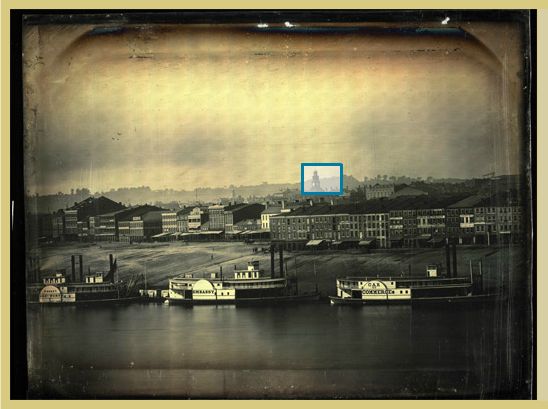
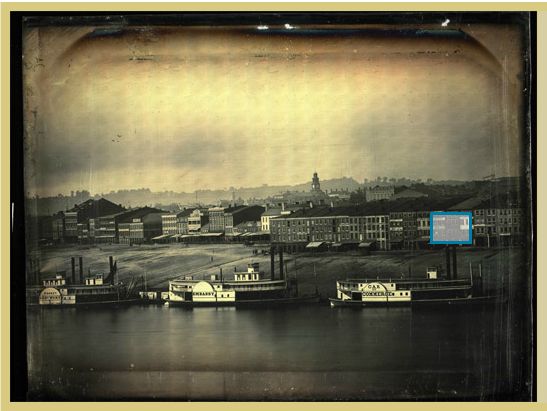
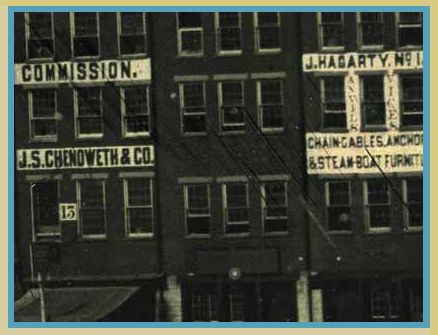
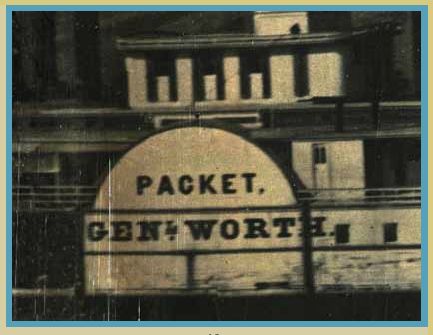
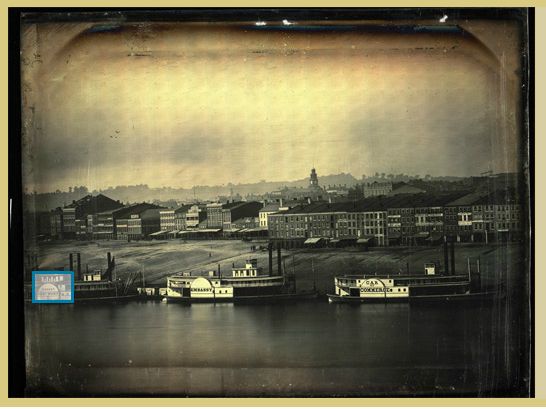
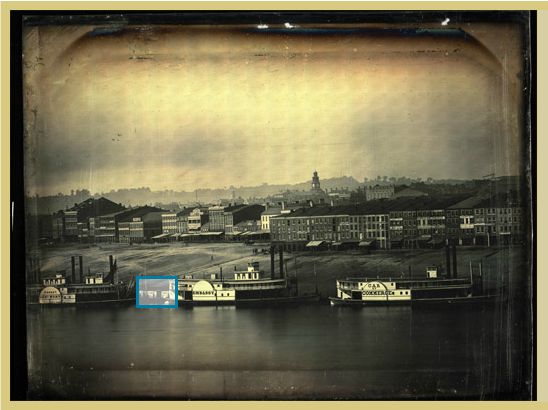
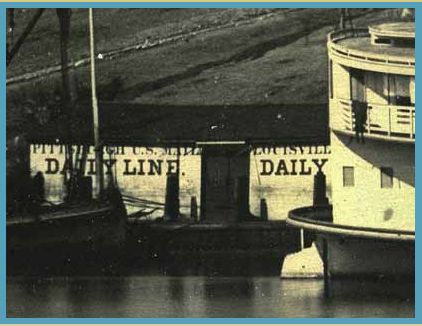
The 120° panoramic image of the Cincinnati riverfront, properly titled Daguerreotype View of Cincinnati. Taken from Newport, Ky, was reassembled from a later series of 8 × 10 film negatives. The original panorama consisted of eight full-plate (6.5 × 8.5") daguerreotypes and was taken in September 1848 by Porter and Fontayne (although most likely just by Porter). It shows a two mile stretch of the Cincinnati riverfront, from the Public Landing to the town of Fulton. Of the 60 or so boats pictured, 17 can be identified by name. They are (l→r) the Lancaster, the Wave, the Colorado, the Highland Mary No. 2, the Doctor Franklin No. 2, the Gen. Worth, the Embassy, the Car of Commerce, the Daily Line, the Brooklyn, the Orleans, the John Hancock, the Meteor, the Ohio Belle, the Palestine, the Cincinnatus, and the New England. Among its other details (from left to right) are the office of the composer Stephen Foster, a shipping clerk at the time, the twin- towered Christ Church, the Botanico Medical College, the home of Jacob Strader, president of the Little Miami Railroad, St. Philomena’s Church, and the Mt. Adams Observatory. It is the first complete image of the Cincinnati riverfront, then the sixth largest city and the largest inland port in the US. More importantly, it is the first known image of inland steamboats and of a railroad terminal. It is also one of the earliest known images of freed slaves. The Porter family loaned the panorama to the Public Library of Cincinnati and Hamilton County in the early 1900s and the plates, still in their original frame and matte were displayed in the old Main Library for years. In the 1940s the Library, under director Carl Vitz, bought the plates. Although the Library allowed them to be professionally photographed several times they were removed from general view - too fragile for public display. In 2007 the PLCHC sent the plates to the George Eastman House for restoration, where, after apparently some discussion of who was responsible if it went badly, the plates were disassembled, cleaned. then sealing in argon. The conservators created high-res digital scans using a 16× stereo microscope as a record and researchers at the University of Rochester then developed several novel image analysis techniques to digitally restore the image: To capture all of the detail present in the original image the Eastman conservators had to scan each plate at the equivalent of 144,000 MP: |
| XXXXX |
| XXXXX |
| How Mike Solved the Puzzle |
| XXXX |
1. What city is this? 2. In the modern city, what building would obstruct the photographer's view of this scene if he were standing at the same location today? 3. Why is this picture of such high historical interest? TinEye Alert: You can find this photograph using TinEye. However it is much more fun if you solve the puzzle on your own. |

 |  |  |  |
| If you have a picture you'd like us to feature a picture in a future quiz, please email it to us at CFitzp@aol.com. If we use it, you will receive a free analysis of your picture. You will also receive a free Forensic Genealogy CD or a 10% discount towards the purchase of the Forensic Genealogy book. |


 |  |  |  |
| ********** |

| If you enjoy our quizzes, don't forget to order our books! Click here. |

| Quiz #309 Results |
| Quiz #309 June 12, 2011 |

| Answers: 1. Cincinnati, OH 2. Paul Brown Stadium, for one |
| Idea for this quiz submitted by Quizmaster Emeritus Dr. Stan Read. |

| ********** |
| Congratulations to Our Winners! Shirley Yurkewich Marilyn Hamill Karen Petrus Sherry Marshall Winnifred Evans Tish Olshefski Arthur Hartwell Don Draper Mike Dalton Peter Norton Daniel E. Jolley Nicole Blank Diane Burkett Jim Kiser Donna Jolley & Stephen Jolley Marjorie Wilser |
| Comments from Our Readers |
I agree the pictures are incredible. I was having a hard time viewing the details on my
laptop, but will explore some of the other links to see if these are better.
Looking at the relatively steep rise from the water I immediately thought of Cincinnati
or Memphis, but there's nothing in Memphis other than the Pyramid that would block
that view today and the camera would be focused to the east so shadows would not
seem to be correct.
But for Cincinnati, the looking north orientation fit and I could easily envision the old
Riverfront Stadium, where I'd spent many a summer night watching Reds' baseball in
the 1970's, superimposed on the scene.
Something in my gut just immediately made me think Cincinnati riverfront, but I first
Googled "mahogany sawmill" and this picture was there confirming my first
impression. Diane Burkett
*****
My first search centered on the boat "Brooklyn but my search led to boat rentals
in Australia. Next I thought one business said Mulholland which led to San Francisco
and a leather business - not right. Then I decided it said Holbrook (funny these words
don't look anything alike) which led to a question "Did I mean..." and this time the
photos of Cinncinnati came up. Shirley Yurkewich
*****
Here are some pictures concerning this week's puzzle. The first one, from an 1838
map, shows the public landing. The second one is to the west of this, showing the
location of James Easton Bedgood's shoemaking establishment. My 3 gr grandfather.
The last is a modern view of that same area. Depressing, isn't it? Marilyn Hamill
*****
I didn't use TinEye, but a search for "Brooklyn Packet" got me there -- good thing for
me since my first guess was that it was somewhere along the Mississippi...! btw,
TinEye has been EXTREMELY useful for me when I try to look up knitting patterns
that I might be interested in making. Karen Petrus
*****
Extra - my great-grandfather, Gustav Tafel, arrived by packet in Cincinnati in Sep 1847
from Germany. So this is what he saw. He was later Mayor of Cincinnati.
Sherry Marshall
*****
I found it by searching Gaylor M (don't remember the rest of the name) and it led me
right to the Library Foundation page of Cincinnati & Hamilton County.
Tish Olshefski
*****
My original searches were for early steamboat/paddle boat photos and I was guessing
the date as around 1880. I was quite amazed that the year of this photo was 1848.
Don Draper
*****
It's not clear to me whether Yeatsmans Cove (supposedly the foreground) is just where
the park is today, or whether it covered a broader stretch of riverfront. Not certain, but
I think the park is off to the right of the picture. Can't quite nail down where the
camera was, can't devote more time to it. Good quiz! Peter Norton
*****
A thought occurred to me as I was reading Carl Vitz's paper that he was an early
version of Colleen Fitzpatrick because of the detective work he went through to
determine when and where the panorama plates were taken. Great quiz!
Daniel E. Jolley
*****
I got the city fairly quickly by Googling "Steam Engine & Repairing Shop".
I think it was fascinating how they figured out the exact day and time that the pictures
were taken (reminds me of that 'dead horse' photo that you posted about a while back
when you figured out the same thing). Too, the pictures are amazingly detailed - it's so
strange how much the city has changed since then. My first guess was San Francisco
but I was way off the mark. :)
My uncle lived in Cincinnati for many years; I bet he'd love to see these photos in
person but he's been in CT for some time now.
I also wonder about what happens afterwards whenever I see people in vintage photos;
wonder if they knew they were being preserved as a moment in history? Nicole Blank
*****
Nice one! I much prefer the old photos to the modern ones.
However, the image itself is of such limited resolution that I can't enlarge it enough to
read most of the building signs, a real minus for identification. Fortunately I was able to
google one of the largest signs successfully.
Hooray for old pix! Marjorie Wilser
N.B. It might be a question with the resolution of your screen. I assume you clicked
on the thumbnail of the quiz pic to get the full version. If you ever need it, I can
email you a copy of the photo.
I have a few ideas on where to find old photos for the quizzes that are TinEye
negative. It's getting harder and harder as the image search engines are getting
better and better. - Q. Gen.
*****
I think the featured photograph was taken from the Kentucky side of Ohio River and
possibly from the top deck of a steamboat. The photographer would have been at
sufficient distance from the Ohio shore to get the wide view and the angle of
photgraph to water appears to be almost straight on and close to the water. Hence a
modern day view of some of the original downtown area would be blocked by the
buildings close to the waterfront. It is likely that some of area along the river waterfront
may have been filled in by landfill.
On one of those map sites (slow to load or browse) I noticed a floating barge/ Hooters
restaurant on the Kentucky side of the river; that locale could have been the vantage
point for the photographer. A steam boat in that vicinity back in the day could have
been a floating brothel and gambling venue. Mike Dalton
laptop, but will explore some of the other links to see if these are better.
Looking at the relatively steep rise from the water I immediately thought of Cincinnati
or Memphis, but there's nothing in Memphis other than the Pyramid that would block
that view today and the camera would be focused to the east so shadows would not
seem to be correct.
But for Cincinnati, the looking north orientation fit and I could easily envision the old
Riverfront Stadium, where I'd spent many a summer night watching Reds' baseball in
the 1970's, superimposed on the scene.
Something in my gut just immediately made me think Cincinnati riverfront, but I first
Googled "mahogany sawmill" and this picture was there confirming my first
impression. Diane Burkett
*****
My first search centered on the boat "Brooklyn but my search led to boat rentals
in Australia. Next I thought one business said Mulholland which led to San Francisco
and a leather business - not right. Then I decided it said Holbrook (funny these words
don't look anything alike) which led to a question "Did I mean..." and this time the
photos of Cinncinnati came up. Shirley Yurkewich
*****
Here are some pictures concerning this week's puzzle. The first one, from an 1838
map, shows the public landing. The second one is to the west of this, showing the
location of James Easton Bedgood's shoemaking establishment. My 3 gr grandfather.
The last is a modern view of that same area. Depressing, isn't it? Marilyn Hamill
*****
I didn't use TinEye, but a search for "Brooklyn Packet" got me there -- good thing for
me since my first guess was that it was somewhere along the Mississippi...! btw,
TinEye has been EXTREMELY useful for me when I try to look up knitting patterns
that I might be interested in making. Karen Petrus
*****
Extra - my great-grandfather, Gustav Tafel, arrived by packet in Cincinnati in Sep 1847
from Germany. So this is what he saw. He was later Mayor of Cincinnati.
Sherry Marshall
*****
I found it by searching Gaylor M (don't remember the rest of the name) and it led me
right to the Library Foundation page of Cincinnati & Hamilton County.
Tish Olshefski
*****
My original searches were for early steamboat/paddle boat photos and I was guessing
the date as around 1880. I was quite amazed that the year of this photo was 1848.
Don Draper
*****
It's not clear to me whether Yeatsmans Cove (supposedly the foreground) is just where
the park is today, or whether it covered a broader stretch of riverfront. Not certain, but
I think the park is off to the right of the picture. Can't quite nail down where the
camera was, can't devote more time to it. Good quiz! Peter Norton
*****
A thought occurred to me as I was reading Carl Vitz's paper that he was an early
version of Colleen Fitzpatrick because of the detective work he went through to
determine when and where the panorama plates were taken. Great quiz!
Daniel E. Jolley
*****
I got the city fairly quickly by Googling "Steam Engine & Repairing Shop".
I think it was fascinating how they figured out the exact day and time that the pictures
were taken (reminds me of that 'dead horse' photo that you posted about a while back
when you figured out the same thing). Too, the pictures are amazingly detailed - it's so
strange how much the city has changed since then. My first guess was San Francisco
but I was way off the mark. :)
My uncle lived in Cincinnati for many years; I bet he'd love to see these photos in
person but he's been in CT for some time now.
I also wonder about what happens afterwards whenever I see people in vintage photos;
wonder if they knew they were being preserved as a moment in history? Nicole Blank
*****
Nice one! I much prefer the old photos to the modern ones.
However, the image itself is of such limited resolution that I can't enlarge it enough to
read most of the building signs, a real minus for identification. Fortunately I was able to
google one of the largest signs successfully.
Hooray for old pix! Marjorie Wilser
N.B. It might be a question with the resolution of your screen. I assume you clicked
on the thumbnail of the quiz pic to get the full version. If you ever need it, I can
email you a copy of the photo.
I have a few ideas on where to find old photos for the quizzes that are TinEye
negative. It's getting harder and harder as the image search engines are getting
better and better. - Q. Gen.
*****
I think the featured photograph was taken from the Kentucky side of Ohio River and
possibly from the top deck of a steamboat. The photographer would have been at
sufficient distance from the Ohio shore to get the wide view and the angle of
photgraph to water appears to be almost straight on and close to the water. Hence a
modern day view of some of the original downtown area would be blocked by the
buildings close to the waterfront. It is likely that some of area along the river waterfront
may have been filled in by landfill.
On one of those map sites (slow to load or browse) I noticed a floating barge/ Hooters
restaurant on the Kentucky side of the river; that locale could have been the vantage
point for the photographer. A steam boat in that vicinity back in the day could have
been a floating brothel and gambling venue. Mike Dalton
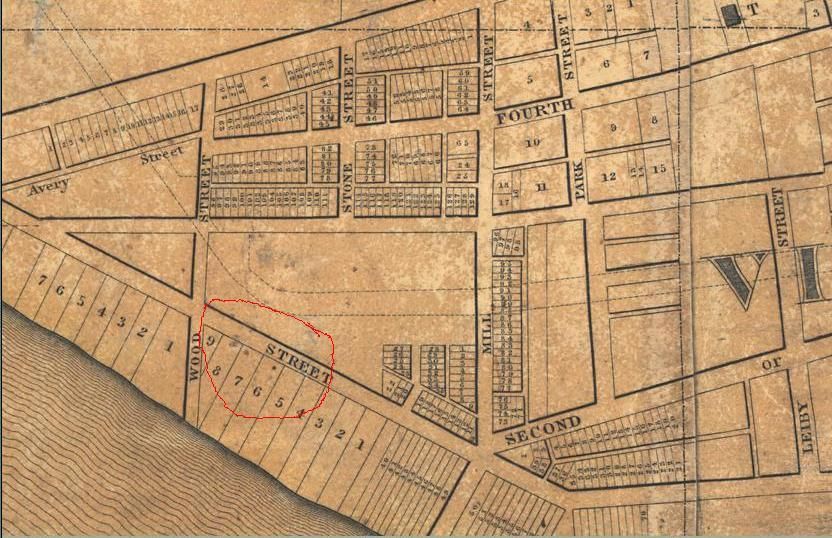
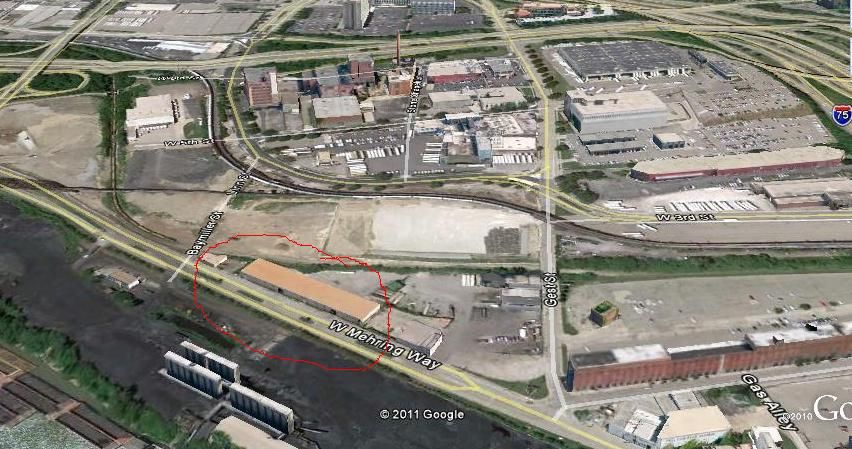
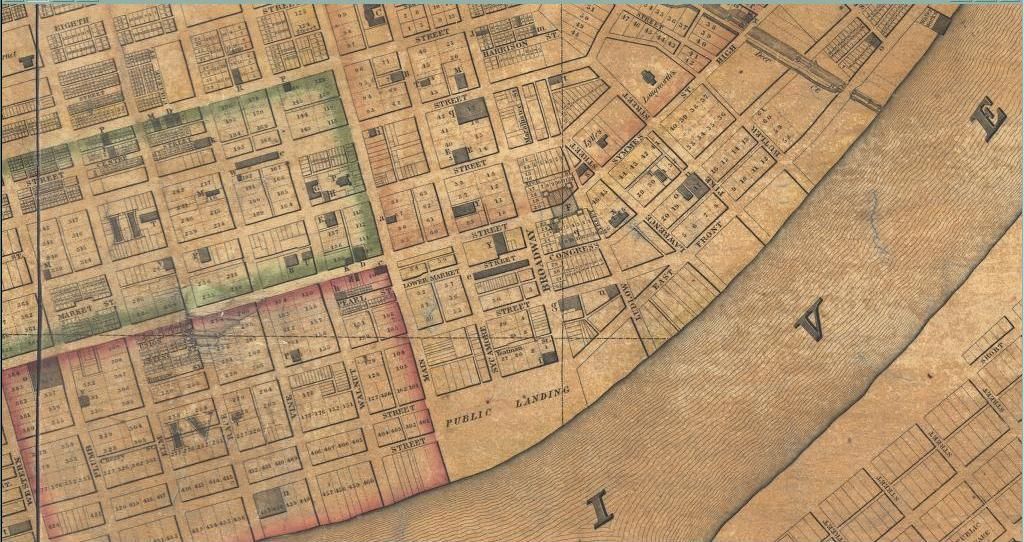
| Here are some pictures concerning this week's puzzle. The first one, from an 1838 map, shows the public landing. The second one is to the west of this, showing the location of James Easton Bedgood's shoemaking establishment. My 3 gr grandfather. The last is a modern view of that same area. Depressing, isn't it? Marilyn Hamill |
| I binged instead of googling. Binged brooklyn sidewheeler and went to paddle steamer wikipedia and scrolled down to University of Wisconsin - La Crosse Historic Steamboat Photographs. On this website: keyworded brooklyn to search the collection. Number two result was contest photo Brooklyn Packet 1847 - 1853. According to website plate number three: It is the oldest surviving (Sept. 24, 1848)daguerreotype photograph of its kind of an American city: Cincinnati, Ohio. The photograph was taken of area which is today known as Sawyer's Point Park which was known as Yeatman's Cove on the Ohio River. View of the downtown from this vantage point is blocked by the Sawyer Point Building on 720 E. Pete Rose Way Cincinnati, OH 45202 Mike Dalton |
| ********** |
| ********** |
| ********** |
| ********** |
| 1948 Daguerreotypes Bring Middle America's Past Back to Life www.wired.com/magazine/2010/07/ff_daguerrotype_panorama/ |
In 1848, Charles Fontayne and William
Porter produced one of the most famous
photographs in the history of the medium
— a panorama spanning some 2 miles of
Cincinnati waterfront. They did it with
eight 6.5- by 8.5-inch daguerreotype
plates, a then-new technology that in
skilled hands displays mind-blowing
resolution.
Fontayne and Porter were definitely
Porter produced one of the most famous
photographs in the history of the medium
— a panorama spanning some 2 miles of
Cincinnati waterfront. They did it with
eight 6.5- by 8.5-inch daguerreotype
plates, a then-new technology that in
skilled hands displays mind-blowing
resolution.
Fontayne and Porter were definitely
skilled, but no one knew just how amazing their images were until three years ago,
when conservators at George Eastman House in Rochester, New York, began
restoration work on the deteriorating plates. Magnifying glasses didn’t exhaust their
detail; neither did an ultrasharp macro lens. Finally, the conservators deployed a stereo
microscope. What they saw astonished them: The details — down to window curtains
and wheel spokes — remained crisp even at 30X magnification. The panorama could be
blown up to 170 by 20 feet without losing clarity; a digicam would have to record
140,000 megapixels per shot to match that. Under the microscope, the plates revealed a
vanished world, the earliest known record of an urbanizing America.
But the conservators also found trouble. At that magnification, dust motes smaller than
red blood cells became image-obscuring blobs. Corrosion from a few molecules of
water obscured a face peeking out a window. Even polishing marks from the original
preparation of the plates became a mass of dark streaks.
Trying to restore the plates themselves might have damaged the images, and the
conservators didn’t want to risk ruining the finest American daguerreotypes in
existence. So they put them in a case filled with inert argon gas to arrest the
deterioration and went digital, turning to computer vision specialists at the University of
Rochester. To them, the images were just noisy data, which they knew how to scrub.
Now Fontayne and Porter’s daguerreotypes are stabilized and its details restored —
21st-century technology rescued an image from the 19th. The Cincinnati Public Library
plans to make a zoomable version available online in the next year.
when conservators at George Eastman House in Rochester, New York, began
restoration work on the deteriorating plates. Magnifying glasses didn’t exhaust their
detail; neither did an ultrasharp macro lens. Finally, the conservators deployed a stereo
microscope. What they saw astonished them: The details — down to window curtains
and wheel spokes — remained crisp even at 30X magnification. The panorama could be
blown up to 170 by 20 feet without losing clarity; a digicam would have to record
140,000 megapixels per shot to match that. Under the microscope, the plates revealed a
vanished world, the earliest known record of an urbanizing America.
But the conservators also found trouble. At that magnification, dust motes smaller than
red blood cells became image-obscuring blobs. Corrosion from a few molecules of
water obscured a face peeking out a window. Even polishing marks from the original
preparation of the plates became a mass of dark streaks.
Trying to restore the plates themselves might have damaged the images, and the
conservators didn’t want to risk ruining the finest American daguerreotypes in
existence. So they put them in a case filled with inert argon gas to arrest the
deterioration and went digital, turning to computer vision specialists at the University of
Rochester. To them, the images were just noisy data, which they knew how to scrub.
Now Fontayne and Porter’s daguerreotypes are stabilized and its details restored —
21st-century technology rescued an image from the 19th. The Cincinnati Public Library
plans to make a zoomable version available online in the next year.


| ********** |
| ********** |
| ********** |
| ********** |
| ********** |
| ********** |
| ********** |
| ********** |
| Daguerreotypes |
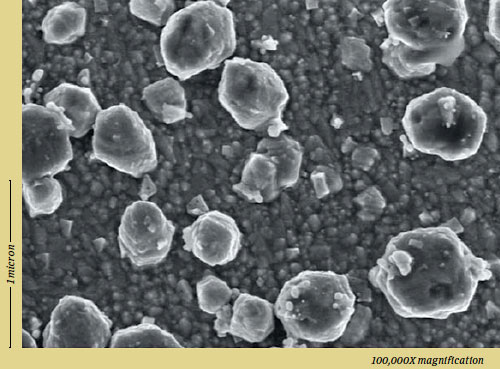
Daguerreotypes start as copper plates
with a thin, mirror-polished coating of
silver that’s been exposed to halogen gas
(iodine or bromine) to make silver halide.
Light hitting this compound knocks an
electron loose, which attaches to a silver
ion, forming a neutral silver atom. The
result is that all the places on the plate
exposed to light are clusters of pure
silver, and the rest is silver halide.
with a thin, mirror-polished coating of
silver that’s been exposed to halogen gas
(iodine or bromine) to make silver halide.
Light hitting this compound knocks an
electron loose, which attaches to a silver
ion, forming a neutral silver atom. The
result is that all the places on the plate
exposed to light are clusters of pure
silver, and the rest is silver halide.
Next, the exposed plate is held over a warm pool of mercury (don’t breathe!). The
mercury combines with the silver atoms, creating the equivalent of a digital image’s
pixel: a tiny “grain” between 150 and 800 nanometers in diameter that scatters light,
making areas of the surface that were exposed to more light appear brighter. Finally,
the plate is soaked in sodium thiosulfate, which washes away the unexposed silver
halide, leaving dark regions — the image’s blacks and grays.
The result is a one-of-a-kind direct positive — as opposed to the negative produced by
modern chemical photography — with a haunting, soft, almost three-dimensional
quality. Look at a daguerreotype from the wrong angle and you’ll see only a reflection:
The image is trapped inside the mirrored surface.
mercury combines with the silver atoms, creating the equivalent of a digital image’s
pixel: a tiny “grain” between 150 and 800 nanometers in diameter that scatters light,
making areas of the surface that were exposed to more light appear brighter. Finally,
the plate is soaked in sodium thiosulfate, which washes away the unexposed silver
halide, leaving dark regions — the image’s blacks and grays.
The result is a one-of-a-kind direct positive — as opposed to the negative produced by
modern chemical photography — with a haunting, soft, almost three-dimensional
quality. Look at a daguerreotype from the wrong angle and you’ll see only a reflection:
The image is trapped inside the mirrored surface.
| Silver particles compose the image. |
| ********** |
| Repairing the Damage |
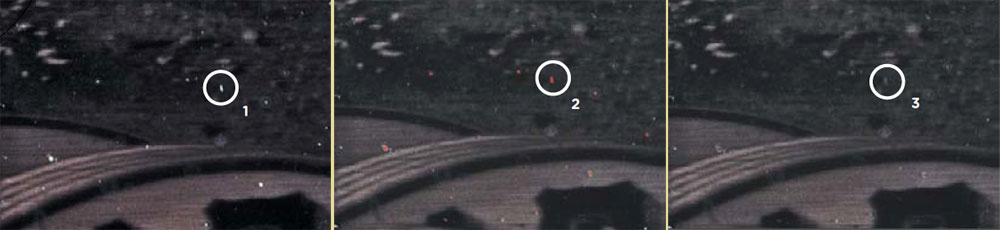
The surface of a daguerreotype is so finely textured that dust can adhere to it and
become impossible to remove without damaging the image. And even the tiniest
particles, which at 30X to 100X magnification show up as bright white spots, can
sometimes cause the surrounding areas to tarnish.
That’s where the computer vision specialists came in. A team led by Ross Messing,
Paul Ardis, and Xiaoqing Tang found that in the Cincinnati daguerreotype, about one
pixel in 500 was obscured by dust. And with the series totaling nearly 9 billion pixels,
identifying and repairing all the problem areas by hand was obviously out of the
question.
Instead, they marked all the dust specks in one small patch and then used machine-
learning techniques to train a computer to detect others automatically. The computers
searched for other regions in the image similar to the surroundings of the missing pixels
and then performed simple copy-and-paste operations to fill in the holes.
become impossible to remove without damaging the image. And even the tiniest
particles, which at 30X to 100X magnification show up as bright white spots, can
sometimes cause the surrounding areas to tarnish.
That’s where the computer vision specialists came in. A team led by Ross Messing,
Paul Ardis, and Xiaoqing Tang found that in the Cincinnati daguerreotype, about one
pixel in 500 was obscured by dust. And with the series totaling nearly 9 billion pixels,
identifying and repairing all the problem areas by hand was obviously out of the
question.
Instead, they marked all the dust specks in one small patch and then used machine-
learning techniques to train a computer to detect others automatically. The computers
searched for other regions in the image similar to the surroundings of the missing pixels
and then performed simple copy-and-paste operations to fill in the holes.
| Amazing Details Revealed |
As a historical record, the Fontayne-Porter
daguerreotype is unparalleled. It contains the
first photographic images of steamboats, a
railroad station, and one of the country’s
earliest astronomical observatories. It may also
be one of the earliest pictures to show free
blacks, who were building a community in
Cincinnati, just across the line from Kentucky
slave country. A ditch running from the corner
of a building down to the river — eroded by
effluent from an outhouse — presages the
cholera epidemic that hit the city the following
year.
Even artifacts of daguerreotype preparation
daguerreotype is unparalleled. It contains the
first photographic images of steamboats, a
railroad station, and one of the country’s
earliest astronomical observatories. It may also
be one of the earliest pictures to show free
blacks, who were building a community in
Cincinnati, just across the line from Kentucky
slave country. A ditch running from the corner
of a building down to the river — eroded by
effluent from an outhouse — presages the
cholera epidemic that hit the city the following
year.
Even artifacts of daguerreotype preparation
yielded new knowledge. The silver surface of an unexposed daguerreotype is tricky to
polish to a mirror finish — even the finest cloths or brushes leave tracks that are clearly
visible at high magnification. But the art historians didn’t want those marks removed;
they wanted to be able to enhance them. It turns out that the streaks act as signatures.
Each daguerreotypist had a distinct method of polishing — sweeping tiny suspended
brushes across the plate or hand-polishing (as Fontayne and Porter did) with carefully
chosen cloths. The resulting patterns vary, but in a small region they all look like very
fine, roughly parallel dark lines. So Messing, Ardis, Tang, and their collaborators
designed an algorithm to detect these unique patterns and bleach out the rest of the
image.
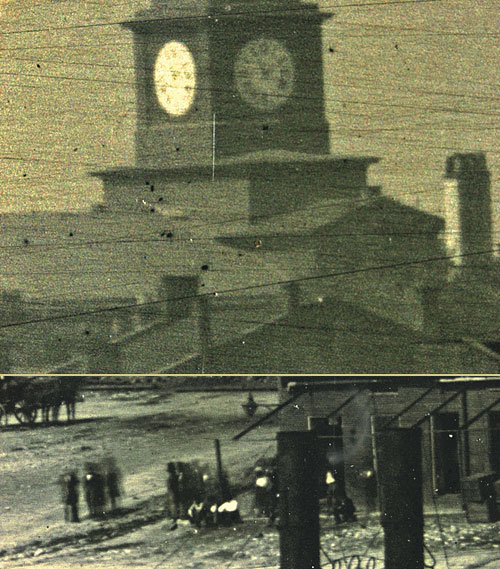
After all the restoration, historians now know the exact hour and minute when the
image was captured. Back in 1947, steamboat enthusiast Frederick Way and Cincinnati
Public Library director Carl Vitz undertook an extensive historical investigation of the
daguerreotype, using steamboat records to identify the only date on which all of those
vessels were in Cincinnati: September 24, 1848. And by analyzing the angles of
shadows, they figured the shots must have been taken just before 2 pm. A clock tower
showed the time, but however much the researchers strained to read the 1-millimeter-
diameter clock face with a magnifying glass, they couldn’t make it out.
After the images emerged from Eastman House’s microscope scanner, the team
cheered when they saw the clock tower: It read 1:55.
polish to a mirror finish — even the finest cloths or brushes leave tracks that are clearly
visible at high magnification. But the art historians didn’t want those marks removed;
they wanted to be able to enhance them. It turns out that the streaks act as signatures.
Each daguerreotypist had a distinct method of polishing — sweeping tiny suspended
brushes across the plate or hand-polishing (as Fontayne and Porter did) with carefully
chosen cloths. The resulting patterns vary, but in a small region they all look like very
fine, roughly parallel dark lines. So Messing, Ardis, Tang, and their collaborators
designed an algorithm to detect these unique patterns and bleach out the rest of the
image.
After all the restoration, historians now know the exact hour and minute when the
image was captured. Back in 1947, steamboat enthusiast Frederick Way and Cincinnati
Public Library director Carl Vitz undertook an extensive historical investigation of the
daguerreotype, using steamboat records to identify the only date on which all of those
vessels were in Cincinnati: September 24, 1848. And by analyzing the angles of
shadows, they figured the shots must have been taken just before 2 pm. A clock tower
showed the time, but however much the researchers strained to read the 1-millimeter-
diameter clock face with a magnifying glass, they couldn’t make it out.
After the images emerged from Eastman House’s microscope scanner, the team
cheered when they saw the clock tower: It read 1:55.
| A Cincinnati Daguerreotype Paper read by Carl Vitz at the Literary Club October 20, 1947 Click here. |
Based on the boats and buildings, the low water level, the foliage, the shadows, as well as the apparent inactivity on the riverfront, and corroborated by historical boat manifests and construction records, water level data and local weather reports, Carl Vitz and Capt. Frederick Way suggest that the panorama was taken in the early afternoon of Sunday, 24 Sept 1848 from York Street in Newport. For full report, click here. |
| A Cincinnati Daguerreotype Paper read by Carl Vitz at the Literary Club October 20, 1947 |
| Riverfront panorama composed from Porter and Fontayne Daguerreotypes. |
| About the Panorama /www.codex99.com/photography/5.html |
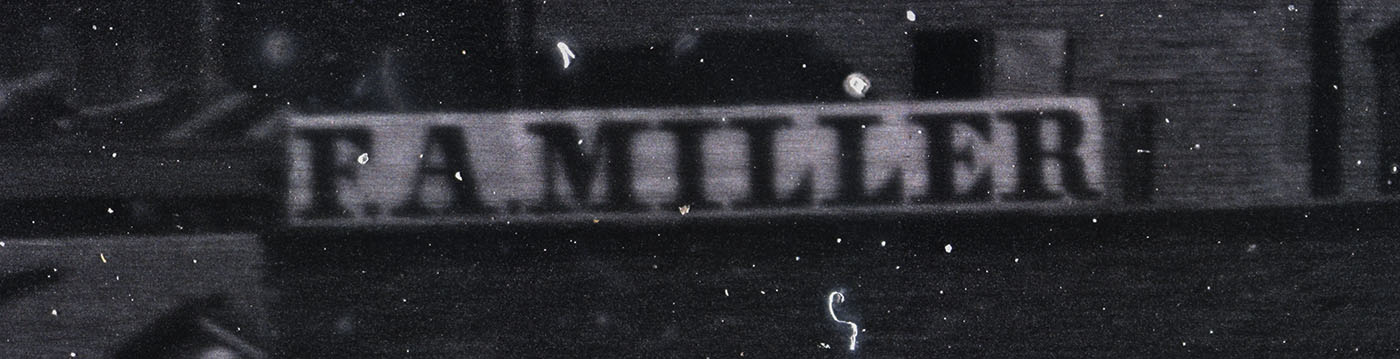
| Nearly terminal detail from Plate 4. |
| XXXXX |