| XXX |
| XXX |
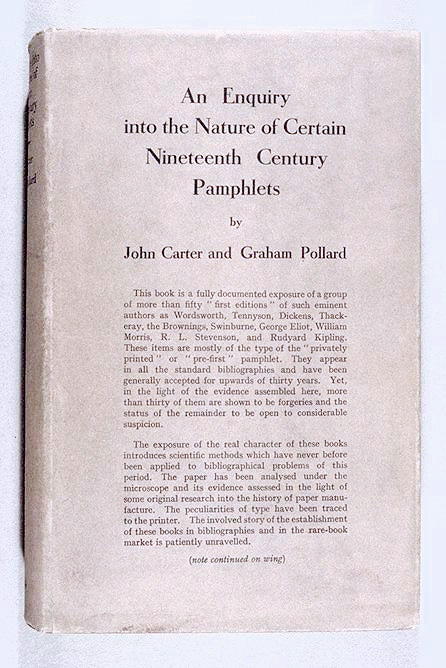
| Since the publication of the original Carter-Pollard Enquiry, more than one hundred of the Wise-Form forgeries and piracies have been identified. Carter and Pollard identified two basic categories for the forgeries which Wise and Forman produced: counterfeit or "binary editions," which were simply fabrications of earlier editions; and "creative" forgeries which purported to be original imprints which preceded previously-known editions of an author's work. As Carter and Pollard pointed out in the Enquiry, this sort of creative forgery was previously unknown. Wise and Forman, both together and sometimes independently, would take a piece by a well-known author which had appeared previously in a periodical or other collection, and issue it in a pamphlet printing with an imprint date which preceded any known separate printing. Since there were no originals against which these creative forgeries could be compared--the usual means of detecting a forgery--Carter and Pollard developed new techniques to identify these forgeries. Carter and Pollard compared the texts with later printings and |
| XXXXX |
| XXXXX |
College of Arts & Sciences to work in the Special Collections Department of the
University of Delaware Library. The Frank W. Tober Collection fund provides support
for the ongoing acquisition and preservation of materials in the subject areas in which
he collected.
Frank W. Tober was born in Detroit, Michigan, in 1919. As a youth, he was an avid
reader who enjoyed history and literature, but he was particularly interested in the
sciences. Following his graduation from high school in 1937, he enrolled at Michigan
Technological University where he earned his bachelor's degree in chemistry in 1941.
He subsequently received a master's degree in chemical engineering from Virginia
Polytechnic Institute in 1941 and a doctorate in physical chemistry from Yale University
in 1948. Frank went on to have a long, successful career as a chemist with the Du Pont
Company; in fact, it was Du Pont which brought him to Delaware. Along the way he
also had the opportunity to work for the Tennessee Valley Authority and during World
War II was recruited to work on the Manhattan Project at its Oak Ridge facility near
Knoxville, Tennessee. Frank's scientific training influenced his approach to book
collecting and extended even to his reading habits. He was an extremely organized
University of Delaware Library. The Frank W. Tober Collection fund provides support
for the ongoing acquisition and preservation of materials in the subject areas in which
he collected.
Frank W. Tober was born in Detroit, Michigan, in 1919. As a youth, he was an avid
reader who enjoyed history and literature, but he was particularly interested in the
sciences. Following his graduation from high school in 1937, he enrolled at Michigan
Technological University where he earned his bachelor's degree in chemistry in 1941.
He subsequently received a master's degree in chemical engineering from Virginia
Polytechnic Institute in 1941 and a doctorate in physical chemistry from Yale University
in 1948. Frank went on to have a long, successful career as a chemist with the Du Pont
Company; in fact, it was Du Pont which brought him to Delaware. Along the way he
also had the opportunity to work for the Tennessee Valley Authority and during World
War II was recruited to work on the Manhattan Project at its Oak Ridge facility near
Knoxville, Tennessee. Frank's scientific training influenced his approach to book
collecting and extended even to his reading habits. He was an extremely organized
Carter & Pollard began their investigation by testing the authenticity of the 1847
Reading edition of Elizabeth Barrett's "Poems". By means of a study of the typography
and the chemical composition of the paper, they ascertained it to be a fraud.
Wise's forgeries were unusual. What he did was to take an essay or a long poem from a
genuine first edition & print it as a searate, pre-dated pamphlet, which then became a
"first". Since 19th century authors often did print such advance pamphlets for their
friends, Wise's fakes were not implausible.
The raison d'etre of his fabrications was the fact that beginning in the seventies, book
collectors began to be interested in first editions of modern authors. In his sixty-odd
fabrications and in the some 250 genuine firsts that he ran up from whatever scraps of
unpublished material by well-known authors he could lay hands on, Wise exploited the
Reading edition of Elizabeth Barrett's "Poems". By means of a study of the typography
and the chemical composition of the paper, they ascertained it to be a fraud.
Wise's forgeries were unusual. What he did was to take an essay or a long poem from a
genuine first edition & print it as a searate, pre-dated pamphlet, which then became a
"first". Since 19th century authors often did print such advance pamphlets for their
friends, Wise's fakes were not implausible.
The raison d'etre of his fabrications was the fact that beginning in the seventies, book
collectors began to be interested in first editions of modern authors. In his sixty-odd
fabrications and in the some 250 genuine firsts that he ran up from whatever scraps of
unpublished material by well-known authors he could lay hands on, Wise exploited the
forgeries have also served as the collecting focus of hundreds of bibliophiles, beginning,
of course, with those collectors of the late nineteenth and early twentieth centuries who
unwittingly assembled the first major collections of the pamphlets Wise and Forman
Wise began collecting books as a schoolboy, spending his pocket money at the barrows
in Farringdon Street. He was a keen collector of first editions in original condition. His
interests were Poetry followed by drama and his collection dating back to Elizabethan
publications was an exhaustive representation.
His collection was funded by selling duplicates and acting as an agent for wealthy
collectors. Wise was given an honorary M.A. degree by the University of Oxford and
elected an honorary Fellow of Worcester College due to his services to bibliographical
science. He become a member of the Consultative Committee of the Friends of the
of course, with those collectors of the late nineteenth and early twentieth centuries who
unwittingly assembled the first major collections of the pamphlets Wise and Forman
Wise began collecting books as a schoolboy, spending his pocket money at the barrows
in Farringdon Street. He was a keen collector of first editions in original condition. His
interests were Poetry followed by drama and his collection dating back to Elizabethan
publications was an exhaustive representation.
His collection was funded by selling duplicates and acting as an agent for wealthy
collectors. Wise was given an honorary M.A. degree by the University of Oxford and
elected an honorary Fellow of Worcester College due to his services to bibliographical
science. He become a member of the Consultative Committee of the Friends of the
The most heavily researched and thoroughly
documented case of literary forgery in history
centers around the series of pamphlets forged by
Thomas James Wise and his collaborator Harry
Buxton Forman. The Wise forgeries have been the
focus of numerous books, countless articles and
papers, entire symposia, and dozens of exhibitions.
Since the publication of John Carter's and Graham
Pollard's An Enquiry into the Nature of Certain
Nineteenth Century Pamphlets (1934), the Wise
forgeries and the persons and events surrounding
them have been subjected to continuous analysis,
discussion, and debate which should continue
unabated well into the next century. The Wise
documented case of literary forgery in history
centers around the series of pamphlets forged by
Thomas James Wise and his collaborator Harry
Buxton Forman. The Wise forgeries have been the
focus of numerous books, countless articles and
papers, entire symposia, and dozens of exhibitions.
Since the publication of John Carter's and Graham
Pollard's An Enquiry into the Nature of Certain
Nineteenth Century Pamphlets (1934), the Wise
forgeries and the persons and events surrounding
them have been subjected to continuous analysis,
discussion, and debate which should continue
unabated well into the next century. The Wise

 |  |  |  |
| If you have a picture you'd like us to feature a picture in a future quiz, please email it to us at CFitzp@aol.com. If we use it, you will receive a free analysis of your picture. You will also receive a free Forensic Genealogy CD or a 10% discount towards the purchase of the Forensic Genealogy book. |


 |  |  |  |
| The Forgeries www.lib.udel.edu/ud/spec/exhibits/forgery/wise.htm |
| ********** |

| If you enjoy our quizzes, don't forget to order our books! Click here. |

| Quiz #299 Results |
| Quiz #299 April 2, 2011 |

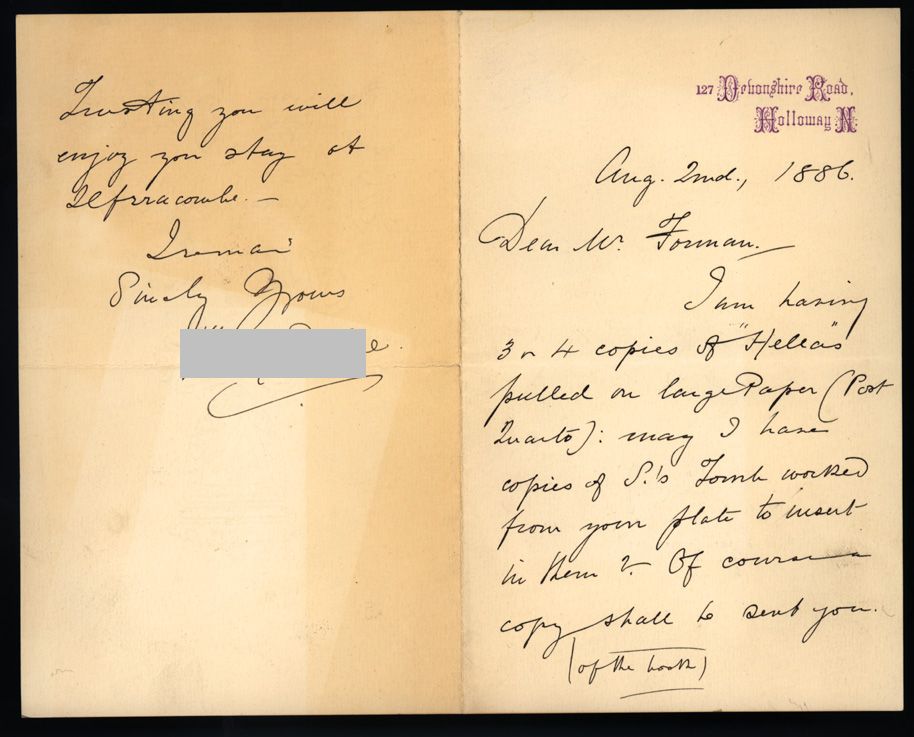
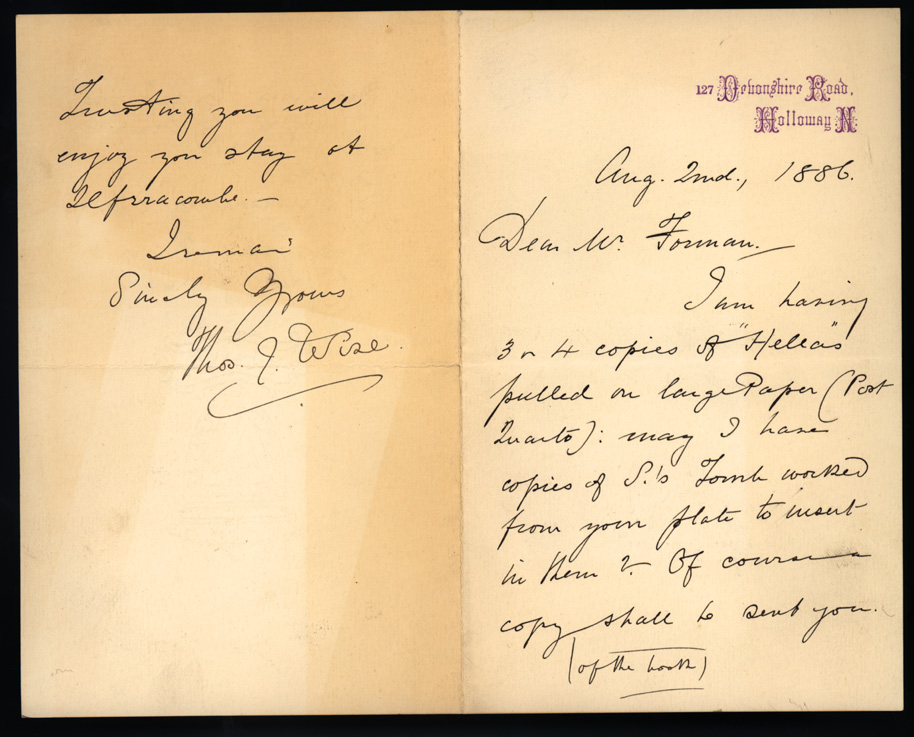
1. Thomas J. Wise 2. The most prolific literary forger 3. University of Delaware |
1. Who wrote the note? 2. What is his claim to fame? 2. Where can you find the largest collection of his works? |
| ********** |
| Suggested by Herschel Browne. |
| Comments from Our Readers |
I’m not sure whether Joyce Veness will have a chance to do this quiz since her and my
Uncle Bob are returning to Illinois from Florida this week, but you might be interested
to know that their daughter April Veness is a Professor of Geography at the University
of Delaware. Daniel E. Jolley
*****
I found the clues simply by Googling the address and the date - from there the story
unfolded very quickly. Brett Payne
*****
I admit to not knowing a thing about these two, despite several years in the
retain/vintage book business. My first guess was Oscar Wilde, given the dates and the
"e" evident in the picture--and Wilde wrote a poem called "Hellas", but moving to
Shelley's Wilde and adding Forman led me directly to the culprits. Pretty cool.
Joe Ruffner
*****
Great quiz! Ed Vielmetti
*****
I saw from the picture that it was obviously a signed book and noticed he address
stamped in the right hand corner of the picture: 127 Devonshire Rd., Holloway N. and
noted the date 1886. I Googled the address and got a hit on Google books-The 1887
edition of "The Wandering Jew" by Percy Bysshe Shelley, and saw that Wise at that
address was actaully a member of the 402 member London Shelley Society. The
salutation inside the book was to a Mr. Forman. From here the fun began. I also
learned that so was H. Buxton Forman, living at 46 Marlborough Hill, in St. John's
Wood, N.W. Amazing! Robert W. Steinmann Jr.
*****
I thought they were passing the works off as their own...Nwadays with the internet
that would be much harder to get away wtih, but I imagine it did take a long time back
then to realize what was going on.
I think sometimes whatever makes money is what's gold - whether it's original or fake.
Reality TV haws a way of making celebrities out of "regular" people; whatever is
entertaining beings in the $ I guess it's real if we want it to be?? Nicole Blank
*****
It does make one wonder what is authentic and what is fake in the art world and, of
course, it begs the question as to does it really matter if it is real or not. Especially,
when we see "so-called" forensic art experts like this guy in Canada, Peter Paul Biro,
who, during the past several years, has pioneered a radical new approach to
authenticating pictures. He does not merely try to detect the artist's invisible hand; he
scours a painting for the artist's fingerprints, inpressed in the paint or on the canvas.
Treating each painting as a crime scene, in which asn artist has left behind traces of
evidence, he has tried to render objective what has historically been subjective. (Yesh,
right!) To me this is the perfect set up for huge money art fraud.
Interestingly enough, this guy is supposed to be the only one of his type in the owrld -
how convenient is that? He is declaring possible fakes as works of the masters, such
as Da Vinci and Pollack. You might be in the wrong business. LOL :-)
Personally, thruth is truth to me, but I am not in the majority, it would seem.
Cynthia Costigan
*****
How do some paintings/artists get such acclaim and get to be worth so outrageiously
much - when the vast majority of people think they are junk? Debbie Johnson
*****
Ah, what is real? Reminds me of a quote that says in effect that reality is what one
perceives it to be. Don't know if I agree with that, but it's an interesting thought.
Teri Walton
*****
I have a sister-in-law whose husband had bought her a 3-carat diamond ring -
absolutely gorgeous!!!! But she was always afraid to wear it for fear of being lost or
stolen, so she had a copy made with lesser quality materials. However, since everyone
knew she had the ring, no one ever realized that she was always wearing the cpy!! The
genuine article stayed locked in their safety deposit box at the bank!! The whole
scenario was very puzzling to me - ha, ha!! Elaine C. Hebert
*****
Yes, it does make you wonder [what is real and what is not]. I wont' be buying any art
though. My wife is an artist so our house is full of stuff. I also have lots of work by
my uncle that is real unless he is a forger. LOL. He is somewhat well known. His
website is http://barforbes.com, is you want to see some of his work. Gary Sterne
*****
My mother-in-law went to a talk at the Detroit Institute of the Arts on some Sumerian
antiquities, or perhaps early 20c imitations. As long as the provenance is interesting
enough, the work of art might be interesting enough to exhibit at a museum.
See http://www.ida.org/calendar/lecture.aspex?id=2614&iid=
Gudea of Lagash: Sumerian or 20th-Century Fake?
DIA Lecture Hall
In 1982 the DIA acquired an iconic statuette of Gudea of Lagash. It was allegedly
discovered in 1924 at Tello (Ancient Girsu, Iraq), a site wubject to illegal excavations.
A scholarly workshop will consider the possibility that the statuette mght have come
from such an excavation or is perhaps a fake made to satisfy a new market for
Sumerian art. A smaller panel of discussants will present the major issues discussed in
the workshop to the public. Ed Vielmetti
*****
The whole question of forgery/authenticism etc. has been visited so many times, and so
much has been said about it. In my view it's really rather simple. If it's not what it
purports to be, then it's not worth consideration , except as an artifact of academic
interest. If it makes no attempt to hide that fact that it's a copy, then it can legitimately
be regarded as an object in its own right. Full stop.
There is so much money to be made in the "art" and "histrical artifact" game that I think
you are bound to have a large percentage of inauthentic works. The fun is in the
finding and exposing of them, I suppose. Brett Payne
*****
I guess they are authentic fakes. Even the fake had to be created...right?
Tish Olshevski
Uncle Bob are returning to Illinois from Florida this week, but you might be interested
to know that their daughter April Veness is a Professor of Geography at the University
of Delaware. Daniel E. Jolley
*****
I found the clues simply by Googling the address and the date - from there the story
unfolded very quickly. Brett Payne
*****
I admit to not knowing a thing about these two, despite several years in the
retain/vintage book business. My first guess was Oscar Wilde, given the dates and the
"e" evident in the picture--and Wilde wrote a poem called "Hellas", but moving to
Shelley's Wilde and adding Forman led me directly to the culprits. Pretty cool.
Joe Ruffner
*****
Great quiz! Ed Vielmetti
*****
I saw from the picture that it was obviously a signed book and noticed he address
stamped in the right hand corner of the picture: 127 Devonshire Rd., Holloway N. and
noted the date 1886. I Googled the address and got a hit on Google books-The 1887
edition of "The Wandering Jew" by Percy Bysshe Shelley, and saw that Wise at that
address was actaully a member of the 402 member London Shelley Society. The
salutation inside the book was to a Mr. Forman. From here the fun began. I also
learned that so was H. Buxton Forman, living at 46 Marlborough Hill, in St. John's
Wood, N.W. Amazing! Robert W. Steinmann Jr.
*****
I thought they were passing the works off as their own...Nwadays with the internet
that would be much harder to get away wtih, but I imagine it did take a long time back
then to realize what was going on.
I think sometimes whatever makes money is what's gold - whether it's original or fake.
Reality TV haws a way of making celebrities out of "regular" people; whatever is
entertaining beings in the $ I guess it's real if we want it to be?? Nicole Blank
*****
It does make one wonder what is authentic and what is fake in the art world and, of
course, it begs the question as to does it really matter if it is real or not. Especially,
when we see "so-called" forensic art experts like this guy in Canada, Peter Paul Biro,
who, during the past several years, has pioneered a radical new approach to
authenticating pictures. He does not merely try to detect the artist's invisible hand; he
scours a painting for the artist's fingerprints, inpressed in the paint or on the canvas.
Treating each painting as a crime scene, in which asn artist has left behind traces of
evidence, he has tried to render objective what has historically been subjective. (Yesh,
right!) To me this is the perfect set up for huge money art fraud.
Interestingly enough, this guy is supposed to be the only one of his type in the owrld -
how convenient is that? He is declaring possible fakes as works of the masters, such
as Da Vinci and Pollack. You might be in the wrong business. LOL :-)
Personally, thruth is truth to me, but I am not in the majority, it would seem.
Cynthia Costigan
*****
How do some paintings/artists get such acclaim and get to be worth so outrageiously
much - when the vast majority of people think they are junk? Debbie Johnson
*****
Ah, what is real? Reminds me of a quote that says in effect that reality is what one
perceives it to be. Don't know if I agree with that, but it's an interesting thought.
Teri Walton
*****
I have a sister-in-law whose husband had bought her a 3-carat diamond ring -
absolutely gorgeous!!!! But she was always afraid to wear it for fear of being lost or
stolen, so she had a copy made with lesser quality materials. However, since everyone
knew she had the ring, no one ever realized that she was always wearing the cpy!! The
genuine article stayed locked in their safety deposit box at the bank!! The whole
scenario was very puzzling to me - ha, ha!! Elaine C. Hebert
*****
Yes, it does make you wonder [what is real and what is not]. I wont' be buying any art
though. My wife is an artist so our house is full of stuff. I also have lots of work by
my uncle that is real unless he is a forger. LOL. He is somewhat well known. His
website is http://barforbes.com, is you want to see some of his work. Gary Sterne
*****
My mother-in-law went to a talk at the Detroit Institute of the Arts on some Sumerian
antiquities, or perhaps early 20c imitations. As long as the provenance is interesting
enough, the work of art might be interesting enough to exhibit at a museum.
See http://www.ida.org/calendar/lecture.aspex?id=2614&iid=
Gudea of Lagash: Sumerian or 20th-Century Fake?
DIA Lecture Hall
In 1982 the DIA acquired an iconic statuette of Gudea of Lagash. It was allegedly
discovered in 1924 at Tello (Ancient Girsu, Iraq), a site wubject to illegal excavations.
A scholarly workshop will consider the possibility that the statuette mght have come
from such an excavation or is perhaps a fake made to satisfy a new market for
Sumerian art. A smaller panel of discussants will present the major issues discussed in
the workshop to the public. Ed Vielmetti
*****
The whole question of forgery/authenticism etc. has been visited so many times, and so
much has been said about it. In my view it's really rather simple. If it's not what it
purports to be, then it's not worth consideration , except as an artifact of academic
interest. If it makes no attempt to hide that fact that it's a copy, then it can legitimately
be regarded as an object in its own right. Full stop.
There is so much money to be made in the "art" and "histrical artifact" game that I think
you are bound to have a large percentage of inauthentic works. The fun is in the
finding and exposing of them, I suppose. Brett Payne
*****
I guess they are authentic fakes. Even the fake had to be created...right?
Tish Olshevski
| Congratulations to Our Winners Daniel E. Jolley Diane Burkett Betty Chambers Margreet Brouwer Margaret Paxton Brett Payne Joe Ruffner Janice M. Sellers Polly Kimmitt Diane Burkett Ed Vielmetti Dennis Brann Teri Walton Polly Kimmitt Stephen Jolley Debbie Johnson Carl Blessing Gary Sterne Elaine C. Hebert Stan Read Simona MacManus Peter Norton Mike Dalton Cynthia Costigan Louise Helmer Betty Chambers Alan Lemm Robert W. Steinmann, Jr. Nicole Blank Tish Olshevski Alan Cullinan Arthur Hartwell Margaret Waterman Milene Rawlinson Marilyn Hamill |
At a dinner party on 7 April 1889, at the home of Browning's friend the artist Rudolf
Lehmann, an Edison cylinder phonograph recording was made on a white wax cylinder
by Edison's British representative, George Gouraud. In the recording, which still exists,
Browning recites part of "How They Brought the Good News from Ghent to Aix" (and
can be heard apologizing when he forgets the words). When the recording was played
in 1890 on the anniversary of his death, at a gathering of his admirers, it was said to be
the first time anyone's voice "had been heard from beyond the grave."
Lehmann, an Edison cylinder phonograph recording was made on a white wax cylinder
by Edison's British representative, George Gouraud. In the recording, which still exists,
Browning recites part of "How They Brought the Good News from Ghent to Aix" (and
can be heard apologizing when he forgets the words). When the recording was played
in 1890 on the anniversary of his death, at a gathering of his admirers, it was said to be
the first time anyone's voice "had been heard from beyond the grave."
| On the Subject of English Literature... An Interesting Aside about Robert Browning en.wikipedia.org/wiki/Robert_Browning |
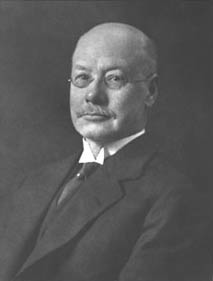
| Thomas James Wise 1859-1937 |
| Thomas James Wise |
| ********** |
Bodleian and was elected President of the Bibliographical
Society in 1922–1924.
In 1934 his reputation was damaged by the publication
of "An Enquiry into the Nature of Certain Nineteenth
Century Pamphlets". Written by John Carter and
Graham Pollard, two rare-book dealers, it proved that a
number of first editions by such writers as the
Brownings, Ruskin & Swinburne, were not first editions
but
counterfeits. These included a large number of rare first
edition pamphlets from 19th century authors which
depended solely on Wise's published works for their
authenticity were fakes. The Enquirers did not say that
Mr. Wise was the forger but that he accepted the
forgeries, purchased them, & sold them in quantity.
Society in 1922–1924.
In 1934 his reputation was damaged by the publication
of "An Enquiry into the Nature of Certain Nineteenth
Century Pamphlets". Written by John Carter and
Graham Pollard, two rare-book dealers, it proved that a
number of first editions by such writers as the
Brownings, Ruskin & Swinburne, were not first editions
but
counterfeits. These included a large number of rare first
edition pamphlets from 19th century authors which
depended solely on Wise's published works for their
authenticity were fakes. The Enquirers did not say that
Mr. Wise was the forger but that he accepted the
forgeries, purchased them, & sold them in quantity.
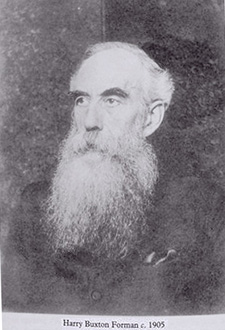
| Henry Buxton Forman |
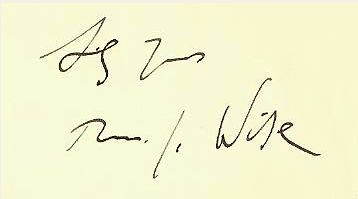
| The Quiz Photo with the signature showing |
| XXXXX |
When Frank W. Tober died in June 1995, he left
behind one of the most significant bequests the
University of Delaware Library has ever
received. In addition to the several thousand
books, hundreds of manuscripts and papers, and
other materials which form the Frank W. Tober
Collection, he also provided for the continuing
support and preservation of the collection by
establishing two separate endowments. The
Ellen Brady Tober Curatorial Fund, which
honors Frank Tober's late wife Ellen, helps
support an assistantship which provides an
annual stipend to a graduate student in the
behind one of the most significant bequests the
University of Delaware Library has ever
received. In addition to the several thousand
books, hundreds of manuscripts and papers, and
other materials which form the Frank W. Tober
Collection, he also provided for the continuing
support and preservation of the collection by
establishing two separate endowments. The
Ellen Brady Tober Curatorial Fund, which
honors Frank Tober's late wife Ellen, helps
support an assistantship which provides an
annual stipend to a graduate student in the
containing Wiseiana.
Frank Tober also collected manuscript and archival material. His collection houses
eighty-five of Thomas Wise's letters, as well as correspondence and other archival
materials pertaining to such pivotal figures as H. Buxton Forman, Maurice Buxton
Forman, Edmund Gosse, A. Edward Newton, Clement Shorter, Theodore
Watts-Dunston, Gabriel Wells, and Louise Wise. In addition, he managed to locate
unique research materials by or relating to such scholars as John Carter, Wilfred
Partington, Graham Pollard, Fannie Ratchford, William B. Todd, and others for his
collection. No item was too peripheral for his attention and the result is a unique
assemblage of primary and secondary sources offering numerous research
opportunities for the Wise student, scholar, and enthusiast.
en.wikipedia.org/wiki/Thomas_James_Wise
www.lib.udel.edu/ud/spec/exhibits/forgery/wise.htm
www.newyorker.com/archive/1962/11/10/1962_11_10_168_...
Frank Tober also collected manuscript and archival material. His collection houses
eighty-five of Thomas Wise's letters, as well as correspondence and other archival
materials pertaining to such pivotal figures as H. Buxton Forman, Maurice Buxton
Forman, Edmund Gosse, A. Edward Newton, Clement Shorter, Theodore
Watts-Dunston, Gabriel Wells, and Louise Wise. In addition, he managed to locate
unique research materials by or relating to such scholars as John Carter, Wilfred
Partington, Graham Pollard, Fannie Ratchford, William B. Todd, and others for his
collection. No item was too peripheral for his attention and the result is a unique
assemblage of primary and secondary sources offering numerous research
opportunities for the Wise student, scholar, and enthusiast.
en.wikipedia.org/wiki/Thomas_James_Wise
www.lib.udel.edu/ud/spec/exhibits/forgery/wise.htm
www.newyorker.com/archive/1962/11/10/1962_11_10_168_...
| ********** |
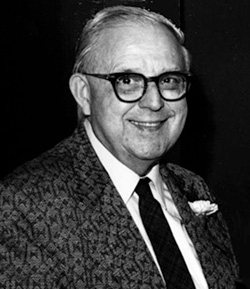
| Frank W. Tober www.lib.udel.edu/ud/spec/exhibits/forgery/tober.htm |
individual and maintained notebooks in
which he recorded his detailed
responses to books. He also retained
correspondence with booksellers, copies
of invoices and dealer
catalogs, and kept thorough records of
his acquisitions.
Although the focus of this exhibition is
the forgery collection which Frank
regarded as the cornerstone of his
personal library, the range of his
collecting interests was astonishing. For
much of his life he was a major
collector of stamps and, to a lesser
extent, coins. But when his bibliophilic
pursuits became predominant--to the
point of "bibliomania," as he liked to
say--Frank left his philatelic interests
behind and devoted himself exclusively
to book collecting. Frank had eclectic
tastes in art and literature and was a
lifelong student of history. One of the
first subjects in which he began
seriously to collect was the era of
Napoleon and the French Revolution. He
which he recorded his detailed
responses to books. He also retained
correspondence with booksellers, copies
of invoices and dealer
catalogs, and kept thorough records of
his acquisitions.
Although the focus of this exhibition is
the forgery collection which Frank
regarded as the cornerstone of his
personal library, the range of his
collecting interests was astonishing. For
much of his life he was a major
collector of stamps and, to a lesser
extent, coins. But when his bibliophilic
pursuits became predominant--to the
point of "bibliomania," as he liked to
say--Frank left his philatelic interests
behind and devoted himself exclusively
to book collecting. Frank had eclectic
tastes in art and literature and was a
lifelong student of history. One of the
first subjects in which he began
seriously to collect was the era of
Napoleon and the French Revolution. He
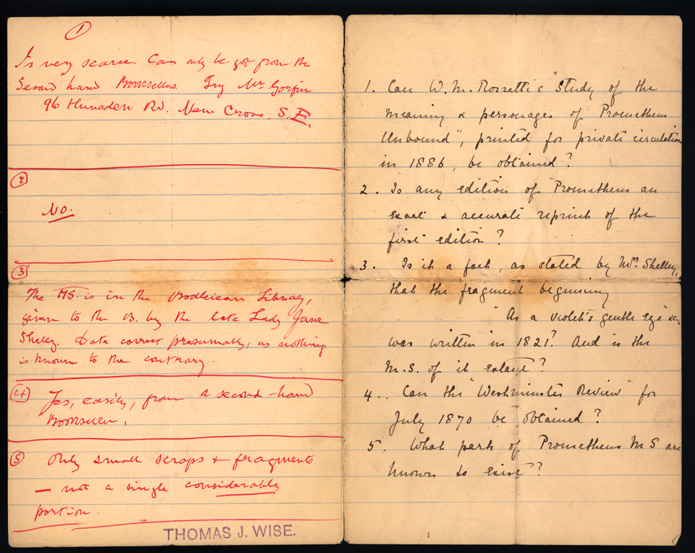
| Thomas James Wise, 1859-1937. Autograph notes, undated, 1 p. |
| Much of Wise's correspondence in the Frank W. Tober Collection concerns the bibliographic research queries presented to Wise by collectors and scholars. This query is part of a small group of letters from Wise to Charles Dealtry Locock, the distinguished Shelley editor. On this sheet, Wise's writes his replies to the left of Locock's questions; the document also contains Wise's rubber-stamp signature. |
assembled a collection of several hundred eighteenth and nineteenth century books and
pamphlets, and managed to acquire original manuscripts, historical documents, and
ephemeral material. In 1992, this collection became the first of Frank's gifts to the
University of Delaware Library.
Frank was also an amateur printer and had his own imprint, the Pucca Press, under
which he issued small booklets and holiday greeting cards. As he did with most of his
interests, Frank sought to learn as much as possible and began collecting books on the
history and technology of printing. Soon he was seeking out material on a variety of
specialized topics, including bookbinding, publishing history, typography, illustration,
bibliography, and even the history of book collecting. Frank's scientific curiosity led
him into such technical areas as the chemistry of ink and paper and these merged with
his growing interest in forgery. Frank began to collect seriously on these subjects,
especially in the history of papermaking and on the manufacture of paper.
Frank's interest in the history of printing also stimulated him to collect examples of fine
printing, from early printed books to the productions of contemporary fine presses.
Frank was particularly fond of the Bird & Bull Press and would have been pleased that
pamphlets, and managed to acquire original manuscripts, historical documents, and
ephemeral material. In 1992, this collection became the first of Frank's gifts to the
University of Delaware Library.
Frank was also an amateur printer and had his own imprint, the Pucca Press, under
which he issued small booklets and holiday greeting cards. As he did with most of his
interests, Frank sought to learn as much as possible and began collecting books on the
history and technology of printing. Soon he was seeking out material on a variety of
specialized topics, including bookbinding, publishing history, typography, illustration,
bibliography, and even the history of book collecting. Frank's scientific curiosity led
him into such technical areas as the chemistry of ink and paper and these merged with
his growing interest in forgery. Frank began to collect seriously on these subjects,
especially in the history of papermaking and on the manufacture of paper.
Frank's interest in the history of printing also stimulated him to collect examples of fine
printing, from early printed books to the productions of contemporary fine presses.
Frank was particularly fond of the Bird & Bull Press and would have been pleased that
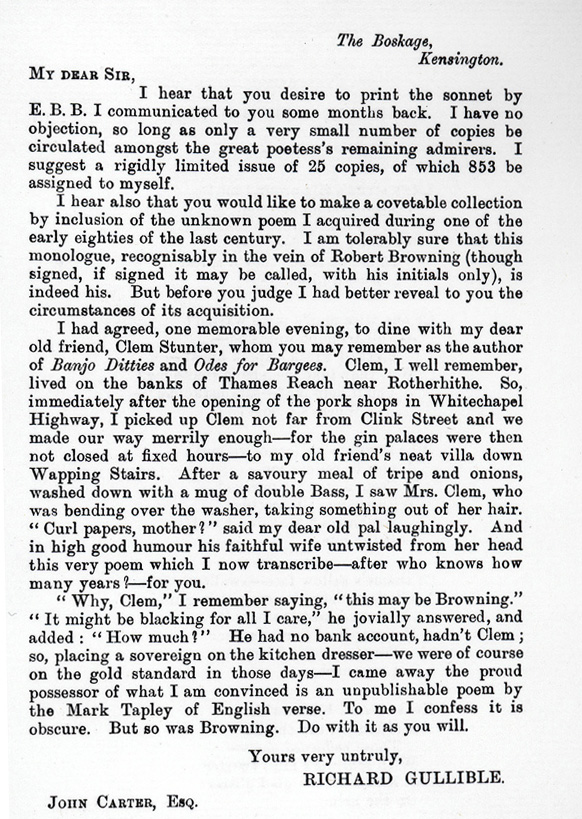
| XXX The Gullible Papers (1934) The English collector Richard Jennings (188 new Thomas J. Wise and had been duped by him, wrote a series of parodies shortly after the publication of the Carter and Pollard Enquiry which were printed in five single-sheet publications and circulated to a small circle of friends. Jennings chose the pen name Richard Gullible and the publications have been termed The Gullible Papers ever since. All five of The Gullible Papers are quite scarce and Frank Tober 's co lection includes two of the five pieces. |
its founder, Henry Morris, designed the catalog for
this exhibition.
Although Frank Tober continued to collect in all of
these and other areas, he devoted the greatest
amount of his time, energy, and resources to his
literary forgery collection. As a physical chemist,
Frank had a professional curiosity about the
technical processes involved in the detection of
forgeries and often said that this initiated his
interest in the forgeries of Thomas J. Wise and H.
Buxton Forman. He was drawn to the
investigations of John Carter and Graham Pollard,
who employed state-of-the-art chemical
examinations of the papers used by Wise to expose
him as a forger. In addition, though Frank did not
regard Thomas J. Wise as a kindred spirit, he was
intrigued by the fact that Wise had a long career in
the chemical industry. Even as he was embarking
upon his career as a forger, Thomas J. Wise was
also a successful commodities broker in the
essential oils used in perfumes and his firm, H.
Rubeck, built essential oil recovery plants in Spain
and Portugal. Frank became fascinated by the
Wise-Forman forgeries and collected virtually
everything he could relating to the actual forgeries
or to the various individuals associated with them.
At the time of his death in 1995, his collection
included over half of the known Wise-Forman
forgeries and piracies, as well as a massive amount
of related primary and secondary material. In
addition, he expanded his collecting purview to
include other forgers such as George Psalmanazar,
Thomas Chatterton, James Macpherson, John
Payne Collier, and Frederic Prokosch. His literary
forgery collecting also broadened to encompass
this exhibition.
Although Frank Tober continued to collect in all of
these and other areas, he devoted the greatest
amount of his time, energy, and resources to his
literary forgery collection. As a physical chemist,
Frank had a professional curiosity about the
technical processes involved in the detection of
forgeries and often said that this initiated his
interest in the forgeries of Thomas J. Wise and H.
Buxton Forman. He was drawn to the
investigations of John Carter and Graham Pollard,
who employed state-of-the-art chemical
examinations of the papers used by Wise to expose
him as a forger. In addition, though Frank did not
regard Thomas J. Wise as a kindred spirit, he was
intrigued by the fact that Wise had a long career in
the chemical industry. Even as he was embarking
upon his career as a forger, Thomas J. Wise was
also a successful commodities broker in the
essential oils used in perfumes and his firm, H.
Rubeck, built essential oil recovery plants in Spain
and Portugal. Frank became fascinated by the
Wise-Forman forgeries and collected virtually
everything he could relating to the actual forgeries
or to the various individuals associated with them.
At the time of his death in 1995, his collection
included over half of the known Wise-Forman
forgeries and piracies, as well as a massive amount
of related primary and secondary material. In
addition, he expanded his collecting purview to
include other forgers such as George Psalmanazar,
Thomas Chatterton, James Macpherson, John
Payne Collier, and Frederic Prokosch. His literary
forgery collecting also broadened to encompass
related subjects such as counterfeiting, the forgery of artwork and furniture, hoaxes,
and imaginary books and libraries.
and imaginary books and libraries.
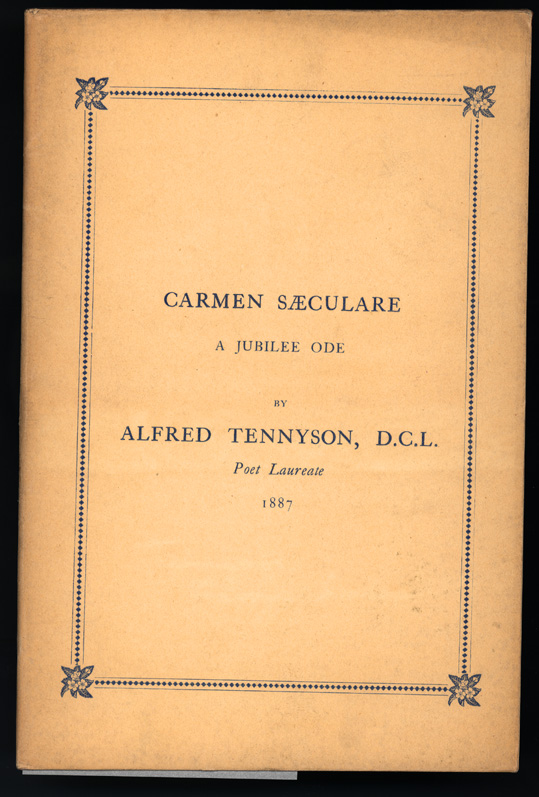
| Alfred Tennyson, Baron Tennyson, 1809-1892. Carmen Saeculare: an Ode. London: Printed for Private Distribution, 1887. This pamphlet was proven to be a forgery by its use of a type ornament on the front cover-- Primrose 2-line Pica Border No. 2--which had not been designed until 1903. This copy bears a presenta- tion inscription from Thomas J.Wise in which he notes the pamphlet was "issued by Tennyson himself." |
sometimes found that the suspicious texts followed demonstrably
later versions. They scoured auction records to determine when the
suspect pamphlets first appeared for sale. In addition, they would
search for presentation copies of the suspected forgeries or glean
through authors' correspondence for references to these alleged
publications; seldom did they find any such examples which
suggested the publications were actually authentic. Finally, they
analyzed the chemical composition of the papers and the history of
the types used in the suspected pamphlets. They were able to
demonstrate convincingly that many of the pamphlets could not have
appeared at the time of their alleged imprint dates because either the
paper or the type was not yet in existence. At the time of his death in
1995, Frank Tober had acquired nearly half of the more than one
hundred known Wise-Forman forgeries and piracies. In addition, he
focused his collecting on other books which Wise or Forman had
either written or edited and acquired one hundred sixty individual titles
later versions. They scoured auction records to determine when the
suspect pamphlets first appeared for sale. In addition, they would
search for presentation copies of the suspected forgeries or glean
through authors' correspondence for references to these alleged
publications; seldom did they find any such examples which
suggested the publications were actually authentic. Finally, they
analyzed the chemical composition of the papers and the history of
the types used in the suspected pamphlets. They were able to
demonstrate convincingly that many of the pamphlets could not have
appeared at the time of their alleged imprint dates because either the
paper or the type was not yet in existence. At the time of his death in
1995, Frank Tober had acquired nearly half of the more than one
hundred known Wise-Forman forgeries and piracies. In addition, he
focused his collecting on other books which Wise or Forman had
either written or edited and acquired one hundred sixty individual titles
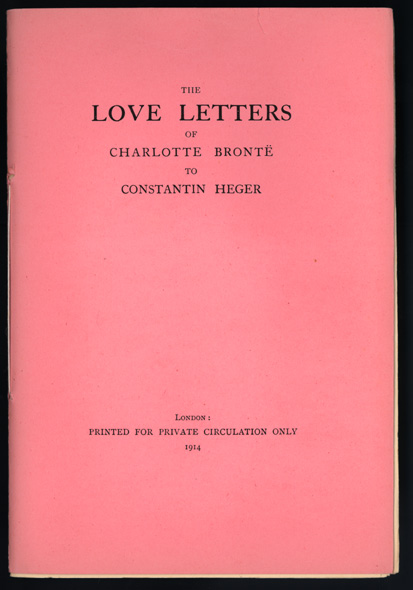
| Charlotte Bronte, 1816-1855. The Love Letters of Charlotte Bronte to Constantin Heger. London: Printed for Private Circulation Only, 1914. This collection of Charlotte Bronte's letters is an unauthorized piracy which Wise published in an edition of thirty copies. |
| XXX |
| George Eliot, 1819-1880. Brother and Sister: Sonnets, by Marian Lewes [pseudonym]. London: For Private Circulation Only, 1869. This collection of George Eliot's sonnets is regarded as the first of the creative forgeries. It was not an attempt to replicate a genuine book which had appeared previously, but was instead an alleged first separate printing of a piece which had appeared elsewhere. This copy |
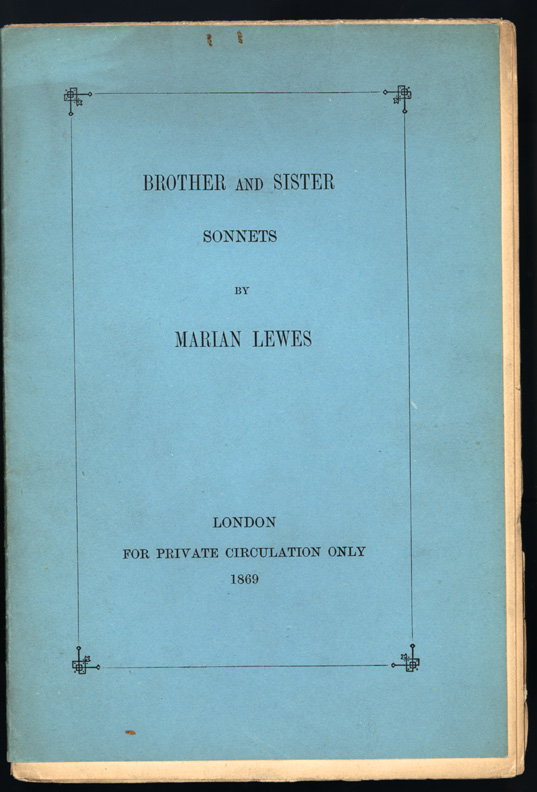
of Brother and Sister is from the library of the American
composer and book collector Jerome Kern.
composer and book collector Jerome Kern.
| XXX |
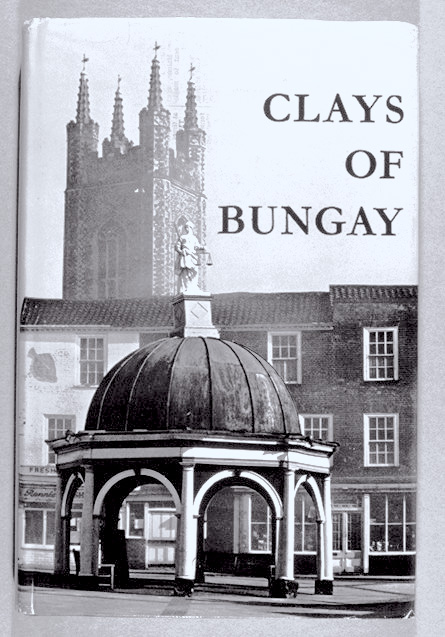
| Moran, James. Clays of Bungay. Bungay: Richard Clay & Co., [1978]. One of the critical break- throughs in the Carter-Pollard investigation occurred with the discovery of a specific type-- Clays No. 3 Long Primer--which was present in many of the suspected pamphlets and which had been introduced in a re- designed form by the London printing firm of Richard Clay during the early 1880s. The |
evidence showed that quite a few of the suspect pamphlets
had been printed by Clay, who had done other printing for
Wise, and that the use of this distinctive type in pamphlets
with imprint dates much earlier than actual introduction of
the type helped identify them as forgeries. This history of the
printing house includes a chapter on Thomas J. Wise.
had been printed by Clay, who had done other printing for
Wise, and that the use of this distinctive type in pamphlets
with imprint dates much earlier than actual introduction of
the type helped identify them as forgeries. This history of the
printing house includes a chapter on Thomas J. Wise.
| ********** |
| ********** |
| XXX |
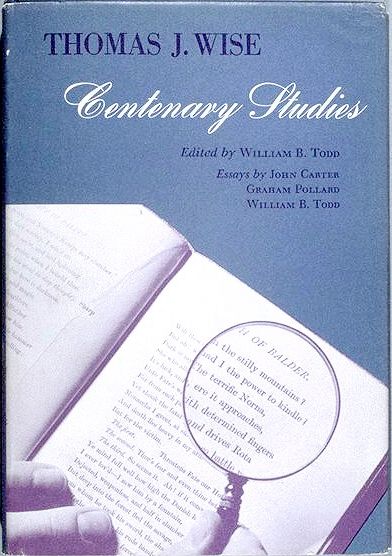
| Thomas J. Wise, Centenary Studies, edited by William B. Todd. Austin: University of Texas Press; Edinburgh: Thomas Nelson and Sons, [1959]. William B. Todd has been one of the chief investigators into the bibliographic puzzles presented by the Wise forgeries. This collection of essays published in conjunction with the centenary of the birth of Thomas J. Wise includes Todd's "A Handlist of Thomas J. Wise" which remains |
the most comprehensive check- list of books forged, pirated,
and edited by Wise. This copy of Thomas J. Wise, Centenary
Studies is from the library of John Carter and bears his
signature and autograph notations.
and edited by Wise. This copy of Thomas J. Wise, Centenary
Studies is from the library of John Carter and bears his
signature and autograph notations.
first-edition mania.
Shortly after Wise's death the Library was sold to the
British Museum by his widow for £66,000. The works
were compared with the British Museum's former
collection at which point it was discovered that over 200
book leaves were missing and 89 of these matching
leaves were found in the Wise volumes. Henry Wrenn
had built up a drama collection (housed in the University
of Texas) and Wise had helped with supplying these
volumes, when the Texas authorities sent relevant
volumes for comparison, 60 of these books were also
found to have been completed with thefts from the
British Museum library.
Shortly after Wise's death the Library was sold to the
British Museum by his widow for £66,000. The works
were compared with the British Museum's former
collection at which point it was discovered that over 200
book leaves were missing and 89 of these matching
leaves were found in the Wise volumes. Henry Wrenn
had built up a drama collection (housed in the University
of Texas) and Wise had helped with supplying these
volumes, when the Texas authorities sent relevant
volumes for comparison, 60 of these books were also
found to have been completed with thefts from the
British Museum library.
A detailed scientific investigation by David Foxon was published by the Bibliographic
Society in 1959 with the conclusion that Wise must have known that some of the book
leaves added to his collection were stolen and that it was probable that he would have
taken the leaves himself.
Wise's published works included detailed bibliographies of Tennyson, Swinburne,
Landor, Wordsworth, Coleridge, Ruskin, the Brownings, the Brontës, Shelly and
Conrad. He was the copyright owner and co-editor of the Bonchurch edition of
Swinburne's works.
Frank Tober regarded his collection on the Wise forgeries to be the centerpiece of his
library. With his longstanding interest in the chemistry of paper and ink, and in the
technical analysis of forgeries, Frank was drawn inexorably to the Wise forgeries.
Knowing that he had arrived rather late in the game in terms of building a major
collection of Wise forgeries, Frank Tober expanded his purview to include a broad
range of topics. He still tried to collect as many examples of the Wise forgeries as he
could and by the end of his life had managed to acquire over half of the more than one
hundred known Wise-Forman forgeries and piracies. He also collected books,
Society in 1959 with the conclusion that Wise must have known that some of the book
leaves added to his collection were stolen and that it was probable that he would have
taken the leaves himself.
Wise's published works included detailed bibliographies of Tennyson, Swinburne,
Landor, Wordsworth, Coleridge, Ruskin, the Brownings, the Brontës, Shelly and
Conrad. He was the copyright owner and co-editor of the Bonchurch edition of
Swinburne's works.
Frank Tober regarded his collection on the Wise forgeries to be the centerpiece of his
library. With his longstanding interest in the chemistry of paper and ink, and in the
technical analysis of forgeries, Frank was drawn inexorably to the Wise forgeries.
Knowing that he had arrived rather late in the game in terms of building a major
collection of Wise forgeries, Frank Tober expanded his purview to include a broad
range of topics. He still tried to collect as many examples of the Wise forgeries as he
could and by the end of his life had managed to acquire over half of the more than one
hundred known Wise-Forman forgeries and piracies. He also collected books,
| Signature of Thomas J. Wise |
magazines, scholarly journals, clippings,
offprints of articles, exhibit catalogs,
ephemera, and a host of other sources
relating to Thomas J. Wise, H. Buxton
Forman, and the circle of individuals
associated with them. He acquired auction
catalogs featuring copies of the forged
pamphlets for sale prior to the publication
of the Enquiry, as well as catalogs
offering the libraries of private collections
offprints of articles, exhibit catalogs,
ephemera, and a host of other sources
relating to Thomas J. Wise, H. Buxton
Forman, and the circle of individuals
associated with them. He acquired auction
catalogs featuring copies of the forged
pamphlets for sale prior to the publication
of the Enquiry, as well as catalogs
offering the libraries of private collections
| ********** |