In 1913, while Walker traveled to Central America and the Caribbean to expand her
business, her daughter A’Lelia, moved into a fabulous new Harlem townhouse and
Walker Salon, designed by African American architect, Vertner W. Tandy, who had
designed St. Phillip’s Episcopal Church in Harlem and was the first licensed black
architect in New York State. “There is nothing to equal it,” she wrote to her attorney, F.
B. Ransom. “Not even on Fifth Avenue.”
Madam also decided to build herself a country home, a mansion- not just for herself but
as an example to her race. Tandy designed for Walker exactly the home she wanted: a
show place where she could rest and listen to music and fill up the rooms with her
friends and give mixed-race parties. She could hold significant meetings there to be
attended by prominent people from the worlds of politics, business, and the arts. In
February 1917, ground was broken, and by the time Walker moved in the next
summer, the estate had been given a name by her friend the Italian tenor Enrico
CarusoVilla Lewaro, for the first two letter of each of her daughter Lelia Walker
Robinson’s names.
Walker herself moved to New York in 1916, leaving the day-to-day operations of the
business, her daughter A’Lelia, moved into a fabulous new Harlem townhouse and
Walker Salon, designed by African American architect, Vertner W. Tandy, who had
designed St. Phillip’s Episcopal Church in Harlem and was the first licensed black
architect in New York State. “There is nothing to equal it,” she wrote to her attorney, F.
B. Ransom. “Not even on Fifth Avenue.”
Madam also decided to build herself a country home, a mansion- not just for herself but
as an example to her race. Tandy designed for Walker exactly the home she wanted: a
show place where she could rest and listen to music and fill up the rooms with her
friends and give mixed-race parties. She could hold significant meetings there to be
attended by prominent people from the worlds of politics, business, and the arts. In
February 1917, ground was broken, and by the time Walker moved in the next
summer, the estate had been given a name by her friend the Italian tenor Enrico
CarusoVilla Lewaro, for the first two letter of each of her daughter Lelia Walker
Robinson’s names.
Walker herself moved to New York in 1916, leaving the day-to-day operations of the
where she opened Lelia College to train Walker “hair culturists.”
By early 1910, she had settled in Indianapolis, then the nation’s largest inland
manufacturing center, where she built a factory, hair and manicure salon and another
training school. Less than a year after her arrival, Walker grabbed national headlines in
the black press when she contributed $1,000 to the building fund of the “colored”
YMCA in Indianapolis.
By then, only five years beyond the washtubs, she had established a full cosmetics
factory, beauty school, and mail-order business, completely staffed by black people,
mostly women. Carrying her square black sample bag and her little kerosene stove, she
traveled the rails nonstop in those early days: from Seattle to Oakland and from Xenia,
Ohio to Greenwood, Miss. Jim Crow accommodations were the rule of the day, so
Madam Walker sat in the car closest to the engine, where the cinders whirled through
and soiled her clothes. There were no hotels for her, so she arranged through churches
to stay in people’s homes. But nothing slowed her down. A brilliant marketing
strategist, Walker created nationwide advertising and promotional tours, pitching not
By early 1910, she had settled in Indianapolis, then the nation’s largest inland
manufacturing center, where she built a factory, hair and manicure salon and another
training school. Less than a year after her arrival, Walker grabbed national headlines in
the black press when she contributed $1,000 to the building fund of the “colored”
YMCA in Indianapolis.
By then, only five years beyond the washtubs, she had established a full cosmetics
factory, beauty school, and mail-order business, completely staffed by black people,
mostly women. Carrying her square black sample bag and her little kerosene stove, she
traveled the rails nonstop in those early days: from Seattle to Oakland and from Xenia,
Ohio to Greenwood, Miss. Jim Crow accommodations were the rule of the day, so
Madam Walker sat in the car closest to the engine, where the cinders whirled through
and soiled her clothes. There were no hotels for her, so she arranged through churches
to stay in people’s homes. But nothing slowed her down. A brilliant marketing
strategist, Walker created nationwide advertising and promotional tours, pitching not
Born Sarah Breedlove on December 23, 1867 on a
Delta, Louisiana plantation, to Owen and Minerva
Breedlove. She was one of six children; she had a
sister Louvenia and 4 brothers: Alexander, James,
Solomon, and Owen, Jr. Her parents and elder
siblings were slaves on a Madison Parish
plantation owned by Robert W. Burney. Her
mother died, possibly from cholera, in 1872. Her
father remarried and died shortly afterward when
she was seven years old. Yet this daughter of
former slaves transformed herself from an
uneducated farm laborer and laundress into one of
the twentieth century’s most successful, self-
made women entrepreneurs.
Delta, Louisiana plantation, to Owen and Minerva
Breedlove. She was one of six children; she had a
sister Louvenia and 4 brothers: Alexander, James,
Solomon, and Owen, Jr. Her parents and elder
siblings were slaves on a Madison Parish
plantation owned by Robert W. Burney. Her
mother died, possibly from cholera, in 1872. Her
father remarried and died shortly afterward when
she was seven years old. Yet this daughter of
former slaves transformed herself from an
uneducated farm laborer and laundress into one of
the twentieth century’s most successful, self-
made women entrepreneurs.
| XXX |
| XXX |
| Harold E. Doley, Jr. U.S. Ambassador to the Ivory Coast An African American of Note Owner of Villa Lewaro |

 |  |  |  |
| If you have a picture you'd like us to feature a picture in a future quiz, please email it to us at CFitzp@aol.com. If we use it, you will receive a free analysis of your picture. You will also receive a free Forensic Genealogy CD or a 10% discount towards the purchase of the Forensic Genealogy book. |


 |  |  |  |
| ********** |
| ********** |

| If you enjoy our quizzes, don't forget to order our books! Click here. |

| Quiz #292 Results |
| Quiz #292 February 13, 2011 |

| Answers: 1. Madam C J Walker 2. She was the first African American woman who was a millionaire. 3. February is Black History Month. X |
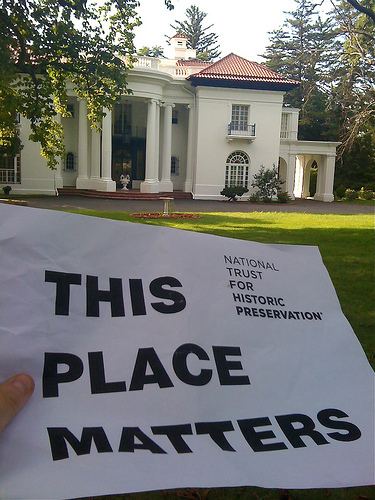
| 1. Who built this mansion? 2. What did this person have in common with Oprah Winfrey? 3. Why is this an appropriate topic for this month? |
| ********** |
| ********** |
| This photo was submitted by Quizmaster Emeritus Dr. Stan Read. |
| Congratulations to Our Winners! Alex Sissoev Nicole Blank Herschel Browne Elaine C. Hebert Daniel E. Jolley Carol Farrant Mary Fraser Diane Burkett Gary Sterne Roberta Martin JoLynn Pfeiffer Jim Kiser Jim Baker Cate Bloomquist Milene Rawlinson Margaret Paxton |
| Comments from Our Readers |
This was not trivial. My initial guess about the plantations (after having solved the third
question first) led me absolutely nowhere. I did learn about Absalom Winfrey and the
five generations of Oprah's ancestors though. Alex Sissoev
*****
I found this week's answer on the 66th page of the "This Place Matters" flickr
photostream www.flickr.com/photos/preservationnation/3875536945/in/pool-
thisplacematters. The mansion is the Villa Lewaro, built in 1918 in Irvington, NY and
the home of Madam(e) C.J. Walker, the first African-American millionairess. Oprah
Winfrey was the 1st African-American billionairess (I spent some time Googling
'mansion + Oprah Winfrey' but got nowhere so chose a different tack). This quiz was
appropriate for February as it is African-American history month. :) I found this page
when I Googled 'C.J. Walker + Oprah Winfrey', not sure if you saw it or not: http:
//apcentral.collegeboard.com/apc/members/homepage/32272.html. I'd honestly never
heard of Madam Walker before, so this was an interesting quiz to me; even found a
website that still sells her hair care products: http://www.madamewalker.net/ though
the prices are quite steep! Nicole Blank
*****
Oprah Winfrey is a self-made African-American woman billionaire, but adjusting for
inflation she would be a mere millionaire in Madam Walker's day. The architect [of
Lewaro], Vertner Woodson Tandy, was the first registered African-American architect
in New York State (or in the United States; accounts vary). Herschel Browne
*****
I really enjoyed this puzzle ... I had never heard of Madam Walker before but was
completely amazed at her accomplishments!!! Elaine C. Hebert
*****
If my answers are right, this was one of the easier puzzles. I googled "This Place
Matters" and, since this is Black History Month, tacked on "underground railroad". One
of the sites was pictures of lots of the National Trust for Historic Preservation. Flipped
through a couple - and voila! I was actually familiar with Madame Walker because of
the Madame CJ Walker Building and Theater here in Indianapolis. Roberta Martin
*****
Do you know exactly: When is White History Month? Jim Kiser
N.B. Every month. - Q. Gen.
*****
Think I’m going to add this to my “to-read” list; she sounds fascinating. Mary Fraser
question first) led me absolutely nowhere. I did learn about Absalom Winfrey and the
five generations of Oprah's ancestors though. Alex Sissoev
*****
I found this week's answer on the 66th page of the "This Place Matters" flickr
photostream www.flickr.com/photos/preservationnation/3875536945/in/pool-
thisplacematters. The mansion is the Villa Lewaro, built in 1918 in Irvington, NY and
the home of Madam(e) C.J. Walker, the first African-American millionairess. Oprah
Winfrey was the 1st African-American billionairess (I spent some time Googling
'mansion + Oprah Winfrey' but got nowhere so chose a different tack). This quiz was
appropriate for February as it is African-American history month. :) I found this page
when I Googled 'C.J. Walker + Oprah Winfrey', not sure if you saw it or not: http:
//apcentral.collegeboard.com/apc/members/homepage/32272.html. I'd honestly never
heard of Madam Walker before, so this was an interesting quiz to me; even found a
website that still sells her hair care products: http://www.madamewalker.net/ though
the prices are quite steep! Nicole Blank
*****
Oprah Winfrey is a self-made African-American woman billionaire, but adjusting for
inflation she would be a mere millionaire in Madam Walker's day. The architect [of
Lewaro], Vertner Woodson Tandy, was the first registered African-American architect
in New York State (or in the United States; accounts vary). Herschel Browne
*****
I really enjoyed this puzzle ... I had never heard of Madam Walker before but was
completely amazed at her accomplishments!!! Elaine C. Hebert
*****
If my answers are right, this was one of the easier puzzles. I googled "This Place
Matters" and, since this is Black History Month, tacked on "underground railroad". One
of the sites was pictures of lots of the National Trust for Historic Preservation. Flipped
through a couple - and voila! I was actually familiar with Madame Walker because of
the Madame CJ Walker Building and Theater here in Indianapolis. Roberta Martin
*****
Do you know exactly: When is White History Month? Jim Kiser
N.B. Every month. - Q. Gen.
*****
Think I’m going to add this to my “to-read” list; she sounds fascinating. Mary Fraser


| Reception in the Office of the C. J. Walker Company, 1929 www.metmuseum.org/explore/artists_view/cjwalker.html |


| “I am a woman who came from the cotton fields of the South. From there I was promoted to the washtub. From there I was promoted to the cook kitchen. And from there I promoted myself into the business of manufacturing hair goods and preparations….I have built my own factory on my own ground.” Madam Walker, National Negro Business League Convention, July 1912 |
| ********** |


| to other parts of the Southern United States. Nonetheless they were always well aware of the disadvantages they faced. Amb. Doley attended segregated schools in the Louisiana area before matriculating at Xavier University in New Orleans where he majored in Accounting and Business Administration and started an investment club. He graduated from the Harvard University Graduate School of Business’s Owner/President Management Program an Executive Education Program. Doley began his career as a stock trader working for Bache & Company Inc., a brokerage house in New Orleans in 1968 immediately after graduating from Xavier University. In 1973, he borrowed $90,000 and bought a seat on the New York Stock Exchange (NYSE). Although there were two other African American firms holding seats on the exchange, Doley's move brought him national attention and with it an ever growing client portfolio. In 1975, Doley founded his own firm, Doley Securities, LLC. Undaunted by those critics who said white people wouldn’t give money to an investment company founded by an African American, Doley proved them wrong by consistently making his clients wealthy. Doley also managed the merger of several National Insurance Association companies and helped found the Republic National Bank and later became the largest stockholder of the United Bank before its merger. An active Republican, Doley's success attracted the attention of the Ronald Reagan Administration. In 1981 he was named the Founding Director of the Minerals Management Service of the United States Department of Interior. Under Doley, Minerals Management became the second largest income source to the United States Government. Two years later President Reagan appointed Doley as the American Ambassador to the Ivory Coast. He was also named Executive Director of the African Development Bank a multi-lateral development institution, a sister institution of the World Bank. Serving as Executive Director, Doley developed the structure that increased the AFDB’s capital by more than 300%. Upon his return to the United States in 1985, Doley continued his African development work by founding the U.S.-Africa Chamber of Commerce to increase trade between African nations and the United States. In the early 1990’s, Doley and his wife, Helena, purchased the Madam CJ Walker Estate, Villa Lewaro. The Villa is listed on the National Register of Historic Places. |
| Ambassador Harold E. Doley, Jr is the founder of Doley Securities, LLC, the oldest African American owned investment banking firm in the nation. Doley is the only African American to have owned a seat on the New York Stock Exchange. Born on March 8, 1947 Harold Doley was one of two boys born to Harold, Sr., a grocer and Kathryn Doley in New Orleans, LA. The Doley family has lived in Louisiana since 1720. The Doley’s had been free people before the Civil War and enjoyed the relatively liberal racial atmosphere of New Orleans as compared |

| The Granite Hotel Winder, GA www.flickr.com/photos/preservation... |

| The Barrow County Courthouse www.flickr.com/photos/preservation... |
Preservation Nation on Flicker |

| John Ward House Haverhill, MA www.flickr.com/photos/preservationnation... |

| Old Hoopers Island Graveyard Honga, Dorchester, MD www.flickr.com/photos/preservationnation... |

| Spring Grove Fish Hatchery The first and oldest fish hatchery in IL www.flickr.com/photos/preservationnation/... |

| Spring Grove Farm Caroline Co., VA www.flickr.com/photos/preservationnation... |

| Public Service Staircase Milwaukee, WI www.flickr.com/photos/preservationnation... |

| 3 for $33 Hair Care Combo: Glossine with Glossine Conditioner and Vegetable Shampoo shop.madamewalker.net |
| Madam C. J. Walker 1867-1919 www.madamcjwalker.com and bluegrasstrust.org/documents/MadamC.J.Walker.pdf en.wikipedia.org/wiki/Madam_C_J_Walker |
(Top) One of the first of Madam's
manufacturing building in Indianapolis.
It contained part of A’Lelia Walker’s
college and a C.J. Walker Beauty Salon.
afamstud.intrasun.tcnj.edu/harlemrenaissance/hurd2/
(Right) Stock certificates for Madam's
conpany.
manufacturing building in Indianapolis.
It contained part of A’Lelia Walker’s
college and a C.J. Walker Beauty Salon.
afamstud.intrasun.tcnj.edu/harlemrenaissance/hurd2/
(Right) Stock certificates for Madam's
conpany.

Orphaned at age seven, she and her older sister, Louvenia, survived by working in the
cotton fields of Delta and nearby Vicksburg, Mississippi. At 14, she married Moses
McWilliams to escape abuse from her cruel brother-in-law, Jesse Powell.
Her only daughter, Lelia (later known as A’Lelia Walker) was born on June 6, 1885.
When her husband died two years later, she moved to St. Louis to join her four
brothers who had established themselves as barbers. Working for as little as $1.50 a
day, she managed to save enough money to educate her daughter in the city’s public
schools. Friendships with other black women who were members of St. Paul A.M.E.
Church and the National Association of Colored Women exposed her to a new way of
viewing the world.
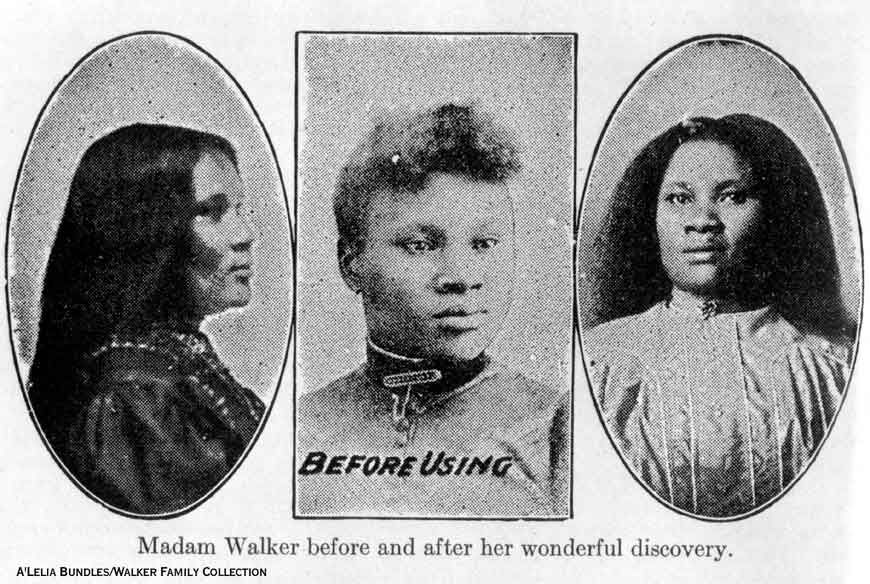
During the 1890s, Sarah began to suffer from a scalp ailment that caused her to lose
most of her hair. She experimented with many homemade remedies and store-bought
products, including those made by Annie Malone, another black woman entrepreneur.
In 1905 Sarah moved to Denver as a sales agent for Malone, then married her third
husband, Charles Joseph Walker, a St. Louis newspaperman. After changing her name
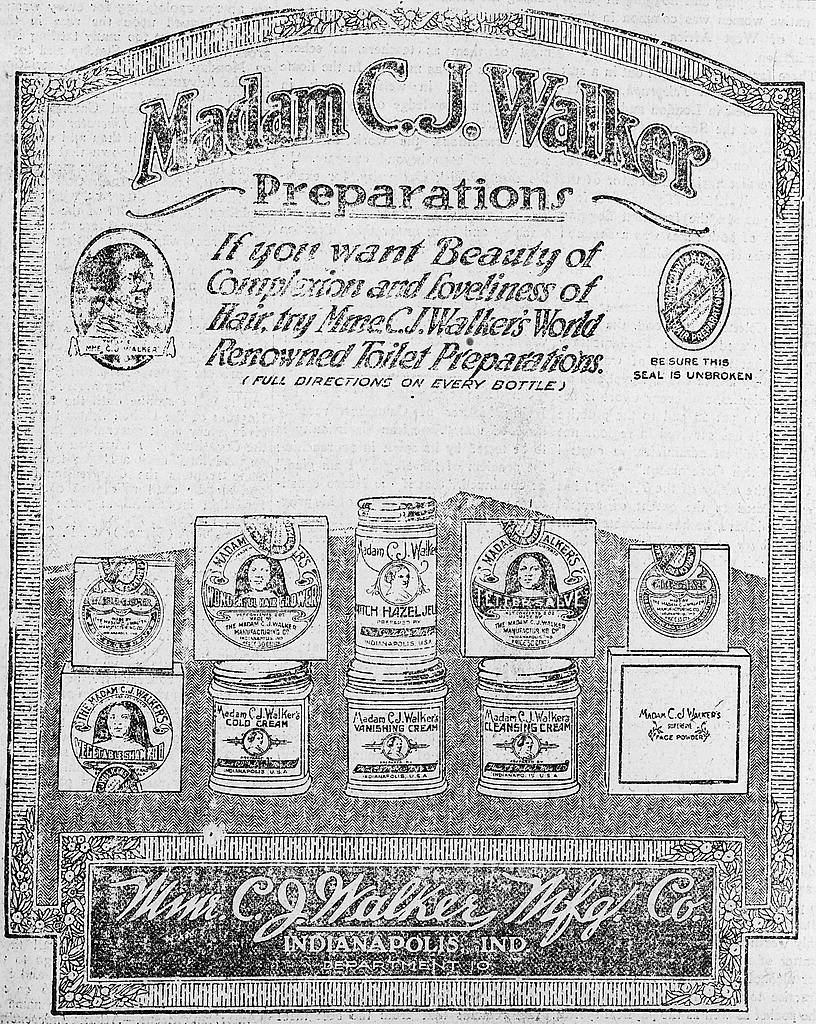
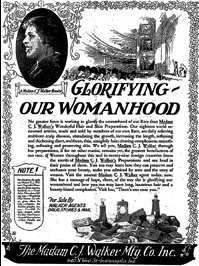
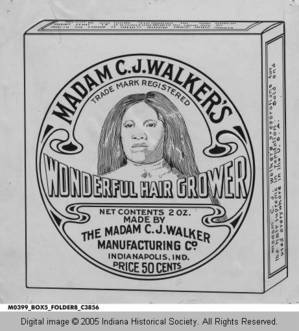
to “Madam” C. J. Walker, she founded her own business and began selling Madam
Walker’s Wonderful Hair Grower, a scalp conditioning and healing formula, which she
claimed had been revealed to her in a dream. Madam Walker, by the way, did NOT
invent the straightening comb or chemical perms, though many people incorrectly
cotton fields of Delta and nearby Vicksburg, Mississippi. At 14, she married Moses
McWilliams to escape abuse from her cruel brother-in-law, Jesse Powell.
Her only daughter, Lelia (later known as A’Lelia Walker) was born on June 6, 1885.
When her husband died two years later, she moved to St. Louis to join her four
brothers who had established themselves as barbers. Working for as little as $1.50 a
day, she managed to save enough money to educate her daughter in the city’s public
schools. Friendships with other black women who were members of St. Paul A.M.E.
Church and the National Association of Colored Women exposed her to a new way of
viewing the world.
During the 1890s, Sarah began to suffer from a scalp ailment that caused her to lose
most of her hair. She experimented with many homemade remedies and store-bought
products, including those made by Annie Malone, another black woman entrepreneur.
In 1905 Sarah moved to Denver as a sales agent for Malone, then married her third
husband, Charles Joseph Walker, a St. Louis newspaperman. After changing her name
to “Madam” C. J. Walker, she founded her own business and began selling Madam
Walker’s Wonderful Hair Grower, a scalp conditioning and healing formula, which she
claimed had been revealed to her in a dream. Madam Walker, by the way, did NOT
invent the straightening comb or chemical perms, though many people incorrectly
believe that to be true.
To promote her products, the new
“Madam C.J. Walker” traveled for a year
and a half on a dizzying crusade
throughout the heavily black South and
Southeast, selling her products door to
door, demonstrating her scalp treatments
in churches and lodges, and devising sales
and marketing strategies. In 1908, she
temporarily moved her base to Pittsburgh
To promote her products, the new
“Madam C.J. Walker” traveled for a year
and a half on a dizzying crusade
throughout the heavily black South and
Southeast, selling her products door to
door, demonstrating her scalp treatments
in churches and lodges, and devising sales
and marketing strategies. In 1908, she
temporarily moved her base to Pittsburgh
Madam C. J. Walker Manufacturing
Company in Indianapolis to Ransom and
Alice Kelly, her factory forelady and a
former school teacher. She continued to
oversee the business and to work in the
New York office. Once in Harlem, she
quickly became involved in Harlem’s
social and political life, taking special
interest in the NAACP’s anti-lynching
movement to which she contributed
$5,000.
In July 1917, when a white mob
murdered more than three dozen blacks in
East St. Louis, Illinois, Walker joined a
Company in Indianapolis to Ransom and
Alice Kelly, her factory forelady and a
former school teacher. She continued to
oversee the business and to work in the
New York office. Once in Harlem, she
quickly became involved in Harlem’s
social and political life, taking special
interest in the NAACP’s anti-lynching
movement to which she contributed
$5,000.
In July 1917, when a white mob
murdered more than three dozen blacks in
East St. Louis, Illinois, Walker joined a
group of Harlem leaders who visited the White House to present a petition advocating
federal anti-lynching legislation.
As her business continued to grow, Walker organized her agents into local and state
clubs. Her Madam C. J. Walker Hair Culturists Union of America convention in
Philadelphia in 1917 must have been one of the first national meetings of
businesswomen in the country. Walker used the gathering not only to reward her
agents for their business success, but to encourage their political activism as well.
“This is the greatest country under the sun,” she told them. “But we must not let our
love of country, our patriotic loyalty cause us to abate one whit in our protest against
wrong and injustice. We should protest until the American sense of justice is so aroused
that such affairs as the East St. Louis riot be forever impossible.”
By the time she died at her estate, Villa Lewaro, in Irvington-on-Hudson, New York,
she had helped create the role of the 20th Century, self-made American
businesswoman; established herself as a pioneer of the modern black hair-care and
cosmetics industry; and set standards in the African-American community for
corporate and community giving. Tenacity and perseverance, faith in herself and in
federal anti-lynching legislation.
As her business continued to grow, Walker organized her agents into local and state
clubs. Her Madam C. J. Walker Hair Culturists Union of America convention in
Philadelphia in 1917 must have been one of the first national meetings of
businesswomen in the country. Walker used the gathering not only to reward her
agents for their business success, but to encourage their political activism as well.
“This is the greatest country under the sun,” she told them. “But we must not let our
love of country, our patriotic loyalty cause us to abate one whit in our protest against
wrong and injustice. We should protest until the American sense of justice is so aroused
that such affairs as the East St. Louis riot be forever impossible.”
By the time she died at her estate, Villa Lewaro, in Irvington-on-Hudson, New York,
she had helped create the role of the 20th Century, self-made American
businesswoman; established herself as a pioneer of the modern black hair-care and
cosmetics industry; and set standards in the African-American community for
corporate and community giving. Tenacity and perseverance, faith in herself and in



| Madame Walker and her agents. |
her tonics and lotions but herself and her
story. When Charles J. Walker cautioned
her to settle for local success, she
rebuked him for his lack of vision and
divorced him in 1912. A soon as she
could afford one (and maybe before), she
bought an electric runabout automobile to
take her around Indianapolis and soon
after that, a seven--passenger touring car.
No more Jim Crow railroad cars. Madam
Walker had a chauffeur.
story. When Charles J. Walker cautioned
her to settle for local success, she
rebuked him for his lack of vision and
divorced him in 1912. A soon as she
could afford one (and maybe before), she
bought an electric runabout automobile to
take her around Indianapolis and soon
after that, a seven--passenger touring car.
No more Jim Crow railroad cars. Madam
Walker had a chauffeur.

Madam C.J. Walker (left) shown in
1913 along with (left to right) Freeman
B. Ransom, Booker T. Washington,
Alexander Manning, Dr. Joseph Ward
and R. W. Bullock. (Madam Walker
Collection, Ind. Historical Society
Library). www2.indystar.com/library/factfiles...
1913 along with (left to right) Freeman
B. Ransom, Booker T. Washington,
Alexander Manning, Dr. Joseph Ward
and R. W. Bullock. (Madam Walker
Collection, Ind. Historical Society
Library). www2.indystar.com/library/factfiles...
God, quality products and “honest business dealings” were
the elements and strategies she prescribed for aspiring
entrepreneurs who requested the secret to her rags-to-
riches ascent. “There is no royal flower-strewn path to
success,” she once commented. “And if there is, I have
not found it for if I have accomplished anything in life it is
because I have been willing to work hard.”
“Perseverance is my motto. It laid the Atlantic cable; it
gave us the telegraph, telephone, and wireless. It gave to
the world an Abraham Lincoln, and to a race freedom.”
And on the subject of her beginnings she said simply, “I
got my start by giving myself a start."
the elements and strategies she prescribed for aspiring
entrepreneurs who requested the secret to her rags-to-
riches ascent. “There is no royal flower-strewn path to
success,” she once commented. “And if there is, I have
not found it for if I have accomplished anything in life it is
because I have been willing to work hard.”
“Perseverance is my motto. It laid the Atlantic cable; it
gave us the telegraph, telephone, and wireless. It gave to
the world an Abraham Lincoln, and to a race freedom.”
And on the subject of her beginnings she said simply, “I
got my start by giving myself a start."

| A'Lelia Walker Madam's daughter |
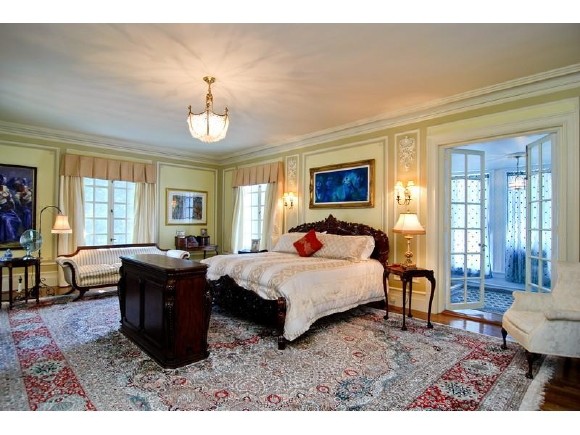
Villa Lewaro in Irvington, New York is a National
Historic Landmark. The home, also known as the
Anne E. Poth Home, was the home of Madam C. J.
Walker from 1918 to 1919, believed to be the first
female, and first African-American, self-made
millionaire (she made her money selling shampoo and
other hair care). The mansion is an Italianate villa
house designed for Walker by Vertner Tandy, the first
registered African-American architect and was
constructed during 1916-1918 at an estimated cost of
$250,000, a fortune at the time. The name Villa
Lewaro was coined by a visitor, Enrico Caruso, from
the first two letters of each word in Lelia Walker
Robinson, the name of her daughter, who later went
by the name of A'Lelia Walker.
The home was used as a conference center on race
Historic Landmark. The home, also known as the
Anne E. Poth Home, was the home of Madam C. J.
Walker from 1918 to 1919, believed to be the first
female, and first African-American, self-made
millionaire (she made her money selling shampoo and
other hair care). The mansion is an Italianate villa
house designed for Walker by Vertner Tandy, the first
registered African-American architect and was
constructed during 1916-1918 at an estimated cost of
$250,000, a fortune at the time. The name Villa
Lewaro was coined by a visitor, Enrico Caruso, from
the first two letters of each word in Lelia Walker
Robinson, the name of her daughter, who later went
by the name of A'Lelia Walker.
The home was used as a conference center on race
relations issues. Walker died there in 1919
and it was inherited by her daughter A'Lelia
Walker who owned it until she died in
1931. It then became the Anne E. Poth
Home for Convalescent and Aged
Members of the Companions of the Forest
in America. The home is on more than
three acres. The 30-room mansion has
eight bedrooms and elaborate details
including the original bronze chandelier,
stained glass windows, intricate moldings
and coffered ceilings. The renovated
and it was inherited by her daughter A'Lelia
Walker who owned it until she died in
1931. It then became the Anne E. Poth
Home for Convalescent and Aged
Members of the Companions of the Forest
in America. The home is on more than
three acres. The 30-room mansion has
eight bedrooms and elaborate details
including the original bronze chandelier,
stained glass windows, intricate moldings
and coffered ceilings. The renovated
kitchen provides access to the outdoors. The property includes a large renovated
carriage house and a reflecting pool. It is listed at $6.8 million.
carriage house and a reflecting pool. It is listed at $6.8 million.



| See more pictures of Villa Lewaro. Click here. |
| ********** |
| ********** |
| ********** |