language well. He wrote out the key phrase phonetically and practiced it before his
speech in front of the Schöneberger Rathaus (town hall) in Berlin, and his words were
warmly received. Yet this German myth has been perpetuated by teachers of German
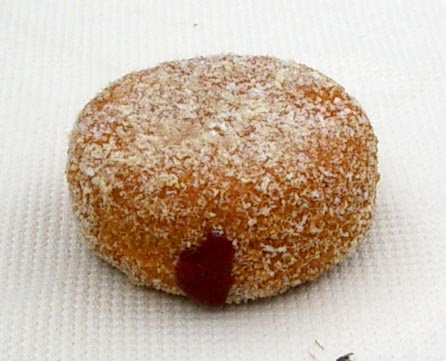
and other people who should know better. Although a "Berliner" is also a type of jelly
doughnut, in the context used by JFK it could not have been misunderstood any more
than if I told you "I am a danish" in English. You might think I was crazy, but you
wouldn't think I was claiming to be a citizen of Denmark (Dänemark). Here is
Kennedy's full statement:
All free men, wherever they live, are citizens of Berlin, and, therefore, as a free man, I
take pride in the words, “Ich bin ein Berliner.”
Part of the problem here stems from the fact that in statements of nationality or
citizenship, German often leaves off the "ein." But in Kennedy's statement, the "ein" was
speech in front of the Schöneberger Rathaus (town hall) in Berlin, and his words were
warmly received. Yet this German myth has been perpetuated by teachers of German
and other people who should know better. Although a "Berliner" is also a type of jelly
doughnut, in the context used by JFK it could not have been misunderstood any more
than if I told you "I am a danish" in English. You might think I was crazy, but you
wouldn't think I was claiming to be a citizen of Denmark (Dänemark). Here is
Kennedy's full statement:
All free men, wherever they live, are citizens of Berlin, and, therefore, as a free man, I
take pride in the words, “Ich bin ein Berliner.”
Part of the problem here stems from the fact that in statements of nationality or
citizenship, German often leaves off the "ein." But in Kennedy's statement, the "ein" was
Answers: 1. June 26, 1963 in Berlin 2. 149 (or 150 if you count the day he gave the speech.) |
| Congratulations to Our Winners! Jim Kiser John Fitzpatrick Carole Cropley Alan Lemm Jim Bullock Diane Burkett Debbie Ciccarelli Gary Sterne Mary Hurley Gerald Vanlandingham Wayne Douglas Carl Blessing Sandy McConathy Rick Mackinney Jim Baker Margaret Paxton Grace Hertz JoLynn Pfeiffer Karen Kay Bunting Susan E. Skidmore Dorothy Nagle Molly Collins Cindy Jolley Richard Wakeham Talea Jurrens Joshua Kreitzer Jocelyn Thayer Mary Wallace Bridges Debbie Sterbinsky Steve Jolley Charlotte Kirby Milene Rawlinson Alan Cullinan Cyndy Brabender Daniel Jolley Larry Slavens Arthur Hartwell Don Draper Peter Norton Donna Jolley John Fitzpatrick Terry A. Hollenstain Tish Olshefski Dennis Brann Rebecca Bare Mark Goldberg Mike Swierczewski Debbie Johnson Jessica Jolley Nicole Blank Gina Espinoza Janice M. Sellers Sharon Martin Margaret Waterman Stan Read Deb Sanders Collier Smith Frank P. Nollette Patty Kiker Betty Chambers Marilyn Hamill Maureen Dolan Mary Tanona Brian Kemp Carol Colgan Michelle Decatur Bob and Venita Wilson Maureen O'Connor Robert W. Steinmann, Jr. Robert Edward McKenna, QPL |

 |  |  |  |
| If you have a picture you'd like us to feature a picture in a future quiz, please email it to us at CFitzp@aol.com. If we use it, you will receive a free analysis of your picture. You will also receive a free Forensic Genealogy CD or a 10% discount towards the purchase of the Forensic Genealogy book. |


 |  |  |  |
| ********** |
| ********** |

| If you enjoy our quizzes, don't forget to order our books! Click here. |

| Quiz #267 Results |
| ********** |
AltaVista's Babel Fish translation software — not always the most accurate of
interpreters — was able to make perfect sense of the phrase, rendering "Ich bin ein
Berliner" in English as "I am a citizen of Berlin" without missing a ping (try it yourself!).
interpreters — was able to make perfect sense of the phrase, rendering "Ich bin ein
Berliner" in English as "I am a citizen of Berlin" without missing a ping (try it yourself!).
| For a website that can calculate how many days are between two dates, please click here and scroll down to Date Calculator. |
| Did President Kennedy Say He Was a Jelly Doughnut? http://german.about.com/library/blgermyth06.htm |
| ********** |
There is a persistent claim that JFK's
famous German phrase, "Ich bin ein
Berliner," was a gaffe that translates as "I
am a jelly doughnut." But when Kennedy
made that statement in a West Berlin
speech in 1963, his German audience
understood exactly what his words
meant: "I am a citizen of Berlin." They
also understood that he was saying that
he stood by them in their Cold War battle
against the Berlin Wall and a divided
Germany.
No one laughed at or misunderstood
President Kennedy's words spoken in
German. In fact, he had been provided
help from translators who knew the
famous German phrase, "Ich bin ein
Berliner," was a gaffe that translates as "I
am a jelly doughnut." But when Kennedy
made that statement in a West Berlin
speech in 1963, his German audience
understood exactly what his words
meant: "I am a citizen of Berlin." They
also understood that he was saying that
he stood by them in their Cold War battle
against the Berlin Wall and a divided
Germany.
No one laughed at or misunderstood
President Kennedy's words spoken in
German. In fact, he had been provided
help from translators who knew the
| Answer to Quiz #267 August 8, 2010 |
| TinEye spoiler alert. You can find this photograph on TinEye, but it's much more fun if you solve the puzzle on your own. |
I'm just the right age (73) and had the right experiences (served in the army in Germany
in 1959-1961) to have clear memories of that period. Also Kennedy was the first
president that I had the opportunity to vote for (absentee ballot from Germany). We
had to be 21 back then to vote. I was fortunate enough to have been on orders to
come home just as the Berlin Wall was being built. Others were having their tour
overseas extended indefinitely when the wall went up and National Guard members
were being activated to go to Germany.
Incidentally, while I was over there, I was on leave in Vienna, Austria, when Kennedy
& Khrushchev met at the 1961 Vienna Summit. I got to see the Kennedys drive by in a
motorcade in front of the Schoenbrunn Palace and remember the warm feeling I had as
I watched the cheering of the crowds. Jim Bullock
*****
The third part [of the quiz] is prejudicial to us diabetics - but it might be a frankfurter
rather than a hamburger, both in common American parlance associated with Germany.
Richard Wakeham
*****
I've got an answer for you early this week! :-) I did a google search for JFK speeches
and found the correct photo after a few pages. Luckily, this page also had the
information about the jelly doughnut urban legend. ....And I first thought it was because
JFK was a tart. ;-) Hehehe..Now I'm craving kolaches!! I checked with the Kolache
Factory and it costs $61.00 to ship 4 dozen here! Drat! :-) Talea Jurrens
*****
This was an easy one. The German speech was what came to mind so I searched
Kennedy Ich ben ein Berliner in google images. There was the picture. Then I
searched history of the jelly doughnut and in the first 6 hits 3 of them referenced the
speech. Milene Rawlinson
*****
I found a couple more links of interest for the quiz. The Wiki article gives a nice
breakdown of the speech and I had to watch the video for myself. It does look like
there were a few moments of "distraction" after he said those famous words and I
especially like the part where he says "I appreciate my interpreter translating my
German." Could it be a clue? Either way, it does make a nice piece of history.
http://en.wikipedia.org/wiki/Ich_bin_ein_Berliner
http://www.americanrhetoric.com/speeches/jfkberliner.html Talea Jurrens
*****
A hamburger? Not the faintest idea. Richard Wakeham
*****
During his oration Kennedy used the phrase "Ich bin ein Berliner" - translating into "I
am a citizen of Berlin" or "I am at one with the citizens of Berlin".I confirmed with my
friends at the German Canadian Club, where I play tennis, that this is exactly how he
should have expressed the intended message. Regarding the doughnut - in some areas
of Germany, a "Berliner" is the name given to a jam or jelly doughnut. One of my
friends said he remembers the center being filled with marmalade and sometimes creamy
icing.
At any rate, some journalists, (e.g. from N.Y. Times) and other individuals felt that
what Kennedy said might have been interpreted as "I am a jelly doughnut". When
Kennedy used the German language expression there were smiles of appreciation and a
loud roar of approval could be heard; people were not making fun of his message.
During the "Cold War", especially in 1963, there was very much the threat of armed
conflict from the Soviet Union. How stressful it must have been for families on either
side of the Berlin Wall when they had friends or relatives on the opposite side and could
make no real contact! Don Draper
*****
My foreign language in high school was German -we all got a kick out of his speech.
Jocelyn Thayer
*****
I recall wondering, after hearing of this, why there was no sign of snicker or titter from
that vast crowd, only enthusiastic ovation. I asked a teacher of German at my high
school about it, ands told that the jelly doughnut thing was nonsense.
I didn't need Google for this one, other than to confirm what was already in my
memory, which works occasionally. Obviously John Kennedy at the microphones, and,
equally obviously, to me, at least, Berlin Mayor Willy Brandt on the far right. Brandt
was rather a hero of mine at the time, and a distinctive face. Peter Norton
*****
Interesting stories behind the quiz this week! My mouth begins to water just thinking
about yummy jelly doughnuts!!!!!!!!!!!! Grace Hertz
*****
Kennedy's speech was wonderfully written and very stirring. I haven't heard the like
since. If he misspoke, well, it was in an effort to describe how free people felt
themselves threatened on all sides during the Cold War. It was not at all like that
speech Carter gave in Poland in which his translator said that he "lusted after the Polish
people" rather than that he "loved the Polish people"! I'd be a jelly doughnut any time!
Margaret Paxton
*****
I think it is funny mistake, too. I watched the speech on YouTube yesterday. On a side
note--here's some trivia for you. My cousin, R. K. Higgins was the Dallas police
officer who lifted JFK from the car to the stretcher, when JFK arrived at Parkland
Memorial Hospital. Molly Collins
****
What I love the most about these puzzles is I learn something from every one of them,
and they usually come out watching Jeopardy, as you know!! Best regards
Dorothy Nagle
*****
This quiz was super easy. One google search of "JFK Jelly donut" lead to the immediate
answer. My quickest solve ever. The speach was on:June 26, 1963 and he was killed:
November 22, 1963 just short of 5 months. Jim Kiser
*****
I'm sure the locals got a chuckle out of it... John Fitzpatrick
*****
It helps to have lived at the time! Debbie Johnson
*****
Thank you for picking my hearo for this week's quiz. I gave me the goosebumps just
to watch the speech on YouTube. Sharon Martin
*****
I arrived at the solution by recognizing JFK in the photo, and associating him with the
jelly donut. Those of us fortunate enough to have lived to see and hear him will not
likely forget the hullaballoo over the phrase, albeit undeserved. Collier Smith
*****
Vielen Dank, mein lieber Doktor Fitzpatrick, für einen weiteren unterhaltsamen Quiz.
Patty Kiker
N.B. Ich freue mich, dass Zie mein Puzzle genossen haben. Q. Gen.
*****
And besides what is so wrong about a jelly doughnut anyway, they certainly keep our
men in blue going strong around here!! Mary Wallace Bridges
*****
Oh, yes! the crowd definitely knew what he meant and rejoiced in it. trying a language
not your own - and one you haven't even studied - is risky at best. he did a great job
IMO. BTW - Irfanview works great - thanks! Debbie Johnson
N.B. See www.irfanview.com for a nice little photo program. Q. Gen.
*****
No, it wasn't a mistake at all. His German statement correctly said that he was a
Berliner at heart. The fact that the statement can also mean that he is a Berliner (term
for a jelly doughnut there) is coincidental. It's kinda like saying, "I am Danish" in the
US -- Is the speaker a Dane or a pastry? Context tells you that. Mike the Finn
(according to my DNA results, anyway). Mike Swierczewski
*****
I’ve also heard that the problem really was more that people from Berlin didn’t generally
call themselves Berliners, even though it was grammatically correct. They did,
however, call jelly donuts by that name. I’m going to my in-laws for dinner tonight.
They’re from Germany , and still lived there at the time. I’m going to ask them about
their reaction to Kennedy’s speech. I’m sure they’re going to shake their heads and
laugh. Thanks for another fun puzzle! Maureen Dolan
*****
Ich bin kein paczki. Marilyn Hamill
N.B. Was ist ein Paczki? Q. Gen.
Es ist ein Gelee Krapfen mit Füllung auf Mardi Gras gefressen zu beschneiden. M.H.
N.B. Google translate: It is a jelly donut with filling on Tuesday to curtail eating
grass. Q. Gen.
*****
I don't speak a word of German, but as I understand the President was right. If
Kennedy had actually been a native of Berlin, he would have said "ich bin Berliner."
Since he was speaking figuratively, apparently the "ein" is correct. I still get a chuckle
over the "I am a jelly doughnut" thing though. Mark Goldberg
in 1959-1961) to have clear memories of that period. Also Kennedy was the first
president that I had the opportunity to vote for (absentee ballot from Germany). We
had to be 21 back then to vote. I was fortunate enough to have been on orders to
come home just as the Berlin Wall was being built. Others were having their tour
overseas extended indefinitely when the wall went up and National Guard members
were being activated to go to Germany.
Incidentally, while I was over there, I was on leave in Vienna, Austria, when Kennedy
& Khrushchev met at the 1961 Vienna Summit. I got to see the Kennedys drive by in a
motorcade in front of the Schoenbrunn Palace and remember the warm feeling I had as
I watched the cheering of the crowds. Jim Bullock
*****
The third part [of the quiz] is prejudicial to us diabetics - but it might be a frankfurter
rather than a hamburger, both in common American parlance associated with Germany.
Richard Wakeham
*****
I've got an answer for you early this week! :-) I did a google search for JFK speeches
and found the correct photo after a few pages. Luckily, this page also had the
information about the jelly doughnut urban legend. ....And I first thought it was because
JFK was a tart. ;-) Hehehe..Now I'm craving kolaches!! I checked with the Kolache
Factory and it costs $61.00 to ship 4 dozen here! Drat! :-) Talea Jurrens
*****
This was an easy one. The German speech was what came to mind so I searched
Kennedy Ich ben ein Berliner in google images. There was the picture. Then I
searched history of the jelly doughnut and in the first 6 hits 3 of them referenced the
speech. Milene Rawlinson
*****
I found a couple more links of interest for the quiz. The Wiki article gives a nice
breakdown of the speech and I had to watch the video for myself. It does look like
there were a few moments of "distraction" after he said those famous words and I
especially like the part where he says "I appreciate my interpreter translating my
German." Could it be a clue? Either way, it does make a nice piece of history.
http://en.wikipedia.org/wiki/Ich_bin_ein_Berliner
http://www.americanrhetoric.com/speeches/jfkberliner.html Talea Jurrens
*****
A hamburger? Not the faintest idea. Richard Wakeham
*****
During his oration Kennedy used the phrase "Ich bin ein Berliner" - translating into "I
am a citizen of Berlin" or "I am at one with the citizens of Berlin".I confirmed with my
friends at the German Canadian Club, where I play tennis, that this is exactly how he
should have expressed the intended message. Regarding the doughnut - in some areas
of Germany, a "Berliner" is the name given to a jam or jelly doughnut. One of my
friends said he remembers the center being filled with marmalade and sometimes creamy
icing.
At any rate, some journalists, (e.g. from N.Y. Times) and other individuals felt that
what Kennedy said might have been interpreted as "I am a jelly doughnut". When
Kennedy used the German language expression there were smiles of appreciation and a
loud roar of approval could be heard; people were not making fun of his message.
During the "Cold War", especially in 1963, there was very much the threat of armed
conflict from the Soviet Union. How stressful it must have been for families on either
side of the Berlin Wall when they had friends or relatives on the opposite side and could
make no real contact! Don Draper
*****
My foreign language in high school was German -we all got a kick out of his speech.
Jocelyn Thayer
*****
I recall wondering, after hearing of this, why there was no sign of snicker or titter from
that vast crowd, only enthusiastic ovation. I asked a teacher of German at my high
school about it, ands told that the jelly doughnut thing was nonsense.
I didn't need Google for this one, other than to confirm what was already in my
memory, which works occasionally. Obviously John Kennedy at the microphones, and,
equally obviously, to me, at least, Berlin Mayor Willy Brandt on the far right. Brandt
was rather a hero of mine at the time, and a distinctive face. Peter Norton
*****
Interesting stories behind the quiz this week! My mouth begins to water just thinking
about yummy jelly doughnuts!!!!!!!!!!!! Grace Hertz
*****
Kennedy's speech was wonderfully written and very stirring. I haven't heard the like
since. If he misspoke, well, it was in an effort to describe how free people felt
themselves threatened on all sides during the Cold War. It was not at all like that
speech Carter gave in Poland in which his translator said that he "lusted after the Polish
people" rather than that he "loved the Polish people"! I'd be a jelly doughnut any time!
Margaret Paxton
*****
I think it is funny mistake, too. I watched the speech on YouTube yesterday. On a side
note--here's some trivia for you. My cousin, R. K. Higgins was the Dallas police
officer who lifted JFK from the car to the stretcher, when JFK arrived at Parkland
Memorial Hospital. Molly Collins
****
What I love the most about these puzzles is I learn something from every one of them,
and they usually come out watching Jeopardy, as you know!! Best regards
Dorothy Nagle
*****
This quiz was super easy. One google search of "JFK Jelly donut" lead to the immediate
answer. My quickest solve ever. The speach was on:June 26, 1963 and he was killed:
November 22, 1963 just short of 5 months. Jim Kiser
*****
I'm sure the locals got a chuckle out of it... John Fitzpatrick
*****
It helps to have lived at the time! Debbie Johnson
*****
Thank you for picking my hearo for this week's quiz. I gave me the goosebumps just
to watch the speech on YouTube. Sharon Martin
*****
I arrived at the solution by recognizing JFK in the photo, and associating him with the
jelly donut. Those of us fortunate enough to have lived to see and hear him will not
likely forget the hullaballoo over the phrase, albeit undeserved. Collier Smith
*****
Vielen Dank, mein lieber Doktor Fitzpatrick, für einen weiteren unterhaltsamen Quiz.
Patty Kiker
N.B. Ich freue mich, dass Zie mein Puzzle genossen haben. Q. Gen.
*****
And besides what is so wrong about a jelly doughnut anyway, they certainly keep our
men in blue going strong around here!! Mary Wallace Bridges
*****
Oh, yes! the crowd definitely knew what he meant and rejoiced in it. trying a language
not your own - and one you haven't even studied - is risky at best. he did a great job
IMO. BTW - Irfanview works great - thanks! Debbie Johnson
N.B. See www.irfanview.com for a nice little photo program. Q. Gen.
*****
No, it wasn't a mistake at all. His German statement correctly said that he was a
Berliner at heart. The fact that the statement can also mean that he is a Berliner (term
for a jelly doughnut there) is coincidental. It's kinda like saying, "I am Danish" in the
US -- Is the speaker a Dane or a pastry? Context tells you that. Mike the Finn
(according to my DNA results, anyway). Mike Swierczewski
*****
I’ve also heard that the problem really was more that people from Berlin didn’t generally
call themselves Berliners, even though it was grammatically correct. They did,
however, call jelly donuts by that name. I’m going to my in-laws for dinner tonight.
They’re from Germany , and still lived there at the time. I’m going to ask them about
their reaction to Kennedy’s speech. I’m sure they’re going to shake their heads and
laugh. Thanks for another fun puzzle! Maureen Dolan
*****
Ich bin kein paczki. Marilyn Hamill
N.B. Was ist ein Paczki? Q. Gen.
Es ist ein Gelee Krapfen mit Füllung auf Mardi Gras gefressen zu beschneiden. M.H.
N.B. Google translate: It is a jelly donut with filling on Tuesday to curtail eating
grass. Q. Gen.
*****
I don't speak a word of German, but as I understand the President was right. If
Kennedy had actually been a native of Berlin, he would have said "ich bin Berliner."
Since he was speaking figuratively, apparently the "ein" is correct. I still get a chuckle
over the "I am a jelly doughnut" thing though. Mark Goldberg
| ********** |
| Pfannkuchen (Berliner) |
Zutaten für Portionen
500 g Mehl
3 Ei(er)
50 g Zucker
½ Zitrone(n), den Abrieb
½ TL Salz
20 g Hefe
100 g Margarine
Milch, lauwarme
Marmelade, (Erdbeer-) zum Füllen
1 Eiweiß
Öl, neutrales, zum Ausbacken
Puderzucker
Zubereitung
Aus den Backzutaten einen Hefeteig herstellen, auf kaltem Wege gehen lassen.
Ca. 1/2 cm. dick ausrollen, mit einem (Senf)Glas Kreise ausstechen und ca. 1 Teelöffel
Marmelade in die Mitte geben. Den Rand eines 2. Teigkreises mit Eiweiß einpinseln und
fest auf den Marmeladenkreis aufdrücken.
Die Berliner an einem warmen Ort gut aufgehen lassen.
In der Fritteuse das Fett erhitzen (Stäbchenprobe) und die Berliner, umgekehrt wie sie
vorher lagen, reintun und von beiden Seiten braun backen lassen.
Auf einem Sieb abtropfen lassen und sofort mit Puderzucker bestreuen.
Zubereitungszeit: ca. 30 Min.
Ruhezeit: ca. 2 Std.
Schwierigkeitsgrad: normal
Brennwert p. P.: keine Angabe
Freischaltung: 19.02.09
Rezept-Statistiken: 7.319 (108)* gelesen
66 (2)* gespeichert
373 (6)* gedruckt
4 (0)* verschickt
* nur in diesem Monat
http://www.chefkoch.de/rezepte/1299611235049244/Berliner-Pfannkuchen.html
500 g Mehl
3 Ei(er)
50 g Zucker
½ Zitrone(n), den Abrieb
½ TL Salz
20 g Hefe
100 g Margarine
Milch, lauwarme
Marmelade, (Erdbeer-) zum Füllen
1 Eiweiß
Öl, neutrales, zum Ausbacken
Puderzucker
Zubereitung
Aus den Backzutaten einen Hefeteig herstellen, auf kaltem Wege gehen lassen.
Ca. 1/2 cm. dick ausrollen, mit einem (Senf)Glas Kreise ausstechen und ca. 1 Teelöffel
Marmelade in die Mitte geben. Den Rand eines 2. Teigkreises mit Eiweiß einpinseln und
fest auf den Marmeladenkreis aufdrücken.
Die Berliner an einem warmen Ort gut aufgehen lassen.
In der Fritteuse das Fett erhitzen (Stäbchenprobe) und die Berliner, umgekehrt wie sie
vorher lagen, reintun und von beiden Seiten braun backen lassen.
Auf einem Sieb abtropfen lassen und sofort mit Puderzucker bestreuen.
Zubereitungszeit: ca. 30 Min.
Ruhezeit: ca. 2 Std.
Schwierigkeitsgrad: normal
Brennwert p. P.: keine Angabe
Freischaltung: 19.02.09
Rezept-Statistiken: 7.319 (108)* gelesen
66 (2)* gespeichert
373 (6)* gedruckt
4 (0)* verschickt
* nur in diesem Monat
http://www.chefkoch.de/rezepte/1299611235049244/Berliner-Pfannkuchen.html
| ********** |
| Kennedy's speech in Berlin upload.wikimedia.org/wiki... |

There are commemorative sites to Kennedy
in Berlin, such as the German-American
John F. Kennedy School and the John F.
Kennedy Institute for North American
Studies of the Free University of Berlin.
Also, the public square in front of the
Rathaus Schöneberg (where Kennedy made
the famous speech, see image to right) was
renamed "John-F.-Kennedy-Platz". A large
plaque dedicated to Kennedy is mounted on
a column at the entrance of the building and
the room above the entrance and
overlooking the square is dedicated to
Kennedy and his visit.
The original manuscript of the speech is
stored with the National Archives and
Records Administration.
en.wikipedia.org/wiki/Ich_bin_ein_Berliner
in Berlin, such as the German-American
John F. Kennedy School and the John F.
Kennedy Institute for North American
Studies of the Free University of Berlin.
Also, the public square in front of the
Rathaus Schöneberg (where Kennedy made
the famous speech, see image to right) was
renamed "John-F.-Kennedy-Platz". A large
plaque dedicated to Kennedy is mounted on
a column at the entrance of the building and
the room above the entrance and
overlooking the square is dedicated to
Kennedy and his visit.
The original manuscript of the speech is
stored with the National Archives and
Records Administration.
en.wikipedia.org/wiki/Ich_bin_ein_Berliner
| 3. He ended his speech with the famous statement, "Ich bin ein Berliner", intending to indicate his solidarity with the people of Berlin in light of the recent construction of the Berlin Wall. However, a Berliner is a type of German pastry, so that the phrase can be interpreted as "I am a jelly donut". Kennedy was grammatically correct, although the spin doctors have had 50+ years to smooth things over with research on the distribution of donuts in Germany and the names they are given in each region. "Berliner Pfannkuchen" is the official name of the desserts, but they are called Pfannkuchen in Berlin. However, the crowd would not have misinterpreted Kennedy's statement any more than someone would misinterpret "I am a New Yorker" to indicate the person speaking was a magazine. |
correct and expressed that he was "one" of
them. Not only that, but in Berlin a jelly
doughnut is actually called ein
Pfannkuchen, not ein Berliner. (In most of
Germany, der Pfannkuchen means
"pancake.") Over the years there have been
translation or interpreting errors with U.S.
public officials abroad, but this isn't one of
them.
them. Not only that, but in Berlin a jelly
doughnut is actually called ein
Pfannkuchen, not ein Berliner. (In most of
Germany, der Pfannkuchen means
"pancake.") Over the years there have been
translation or interpreting errors with U.S.
public officials abroad, but this isn't one of
them.
| ********** |
| Comments from Our Readers |

| ********** |
| ********** |
| Quiz Number 267, 8 August 2010 IF IT AIN'T JELLY IT MUST BE JAM President Kennedy on 26 June 1963 gave a Berlin supporting speech, On 22 November1963 he was assinated 153 days after that outreach. It was intent to identify himself as a "Citizen of Berlin." However using the expression of " Ich bin ein Berlin'" Unfortunately the literal translation of that foreign expression, He identified himself as a "Jam doughnut." in the concession, The intent of the speech was accepted well by one and all, As it was his intention to support Berlin in their recovery call. Robert E. McKenna Quiz Poet Laureate ***** In expressing his solidarity And making a a profession He made a jocularity. That became a sweet concession. If I say I'm a New Yorker You must know that I mean I am a native of the town And not a magazine. Colleen Fitzpatrick, PhD Understand of Robert Edward McKenna Quiz Poet Laureate |

| 1. When did this historic event take place? 2. How many days did it occur before he was assassinated? 3. What does this event have to do with the item in the picture to the left? |