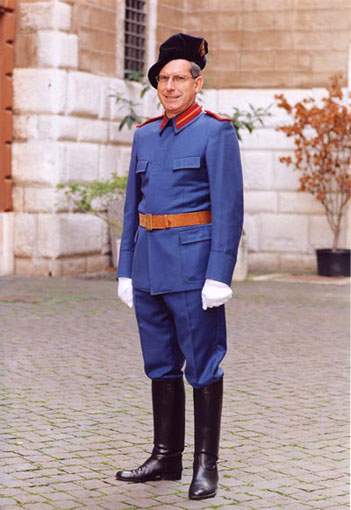
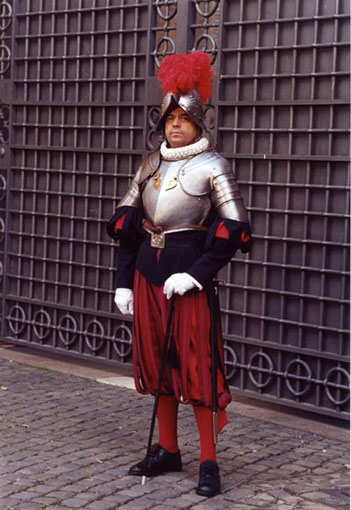
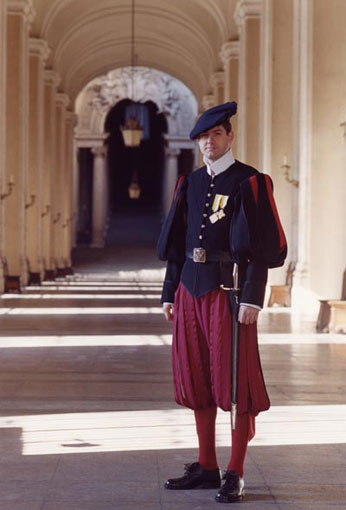
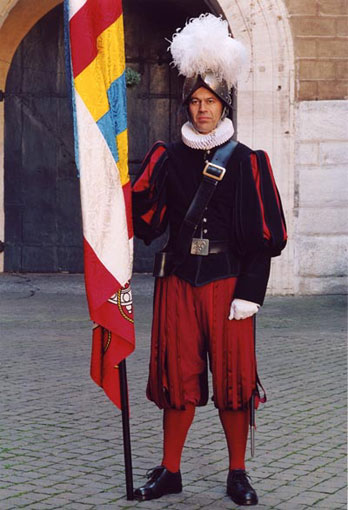
| Swiss Guard Uniforms www.schweizergarde.org/ |
| Officer Gala |
regular Swiss mercenary regiments served as line troops in various armies, notably
those of France, Spain and Naples up to the 19th century.
Various units of Swiss Guard have existed for hundreds of years. The earliest such
detachment was the Swiss Hundred Guard (Cent-Garde) at the French court (1497 –
1830). This small force was complemented in 1567 by a Swiss Guard regiment. The
Papal Swiss Guard in the Vatican was founded in 1506 and is the only Swiss Guard
that still exists. In the 18th century several other Swiss Guards existed for periods in
various European courts.
Recruiting, equipping and instructing mercenary soldiers and sending them to the
service of French kings and Italian dukes was once big business for patrician families in
central Switzerland.
During the Reformation the institution was challenged by Huldrych Zwingli, a military
chaplain who was a veteran of military campaigns in northern Italy. He met with fierce
resistance, since the mercenaries were a major source of income for influential families,
those of France, Spain and Naples up to the 19th century.
Various units of Swiss Guard have existed for hundreds of years. The earliest such
detachment was the Swiss Hundred Guard (Cent-Garde) at the French court (1497 –
1830). This small force was complemented in 1567 by a Swiss Guard regiment. The
Papal Swiss Guard in the Vatican was founded in 1506 and is the only Swiss Guard
that still exists. In the 18th century several other Swiss Guards existed for periods in
various European courts.
Recruiting, equipping and instructing mercenary soldiers and sending them to the
service of French kings and Italian dukes was once big business for patrician families in
central Switzerland.
During the Reformation the institution was challenged by Huldrych Zwingli, a military
chaplain who was a veteran of military campaigns in northern Italy. He met with fierce
resistance, since the mercenaries were a major source of income for influential families,
| Read more about the Swiss Guard The Official Swiss Guard Homepage www.schweizergarde.org/ The Vatican Website www.vatican.va/roman_curia/swiss_guard... Contemporary Account of the 10th of August Insurrection chnm.gmu.edu/revolution/d/319/ Wikipedia Article en.wikipedia.org/wiki/Swiss_Guard |
| How Marjorie Solved the Puzzle |
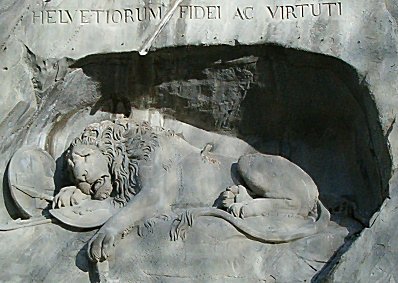
| HELVETIORUM FIDEI AC VIRTUTI The loyalty and bravery of the Swiss DIE X AUGUSTI II ET III SEPTEMBRIS MDCCXCII 10 August, 2 and 3 September 1792 HAEC SUNT NOMINA EORUM QUI NE SACRAMENTI FIDEM FALLERENT Honour roll of the soldiers, who, while upholding their oath of allegiance |

 |  |  |  |
| If you have a picture you'd like us to feature a picture in a future quiz, please email it to us at CFitzp@aol.com. If we use it, you will receive a free analysis of your picture. You will also receive a free Forensic Genealogy CD or a 10% discount towards the purchase of the Forensic Genealogy book. |


 |  |  |  |
| ********** |
| ********** |

| If you enjoy our quizzes, don't forget to order our books! Click here. |

| Enter Contest |
The Lion Monument in Lucerne is a giant
dying lion carved out of a wall of
sandstone rock above a pond at the east
end of the medieval town. It was
designed as a memorial for the mercenary
soldiers from central Switzerland who
lost their lives while serving the French
king Louis XVI during the French
Revolution.
From the early 17th century, a regiment of
dying lion carved out of a wall of
sandstone rock above a pond at the east
end of the medieval town. It was
designed as a memorial for the mercenary
soldiers from central Switzerland who
lost their lives while serving the French
king Louis XVI during the French
Revolution.
From the early 17th century, a regiment of
| The Lion of Lucerne travelguide.all-about-switzerland.info... en.wikipedia.org/wiki/Lion_Monument |
1. Lucerne, Switzerland 2. Defeat of the Swiss Guard, August 1792 at the Tuilleries Garden in Paris. 3. According to Mark Twain, "This is the saddest and most moving piece of stone in the world." We also accepted the inscription on the monument in response to question #3. |
| SOLERTI AMICORUM CURA CLADI SUPERFUERUNT Survived the battle through the care and attention of friends: DUCES XVI 16 officers H. Salis-Zizers, Dürler, Pfyffer-Altishofen, E. Zimmermann, Repond, I. Zimmermann, Deluze, A. Zimmermann, Glutz, Gibelin, Maillardoz, De Ville, Constant-Rebecque, Lacorbière, Forestier, Loretan. MILITES CIRCITER CCCL approximately 350 soldiers |
| FORTISSIME PUGNANTES CECIDERUNT Fell in the line of duty DUCES XXVI 26 officers Maillardoz, Bachmann, Reding, Erlach, Salis-Zizers, H Diesbach, Gottrau, L Zimmermann, Wild, Castelberg, Gros, P. Glutz, S. Maillardoz, Ernest, Forestier, Diesbach, Steinbrugg, Waltner, I. Maillardoz, Müller, Montmollin, Castella, Orgemont, Caprez, Allemann, Chollet, Boecking, Richter MILITES CIRCITER DCCLX approximately 760 soldiers |
| The Lion stumped me for a few minutes. The inscription appeared to be Latin (and turned out later to be) but the photo wasn't helpful. I used Google's image search to find images of "stone lion," which led me to a captioned shot of "lime stone lion" in Lucerne. Once I could read the Latin I realized it was Swiss. A Google advanced search (not image) for "Lucerne" and (exact phrase) "lion monument" got me the answers.com website with the rest of the information. So, it's in Lucerne, Switzerland; commemorates the massacre of the Swiss Guards during the French Revolution; and writer Mark Twain said it was "the most mournful and moving piece of stone in the world," with fuller quote found on another website from his _A Tramp Abroad_. I think my time total was 10 minutes, of which the first five were spent staring at it to determine strategy. Marjorie Wilser |
Swiss Guards is the name given to the
Swiss soldiers who have served as
bodyguards, ceremonial guards, and
palace guards at foreign European courts
since the late 15th century. In
contemporary usage, it refers to the
Pontifical Swiss Guard of Vatican City.
They have a high reputation for discipline
and loyalty to their employers. Apart from
household and guard units, some
formations also serve as fighting troops;
Swiss soldiers who have served as
bodyguards, ceremonial guards, and
palace guards at foreign European courts
since the late 15th century. In
contemporary usage, it refers to the
Pontifical Swiss Guard of Vatican City.
They have a high reputation for discipline
and loyalty to their employers. Apart from
household and guard units, some
formations also serve as fighting troops;
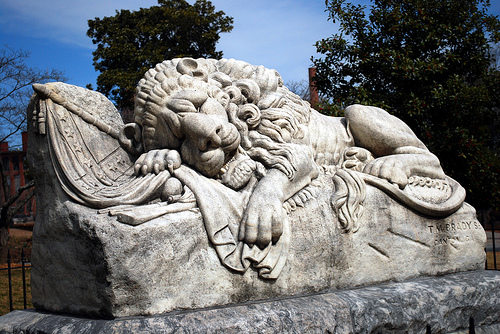
Lion Statue in Atlanta A near-copy of the Lion of Lucerne, Switzerland, the Lion of Atlanta is a monument to the more than 3,000 unknown confederate soldiers who lie in Oakland Cemetery. Carved in 1894 by T.M. Brady of Georgia marble. www.flickr.com/photos/andycoan/4395261743/in/set-72157620429714028/ |
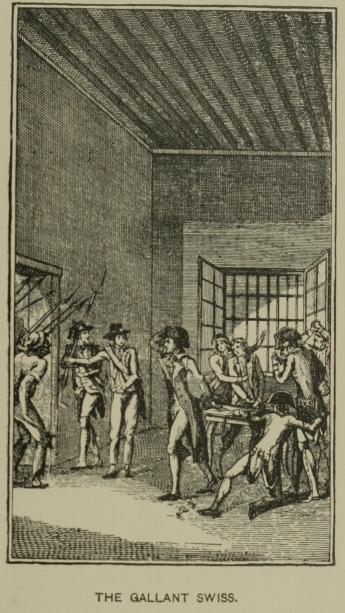
Swiss mercenaries had served as part of the Royal Household of France. On 6 October
1789, King Louis XVI had been forced to move with his family from the Palace of
Versailles to the Tuileries Palace in Paris. In June 1791 he tried to flee abroad. In the
1792 10th of August Insurrection, revolutionaries stormed the palace. Fighting broke
out spontaneously after the Royal Family had been escorted from the Tuileries to take
refuge with the Legislative Assembly. The Swiss mercenary troops tried to defend the
royal family and make sure the royals could escape. The Swiss ran low on ammunition
and were soon overwhelmed by superior numbers. A note written by the King has
survived, ordering the Swiss to retire and return to their barracks, but this was only
acted on after their position had become untenable.
Of the Swiss Guards defending the Tuileries, more than six hundred were killed during
the fighting or massacred after surrender. An estimated two hundred more died in
prison of their wounds or were killed during the September Massacres that followed.
The regimental standards had been secretly buried by the adjutant shortly before the
regiment was summoned to the Tuileries on the night of August 9, indicating that the
likely end was foreseen. They were discovered by a gardener and ceremonially burned
by the new Republican authorities.
1789, King Louis XVI had been forced to move with his family from the Palace of
Versailles to the Tuileries Palace in Paris. In June 1791 he tried to flee abroad. In the
1792 10th of August Insurrection, revolutionaries stormed the palace. Fighting broke
out spontaneously after the Royal Family had been escorted from the Tuileries to take
refuge with the Legislative Assembly. The Swiss mercenary troops tried to defend the
royal family and make sure the royals could escape. The Swiss ran low on ammunition
and were soon overwhelmed by superior numbers. A note written by the King has
survived, ordering the Swiss to retire and return to their barracks, but this was only
acted on after their position had become untenable.
Of the Swiss Guards defending the Tuileries, more than six hundred were killed during
the fighting or massacred after surrender. An estimated two hundred more died in
prison of their wounds or were killed during the September Massacres that followed.
The regimental standards had been secretly buried by the adjutant shortly before the
regiment was summoned to the Tuileries on the night of August 9, indicating that the
likely end was foreseen. They were discovered by a gardener and ceremonially burned
by the new Republican authorities.
| History of the Swiss Guard travelguide.all-about-switzerland.info... en.wikipedia.org/wiki/Swiss_Guard www.schweizergarde.org/ |
| Directions to the Lion Monument in Lucerne |
| Comments from Our Readers |
Thanks again for taking us to another interesting spot in our amazing world.
Venita Wilson
*****
To solve this I did a search for “lion sculpture” and the first offerings were the sleeping
lion of Bavaria in Nafplio. The sculpture is similar but this one does not have a spear
sticking in it like the Lucerne lion. I added “sleeping” the search (google images) and
found the lion of the photo quiz.
Like many quizzes this one invites further exploration of related topics. The other
works of the Danish sculptor, Bertel Thorvaldson were of interest. I read that a man
named Lukas Ahorn actually did much of the cutting of the sandstone rock in 1820-21
- Thorvaldson must have been like a designer and project director. I thought this would
take a very long time to achieve but he is given credit for many other works. One might
ask “Why a lion?” to honor the dead Swiss guards. Many Biblical references to this
animal show him to be a “beast” and evil. In other cases the lion is aligned with royalty
(He is King of Beasts). Carved lions often are placed at the entrance to a building -
perhaps serving the function of guarding the area. The slain lion of Lucerne indeed pays
homage to guards who tried to protect the French monarchy. Don Draper
*****
Lion looks a lot like Mr. Rick when he starts 4th period of class...Thanks guys-
where's my gradebook!!!! Mr. Rick and the Quiz Kids
*****
I love Mark Twain's wording. He uses "moving" to describe something that's hard to
physically move, a rock. Caroline Pointer
*****
Mark Twain called the Lion Monument "the saddest and most moving piece of rock in
the world". I tend to agree with him the more I look at that poor lion. Nicole Blank
*****
The internet sure spoils us.... just searched for "lion carved in stone" and voila --
Lucerne Lion! Karen Petrus
*****
I just Wikied "Lion Monument" and spent over an hour following all the
links. http://en.wikipedia.org/wiki/Lion_Monument Mary South
*****
I recognized this photograph immediately because I have seen the sculpture in person. I
was in Lucerne, Switzerland for an international conference many years ago, and I saw
"The Dying Lion", as the locals called it. If you have not seen this info, it is interesting-
http://www.gletschergarten.ch/en/info/2_loewe/material/lionmonument.pdf
Bill Utterback
*****
It is a stunning sight. Sherry Marshall
*****
TinEye not used. Only Google search under "lion carving". Stan Read
*****
I'm so excited to see a picture of something I've seen in person! Jessica Jolley
*****
Did the puzzle without the assistance of TinEye, just punched in "lion wall carving" into
Google image search and got the answer. Great quiz learned alot!
Robert W. Steinmann, Jr.
*****
What a very moving and impressive sculpture commemorating a sad part of history.
Thanks, Fearless Leader! Grace Hertz
*****
Animals have a way of conveying emotion to us that people cannot, and it was fitting
that such a majestic creature in its death throes was chosen to represent fallen soldiers.
Had we actually seen a memorial of fallen soldiers, I think it would be less touching and
poignant (just my opinion). Nicole Blank
*****
Just a week or two ago I was looking for some information on another monument and
happened upon a picture of the Lucerne Lion, so he was very easy to find again.
Magnificent. Peter Norton
Venita Wilson
*****
To solve this I did a search for “lion sculpture” and the first offerings were the sleeping
lion of Bavaria in Nafplio. The sculpture is similar but this one does not have a spear
sticking in it like the Lucerne lion. I added “sleeping” the search (google images) and
found the lion of the photo quiz.
Like many quizzes this one invites further exploration of related topics. The other
works of the Danish sculptor, Bertel Thorvaldson were of interest. I read that a man
named Lukas Ahorn actually did much of the cutting of the sandstone rock in 1820-21
- Thorvaldson must have been like a designer and project director. I thought this would
take a very long time to achieve but he is given credit for many other works. One might
ask “Why a lion?” to honor the dead Swiss guards. Many Biblical references to this
animal show him to be a “beast” and evil. In other cases the lion is aligned with royalty
(He is King of Beasts). Carved lions often are placed at the entrance to a building -
perhaps serving the function of guarding the area. The slain lion of Lucerne indeed pays
homage to guards who tried to protect the French monarchy. Don Draper
*****
Lion looks a lot like Mr. Rick when he starts 4th period of class...Thanks guys-
where's my gradebook!!!! Mr. Rick and the Quiz Kids
*****
I love Mark Twain's wording. He uses "moving" to describe something that's hard to
physically move, a rock. Caroline Pointer
*****
Mark Twain called the Lion Monument "the saddest and most moving piece of rock in
the world". I tend to agree with him the more I look at that poor lion. Nicole Blank
*****
The internet sure spoils us.... just searched for "lion carved in stone" and voila --
Lucerne Lion! Karen Petrus
*****
I just Wikied "Lion Monument" and spent over an hour following all the
links. http://en.wikipedia.org/wiki/Lion_Monument Mary South
*****
I recognized this photograph immediately because I have seen the sculpture in person. I
was in Lucerne, Switzerland for an international conference many years ago, and I saw
"The Dying Lion", as the locals called it. If you have not seen this info, it is interesting-
http://www.gletschergarten.ch/en/info/2_loewe/material/lionmonument.pdf
Bill Utterback
*****
It is a stunning sight. Sherry Marshall
*****
TinEye not used. Only Google search under "lion carving". Stan Read
*****
I'm so excited to see a picture of something I've seen in person! Jessica Jolley
*****
Did the puzzle without the assistance of TinEye, just punched in "lion wall carving" into
Google image search and got the answer. Great quiz learned alot!
Robert W. Steinmann, Jr.
*****
What a very moving and impressive sculpture commemorating a sad part of history.
Thanks, Fearless Leader! Grace Hertz
*****
Animals have a way of conveying emotion to us that people cannot, and it was fitting
that such a majestic creature in its death throes was chosen to represent fallen soldiers.
Had we actually seen a memorial of fallen soldiers, I think it would be less touching and
poignant (just my opinion). Nicole Blank
*****
Just a week or two ago I was looking for some information on another monument and
happened upon a picture of the Lucerne Lion, so he was very easy to find again.
Magnificent. Peter Norton
| Comgratulations to Our Winners! Mr. Rick and the Quiz Kids Roar Along! (Get it....ROAR along?) And I'm not Lion! Diane Burkett Mary South Tim Fitzpatrick (Brother of Q. Gen.) Tamura Jones Bill Utterback Marjorie Wilser Judy Lewin Alan Lemm Kay Meyer Teresa Yu Evan Hindman Laurel Fletchner Gerald Vanlandingham Gary Sterne Don Draper Caroline Pointer Elaine C. Hebert Sandy McConathy Jim Kiser Norm Smith Rebecca Bare Bill Hurley Donna Jolley Kathleen Londagin John Chulick Marilyn Hamill Nicole Blank Karen Petrus Peter Norton Carl Blessing JoLynn Pfeiffer Margaret Paxton Sherry Marshall Edee Scott Maureen O'Connor Robin Depietro Stan Read Ben Truwe Jessica Jolley Sharon Martin Linda Williams Karen Kay Bunting Joshua Kreitzer Judy Pfaff Debbie Johnson Daniel Jolley Robert W. Steinmann, Jr. Beth Long Betty Chambers Grace Hertz Jocelyn Thayer |
| How Norm Solved the Puzzle |
red uniform coat. However two surviving Swiss officers went on to reach senior rank
under Napoleon.
An officer of the Swiss guards, second lieutenant Carl Pfyffer von Altishofen, a
descendant from an influential patrician family, happened to be on home leave in
Lucerne when his fellow soldiers were killed in Paris. After the times of revolution were
over in 1815 and France as well as Switzerland had returned to conservative regimes,
Pfyffer felt obliged to erect a memorial to honor the mercenary soldiers. He began
collecting money in 1818.
Liberal politicians from all over Switzerland disapproved of the memorial, but they were
in a minority position during the 1820's and Pfyffer was backed by a majority in
Lucerne. The monument was designed by Danish sculptor Bertel Thorvaldsen, and
finally hewn in 1820–21 by Lukas Ahorn, in a former sandstone quarry near Lucerne.
The monument is dedicated Helvetiorum Fidei ac Virtuti ("To the loyalty and bravery of
the Swiss"). The dying lion is portrayed impaled by a spear, covering a shield bearing
the fleur-de-lis of the French monarchy; beside him is another shield bearing the coat of
arms of Switzerland. The inscription below the sculpture lists the names of the officers,
and approximate numbers of the soldiers who died (DCCLX = 760), and survived
(CCCL = 350).
under Napoleon.
An officer of the Swiss guards, second lieutenant Carl Pfyffer von Altishofen, a
descendant from an influential patrician family, happened to be on home leave in
Lucerne when his fellow soldiers were killed in Paris. After the times of revolution were
over in 1815 and France as well as Switzerland had returned to conservative regimes,
Pfyffer felt obliged to erect a memorial to honor the mercenary soldiers. He began
collecting money in 1818.
Liberal politicians from all over Switzerland disapproved of the memorial, but they were
in a minority position during the 1820's and Pfyffer was backed by a majority in
Lucerne. The monument was designed by Danish sculptor Bertel Thorvaldsen, and
finally hewn in 1820–21 by Lukas Ahorn, in a former sandstone quarry near Lucerne.
The monument is dedicated Helvetiorum Fidei ac Virtuti ("To the loyalty and bravery of
the Swiss"). The dying lion is portrayed impaled by a spear, covering a shield bearing
the fleur-de-lis of the French monarchy; beside him is another shield bearing the coat of
arms of Switzerland. The inscription below the sculpture lists the names of the officers,
and approximate numbers of the soldiers who died (DCCLX = 760), and survived
(CCCL = 350).
| Quiz #252 April 12, 2010 |
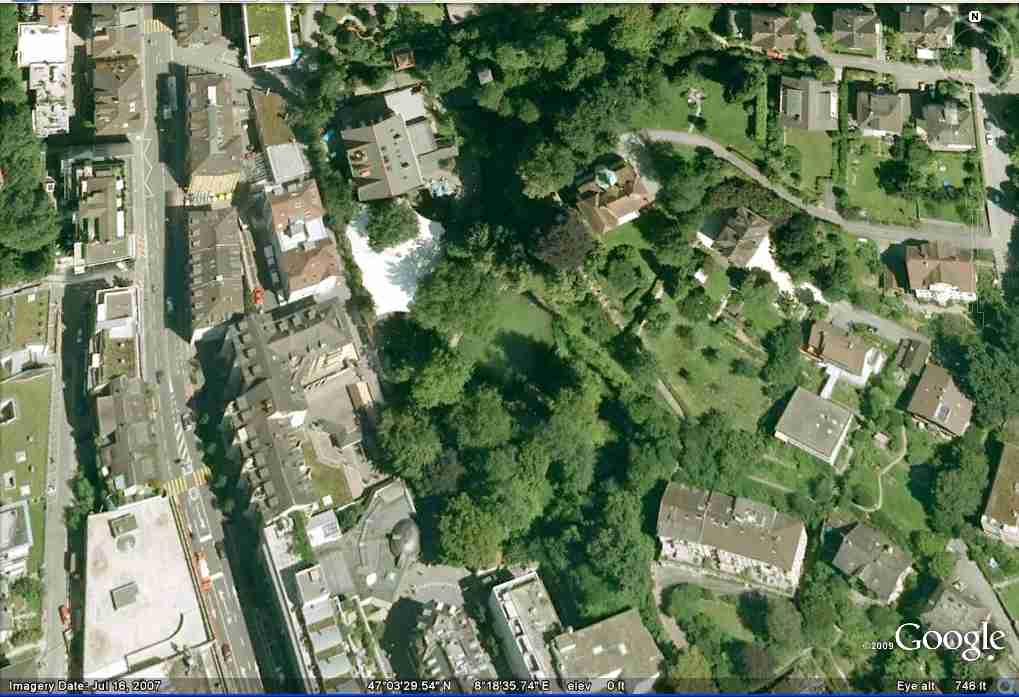
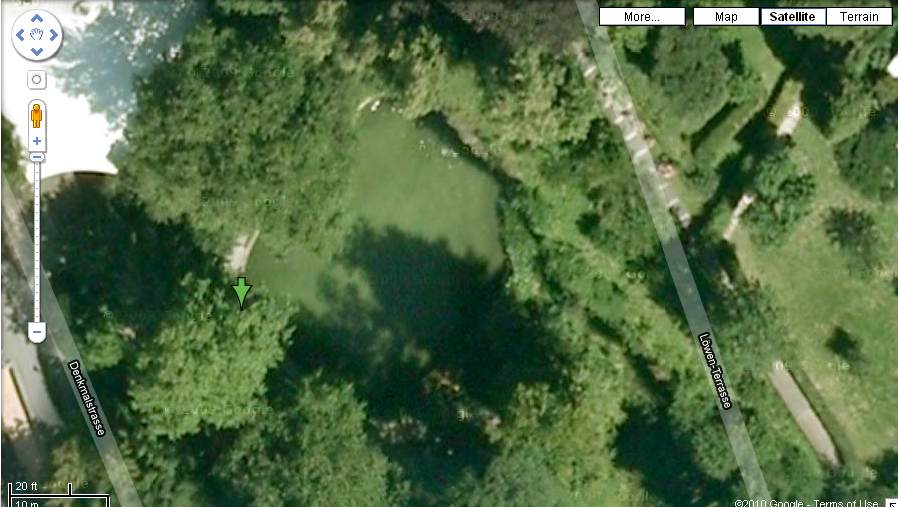
| By bus: From the main train station take a northbound bus number 1 (Maihof) 19 (Kantonsspital/Friedental) 22 (Perlen/Inwil) 23 (Dierikon-Root) until stop "Löwenplatz" [Lion Square]. From Löwenplatz turn to the right for a few steps and then left again and follow either Löwengartenstrasse or Denkmalstrasse leading you north to the Alpineum. From there it's only a few more steps to the entrance to the English Garden with the Lion Monument and the Glacier Garden. GPS coordinates: latitude=47.058326 longitude=8.310589 maps by search.ch and google. |
| I first tried to solve this quiz by focusing on the inscription above the lion. I could not make out clearly the letters so I took another tact of using Google to see what I could find. I went "basic" this time and literally described what the picture depicted; namely, "lion carved in stone". The first "hit" was the link to this monument. This was an interesting piece of Swiss history. Norm Smith |
Apart from about a hundred Swiss who
escaped from the Tuileries, some hidden
by sympathetic Parisians, the only
survivors of the regiment were a 300
strong detachment which had been sent to
Normandy a few days before August 10.
The Swiss officers were mostly amongst
those massacred, although Major Karl
Josef von Bachmann — in command at
the Tuileries — was formally tried and
guillotined in September, still wearing his
escaped from the Tuileries, some hidden
by sympathetic Parisians, the only
survivors of the regiment were a 300
strong detachment which had been sent to
Normandy a few days before August 10.
The Swiss officers were mostly amongst
those massacred, although Major Karl
Josef von Bachmann — in command at
the Tuileries — was formally tried and
guillotined in September, still wearing his
1. Where is this carving located? 2. What does it commemorate? 3. Give a famous quote about this sculpture. TINEYE SPOILER ALERT. Try to do this puzzle without the assistance of Tineye. It will be more fun. |
| Suggested by long time Quizmaster Milene Rawlinson |
| ********** |

| ********** |
| ********** |
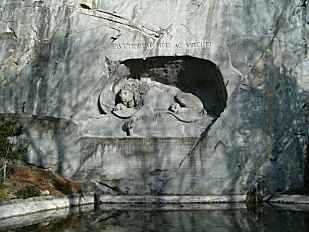
| The Lion lies in his lair in the perpendicular face of a low cliff — for he is carved from the living rock of the cliff. His size is colossal, his attitude is noble. His head is bowed, the broken spear is sticking in his shoulder, his protecting paw rests upon the lilies of France. Vines hang down the cliff and wave in the wind, and a clear stream trickles from above and empties into a pond at the base, and in the smooth surface of the pond the lion is mirrored, among the water-lilies. Around about are green trees and grass. The place is a sheltered, reposeful woodland nook, remote from noise and stir and confusion — and all this is fitting, for lions do die in such places, and not on granite pedestals in public squares fenced with fancy iron railings. The Lion of Lucerne would be impressive anywhere, but nowhere so impressive as where he is. – Mark Twain, A Tramp Abroad, 1880 |
The pose of the ion was copied in 1894
by Thomas M. Brady (1849-1907) for
his Lion of Atlanta in the Oakland
Cemetery in Atlanta, Georgia.The Lion
Monument was inaugurated on August
10, 1821.
Originally the site was private property.
In 1882 the city of Lucerne bought it.
The site is accessible without an entrance
fee. The monument soon became one of
Lucerne's major tourist attractions.
The Lion Monument was designed by
Bertel Thorvaldsen (1770-1884), a
classicist Danish sculptor in 1819 while
he stayed in Rome, Italy.
Lucas Ahorn (1789-1856), a
stone-mason from Constance (southern
Germany) actually carved it out of the
sandstone rock in 1820/1821.
The giant sculpture is 6 m [20 ft] high
and 10 m [33 ft] long. The upright wall
of rock is the remains of a quarry
exploited over centuries to build the town.
by Thomas M. Brady (1849-1907) for
his Lion of Atlanta in the Oakland
Cemetery in Atlanta, Georgia.The Lion
Monument was inaugurated on August
10, 1821.
Originally the site was private property.
In 1882 the city of Lucerne bought it.
The site is accessible without an entrance
fee. The monument soon became one of
Lucerne's major tourist attractions.
The Lion Monument was designed by
Bertel Thorvaldsen (1770-1884), a
classicist Danish sculptor in 1819 while
he stayed in Rome, Italy.
Lucas Ahorn (1789-1856), a
stone-mason from Constance (southern
Germany) actually carved it out of the
sandstone rock in 1820/1821.
The giant sculpture is 6 m [20 ft] high
and 10 m [33 ft] long. The upright wall
of rock is the remains of a quarry
exploited over centuries to build the town.
| ********** |
| Swiss Guard being brought to the guillotine. en.wikipedia.org/... |
| Google Map Satellite View of Lion Monument |
| Google Earth View of Lion Monument |
| ********** |
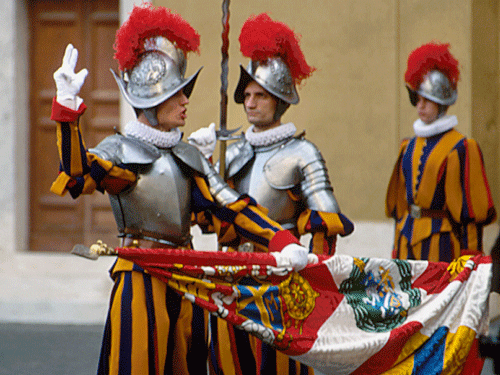
every year in the San Damaso Courtyard
(Italian: Cortile di San Damaso) in the
Vatican. (May 6 is the anniversary of the
Sack of Rome.) In 2008 the ceremony
took place in the presence of the head of
the Swiss army. The chaplain of the guard
reads aloud the oath in the language of the
guard (mostly German, some French, a
little Italian):
(German version) "Ich schwöre, treu,
redlich und ehrenhaft zu dienen dem
(Italian: Cortile di San Damaso) in the
Vatican. (May 6 is the anniversary of the
Sack of Rome.) In 2008 the ceremony
took place in the presence of the head of
the Swiss army. The chaplain of the guard
reads aloud the oath in the language of the
guard (mostly German, some French, a
little Italian):
(German version) "Ich schwöre, treu,
redlich und ehrenhaft zu dienen dem
regierenden Papst [name] und seinen rechtmäßigen Nachfolgern, und mich mit ganzer
Kraft für sie einzusetzen, bereit, wenn es erheischt sein sollte, selbst mein Leben für sie
hinzugeben. Ich übernehme dieselbe Verpflichtung gegenüber dem Heiligen Kollegium
der Kardinäle während der Sedisvakanz des Apostolischen Stuhls. Ich verspreche
überdies dem Herrn Kommandanten und meinen übrigen Vorgesetzten Achtung, Treue
und Gehorsam. Ich schwöre, alles das zu beobachten, was die Ehre meines Standes
von mir verlangt."
(English translation) "I vow to faithfully, honestly and honorably serve the reigning
Pope [name of Pope] and his legitimate successors, and to dedicate myself to them
with all my strength, ready to sacrifice, should it become necessary, even my own life
for them. I likewise assume this promise toward the members of the Sacred College of
Cardinals during the period of the Sede Vacante of the Apostolic See. Furthermore, I
pledge to the Commandant and to my other superiors respect, fidelity, and obedience. I
swear to abide by all the requirements attendant to the dignity of my rank."
When his name is called, each new guard approaches the Swiss Guard's flag, grasping
the banner in his left hand. He raises his right hand with his thumb, index, and middle
finger extended along three axes, a gesture that symbolizes the Holy Trinity, and speaks:
"Ich, [Name des Rekruten], schwöre, alles das, was mir soeben vorgelesen wurde,
gewissenhaft und treu zu halten, so wahr mir Gott und seine Heiligen helfen."
Kraft für sie einzusetzen, bereit, wenn es erheischt sein sollte, selbst mein Leben für sie
hinzugeben. Ich übernehme dieselbe Verpflichtung gegenüber dem Heiligen Kollegium
der Kardinäle während der Sedisvakanz des Apostolischen Stuhls. Ich verspreche
überdies dem Herrn Kommandanten und meinen übrigen Vorgesetzten Achtung, Treue
und Gehorsam. Ich schwöre, alles das zu beobachten, was die Ehre meines Standes
von mir verlangt."
(English translation) "I vow to faithfully, honestly and honorably serve the reigning
Pope [name of Pope] and his legitimate successors, and to dedicate myself to them
with all my strength, ready to sacrifice, should it become necessary, even my own life
for them. I likewise assume this promise toward the members of the Sacred College of
Cardinals during the period of the Sede Vacante of the Apostolic See. Furthermore, I
pledge to the Commandant and to my other superiors respect, fidelity, and obedience. I
swear to abide by all the requirements attendant to the dignity of my rank."
When his name is called, each new guard approaches the Swiss Guard's flag, grasping
the banner in his left hand. He raises his right hand with his thumb, index, and middle
finger extended along three axes, a gesture that symbolizes the Holy Trinity, and speaks:
"Ich, [Name des Rekruten], schwöre, alles das, was mir soeben vorgelesen wurde,
gewissenhaft und treu zu halten, so wahr mir Gott und seine Heiligen helfen."
and a source of jobs for young men from
economically-challenged areas of the
country. The mercenary issue may have
been the reason why central Switzerland
did not join the reformed church, but
rather stayed Catholic. The dispute over
the mercenaries finally lead to two civil
wars in Switzerland in 1529 and 1531.
Zwingli was killed during the second war.
The Swiss constitution, as amended in
economically-challenged areas of the
country. The mercenary issue may have
been the reason why central Switzerland
did not join the reformed church, but
rather stayed Catholic. The dispute over
the mercenaries finally lead to two civil
wars in Switzerland in 1529 and 1531.
Zwingli was killed during the second war.
The Swiss constitution, as amended in
1874, forbade all military capitulations and recruitment of Swiss by foreign powers,
although volunteering in foreign armies continued until prohibited outright, in 1927. The
sole exception was the Swiss guard at the Vatican. The Vatican had been an Italian
principality until the late 19th century, but it had been reduced to a district of Rome
exempt from Italian jurisdiction.
Recruits to the guards must be Catholic, single males with Swiss citizenship who have
completed basic training with the Swiss military and can obtain certificates of good
conduct. Recruits must have a professional degree or high school diploma and must be
between 19 and 30 years of age and at least 174 cm (5.71 ft) tall. In 2009, the Swiss
Guard commandant, Daniel Anrig, suggested that the Guard might someday be open to
recruiting women, but he added that the admission of female recruits remained far in
the future.
Qualified candidates must apply to serve. If accepted, new guards are sworn on May 6
although volunteering in foreign armies continued until prohibited outright, in 1927. The
sole exception was the Swiss guard at the Vatican. The Vatican had been an Italian
principality until the late 19th century, but it had been reduced to a district of Rome
exempt from Italian jurisdiction.
Recruits to the guards must be Catholic, single males with Swiss citizenship who have
completed basic training with the Swiss military and can obtain certificates of good
conduct. Recruits must have a professional degree or high school diploma and must be
between 19 and 30 years of age and at least 174 cm (5.71 ft) tall. In 2009, the Swiss
Guard commandant, Daniel Anrig, suggested that the Guard might someday be open to
recruiting women, but he added that the admission of female recruits remained far in
the future.
Qualified candidates must apply to serve. If accepted, new guards are sworn on May 6
"I [name of guard], swear diligently and
faithfully to abide by all that has just been
read out to me, so grant me God and so
help me his Saints."
The patron saints of the Guards include
St. Martin (November 11), St. Sebastian
(January 20) and St. Niklaus von Flüe,
“Defensor pacis et pater patriae”
(September 25).
The term of service is between 2 and 25
years.
faithfully to abide by all that has just been
read out to me, so grant me God and so
help me his Saints."
The patron saints of the Guards include
St. Martin (November 11), St. Sebastian
(January 20) and St. Niklaus von Flüe,
“Defensor pacis et pater patriae”
(September 25).
The term of service is between 2 and 25
years.

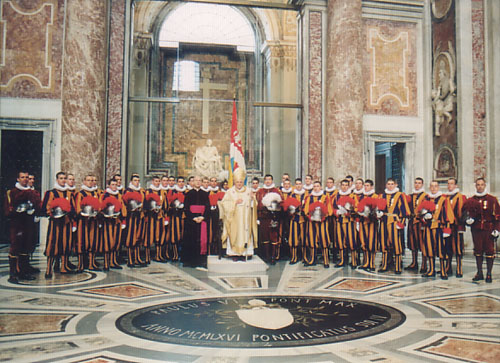
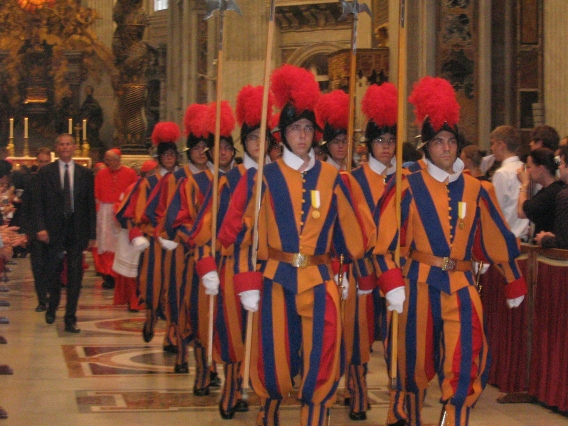
Swiss Guard at 500 year anniversary mass
celebration in 2006. www.schweizergarde.org/
celebration in 2006. www.schweizergarde.org/
| ********** |
| ********** |
| NCO |
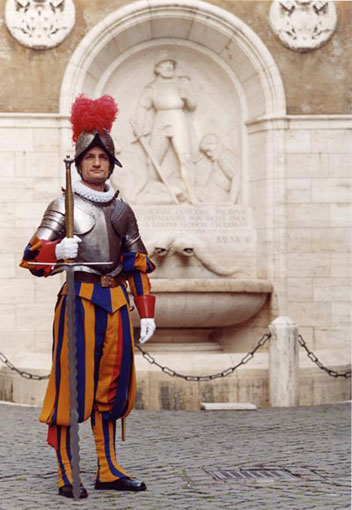
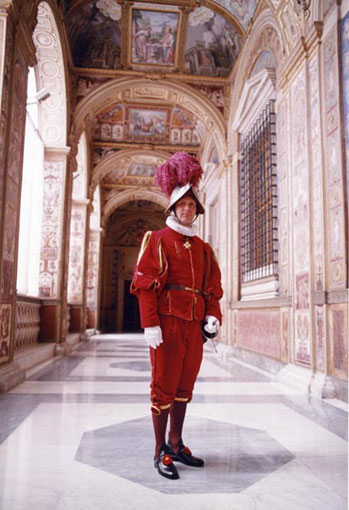
| Officer Drill |
| Sergeant Gala |
| Sgt Grand Gala |
| Sgt Major Gala |