| Interesting Facts about Giant Tortoises |
suggested that other individuals of Geochelone nigra abingdoni may still exist in the wild
at the Galápagos. Researchers have identified one male tortoise from the Volcano Wolf
region of neighboring Galápagos island of Isabela which has half his genes in common
with George's subspecies. This animal must be a first generation intergrade between the
subspecies of the islands Isabela and Pinta. It is possible that a pure Pinta tortoise lives
among the 2,000 tortoises on Isabela.
"The identification of eight individuals of mixed ancestry among only 27 individuals
sampled (estimated Volcano Wolf population size 1,000–2,000) ... suggests the need to
mount an immediate and comprehensive survey ... to search for additional individuals of
Pinta ancestry."
Another male tortoise by the name of Tony, who currently resides in a Prague zoo, has
recently been discovered as most likely being an additional pure breed, native, Pinta
tortoise. Believed to be born around 1960, Tony has been housed in the zoo since 1972.
Peter Pritchard, one of the world’s foremost authorities on Galápagos tortoises (and of
tortoises and turtles of the world more generally), has found the shell on Tony to be
extremely similar to that of George and Pinta museum specimens. Research is still
currently being processed to conform this match and Tony is still currently being held
at the Prague zoo.
at the Galápagos. Researchers have identified one male tortoise from the Volcano Wolf
region of neighboring Galápagos island of Isabela which has half his genes in common
with George's subspecies. This animal must be a first generation intergrade between the
subspecies of the islands Isabela and Pinta. It is possible that a pure Pinta tortoise lives
among the 2,000 tortoises on Isabela.
"The identification of eight individuals of mixed ancestry among only 27 individuals
sampled (estimated Volcano Wolf population size 1,000–2,000) ... suggests the need to
mount an immediate and comprehensive survey ... to search for additional individuals of
Pinta ancestry."
Another male tortoise by the name of Tony, who currently resides in a Prague zoo, has
recently been discovered as most likely being an additional pure breed, native, Pinta
tortoise. Believed to be born around 1960, Tony has been housed in the zoo since 1972.
Peter Pritchard, one of the world’s foremost authorities on Galápagos tortoises (and of
tortoises and turtles of the world more generally), has found the shell on Tony to be
extremely similar to that of George and Pinta museum specimens. Research is still
currently being processed to conform this match and Tony is still currently being held
at the Prague zoo.

 |  |  |  |
| If you have a picture you'd like us to feature a picture in a future quiz, please email it to us at CFitzp@aol.com. If we use it, you will receive a free analysis of your picture. You will also receive a free Forensic Genealogy CD or a 10% discount towards the purchase of the Forensic Genealogy book. |


 |  |  |  |
| Answers: 1. His name is Lonesome George. He could be the last tortoise of his subspecies in existance. 2. The Charles Darwin Station on the Santiago Island in the Galapagos Islands. 3. Geochelone nigra abingdoni, but his friends call him George. |
| ********** |
| ********** |

| If you enjoy our quizzes, don't forget to order our books! Click here. |

| Quiz #240 Results |
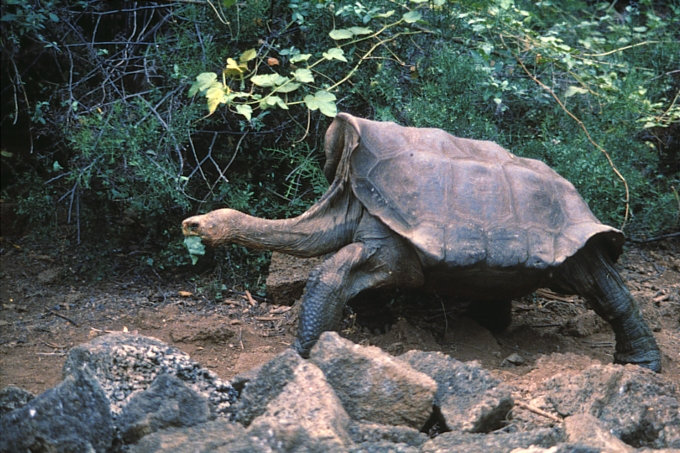
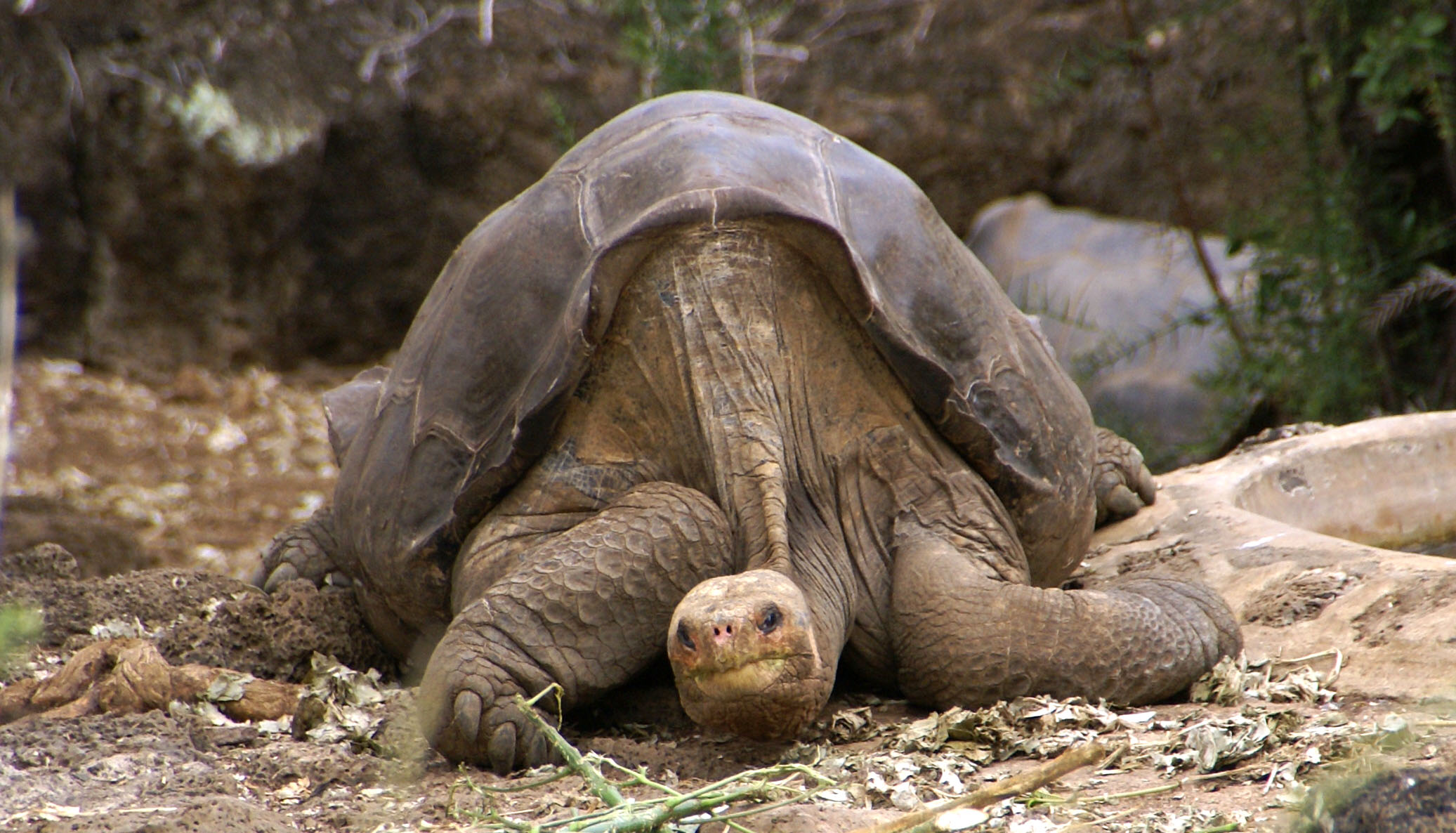
Lonesome George (Spanish: Solitario
Jorge) is the last known individual of the
Pinta Island Tortoise, subspecies
Geochelone nigra abingdoni, one of eleven
subspecies of Galápagos tortoise native to
the Galápagos Islands. He has been
labelled the rarest creature in the world,
and is a potent symbol for conservation
efforts in the Galápagos and
Jorge) is the last known individual of the
Pinta Island Tortoise, subspecies
Geochelone nigra abingdoni, one of eleven
subspecies of Galápagos tortoise native to
the Galápagos Islands. He has been
labelled the rarest creature in the world,
and is a potent symbol for conservation
efforts in the Galápagos and
| Lonesome George http://en.wikipedia.org/wiki/Lonesome_George |
internationally. It is thought that he was named after a character played by American
actor George Gobel.
George was first seen on the island of Pinta on 1 December 1971 by American snail
biologist Joseph Vagvolgyi. The island's vegetation had been decimated by introduced
feral goats, and the indigenous G. n. abingdoni population had been reduced to a single
individual. Relocated for his safety to the Charles Darwin Research Station, George
was penned with two females of a different subspecies, but although eggs have been
produced, none have hatched.
George is estimated to be 60–90 years of age, and is in good health.A prolonged effort
to exterminate goats introduced to Pinta is now complete and the vegetation of the
island is starting to return to its former state.
The presence of mixed race Pinta ancestery tortoises around Wolf Volcano, on
actor George Gobel.
George was first seen on the island of Pinta on 1 December 1971 by American snail
biologist Joseph Vagvolgyi. The island's vegetation had been decimated by introduced
feral goats, and the indigenous G. n. abingdoni population had been reduced to a single
individual. Relocated for his safety to the Charles Darwin Research Station, George
was penned with two females of a different subspecies, but although eggs have been
produced, none have hatched.
George is estimated to be 60–90 years of age, and is in good health.A prolonged effort
to exterminate goats introduced to Pinta is now complete and the vegetation of the
island is starting to return to its former state.
The presence of mixed race Pinta ancestery tortoises around Wolf Volcano, on
| ********** |
| Answers to Quiz #240 January 3, 2010 |
| Comments from Our Readers |
Cool! The Galapagos is a ways down our places to visit list but these turtles live long
lives, so maybe he will still be alive when we finally make it there.
At first I checked to see if he was the oldest turtle (or oldest living thing) since he looks
old in his photo, but that distinction fell on another turtle who died a few years ago at
176. That turtle, Harriet, (being a turtle) looked similar to George but George has a
more distinct shell shape and the oldest turtle was female. Your hint was the clinch pin.
Thanks again for the fun! Barbara Battles
*****
I recognized him right away. There was a PBS episode on Darwin last week, so knew
this was from Galapagos. Your hint allowed me to google him specifically and up
popped Lonesome George! Debbie Johnson
*****
This is the easiest quiz I ever done in here because I already knew the answer.
Christine Bates
*****
I guess when you're lonesome you're not too choosy. Karl Bossard
*****
Alas, [George] needs a lady friend and there are none to be found. Dennis Brann
*****
This has got to be Lonesome George, a Pinta Island tortoise. He lives on one of the
Galapagos islands. He probably won't be able to become a father because as far as
anyone knows he is the last of his species. A $10,000 reward has been posted for the
discovery of a female of his species.
I found this by searching for rare land tortoise in Google images. You did provide a
hint by putting the Galapagos islands in the solution for last week's puzzle. I wondered
why when I noticed it because they are on the wrong side of the Pacific for Millennium
Island. Now I know ;-) Milene Rawlinson
*****
What a fascinating place to visit! Sharon Martin
*****
It is not very often that we are really bothered about the sexual adventures of others, let
alone other creatures beyond us. But all fun aside, human activity has driven many
species on the planet to the verge of extinction and Lonesome George is one of those
who has found himself on that precarious edge. A Pinta Island tortoise, George is the
last of his kind and one could say that the survival of his species rests on his hard shell!
Edee Scott
*****
This was another fast one for me. When I first saw the photo, I immediately thought
"bet that is a galapagos tortoise" - this was because of my biology background (I have a
B.S. and focused on mammals, but every biology student learns all about the
Galapagos).
Anyway, from there it took a few minutes to find it, but there he was. AFTER I found
it I looked at the hint and file name, which just confirmed what I had found.
Gerald Vanlandingham
*****
This is so very sad!! I'd never heard of him before, but it seems such a shame that
they can't halt the extinction of this particular species of tortoise. Nicole Blank
*****
Looking back, it’s sad that whalers and sealers removed all tortoises like George from
his island for food on their boats. I’ve tasted turtle soup - once, and it did not inspire
me to indulge further. I can understand, however, that sailors, years ago, would survive
on any food that could but kept without spoiling and the giant tortoises could
themselves live with little water or nourishment for weeks. Yummy? No! - Yuk!
Don Draper
*****
One wonders if this is the tortoise on whose back stands the elephant on whose back
the world rests? Kitty Huddleston
*****
He is the last of his subspecies, of which there are about 12. He is reportedly at the age
of 90 years old, at his sexual peak, working at to be the mate to a female tortoise of
another subspecies and be the father to her children. Are there other 90 year olds out
there who--- ? Mike Dalton
*****
Quiz # 239 answer result page. Once again, that was a real fun one, was alot of work,
and I learned a whole lot while doing the quiz. Robert W. Steinmann, Jr.
*****
He is so cute. I hope somone finds him a female and gets that $ 10,000 reward!
Dawn Colket
lives, so maybe he will still be alive when we finally make it there.
At first I checked to see if he was the oldest turtle (or oldest living thing) since he looks
old in his photo, but that distinction fell on another turtle who died a few years ago at
176. That turtle, Harriet, (being a turtle) looked similar to George but George has a
more distinct shell shape and the oldest turtle was female. Your hint was the clinch pin.
Thanks again for the fun! Barbara Battles
*****
I recognized him right away. There was a PBS episode on Darwin last week, so knew
this was from Galapagos. Your hint allowed me to google him specifically and up
popped Lonesome George! Debbie Johnson
*****
This is the easiest quiz I ever done in here because I already knew the answer.
Christine Bates
*****
I guess when you're lonesome you're not too choosy. Karl Bossard
*****
Alas, [George] needs a lady friend and there are none to be found. Dennis Brann
*****
This has got to be Lonesome George, a Pinta Island tortoise. He lives on one of the
Galapagos islands. He probably won't be able to become a father because as far as
anyone knows he is the last of his species. A $10,000 reward has been posted for the
discovery of a female of his species.
I found this by searching for rare land tortoise in Google images. You did provide a
hint by putting the Galapagos islands in the solution for last week's puzzle. I wondered
why when I noticed it because they are on the wrong side of the Pacific for Millennium
Island. Now I know ;-) Milene Rawlinson
*****
What a fascinating place to visit! Sharon Martin
*****
It is not very often that we are really bothered about the sexual adventures of others, let
alone other creatures beyond us. But all fun aside, human activity has driven many
species on the planet to the verge of extinction and Lonesome George is one of those
who has found himself on that precarious edge. A Pinta Island tortoise, George is the
last of his kind and one could say that the survival of his species rests on his hard shell!
Edee Scott
*****
This was another fast one for me. When I first saw the photo, I immediately thought
"bet that is a galapagos tortoise" - this was because of my biology background (I have a
B.S. and focused on mammals, but every biology student learns all about the
Galapagos).
Anyway, from there it took a few minutes to find it, but there he was. AFTER I found
it I looked at the hint and file name, which just confirmed what I had found.
Gerald Vanlandingham
*****
This is so very sad!! I'd never heard of him before, but it seems such a shame that
they can't halt the extinction of this particular species of tortoise. Nicole Blank
*****
Looking back, it’s sad that whalers and sealers removed all tortoises like George from
his island for food on their boats. I’ve tasted turtle soup - once, and it did not inspire
me to indulge further. I can understand, however, that sailors, years ago, would survive
on any food that could but kept without spoiling and the giant tortoises could
themselves live with little water or nourishment for weeks. Yummy? No! - Yuk!
Don Draper
*****
One wonders if this is the tortoise on whose back stands the elephant on whose back
the world rests? Kitty Huddleston
*****
He is the last of his subspecies, of which there are about 12. He is reportedly at the age
of 90 years old, at his sexual peak, working at to be the mate to a female tortoise of
another subspecies and be the father to her children. Are there other 90 year olds out
there who--- ? Mike Dalton
*****
Quiz # 239 answer result page. Once again, that was a real fun one, was alot of work,
and I learned a whole lot while doing the quiz. Robert W. Steinmann, Jr.
*****
He is so cute. I hope somone finds him a female and gets that $ 10,000 reward!
Dawn Colket
| ********** |
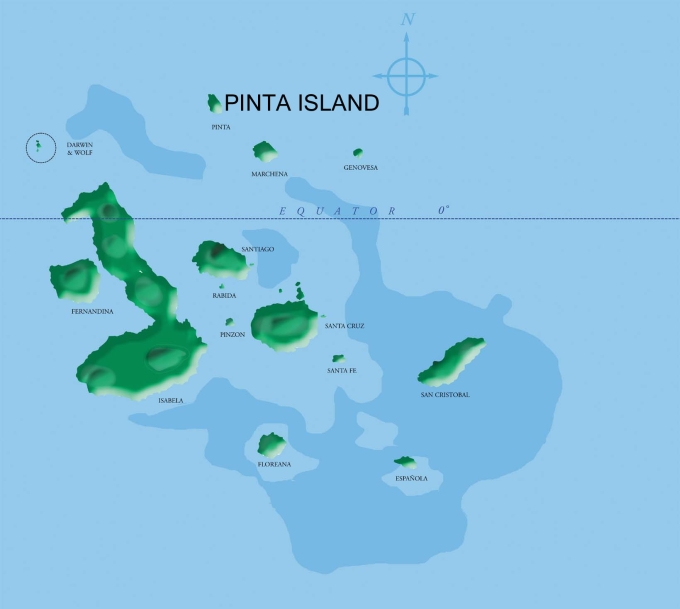
| Pinta Island |
| Pinta Island, also known as Abingdon, is a small uninhabited island located in the north of the archipelago and, along with Genovesa, Marchena, Wolf and Darwin, is slightly separated from the rest of the islands in Galapagos. The land area of 60 square kilometres is protected and the island receives few visitors except scientists. |
neighbouring Isabela island, suggests the
recent presence of at least one Pinta
individual near Wolf Volcano. A possible
purebreed Pinta candidate, male and
dubbed "Tony", lives in a Prague zoo.
There is a reward of $10,000 for the
discovery of a Pinta female.
Attempts at mating Lonesome George
were unsuccessful for several decades,
possibly due to the lack of a female of his
own subspecies, and prompted
recent presence of at least one Pinta
individual near Wolf Volcano. A possible
purebreed Pinta candidate, male and
dubbed "Tony", lives in a Prague zoo.
There is a reward of $10,000 for the
discovery of a Pinta female.
Attempts at mating Lonesome George
were unsuccessful for several decades,
possibly due to the lack of a female of his
own subspecies, and prompted
researchers at the Darwin Station to offer a $10,000 reward for a suitable mate. George
is penned with two females of a different subspecies, Geochelone nigra becki from the
Wolf Volcano region of Isabela island, in the hope that his genotype would be retained
in the resulting progeny. This subspecies was thought to be genetically closest to
George's; however any offspring successfully hatched from George and his consorts
would be intergrades, not purebreds of the Pinta subspecies. On July 21 2008, it was
reported that George had unexpectedly mated with one of his female companions. A
total of thirteen eggs were collected and placed in incubators. However, on November
11 2008, The Charles Darwin Research Center reported that 80% of the eggs showed
weight loss characteristic of being infertile. To the disappointment of the Darwin
Center, by December 2008 the remaining eggs had failed to hatch and x-rays showed
them to be infertile.
is penned with two females of a different subspecies, Geochelone nigra becki from the
Wolf Volcano region of Isabela island, in the hope that his genotype would be retained
in the resulting progeny. This subspecies was thought to be genetically closest to
George's; however any offspring successfully hatched from George and his consorts
would be intergrades, not purebreds of the Pinta subspecies. On July 21 2008, it was
reported that George had unexpectedly mated with one of his female companions. A
total of thirteen eggs were collected and placed in incubators. However, on November
11 2008, The Charles Darwin Research Center reported that 80% of the eggs showed
weight loss characteristic of being infertile. To the disappointment of the Darwin
Center, by December 2008 the remaining eggs had failed to hatch and x-rays showed
them to be infertile.
Pinta is one of six islands that has had notable success in the eradication of introduced goats, which were completely removed after a 30-year campaign, however this island also has the sad reputation of having the smallest tortoise population in the world. Giant tortoises, once present in their thousands, are now extinct in the wild, and only one tortoise remains from this race (Geochelone elephantophus abingdoni) - Lonesome George, who now resides at the Charles Darwin Research Station on Santa Cruz. Attempts to mate him with two females from Wolf volcano on Isabela have so far proved to be unsuccessful. http://www.gct.org/pinta.html |
| Congratulations to Our Winners! Mr. Rick and his QuizKid Heather! Tamura Jones Debbie Johnson Alan Cullinan Barbara Battles Christine Bates Ione Jolly Jim Baker Teresa Yu Margaret Paxton Karl Bossard Karen Kay Bunting Marilyn Hamill Dennis Brann Richard Wakeham Milene Rawlinson Evan Hindman Sharon Martin Margaret Waterman Mary South Carl Blessing Jim Kiser Edee Scott Debbie Sterbinsky Judy Pfaff Stan Read Betty Chambers Peter Norton Janice Sellers Joshua Kreitzer JoLynn Pfeiffer Gerald Vanlandingham Gary Sterne Jinny Collins Nicole Blank Frank P. Nollette Don Draper Kitty Huddleston Suzanne Rude Mike Dalton Ben Truwe Sue Edminster Robin Spence Andrew McDonogh Venita Wilson Robert W. Steinmann, Jr. Diane Burkett |
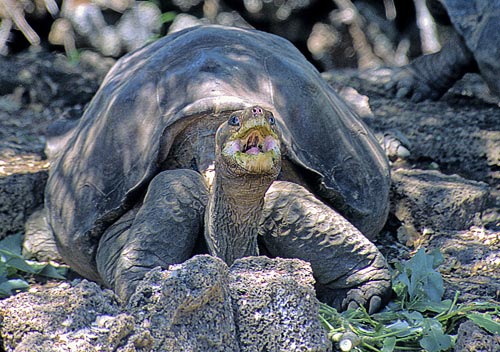
| Lonesome George 2002 http://www.skeptic.com/eskeptic/06-07-28 |
| 1. Why won't he probably ever be able to produce offspring of his own kind? 2. Where does he live? 3. What species is he? Click here for hint. |
However, on 21 July 2009, exactly one
year after first announcing George had
mated, the Galapagos National Park
announced that a second clutch of five
eggs had been laid by one of George's
female companions. The park authority
expressed its hope that the second clutch
of eggs, which it described as being in
perfect condition, might prove to be
fertile. The eggs have been moved to an
incubator. "Now we have to wait for the
incubation period of 120 days to find out
whether they are fertile", the Galapagos
National Park has said. On December 16,
it was announced that the incubation
period for the first 5 eggs had ended and
the eggs were shown to unfortunately be
infertile; also a second batch of 6 eggs laid
after the first batch by the other female
are looking like they might also end up
being infertile.
In May 2007, analysis of genomic
microsatellites (DNA sequences)
| ********** |
| Meet the Tortoises http://www.gianttortoise.org/meet_tortoises.php http://www.facebook.com/galapagostortoiseproject |
| ********* |
| Other Tortoises of Note |
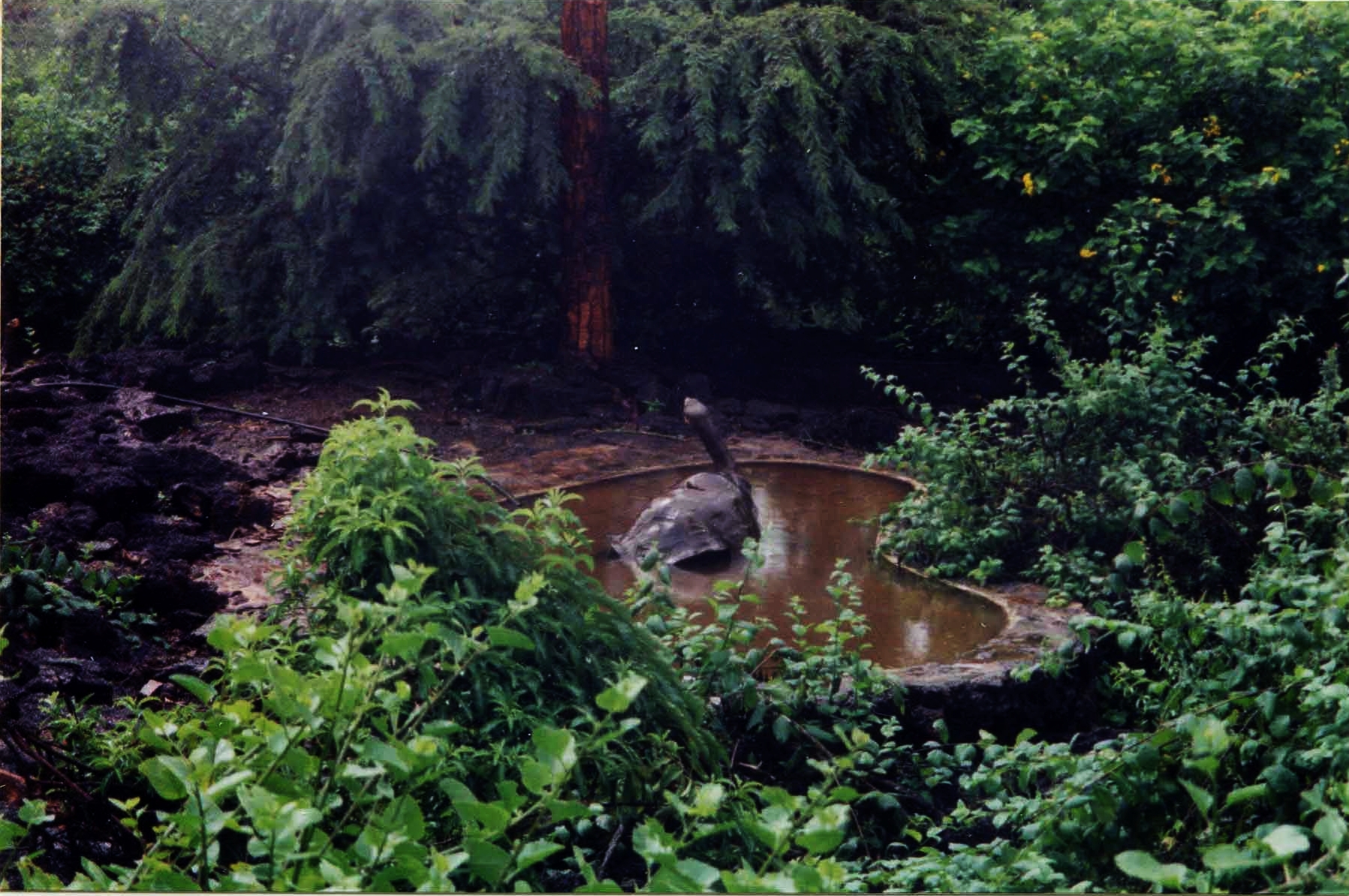
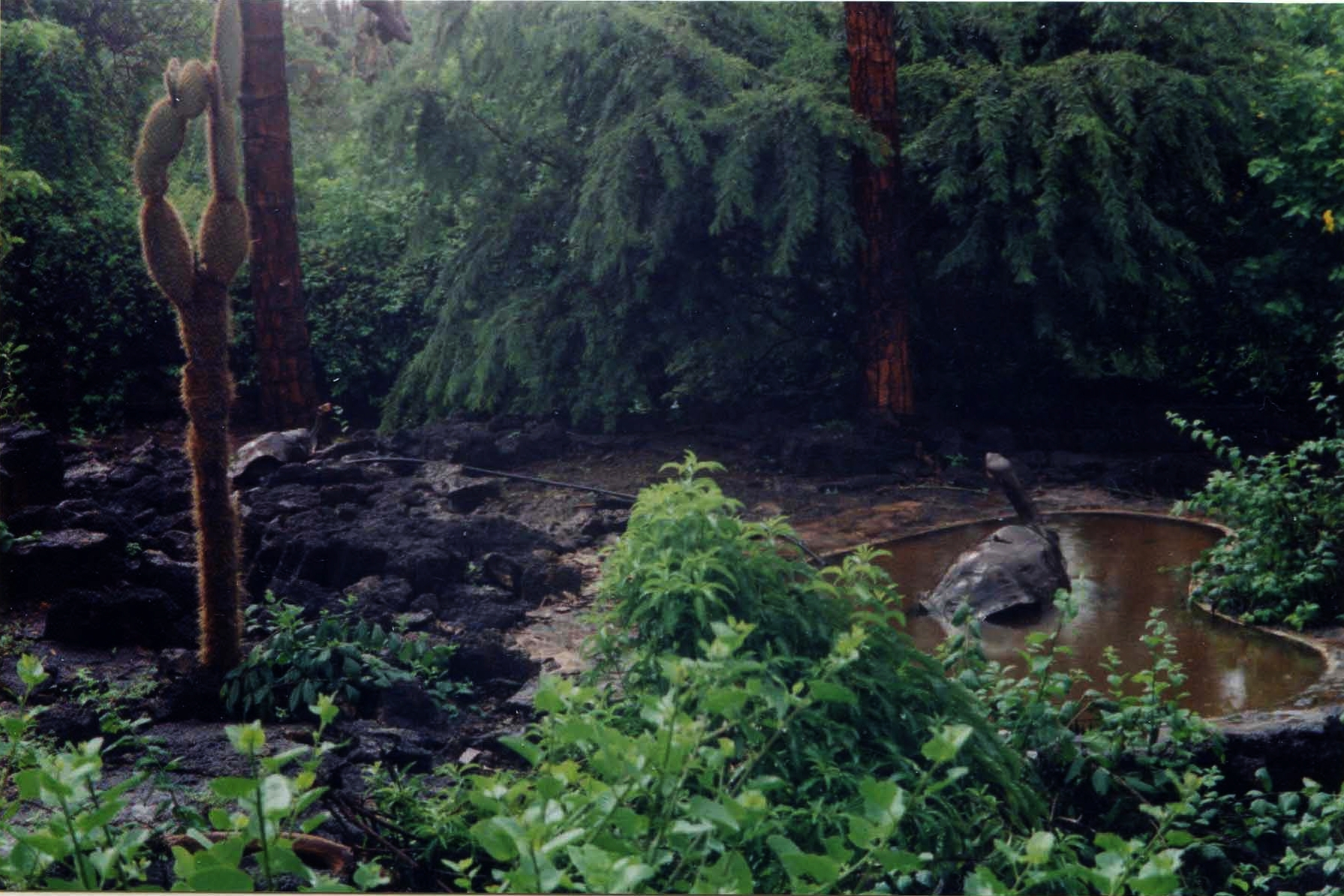
| Lonesome George in his bachelor pad. Charles Darwin Station 1998 Taken by Colleen Fitzpatrick |
| Delmira |
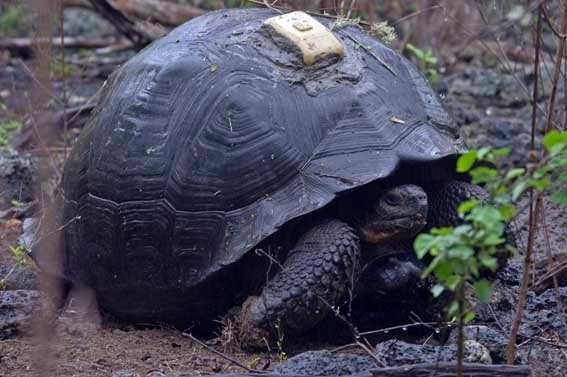
| 1. Their babies’ sex depends on the temperature of the eggs. Cooler = female, warmer = male. 2. They sleep approximately 16 hours a day. 3. The Giant Galapagos Tortoise have two different types of shells” Domebacks and Saddlebacks. The Domebacks are bigger. The Saddlebacks have the ability to stick their necks higher in the air to reach food on off the ground. 4. They use pools of mud and water to warm up or cool down. 5. They haven’t evolved much since arriving to Galapagos because they don’t have many animals to compete with here. 6. Females usually loose body heat faster than males because females are smaller. 7. They are unique because they are the biggest reptile in the world. 8. They never stop growing. 9. People used to eat turtles and use there oil for lamps or for cooking. 10. They have been here in Galapagos for approximately 2 to 3 million years. 11. They can live from 6 months to a year without food or water. 12. They don’t have very good digestion so there poop has o lot of seeds in it. This way they disperse plants around the island. 13. Females are much smaller than males. 14. The skeleton of the tortoises are big and strong. 15. They can walk up 13 km over 2 days, but usually walk much less. 16. The tortoises’ ancestors from the continent were 3 to 4 times bigger than the ones now living in Galapagos, however these ancient giants were killed off nearly 10,000 years ago by humans. 17. They are very strong. 18. The shell is made of the same material as fingernails. 19. For the males the tail is the penis. 20. They have terrible eye sight. 21. The little turtles are very fragile. 22. They don’t have teeth just a strong jaw. 23. Lonesome George is the last remaining tortoise of his species. 24. 8 Giant Tortoises living on the island of Santa Cruz have a GPS on their shells. 25. The Giant Galapagos Tortoise is the coolest animal in the world. |
| ||||||||||||||||||||||||||||||
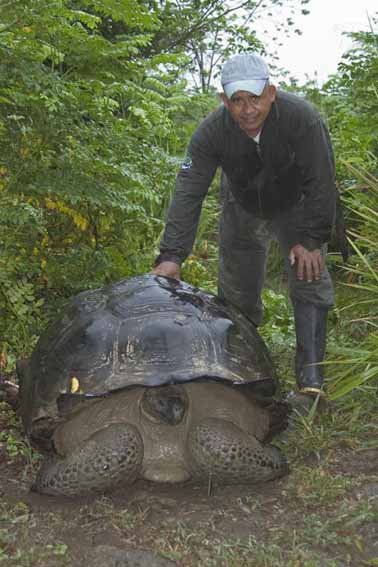
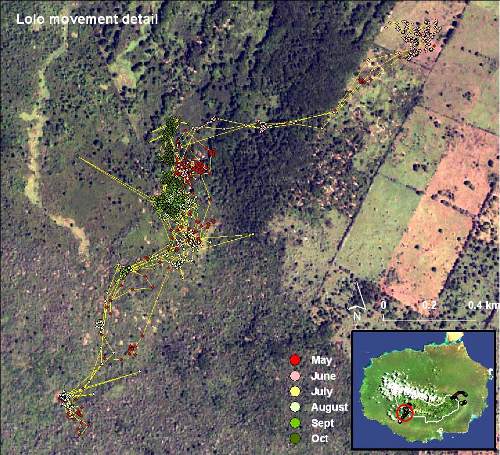
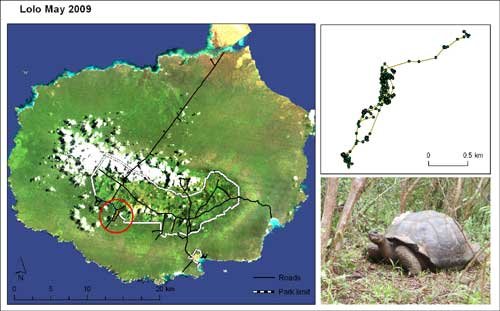
| Top: Lolo Center and Bottom: Lolo's Range |
Even for a giant Galapagos tortoise Lolo is...giant! On
the day he was fitted with his GPS tag, we found him
walking along an open trail in La Reserva region of the
Galapagos National Park. The trail was the only way
through an otherwise huge and impenetrable tangle of a
prickley liana called Caesalpinia bunduc. Even the
Galapagos National Park ranger involved in the tagging
was startled by Lolo's size. That rangers name
was...Lolo, a big, quiet, calm man liked by everyone, and
we thought it fitting to name the tortoise in his honour.
Lolo (the tortoise) was completely calm throughout the
tagging procedure - he put his head in his shell at the
the day he was fitted with his GPS tag, we found him
walking along an open trail in La Reserva region of the
Galapagos National Park. The trail was the only way
through an otherwise huge and impenetrable tangle of a
prickley liana called Caesalpinia bunduc. Even the
Galapagos National Park ranger involved in the tagging
was startled by Lolo's size. That rangers name
was...Lolo, a big, quiet, calm man liked by everyone, and
we thought it fitting to name the tortoise in his honour.
Lolo (the tortoise) was completely calm throughout the
tagging procedure - he put his head in his shell at the
beginning and didn't bring it out until we had packed up
and ready to go. In the first few weeks after tagging,
Lolo remained in a small area of the national park, after
which he moved up into farmland, most likely to enjoy
the new growth of nutritious grass that the rainy Garua
season brings to the highlands roughly between June and
December. Unlike Sebastian and Helber, Lolo's
movements have not yet shown a true migration pattern,
and he seems to prefer moving on a small scale between
farmland and the park.
and ready to go. In the first few weeks after tagging,
Lolo remained in a small area of the national park, after
which he moved up into farmland, most likely to enjoy
the new growth of nutritious grass that the rainy Garua
season brings to the highlands roughly between June and
December. Unlike Sebastian and Helber, Lolo's
movements have not yet shown a true migration pattern,
and he seems to prefer moving on a small scale between
farmland and the park.
| ********** |
| ||||||||||||||||||||||||||||||
| Carolina |
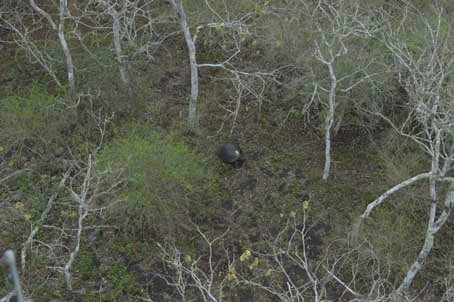
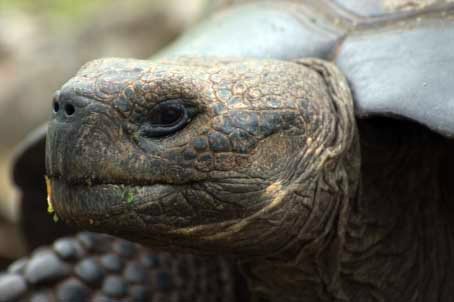
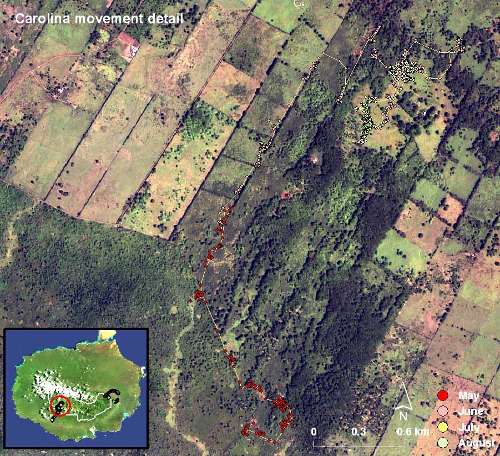
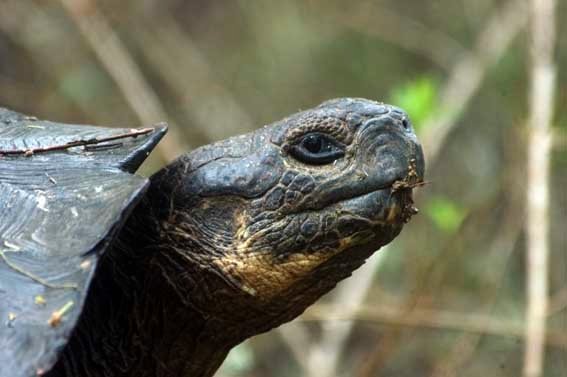
(Top) Carolina in the field; (Center)
Carolina up close; (Bottom) Carolina's
range.
Carolina up close; (Bottom) Carolina's
range.
Carolina lives her life among the 'La
Reserva' tortoise population. She is a
beautiful example of this race of
tortoises, the scientific name of which is
Geochelone nigra porteri. The sub-
species name 'porteri' comes from
Captain Porter, an American naval officer
who sailed Galapagos waters in the early
1800s. While we do not know quite how
old any Galapagos tortoises are, it is quite
possible that Carolina’s mother was
roaming around Santa Cruz when Captain
Porter was fighting the British in the
eastern Pacific and coming to Galapagos
to stock up on tortoise meat! Fortunately
for Carolina, Galapagos tortoises on
Santa Cruz have enjoyed relative peace
during most of her lifetime, and Carolina
leads a tranquil existence.
Carolina was fitted with her GPS tag on
the day she had been mating with
Sebastian (see Sebastian's entry in meet
the tortoises). Soon after this, she
decided to move into the highlands of
Reserva' tortoise population. She is a
beautiful example of this race of
tortoises, the scientific name of which is
Geochelone nigra porteri. The sub-
species name 'porteri' comes from
Captain Porter, an American naval officer
who sailed Galapagos waters in the early
1800s. While we do not know quite how
old any Galapagos tortoises are, it is quite
possible that Carolina’s mother was
roaming around Santa Cruz when Captain
Porter was fighting the British in the
eastern Pacific and coming to Galapagos
to stock up on tortoise meat! Fortunately
for Carolina, Galapagos tortoises on
Santa Cruz have enjoyed relative peace
during most of her lifetime, and Carolina
leads a tranquil existence.
Carolina was fitted with her GPS tag on
the day she had been mating with
Sebastian (see Sebastian's entry in meet
the tortoises). Soon after this, she
decided to move into the highlands of
Galapagos, into the Mariposa Ranch, which belongs to a great friend of the Galapagos
Tortoise Programme called Steve Devine. Rather than take a random route through the
farm, Carolina followed a fence line with an overstory of large trees. Under the trees,
the vegetation is open, without the dense herb/shrub layer of vegetation which makes
movements difficult, even for giant tortoises.
Carolina's movement fly in the face of the traditional wisdom of tortoise seasonal
migrations since she travelled uphill into cool air during the nesting season. While she
moved up the island, most of her female peers moved into the tortoise nesting areas of
the Santa Cruz lowlands. As cold blooded animals, tortoises find it hard to keep their
body temperature up during the cold wet season in Galapagos, and because of their
large bodies it is easier for males to cope with the cold than females. However
whenever we saw Carolina at the Mariposa Farm, she seemed to be fine.
Tortoise Programme called Steve Devine. Rather than take a random route through the
farm, Carolina followed a fence line with an overstory of large trees. Under the trees,
the vegetation is open, without the dense herb/shrub layer of vegetation which makes
movements difficult, even for giant tortoises.
Carolina's movement fly in the face of the traditional wisdom of tortoise seasonal
migrations since she travelled uphill into cool air during the nesting season. While she
moved up the island, most of her female peers moved into the tortoise nesting areas of
the Santa Cruz lowlands. As cold blooded animals, tortoises find it hard to keep their
body temperature up during the cold wet season in Galapagos, and because of their
large bodies it is easier for males to cope with the cold than females. However
whenever we saw Carolina at the Mariposa Farm, she seemed to be fine.
| ********** |
| Sebastian |
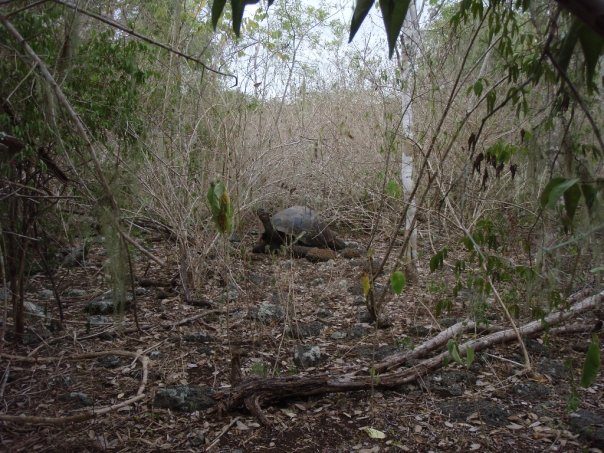
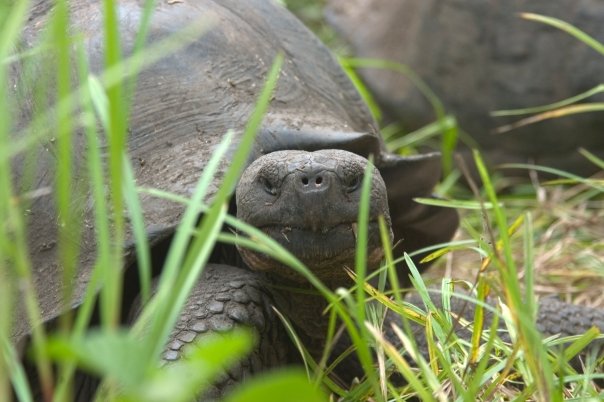
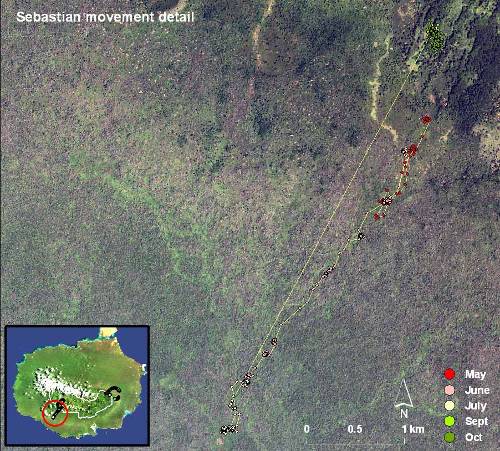
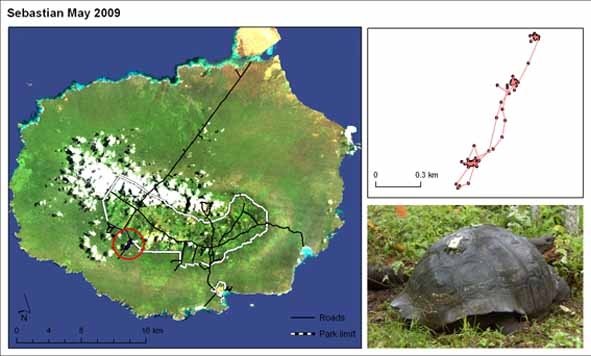
Sebastian is, after Lolo, the biggest
Galapagos tortoise we have tagged. We
estimate that he weights between
250-300kg, particularly after feasting on a
variety of tasty fruits that occur in his
home range during the wet season.
When we tagged him, Sebastian was
'courting' a female tortoise in an area
called 'la Caseta' in Galapagos National
Park. They had been mating in the early
morning before we found them, and we
thought the two of them would make ideal
tortoises for our research since we could
obtain information on whether they
remained together or separated after their
romance. We sadly report that they went
their separate ways! Sebastian soon went
down to the lowlands of Santa Cruz into
the tortoise nesting areas where he
undoubtedly found many other females,
while Carolina moved into the highlands
and into the beautiful Mariposa Ranch,
where incidentally some of the largest
male tortoises on Galapagos can be found.
It seems therefore that Sebastian and
Carolina met like ships in the night. Our
data over the coming years will tell us
whether they every meet again.
Sebastian gets his name from a close
collaborator of the Galapagos Tortoise
Program, a scientist called Sebastian
Cruz, who was born and grew up on
Galapagos. Sebastian normally works on
swallow tailed gull movements but found
the time to help us tag Sebastian the
tortoise.
Galapagos tortoise we have tagged. We
estimate that he weights between
250-300kg, particularly after feasting on a
variety of tasty fruits that occur in his
home range during the wet season.
When we tagged him, Sebastian was
'courting' a female tortoise in an area
called 'la Caseta' in Galapagos National
Park. They had been mating in the early
morning before we found them, and we
thought the two of them would make ideal
tortoises for our research since we could
obtain information on whether they
remained together or separated after their
romance. We sadly report that they went
their separate ways! Sebastian soon went
down to the lowlands of Santa Cruz into
the tortoise nesting areas where he
undoubtedly found many other females,
while Carolina moved into the highlands
and into the beautiful Mariposa Ranch,
where incidentally some of the largest
male tortoises on Galapagos can be found.
It seems therefore that Sebastian and
Carolina met like ships in the night. Our
data over the coming years will tell us
whether they every meet again.
Sebastian gets his name from a close
collaborator of the Galapagos Tortoise
Program, a scientist called Sebastian
Cruz, who was born and grew up on
Galapagos. Sebastian normally works on
swallow tailed gull movements but found
the time to help us tag Sebastian the
tortoise.
| ||||||||||||||||||||||||||||||
| Top: Sebastian in the field. Second: Sebastian up close. Third and Bottom: Sebastian's Range |
| ***** |
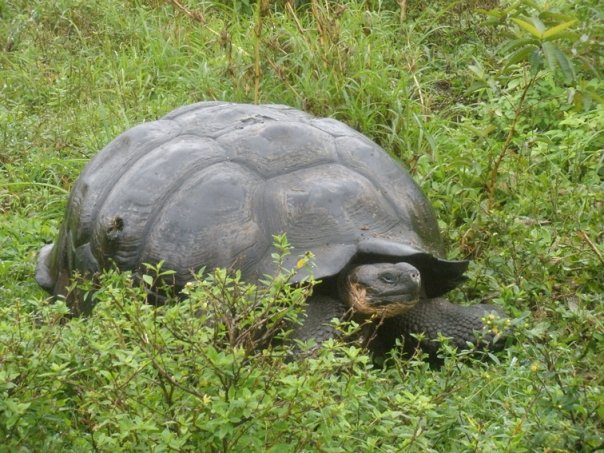
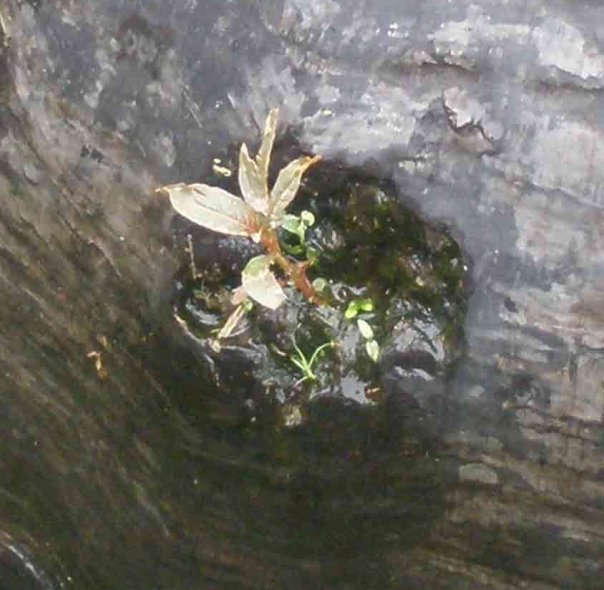
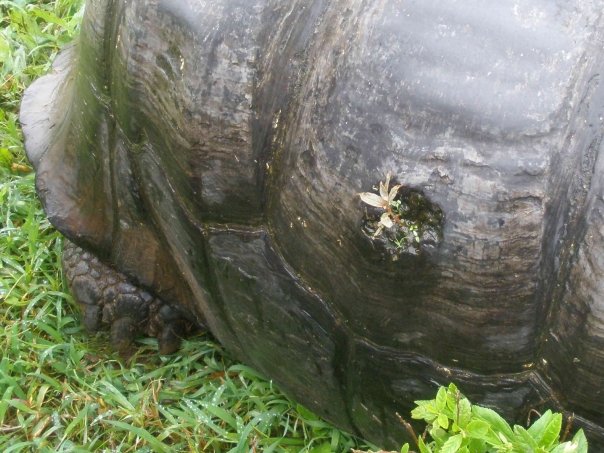
| Sadge, the Self-Gardening Tortoise |
| Learn more about the Galapagos Giant Tortoises on their Facebook page at www.facebook.com/galapagostortoiseproject#/galapagostortoiseproject?v=wall |
| ********** |