man-about-town. His family had grown to six children, and the brood required most of
Catherine's attention. In 1904, Wright designed a house for Edwin Cheney, a neighbor
in Oak Park, and immediately took a liking to Cheney's wife, Mamah Borthwick
Cheney. Mamah Cheney was a modern woman with interests outside the home. She
was an early feminist and Wright viewed her as his intellectual equal. The two fell in
love, even though Wright had been married for almost 20 years. Often the two could be
seen taking rides in Wright's automobile through Oak Park, and they became the talk of
the town. Wright's wife, Kitty, sure that this attachment would fade as the others had,
refused to grant him a divorce. Neither would Edwin Cheney grant one to Mamah. In
1909, even before the Robie House was completed, Wright and Mamah Cheney eloped
to Europe; abandoning their own spouses and children. The scandal that erupted
virtually destroyed Wright's ability to practice architecture in the United States.
Wright and Mamah Cheney traveled extensively throughout Europe. In 1910, during a
stop in Berlin, Wright, with virtually all of his drawings, visited the publishing house of
Ernst Wasmuth, who had agreed to publish his work there. In two volumes, the
Wasmuth Portfolio was thus published and created the first major exposure of Wright's
work in Europe. The later Bauhaus movement's founders claimed to have been inspired
by these books.
Wright remained in Europe for one year (though Mamah Cheney returned to the United
States a few times) and set up home in Fiesole, Italy. During this time, Edwin Cheney
granted her a divorce, though Kitty again refused to grant one to her husband. After
Wright's return to the United States in late 1910, Wright persuaded his mother to
purchase land for him in Spring Green, Wisconsin. The land, purchased on April 10,
1911, was adjacent to land held by his mother's family, the Lloyd-Joneses. Wright
began to build himself a new home, which he called Taliesin, by May of 1911.
Catherine's attention. In 1904, Wright designed a house for Edwin Cheney, a neighbor
in Oak Park, and immediately took a liking to Cheney's wife, Mamah Borthwick
Cheney. Mamah Cheney was a modern woman with interests outside the home. She
was an early feminist and Wright viewed her as his intellectual equal. The two fell in
love, even though Wright had been married for almost 20 years. Often the two could be
seen taking rides in Wright's automobile through Oak Park, and they became the talk of
the town. Wright's wife, Kitty, sure that this attachment would fade as the others had,
refused to grant him a divorce. Neither would Edwin Cheney grant one to Mamah. In
1909, even before the Robie House was completed, Wright and Mamah Cheney eloped
to Europe; abandoning their own spouses and children. The scandal that erupted
virtually destroyed Wright's ability to practice architecture in the United States.
Wright and Mamah Cheney traveled extensively throughout Europe. In 1910, during a
stop in Berlin, Wright, with virtually all of his drawings, visited the publishing house of
Ernst Wasmuth, who had agreed to publish his work there. In two volumes, the
Wasmuth Portfolio was thus published and created the first major exposure of Wright's
work in Europe. The later Bauhaus movement's founders claimed to have been inspired
by these books.
Wright remained in Europe for one year (though Mamah Cheney returned to the United
States a few times) and set up home in Fiesole, Italy. During this time, Edwin Cheney
granted her a divorce, though Kitty again refused to grant one to her husband. After
Wright's return to the United States in late 1910, Wright persuaded his mother to
purchase land for him in Spring Green, Wisconsin. The land, purchased on April 10,
1911, was adjacent to land held by his mother's family, the Lloyd-Joneses. Wright
began to build himself a new home, which he called Taliesin, by May of 1911.

 |  |  |  |
| If you enjoy our quizzes, don't forget to order our books! Click here. |
| If you have a picture you'd like us to feature a picture in a future quiz, please email it to us at CFitzp@aol.com. If we use it, you will receive a free analysis of your picture. You will also receive a free Forensic Genealogy CD or a 10% discount towards the purchase of the Forensic Genealogy book. |

| Quiz #139 Results |


 |  |  |  |
| ********** |
| Frank Lloyd Wright |
| ********** |
| Answer to Quiz #139 - December 16, 2007 |
| ********** |
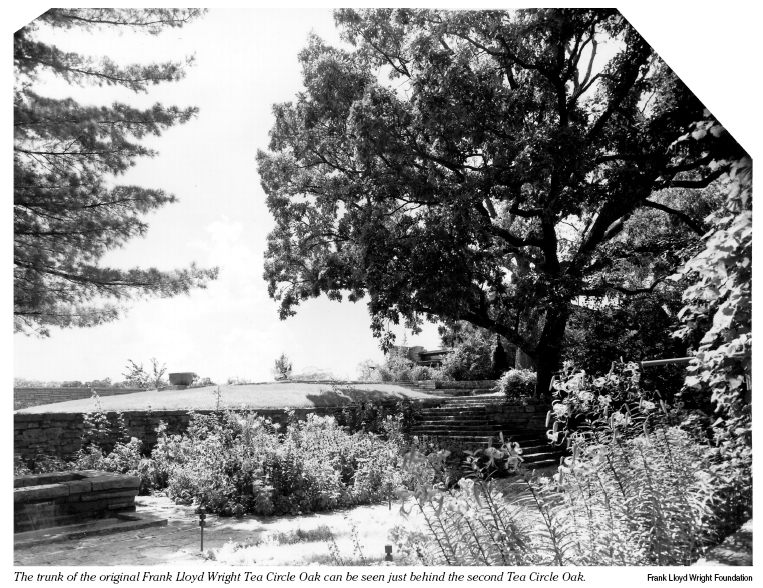
| The Frank Lloyd Wright Tea Circle Oaks Excerpted from Every Root an Anchor: Wisconsin’s Famous and Historic Trees by R. Bruce Allison http://dnr.wi.gov/forestry/Publications/pdf/AnchorTreeBook/Chapters/011%20TeaCircleOaks.pdf |
Frank Lloyd Wright, one of the
world’s great architects, felt the
natural surroundings of a home
or building should be integrated
into the overall design of the
structure. Though not physically
tall, Wright was a towering
figure in his genius, and perhaps
he identified with a mighty white
oak growing on the site he chose
for his own home near Spring
Green in Sauk County. Some
have called Taliesin—the
sprawling complex that includes
workshops, training ground,
farm,
world’s great architects, felt the
natural surroundings of a home
or building should be integrated
into the overall design of the
structure. Though not physically
tall, Wright was a towering
figure in his genius, and perhaps
he identified with a mighty white
oak growing on the site he chose
for his own home near Spring
Green in Sauk County. Some
have called Taliesin—the
sprawling complex that includes
workshops, training ground,
farm,
| Original Tea Circle Oak visible behind the trunk of the second Tea Circle Oak |
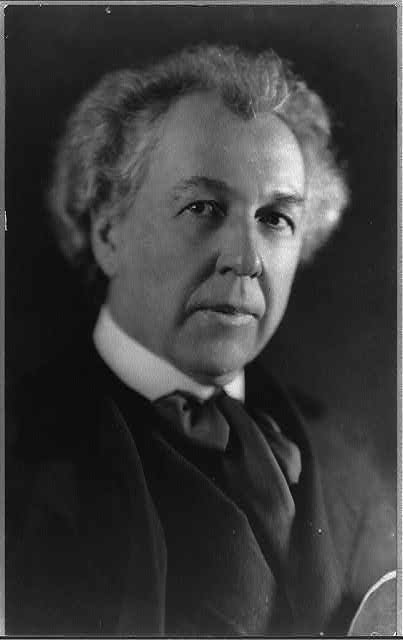
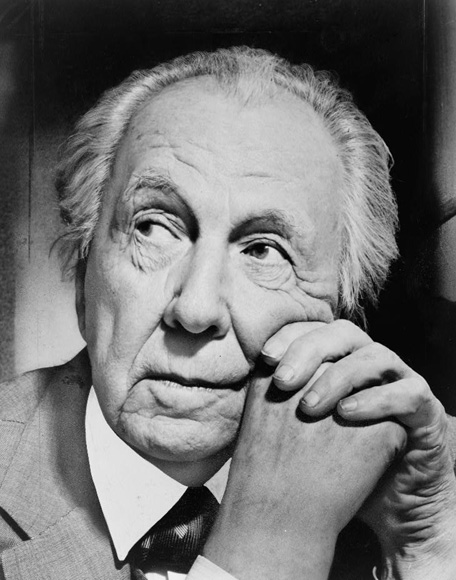
Frank Lloyd Wright (June 8, 1867 – April 9, 1959) was
one of the world's most prominent and influential
architects.
He developed a series of highly individual styles,
influenced the design of buildings all over the world, and
to this day remains America's most famous architect.
Wright was also well known in his lifetime. His colorful
personal life frequently made headlines, most notably for
the failure of his first two marriages and for the 1914 fire
and murders at his Taliesin studio.
Frank Lloyd Wright was born in the agricultural town of
Richland Center, Wisconsin, United States, on June 8,
one of the world's most prominent and influential
architects.
He developed a series of highly individual styles,
influenced the design of buildings all over the world, and
to this day remains America's most famous architect.
Wright was also well known in his lifetime. His colorful
personal life frequently made headlines, most notably for
the failure of his first two marriages and for the 1914 fire
and murders at his Taliesin studio.
Frank Lloyd Wright was born in the agricultural town of
Richland Center, Wisconsin, United States, on June 8,
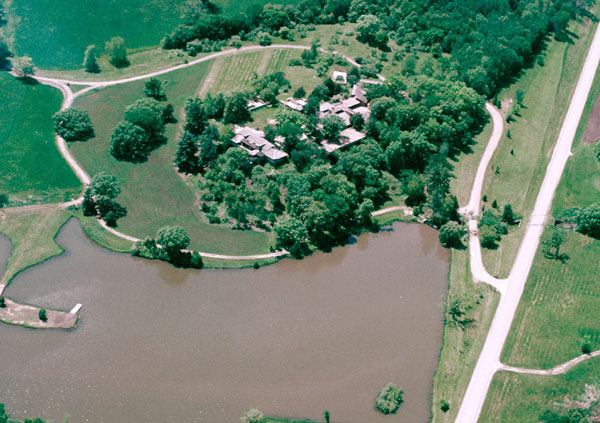
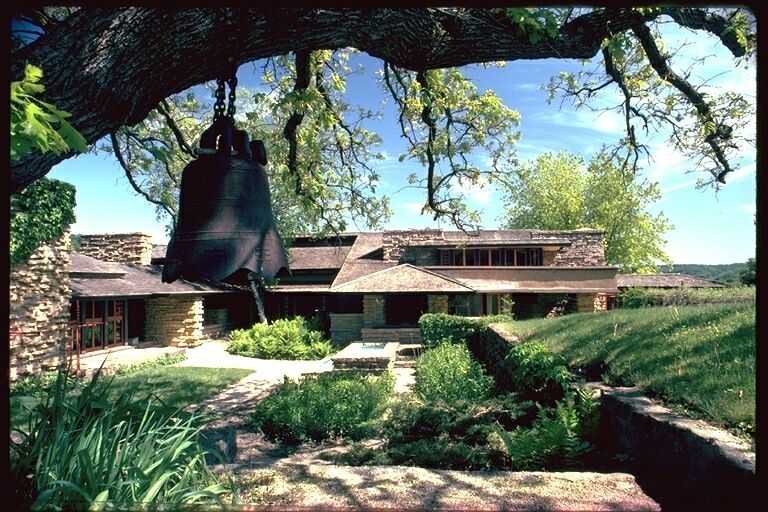
| Taliesen Seen from the top of the hill (Top) An aerial vie (Bottom) Frank Lloyd Wright, 1911 |
| Frank Lloyd Wright Home and Studio Oak Park, IL 1889-1909 |
Taliesin in Spring Green, Wisconsin
was the summer home of American
architect, Frank Lloyd Wright.
Wright began the home in 1911 after
leaving his first wife, Catherine
Tobin, and his Oak Park, Illinois
home and studio in 1909. The
impetus behind Wright’s departure
was his affair with Mamah
Borthwick Cheney, who had been the
wife of one of his clients, Edwin
Cheney. His winter home, Taliesin
West, is located in Scottsdale,
Arizona.
The valley in which Taliesin sits was
originally settled by Wright’s
maternal family, the Lloyd Joneses,
during the Civil War. Immigrants
from Wales, Wright’s maternal
grandfather and uncle were Unitarian
ministers, and his two aunts began a
co-educational school in the family
valley in 1887. Wright’s mother,
Anna Lloyd Jones Wright, began
sending her son to the valley every
summer, beginning when he was
eleven years old. The family, their
was the summer home of American
architect, Frank Lloyd Wright.
Wright began the home in 1911 after
leaving his first wife, Catherine
Tobin, and his Oak Park, Illinois
home and studio in 1909. The
impetus behind Wright’s departure
was his affair with Mamah
Borthwick Cheney, who had been the
wife of one of his clients, Edwin
Cheney. His winter home, Taliesin
West, is located in Scottsdale,
Arizona.
The valley in which Taliesin sits was
originally settled by Wright’s
maternal family, the Lloyd Joneses,
during the Civil War. Immigrants
from Wales, Wright’s maternal
grandfather and uncle were Unitarian
ministers, and his two aunts began a
co-educational school in the family
valley in 1887. Wright’s mother,
Anna Lloyd Jones Wright, began
sending her son to the valley every
summer, beginning when he was
eleven years old. The family, their
Allison and his tree company
crew had the daunting task of
removing it limb by limb
from the building. Many of the
remaining original Wright
understudies at Taliesin mourned
the loss of the tree. Then, with
characteristic perseverance and
determination, they arranged to
have a new oak planted to carry
on the tradition. As a symbolic
and actual replacement, it seems
to embody the spirit of the place,
which Wright determinedly
rebuilt twice after disastrous fires.
During almost 50 years as master
of Taliesin, Wright was often
photographed under the older oak
with visiting dignitaries who
came to pay homage to the
greatness of his original
architectural achievements, or to
visit the magnificent home itself.
The name Taliesin is Welsh and
means shining brow, and indeed
the house, integrated in organic
wholeness with the landscape,
crew had the daunting task of
removing it limb by limb
from the building. Many of the
remaining original Wright
understudies at Taliesin mourned
the loss of the tree. Then, with
characteristic perseverance and
determination, they arranged to
have a new oak planted to carry
on the tradition. As a symbolic
and actual replacement, it seems
to embody the spirit of the place,
which Wright determinedly
rebuilt twice after disastrous fires.
During almost 50 years as master
of Taliesin, Wright was often
photographed under the older oak
with visiting dignitaries who
came to pay homage to the
greatness of his original
architectural achievements, or to
visit the magnificent home itself.
The name Taliesin is Welsh and
means shining brow, and indeed
the house, integrated in organic
wholeness with the landscape,
What a coincidence! I'm reading Loving Frank right now! It's a novel about from
Maymah’s perspective about their romance. She actually left her husband and children
and ran away with Wright to Europe in 1909. There was quite the scandal since there
were 9 children between them. He builds Talisen for her, I’m not sure they ever
married. She and her children were murdered in a horrible way by an employee that
was angry with Wright or just crazy. It’s a new book by Nancy Horan who grew up
on the street they both lived on when the affair began. It’s very enjoyable but I couldn’t
have done what she did to her family. I recommend it. Betty Chambers
What I can't figure out is WHY all those people died. You'd think part of the DESIGN
of his home would include easy escape routes!! Weird! [Fire] codes or no codes -
you'd think that a genius such as he would have considered the possibility of fires...
Hmm. You don't suppose he PLANNED that, do you? He did exchange wives often....
And, what about this guy HE hired? What was the reason he was doing that to
Wright. There's more to know here, me thinks... Jinny Collins
I love the detailed answers! Sometimes when doing a quiz you just want to know
more, and you provide it! Wow, what a picture this week - I never knew that about
Frank Lloyd Wright. I am surprised there hasn't been more of a mention about it or a
movie - you know how folks are fascinated by that sort of thing. I don't know what I
like more - the quizzes or the detailed answers provided on the site! Thanks again, have
a great week. Beth Long
I'm a big Frank Lloyd Wright fan and enjoyed a visit to Taliesin in Spring Green a few
years ago. Needless to say, the tour guide did not dwell on the horrific events that
happened there. Pamela Hoffman
I live only a few minutes from Spring Green and my wife's family has lived in this area
for years. Although I knew who the architect was right away from the picture I had
never heard of the murders, nor had my wife. Very interesting picture quiz for me.
Dave Richardson
The thing I enjoy about your quizzes is that I learn about history in doing them-- I never
knew this about Wright. Tom Tullis
Mr. Wright may have been a little bit on the scandalous side when it came to his
relationships with women, but his architecture is sheer poetry. I LOVE to drive down
into Oak Park and just drool [not literally!!] over his various creations. Merry
Christmas!!!! [p.s., maybe if you're here long enuf on one of your chicago stopovers
we could take a field trip and see Taliesin...] Karen Petrus
It’s surprising that people didn’t know about the murders, although I suppose it
shouldn’t be. How many people will remember the Robert Blake or Phil Spector
scandals fifty or a hundred years from now? And how many people today remember so-
called crimes of the century involving Fatty Arbuckle or Stanford White? Anyway,
there’s a bestselling novel out now called Loving Frank that tells about the killings at
Taliesin, so the sad and sordid story may become better known. At least if it’s made
into a movie. James Crossley
Bob did most of the legwork (finger?work) on this week's quiz but I guessed that the
architect was Frank Lloyd Wright after seeing the jpg ID on the picture before the
questions were posted. Bob & Venita Wilson
I had seen a biography of Wright on PBS several years ago which related this incident.
As I recall, they said that Julian Carlston the murderer, locked all the windows and
exterior doors but one, lit the house afire, stood outside the only unlocked door with his
axe, and hacked to death any who tried to leave. An unforgettable story, to say the
least! Mike Swierczewski
Maymah’s perspective about their romance. She actually left her husband and children
and ran away with Wright to Europe in 1909. There was quite the scandal since there
were 9 children between them. He builds Talisen for her, I’m not sure they ever
married. She and her children were murdered in a horrible way by an employee that
was angry with Wright or just crazy. It’s a new book by Nancy Horan who grew up
on the street they both lived on when the affair began. It’s very enjoyable but I couldn’t
have done what she did to her family. I recommend it. Betty Chambers
What I can't figure out is WHY all those people died. You'd think part of the DESIGN
of his home would include easy escape routes!! Weird! [Fire] codes or no codes -
you'd think that a genius such as he would have considered the possibility of fires...
Hmm. You don't suppose he PLANNED that, do you? He did exchange wives often....
And, what about this guy HE hired? What was the reason he was doing that to
Wright. There's more to know here, me thinks... Jinny Collins
I love the detailed answers! Sometimes when doing a quiz you just want to know
more, and you provide it! Wow, what a picture this week - I never knew that about
Frank Lloyd Wright. I am surprised there hasn't been more of a mention about it or a
movie - you know how folks are fascinated by that sort of thing. I don't know what I
like more - the quizzes or the detailed answers provided on the site! Thanks again, have
a great week. Beth Long
I'm a big Frank Lloyd Wright fan and enjoyed a visit to Taliesin in Spring Green a few
years ago. Needless to say, the tour guide did not dwell on the horrific events that
happened there. Pamela Hoffman
I live only a few minutes from Spring Green and my wife's family has lived in this area
for years. Although I knew who the architect was right away from the picture I had
never heard of the murders, nor had my wife. Very interesting picture quiz for me.
Dave Richardson
The thing I enjoy about your quizzes is that I learn about history in doing them-- I never
knew this about Wright. Tom Tullis
Mr. Wright may have been a little bit on the scandalous side when it came to his
relationships with women, but his architecture is sheer poetry. I LOVE to drive down
into Oak Park and just drool [not literally!!] over his various creations. Merry
Christmas!!!! [p.s., maybe if you're here long enuf on one of your chicago stopovers
we could take a field trip and see Taliesin...] Karen Petrus
It’s surprising that people didn’t know about the murders, although I suppose it
shouldn’t be. How many people will remember the Robert Blake or Phil Spector
scandals fifty or a hundred years from now? And how many people today remember so-
called crimes of the century involving Fatty Arbuckle or Stanford White? Anyway,
there’s a bestselling novel out now called Loving Frank that tells about the killings at
Taliesin, so the sad and sordid story may become better known. At least if it’s made
into a movie. James Crossley
Bob did most of the legwork (finger?work) on this week's quiz but I guessed that the
architect was Frank Lloyd Wright after seeing the jpg ID on the picture before the
questions were posted. Bob & Venita Wilson
I had seen a biography of Wright on PBS several years ago which related this incident.
As I recall, they said that Julian Carlston the murderer, locked all the windows and
exterior doors but one, lit the house afire, stood outside the only unlocked door with his
axe, and hacked to death any who tried to leave. An unforgettable story, to say the
least! Mike Swierczewski
ideas, religion, and ideals, greatly influenced the young Wright, who would later change
his middle name from Lincoln (in honor of Abraham Lincoln) to Lloyd in deference to
this side of the family.
Thus, when Wright decided to begin a home in this valley, he chose the name of the
Welsh bard Taliesin, whose name means, “shining brow” or “radiant brow.” Wright
positioned the home on the “brow” of a hill, a favorite of his from childhood. The home
was designed with three wings that included his living quarters, an office, and farm
buildings. Aside from placing the building into the landscape, Wright used Taliesin as a
way to explore his ideas of Organic architecture. The chimneys and stone piers were
built from local limestone, laid by the stonemasons in a way that evoked the
outcroppings of Wisconsin’s surrounding Driftless Area (the area unaccompanied by
glacial drift) and sand from the nearby Wisconsin River was mixed into the stucco
walls to evoke the river's sandbars.
his middle name from Lincoln (in honor of Abraham Lincoln) to Lloyd in deference to
this side of the family.
Thus, when Wright decided to begin a home in this valley, he chose the name of the
Welsh bard Taliesin, whose name means, “shining brow” or “radiant brow.” Wright
positioned the home on the “brow” of a hill, a favorite of his from childhood. The home
was designed with three wings that included his living quarters, an office, and farm
buildings. Aside from placing the building into the landscape, Wright used Taliesin as a
way to explore his ideas of Organic architecture. The chimneys and stone piers were
built from local limestone, laid by the stonemasons in a way that evoked the
outcroppings of Wisconsin’s surrounding Driftless Area (the area unaccompanied by
glacial drift) and sand from the nearby Wisconsin River was mixed into the stucco
walls to evoke the river's sandbars.
curves like a brow on the side of the hill. Wright made its prairie house style famous,
and it truly belongs among the rolling green hills and oak openings of southern
Wisconsin.
It is natural to compare Wright to an oak. A man of great strength and will, he survived
devastating personal tragedies, an often indifferent or hostile public, and a challenging
press. However, he is now generally recognized as a creative genius. He designed more
than 600 buildings, pioneered a completely new concept called organic architecture and
developed numerous innovations that would be followed for years to come. Perhaps
only a man as strong as an oak could withstand the setbacks he endured while never
losing the confidence in his own ideas and abilities that enabled him to forge ahead in
spite of indifference or criticism.
and it truly belongs among the rolling green hills and oak openings of southern
Wisconsin.
It is natural to compare Wright to an oak. A man of great strength and will, he survived
devastating personal tragedies, an often indifferent or hostile public, and a challenging
press. However, he is now generally recognized as a creative genius. He designed more
than 600 buildings, pioneered a completely new concept called organic architecture and
developed numerous innovations that would be followed for years to come. Perhaps
only a man as strong as an oak could withstand the setbacks he endured while never
losing the confidence in his own ideas and abilities that enabled him to forge ahead in
spite of indifference or criticism.
two children John and Martha, Thomas Brunker, the foreman, Emil Brodelle, a
draftsman, David Lindblom, a landscape gardener, and Ernest Weston, the son of the
carpenter William Weston. Two victims survived the mêleé--William Weston and
draftsman Herb Fritz--and the elder Weston helped to put out the fire that almost
draftsman, David Lindblom, a landscape gardener, and Ernest Weston, the son of the
carpenter William Weston. Two victims survived the mêleé--William Weston and
draftsman Herb Fritz--and the elder Weston helped to put out the fire that almost
| Famous architect. His loved ones were murdered. 1. Who was the architect and who was killed? 2. What is the name of his house? |
| Thanks to Sarah Herbener for suggesting this quiz. |
| Congratulations to Our Winners! Rick's Quiz Angels Ashley and Jina do it again!!! Betty Chambers Jinny Collins Emily Aulicino Fred Stuart Mary Fraser Judy Pfaff Pamela Hoffman Dave Richardson Tom Tullis Mary Beth Emmerichs Elaine C. Hebert Charles Minchew Brian Kemp Sharon Martin Rhonda Taylor Jim Kiser Don Schulteis Stan Read Margaret Waterman Sandy Thompson Brad Labine Kelly Fetherlin Raymond Cathcart Tom Siegel Beth Long Bill Utterback James Crossley Marilyn Hamill Karen Petrus Dawn Carlile Joe Ruffner Andy Hoh Mike Swierczewski Corey Condit Dave Doucette Don Haase Zach Chambers Carl Blessing Diane Burkett Sherry Marshall Tom Tollefsen Dennis Brann Johnny Bradley Karen Rhea Sheri Fenley Barb Marhoul Laurel Chauvin Bob & Venita Wilson Grace Hertz Bob McKenna JoAnne Craig Deb Pritchard Bill Hurley Dave Town Lexie Condit Richard Murray Gina Hudson Mary Osmar Joshua Kreitzer |
| Answers: 1. Maymah Borthwick Cheney, his common law wife, her two children John and Marsha, the foreman Thomas Brunker, Emile Brodelle, a draftsman David Lindblom, a landscape gardener, Ernest Weston, the son of the carpenter William Weston 2. Taliesen, located in Spring Green, WI |
| Comments from Our Readers |
completely consumed the residential wing of the house.
Carlston, hiding in the unlit furnace, survived the fire
but died in jail six weeks later; Gertrude also survived,
having escaped the burning building through the
basement; she denied any knowledge of her husband's
actions.
Wright eventually rebuilt the living quarters, naming it
Taliesin II. These living quarters were again destroyed
by fire on April 22, 1925. According to Wright in his
autobiography, the fire appeared to have begun near a
telephone in his bedroom. Wright also mentioned a
lightning storm approaching immediately before
noticing the fire. Wright scholars speculate that the
storm may have caused an electrical surge through the
telephone system, sparking the fire. Wright began the
rebuilding of Taliesin, which he now named Taliesin
III, shortly afterwards.
In 1940, Frank Lloyd Wright and his third wife,
Olgivanna (December 27, 1898 - March 1, 1985)
formed the Frank Lloyd Wright Foundation, which still
exists. Upon Wright's death in 1959, ownership of the
Taliesin estate in Spring Green, as well as Taliesin
West, passed into the hands of the foundation. The
foundation also owns Frank Lloyd Wright’s archives
and runs a school, the Frank Lloyd Wright School of
Carlston, hiding in the unlit furnace, survived the fire
but died in jail six weeks later; Gertrude also survived,
having escaped the burning building through the
basement; she denied any knowledge of her husband's
actions.
Wright eventually rebuilt the living quarters, naming it
Taliesin II. These living quarters were again destroyed
by fire on April 22, 1925. According to Wright in his
autobiography, the fire appeared to have begun near a
telephone in his bedroom. Wright also mentioned a
lightning storm approaching immediately before
noticing the fire. Wright scholars speculate that the
storm may have caused an electrical surge through the
telephone system, sparking the fire. Wright began the
rebuilding of Taliesin, which he now named Taliesin
III, shortly afterwards.
In 1940, Frank Lloyd Wright and his third wife,
Olgivanna (December 27, 1898 - March 1, 1985)
formed the Frank Lloyd Wright Foundation, which still
exists. Upon Wright's death in 1959, ownership of the
Taliesin estate in Spring Green, as well as Taliesin
West, passed into the hands of the foundation. The
foundation also owns Frank Lloyd Wright’s archives
and runs a school, the Frank Lloyd Wright School of

| ********** |
recreational haven and living quarters—Wright’s finest achievement. He constructed the
Tea Circle around two old oaks. There, on warm afternoons while tea was served,
Wright would converse with the students who had come to Taliesin to live, work and
learn from the master. This practice continues today with the present Fellowship
members, even though Wright is gone.
Wright died at 90 in April 1959 at his Arizona winter home and headquarters. Back in
Wisconsin soon afterwards, a bolt of lightning shattered the larger Tea Circle Oak
beyond saving. However, the smaller oak that had started life under the spreading
canopy of the larger tree quickly filled out to replace the Tea Circle Oak that had been
hit. The second oak thrived, its canopy eventually extending outward in a diameter
of over 100 feet, providing shade and inspiration for the next generation of architects at
Taliesin. Tragically, the second original Tea Circle Oak was blown over by a
devastating windstorm in 1998. With straight-line winds of over 80 miles per hour, the
storm toppled about 15 trees on the estate, including the remaining Tea Circle Oak,
which snapped at the base and fell onto the roof above Mr. Wright’s studio. R. Bruce
Tea Circle around two old oaks. There, on warm afternoons while tea was served,
Wright would converse with the students who had come to Taliesin to live, work and
learn from the master. This practice continues today with the present Fellowship
members, even though Wright is gone.
Wright died at 90 in April 1959 at his Arizona winter home and headquarters. Back in
Wisconsin soon afterwards, a bolt of lightning shattered the larger Tea Circle Oak
beyond saving. However, the smaller oak that had started life under the spreading
canopy of the larger tree quickly filled out to replace the Tea Circle Oak that had been
hit. The second oak thrived, its canopy eventually extending outward in a diameter
of over 100 feet, providing shade and inspiration for the next generation of architects at
Taliesin. Tragically, the second original Tea Circle Oak was blown over by a
devastating windstorm in 1998. With straight-line winds of over 80 miles per hour, the
storm toppled about 15 trees on the estate, including the remaining Tea Circle Oak,
which snapped at the base and fell onto the roof above Mr. Wright’s studio. R. Bruce
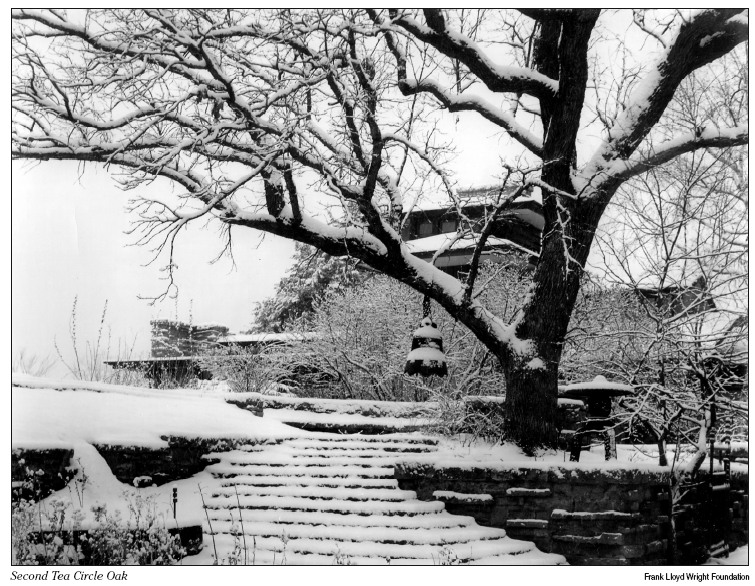
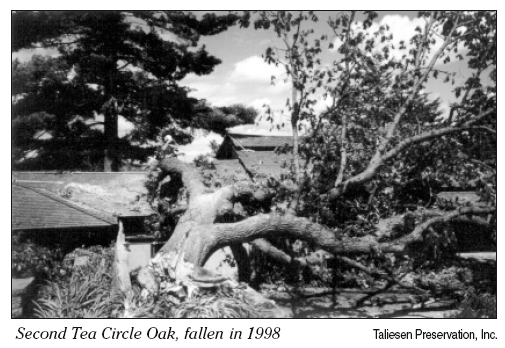
| Second Tea Circle Oak before and after it fell. |
| ********** |
| ********** |
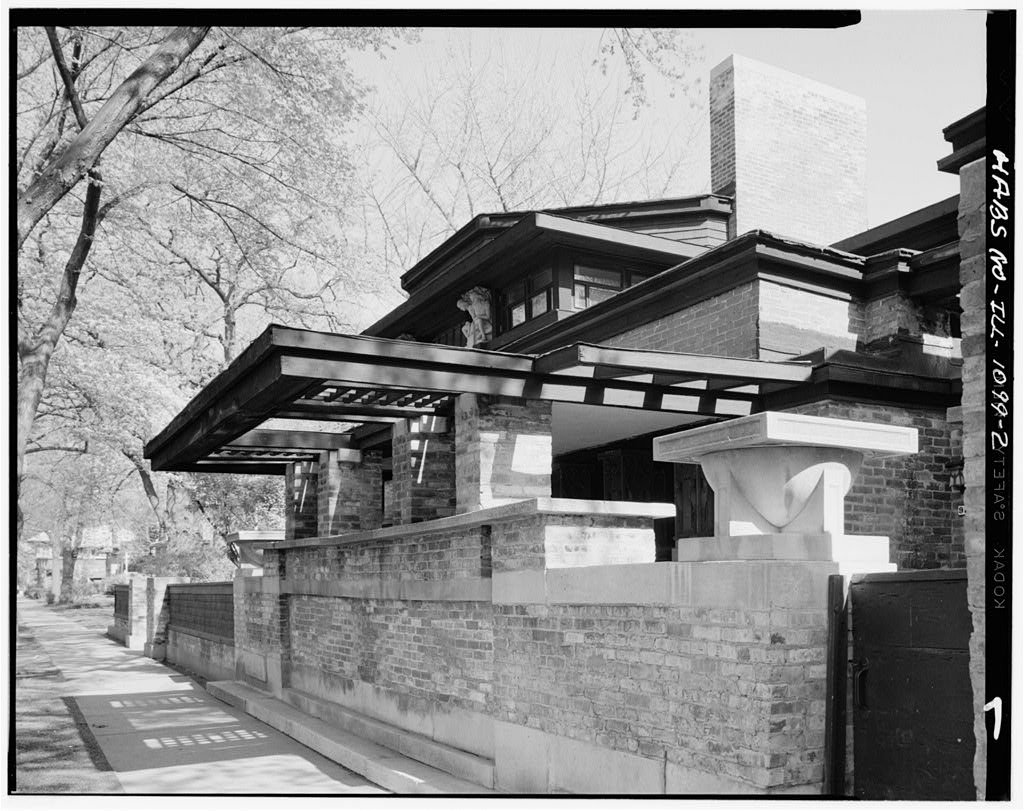
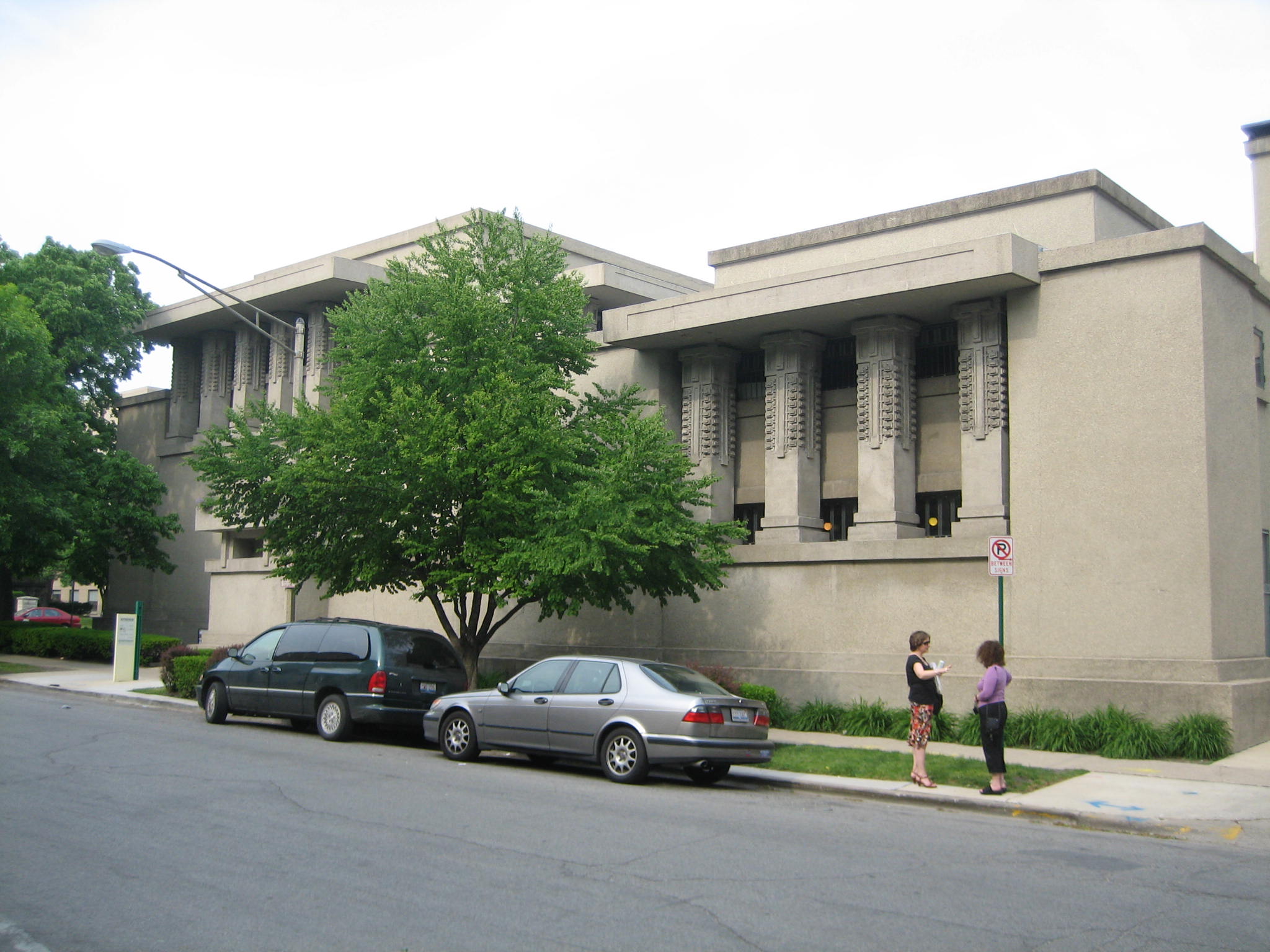
| Unity Temple Oak Park, IL 1905-1908 |
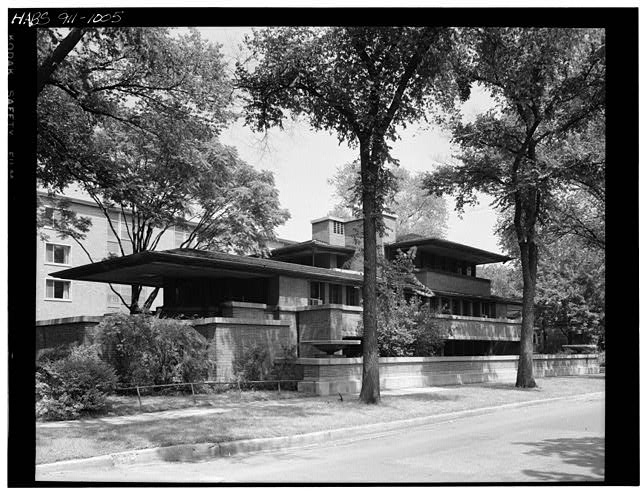
| Robie House Hyde Park, Chicago, IL 1910 |
Wright and Mamah Borthwick (now
going by her maiden name) moved
into Taliesin shortly after Christmas,
1911. On August 15, 1914, while
Wright was in Chicago completing a
large project, Midway Gardens,
Julian Carlston, a manservant whom
Wright had hired two months earlier
(along with his wife, Gertrude, who
served as cook), set fire to the living
quarters of Taliesin and murdered
seven people with an axe as the fire
burned. The dead were: Mamah, her
going by her maiden name) moved
into Taliesin shortly after Christmas,
1911. On August 15, 1914, while
Wright was in Chicago completing a
large project, Midway Gardens,
Julian Carlston, a manservant whom
Wright had hired two months earlier
(along with his wife, Gertrude, who
served as cook), set fire to the living
quarters of Taliesin and murdered
seven people with an axe as the fire
burned. The dead were: Mamah, her
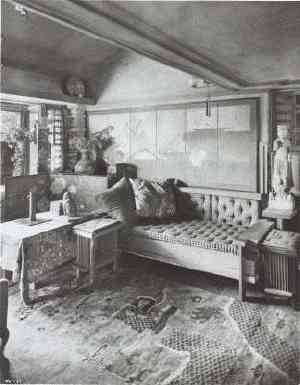
| Interior of Taliesen http://www.architechgallery... |
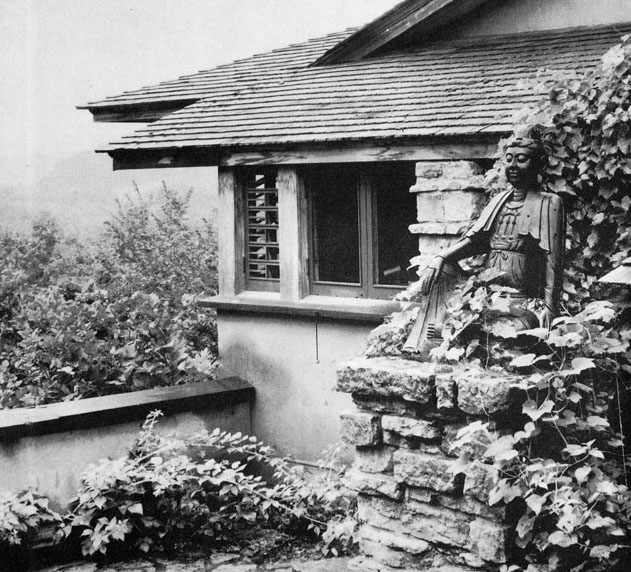
| Window at Taliesen http://www.jamesgivensdesign.com... |
Architecture. The architectural restoration of the Taliesin estate in Wisconsin is under
the supervision of another non-profit organization established in 1991, Taliesin
Preservation, Inc. The entire Taliesin estate is a National Historic Landmark.
the supervision of another non-profit organization established in 1991, Taliesin
Preservation, Inc. The entire Taliesin estate is a National Historic Landmark.
| ********** |
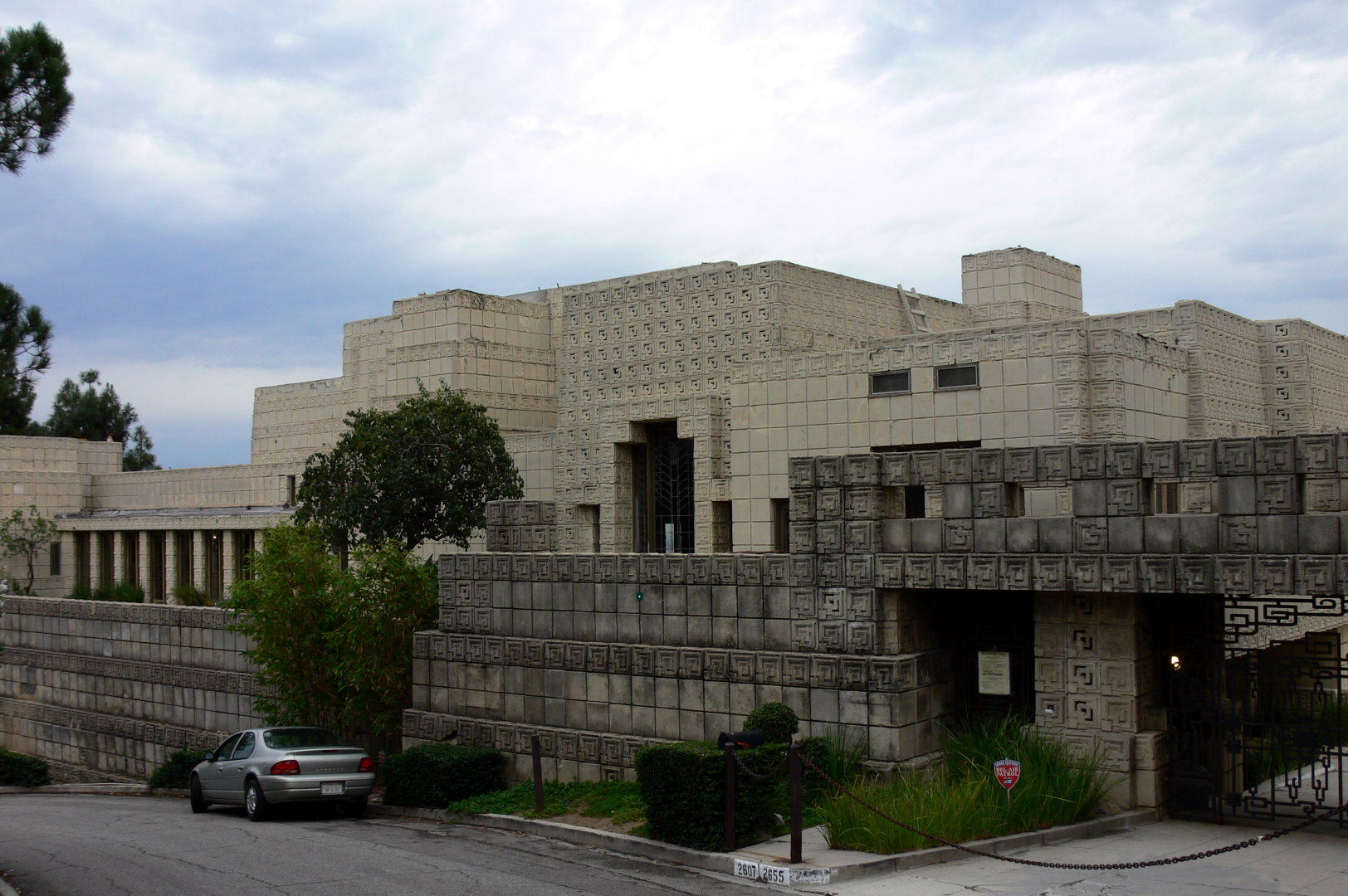
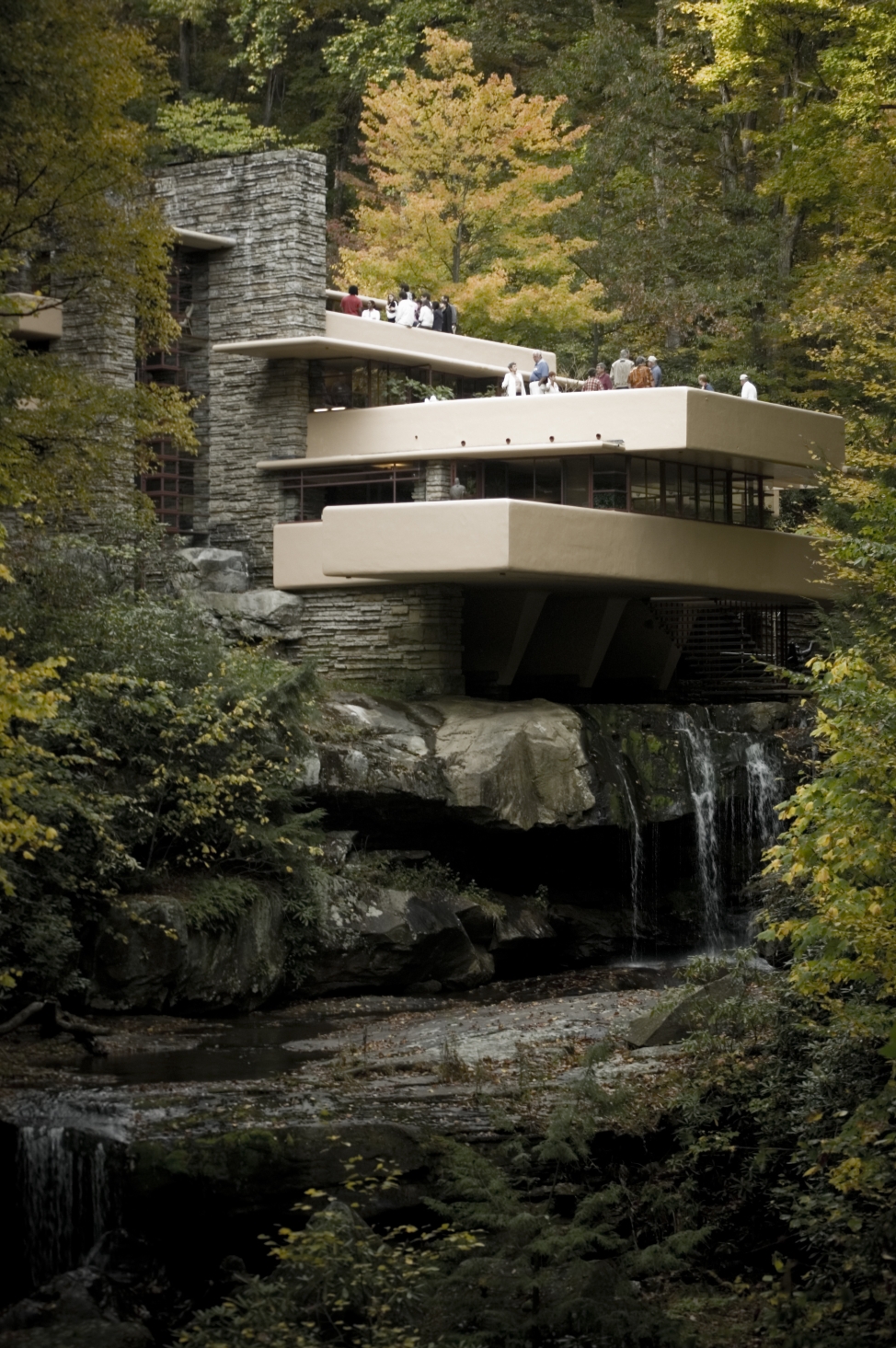
| Fallingwater Mill Run, PA 1935 |

| Gordon House Usonian Home Silverton, OR 1930s-1940s |
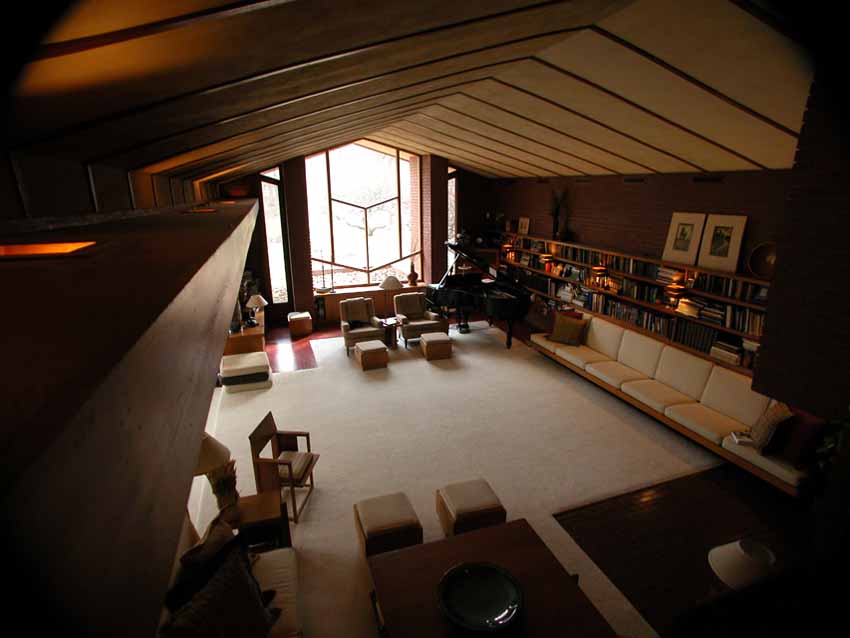
| Mossberg House South Bend, IN 1948 |
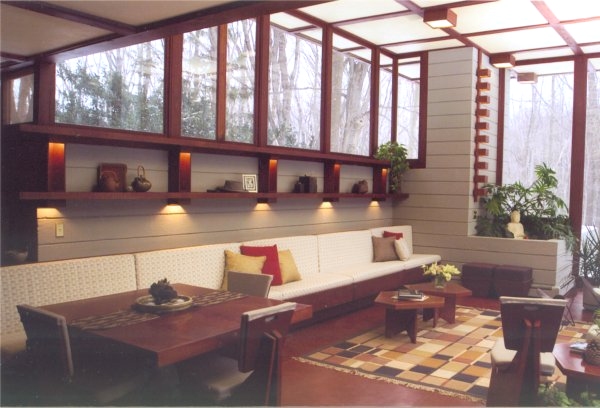
| Louis Penfield House Cleveland, OH 1955 |
| Frank Lloyd Wright |
1867, just two years after the end of the American Civil War. Originally named Frank
Lincoln Wright, he changed his name after his parents' divorce to honor his mother's
Welsh American family, the Lloyd Joneses of Wisconsin.
Wright never attended high school and was admitted to the University of Wisconsin as
a special student in 1885. While attending classes at the University he joined the
Fraternity of Phi Delta Theta. He took classes part-time for two semesters, while
apprenticing under a local builder and professor of civil engineering. In 1887, Wright
left the University without taking a degree (although he was granted an honorary
Doctorate of Fine Arts from the University in 1955) and moved to Chicago, Illinois, still
rebuilding from the Great Chicago Fire of 1871, where he joined the architectural firm
of Joseph Lyman Silsbee. Within the year, he had left Silsbee to work for the firm of
Adler & Sullivan.
In 1889, he married his first wife, Catherine Lee "Kitty" Tobin, purchased land in Oak
Park, Illinois, and built his first home, and eventually his studio there. His mother, Anna,
soon followed Wright to the city, where he purchased a home adjacent to his newly
built residence for her. His marriage to Kitty Tobin, the daughter of a wealthy
businessman, raised his social status, and he became more well-known.
Beginning in 1890, he was assigned all residential design work for the firm. In 1893,
Louis Sullivan discovered that Wright had been accepting private commissions. Sullivan
Lincoln Wright, he changed his name after his parents' divorce to honor his mother's
Welsh American family, the Lloyd Joneses of Wisconsin.
Wright never attended high school and was admitted to the University of Wisconsin as
a special student in 1885. While attending classes at the University he joined the
Fraternity of Phi Delta Theta. He took classes part-time for two semesters, while
apprenticing under a local builder and professor of civil engineering. In 1887, Wright
left the University without taking a degree (although he was granted an honorary
Doctorate of Fine Arts from the University in 1955) and moved to Chicago, Illinois, still
rebuilding from the Great Chicago Fire of 1871, where he joined the architectural firm
of Joseph Lyman Silsbee. Within the year, he had left Silsbee to work for the firm of
Adler & Sullivan.
In 1889, he married his first wife, Catherine Lee "Kitty" Tobin, purchased land in Oak
Park, Illinois, and built his first home, and eventually his studio there. His mother, Anna,
soon followed Wright to the city, where he purchased a home adjacent to his newly
built residence for her. His marriage to Kitty Tobin, the daughter of a wealthy
businessman, raised his social status, and he became more well-known.
Beginning in 1890, he was assigned all residential design work for the firm. In 1893,
Louis Sullivan discovered that Wright had been accepting private commissions. Sullivan
felt betrayed that his favored employee had designed
houses "behind his back," and he asked Wright to leave
the firm. Constantly in need of funds to support his
growing family, Wright designed the homes to supplement
his meager income. Wright referred to these houses as his
"bootleg" designs and the homes are located near the
Frank Lloyd Wright Home and Studio, on Chicago Avenue
in Oak Park. After leaving Sullivan, Wright established his
own practice at his home. By 1901, Wright's completed
projects numbered approximately fifty, including many
houses in Oak Park.
Between 1900 and 1917, his residential designs were
"Prairie Houses" (extended low buildings with shallow,
sloping roofs, clean sky lines, suppressed chimneys,
houses "behind his back," and he asked Wright to leave
the firm. Constantly in need of funds to support his
growing family, Wright designed the homes to supplement
his meager income. Wright referred to these houses as his
"bootleg" designs and the homes are located near the
Frank Lloyd Wright Home and Studio, on Chicago Avenue
in Oak Park. After leaving Sullivan, Wright established his
own practice at his home. By 1901, Wright's completed
projects numbered approximately fifty, including many
houses in Oak Park.
Between 1900 and 1917, his residential designs were
"Prairie Houses" (extended low buildings with shallow,
sloping roofs, clean sky lines, suppressed chimneys,
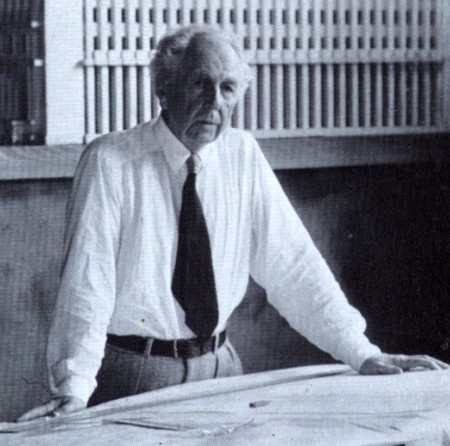
| Frank Lloyd Wright in later years http://myweb.stedwards.edu... |
overhangs and terraces, using unfinished materials), so-called because the design is
considered to complement the land around Chicago. These houses are credited with
being the first examples of the "open plan."
In fact, the manipulation of interior space in residential and public buildings, such as
Unity Temple, the home of the Unitarian Universalist congregation in Oak Park, are
hallmarks of his style. A lifelong Unitarian and member of Unity temple, Wright offered
his services to the congregation after their church burned in 1904. The community
agreed to hire him and he worked on the building between 1905 through 1908. He
believed that humanity should be central to all design
The Westcott House was built between (1907 and 1908), in Springfield, Ohio. It not
only embodies Frank Lloyd Wright’s innovative Prairie Style design but also reflects his
passion for Japanese art and culture as the Westcott House displays unique design traits
characteristic of traditional Japanese design. The Westcott House is the only Prairie
house to be built in Ohio, and it represents an important evolution of Wright’s Prairie
concept. The Westcott House includes an extensive ninety-eight foot pergola, capped
with an intricate wooden trellis, that connects a detached carriage house and garage to
the main house -- features that are included in only a few of Wright’s later Prairie Style
houses designs.
Other Frank Lloyd Wright houses considered to be masterpieces of the late Prairie
Period (1907-1909) are the Frederick Robie House in Chicago and the Avery and
considered to complement the land around Chicago. These houses are credited with
being the first examples of the "open plan."
In fact, the manipulation of interior space in residential and public buildings, such as
Unity Temple, the home of the Unitarian Universalist congregation in Oak Park, are
hallmarks of his style. A lifelong Unitarian and member of Unity temple, Wright offered
his services to the congregation after their church burned in 1904. The community
agreed to hire him and he worked on the building between 1905 through 1908. He
believed that humanity should be central to all design
The Westcott House was built between (1907 and 1908), in Springfield, Ohio. It not
only embodies Frank Lloyd Wright’s innovative Prairie Style design but also reflects his
passion for Japanese art and culture as the Westcott House displays unique design traits
characteristic of traditional Japanese design. The Westcott House is the only Prairie
house to be built in Ohio, and it represents an important evolution of Wright’s Prairie
concept. The Westcott House includes an extensive ninety-eight foot pergola, capped
with an intricate wooden trellis, that connects a detached carriage house and garage to
the main house -- features that are included in only a few of Wright’s later Prairie Style
houses designs.
Other Frank Lloyd Wright houses considered to be masterpieces of the late Prairie
Period (1907-1909) are the Frederick Robie House in Chicago and the Avery and
Queene Coonley House in Riverside. The
Robie House, with its soaring, cantilevered
roof lines, supported by a 110-foot (34
m)-long channel of steel, is the most dramatic.
Its living and dining areas form virtually one
uninterrupted space. This building had a
profound influence on young European
architects after World War I and is sometimes
called the "cornerstone of modernism."
Wright's work, however, was not known to
European architects until the publication of the
Wasmuth Portfolio 1910-1911.
Local gossips noticed Wright's flirtations, and
he developed a reputation in Oak Park as a
Robie House, with its soaring, cantilevered
roof lines, supported by a 110-foot (34
m)-long channel of steel, is the most dramatic.
Its living and dining areas form virtually one
uninterrupted space. This building had a
profound influence on young European
architects after World War I and is sometimes
called the "cornerstone of modernism."
Wright's work, however, was not known to
European architects until the publication of the
Wasmuth Portfolio 1910-1911.
Local gossips noticed Wright's flirtations, and
he developed a reputation in Oak Park as a
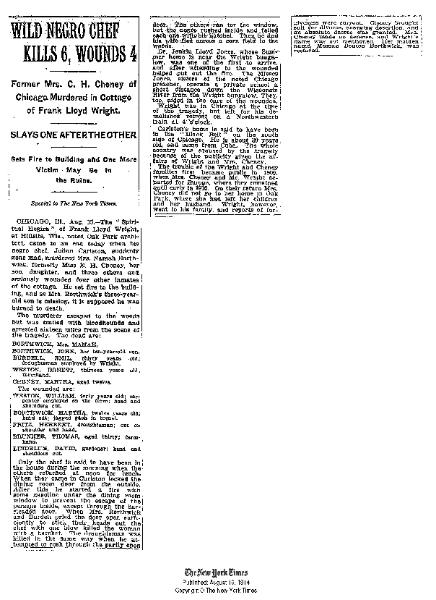
| Original New York Times Article about the Murders August 16, 1914 Open this article in pdf format. Click here. |
| Mystery of the Murders at Taliesen. BBC News 14 January 2001 Click here. |
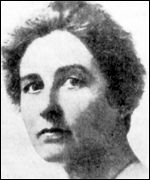
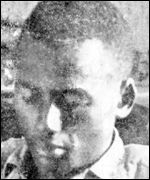
| Maymah Borthwick |
| Julian Carlton |

| Blindsided: Homicide Where It is Least Expected Discusses Taliesen pp 231-234 http://books.google.com/... |
| Murderer of Seven: Sets Fire to Country Home of Frank Lloyd Wright Near Spring Green The Weekly Home News 20 August 1914 Click here. |

| Loving Frank by Nancy Horan Read more. |
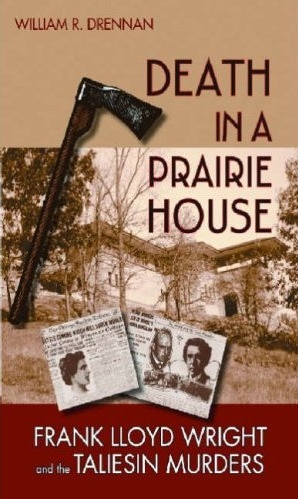
| Death in a Prarie House by William Drennan Read more. |


