| XXX |
| XXX |
| XXX |
| XXX |
| Ten Google Earth satellite pictures of the Boyne Valley. www.irishmegaliths.org.uk/BoyneValley.htm |
| XXX |
| How Diane Solved the Puzzle |

 |  |  |  |
| If you have a picture you'd like us to feature a picture in a future quiz, please email it to us at CFitzp@aol.com. If we use it, you will receive a free analysis of your picture. You will also receive a free Forensic Genealogy CD or a 10% discount towards the purchase of the Forensic Genealogy book. |


 |  |  |  |
| ********** |

| If you enjoy our quizzes, don't forget to order our books! Click here. |

| Quiz #335 Results |

| Answers: 1. New Grange, an ancient Irish Stonehenge. 2. To allow the rays of the sun to penetrate the interior on the Winter Solstice. 3. 50 out of 31,531. |
| Answer to Quiz #335 December 19, 2011 |
| 1. What is this the entrance to? 2. What is the purpose of the square hole above the door? 3. What were your chances of winning the lottery to get in for "the big event" this week? |
| ********** |
| ********** |

| Tin Eye Alert! You can find this photograph on TinEye, but you will have more fun if you solve the puzzle on your own. |

| Congratulations to Our Winners Diane Burkett Grace Hertz James L. Brady Gary Sterne Angel Esparza Joyce Veness Arthur Hartwell Collier Smith Margaret Waterman Dennis Brann Jim Kiser Alex Sissoev Peter Norton Donna Jolley Carol Colgan Jillian Dart Jim Baker James L. Brady Deborah Campisano Mike Dalton Alan Cullinan Robert W. Steinmann, Jr. Nicole Blank Margaret Paxton Cate Bloomquist Barbara Mroz Daniel Jolley Marilyn Hamill |
| Comments from Our Readers |
Very interesting quiz again! Don't you wish that you were one of the 100 very lucky
people to have a ticket to be at Newgrange in Ireland on December 21? What an
amazing feat to construct this!!!!!!! Do you suppose any of your ancestors helped
construct this? Grace Hertz
N.B. Andy and I entered the lottery when we visited New Grange in 2010, but we
didn't win. We figure our chances are 1 in 620 if 31,000 people enter again in the
coming year. With both of us entering, that makes 1 in 310. That's not bad odds.
-Q. Gen.
Start planning for next year! Keep trying! Someone has to be a winner!!!!!!!!!!!!!!!
Grace Hertz!!!!!!!!!
*****
Thanks for another great quiz as usual. I hope to get to Ireland someday. My paternal
line is from somewhere in the UK. Sterne came from the adoption of my grandfather.
My direct paternal line is Hilburn and my YDNA is R1b1a2a1a1a4. I can only trace
them back to 1730 in Virginia. Gary Sterne
*****
My method was simply to search for SPIRAL STONE in Google Images, which turned
up a picture in the first row that matched the large stone and was identified as
Newgrange Entrance Stone. From there it was trivial to find all the rest, because the
connection to the solstice was mentioned prominently in the information about
Newgrange. A further Google search on NEWGRANGE SOLSTICE LOTTERY turned
up the lottery data. Collier Smith
*****
Amazing that when this was built about 3200 BC, the builders could figure out the
precise location for the entrance to let the sun in at the precise time of the solstice. How
did they do that? Margaret Waterman
*****
Stonehenge has always been one of my favorite places on the planet...I will be sure to
add this one to the list. Dennis Brann
*****
Fairly easy puzzle. I just googled Spiral Carvings on Ancient Rocks and shortly came
up with it. I'm amazed that the math to predict the sunlight during the Soltice was
available. You sure it wasn't aliens from outer space. Recently saw a YouTube of a guy
in Michigan who figured out how to re-create Stonehenge using very simply levers and
rocks under huge boulders which he stacked one upon the other. He just engineered it
using simple levers and gravity. Jim Kiser
N.B. No I can't be sure it wasn't aliens who built New Grange. I wasn't there.
- Q. Gen.
*****
Assuming fair game, each applicant's chance was 50/31531x100% = 0.16%. Of
course, mine was 0%, since I only found out about this today... Alex Sissoev
*****
I think I Googled 'carved rock in front of door' came up with nothing useful, then tried
'carved rock spirals' which led to a photo of the entrance rock. I Googled 'Newgrange
lottery 2011' to find this year's number of entrants.
Solstices tend to be big events to many Alaskans, so I found this quiz apt, gobs
of fun, and utterly fascinating. Thanks, Colleen! Now I must fold laundry.
Peter Norton
*****
Colleen- Do I need to answer this ??? It was clowdy yesterday - so the event was not
spectacular. On December 21st (the Winter Solstice) the rising sun shines through the
'Roof Box'; and illuminates the Chamber 19 metres from the entrance. Indiana Jones -
eat your heart out.This is part of our UNESCO World Heritage Site and we are proud of
it. Alan Cullinan
*****
This was interesting and a good mind-expander. I'm beginning to appreciate how
advanced some prehistoric peoples were in art, engineering, construction, and other
disciplines.Sometime, I'd like to further explore prehistoric Irish rock carvings.
Barbara Mroz
*****
Hello Colleen:
1. Deep space astronomy has Hubble photos of universe, heretofore not seen.
2. Newgrange.eu has a lengthy article on newgrange astronomy.
3. Newgrange is popularly known as the cave of the sun for passage of sunlight on
winter solstice.
4. Newgrange is known in Gaelic as the womb of the moon. On a 19 year lunar cycle,
the moonlight shines within the passage.
5. On December 20, 2010 at about 8am, Irish time, the moonlight coincided with the
sunlight shining into the inner chamber. There was a lunar eclipse at winter solstice, an
event not witnessed since construction of Newgrange. There was a marriage of the
moon and the sun within the inner chamber.
6. In the Stargate TV series there was a planet known as Newgrange which had a
stargate. Mike Dalton
people to have a ticket to be at Newgrange in Ireland on December 21? What an
amazing feat to construct this!!!!!!! Do you suppose any of your ancestors helped
construct this? Grace Hertz
N.B. Andy and I entered the lottery when we visited New Grange in 2010, but we
didn't win. We figure our chances are 1 in 620 if 31,000 people enter again in the
coming year. With both of us entering, that makes 1 in 310. That's not bad odds.
-Q. Gen.
Start planning for next year! Keep trying! Someone has to be a winner!!!!!!!!!!!!!!!
Grace Hertz!!!!!!!!!
*****
Thanks for another great quiz as usual. I hope to get to Ireland someday. My paternal
line is from somewhere in the UK. Sterne came from the adoption of my grandfather.
My direct paternal line is Hilburn and my YDNA is R1b1a2a1a1a4. I can only trace
them back to 1730 in Virginia. Gary Sterne
*****
My method was simply to search for SPIRAL STONE in Google Images, which turned
up a picture in the first row that matched the large stone and was identified as
Newgrange Entrance Stone. From there it was trivial to find all the rest, because the
connection to the solstice was mentioned prominently in the information about
Newgrange. A further Google search on NEWGRANGE SOLSTICE LOTTERY turned
up the lottery data. Collier Smith
*****
Amazing that when this was built about 3200 BC, the builders could figure out the
precise location for the entrance to let the sun in at the precise time of the solstice. How
did they do that? Margaret Waterman
*****
Stonehenge has always been one of my favorite places on the planet...I will be sure to
add this one to the list. Dennis Brann
*****
Fairly easy puzzle. I just googled Spiral Carvings on Ancient Rocks and shortly came
up with it. I'm amazed that the math to predict the sunlight during the Soltice was
available. You sure it wasn't aliens from outer space. Recently saw a YouTube of a guy
in Michigan who figured out how to re-create Stonehenge using very simply levers and
rocks under huge boulders which he stacked one upon the other. He just engineered it
using simple levers and gravity. Jim Kiser
N.B. No I can't be sure it wasn't aliens who built New Grange. I wasn't there.
- Q. Gen.
*****
Assuming fair game, each applicant's chance was 50/31531x100% = 0.16%. Of
course, mine was 0%, since I only found out about this today... Alex Sissoev
*****
I think I Googled 'carved rock in front of door' came up with nothing useful, then tried
'carved rock spirals' which led to a photo of the entrance rock. I Googled 'Newgrange
lottery 2011' to find this year's number of entrants.
Solstices tend to be big events to many Alaskans, so I found this quiz apt, gobs
of fun, and utterly fascinating. Thanks, Colleen! Now I must fold laundry.
Peter Norton
*****
Colleen- Do I need to answer this ??? It was clowdy yesterday - so the event was not
spectacular. On December 21st (the Winter Solstice) the rising sun shines through the
'Roof Box'; and illuminates the Chamber 19 metres from the entrance. Indiana Jones -
eat your heart out.This is part of our UNESCO World Heritage Site and we are proud of
it. Alan Cullinan
*****
This was interesting and a good mind-expander. I'm beginning to appreciate how
advanced some prehistoric peoples were in art, engineering, construction, and other
disciplines.Sometime, I'd like to further explore prehistoric Irish rock carvings.
Barbara Mroz
*****
Hello Colleen:
1. Deep space astronomy has Hubble photos of universe, heretofore not seen.
2. Newgrange.eu has a lengthy article on newgrange astronomy.
3. Newgrange is popularly known as the cave of the sun for passage of sunlight on
winter solstice.
4. Newgrange is known in Gaelic as the womb of the moon. On a 19 year lunar cycle,
the moonlight shines within the passage.
5. On December 20, 2010 at about 8am, Irish time, the moonlight coincided with the
sunlight shining into the inner chamber. There was a lunar eclipse at winter solstice, an
event not witnessed since construction of Newgrange. There was a marriage of the
moon and the sun within the inner chamber.
6. In the Stargate TV series there was a planet known as Newgrange which had a
stargate. Mike Dalton
| Special Remark by Quizmaster Mike Dalton |
| The view is looking SE from top. Note upright stone at bottom of hill, it is situated to the SE. A burial mote or mound can be seen in the field, beyond. |
| I found the quiz picture by Googling "spirals carved on stone." This website was one of the first pictures and clearly identifed it as a Kerbstone at Newgrange. www.midnightmoon-celtic.com/ancient-stone-designs.html Diane Burkett |
| The Ancient Astronomers at Newgrange www.mythicalireland.com/astronomy/ancientastronomers.html |
Some time after 6,000 years ago, there
arose a remarkable community of people
on this island. As if from nowhere, these
astute, organised, intelligent and capable
people claimed their stake on this country
and began constructing permanent,
indelible monuments which were to stand
the test of aeons of time. They were the
megalithic builders.
Their constructions are Ireland's best
known, most explored, and possibly least
understood, monuments. The most
famous of these, Newgrange, is a magnet
for tourists, who flock to the Boyne
Valley every year in huge numbers. In
1999, there were 297,000 visitors to
Newgrange, and numbers have been rising
steadily. The nearby megalithic passage
mound at Knowth has recently opened to
tourists also, and the third major Brugh na
Boinne site, Dowth, is also open to the
public. So what is it that attracts people to
these sites? What do they come to see?
What are they told about these remarkable
monuments?
Even to the casual visitor, it is clear that
there is something distinctly mystical
about Newgrange, Knowth and Dowth.
The stark symbolism etched deeply into
the huge megaliths is a written record
which comes to us across over five
millennia. At Newgrange, the huge stone
outside the passage entrance is highly
decorated with huge, swirling spirals. At
Knowth, nearly every stone is decorated,
and the site has been hailed as having the
largest collection of megalithic art in all of
Europe - in fact, over a quarter of all
known megalithic art in western Europe is
at Knowth and its satellite mounds. Two
miles to the east at Dowth, there are more
decorated stones. At Loughcrew, 40
kilometres west of Brugh na Boinne in
County Meath, there are the ancient cairns
of Sliabh na Caillighe, the mountain of the
witch, again featuring vast amounts of
ancient carvings.
Among the familiar patterns, such as
zig-zags, waved lines, spirals and lozenes,
there are some decorations which are
distinctly astronomical in nature. At
Dowth, there are stars and sunwheels, at
Newgrange there's carvings that look like
a representation of Orion's Belt, at
Knowth there is a wealth of astronomical
imagery - crescents and moon shapes,
stars, circles, spirals, sundials and astral
imagery, and possibly even a map of the
moon. At Loughcrew there are suns and
sunwheels, stars and much more. Could it
be that these sites share a common
astronomical purpose? Are we looking
back through the murky mists of time to
an enlightened epoch, a time when men
and women of great intellect and ability
mastered their study of the heavens and
recorded what they saw for posterity?
There is a dim light which shines from the
remote distance of the Neolithic past. It
carries a message of wisdom, of
understanding, of cosmic awe and
inspiration, and astronomical mastery of
the highest order.
arose a remarkable community of people
on this island. As if from nowhere, these
astute, organised, intelligent and capable
people claimed their stake on this country
and began constructing permanent,
indelible monuments which were to stand
the test of aeons of time. They were the
megalithic builders.
Their constructions are Ireland's best
known, most explored, and possibly least
understood, monuments. The most
famous of these, Newgrange, is a magnet
for tourists, who flock to the Boyne
Valley every year in huge numbers. In
1999, there were 297,000 visitors to
Newgrange, and numbers have been rising
steadily. The nearby megalithic passage
mound at Knowth has recently opened to
tourists also, and the third major Brugh na
Boinne site, Dowth, is also open to the
public. So what is it that attracts people to
these sites? What do they come to see?
What are they told about these remarkable
monuments?
Even to the casual visitor, it is clear that
there is something distinctly mystical
about Newgrange, Knowth and Dowth.
The stark symbolism etched deeply into
the huge megaliths is a written record
which comes to us across over five
millennia. At Newgrange, the huge stone
outside the passage entrance is highly
decorated with huge, swirling spirals. At
Knowth, nearly every stone is decorated,
and the site has been hailed as having the
largest collection of megalithic art in all of
Europe - in fact, over a quarter of all
known megalithic art in western Europe is
at Knowth and its satellite mounds. Two
miles to the east at Dowth, there are more
decorated stones. At Loughcrew, 40
kilometres west of Brugh na Boinne in
County Meath, there are the ancient cairns
of Sliabh na Caillighe, the mountain of the
witch, again featuring vast amounts of
ancient carvings.
Among the familiar patterns, such as
zig-zags, waved lines, spirals and lozenes,
there are some decorations which are
distinctly astronomical in nature. At
Dowth, there are stars and sunwheels, at
Newgrange there's carvings that look like
a representation of Orion's Belt, at
Knowth there is a wealth of astronomical
imagery - crescents and moon shapes,
stars, circles, spirals, sundials and astral
imagery, and possibly even a map of the
moon. At Loughcrew there are suns and
sunwheels, stars and much more. Could it
be that these sites share a common
astronomical purpose? Are we looking
back through the murky mists of time to
an enlightened epoch, a time when men
and women of great intellect and ability
mastered their study of the heavens and
recorded what they saw for posterity?
There is a dim light which shines from the
remote distance of the Neolithic past. It
carries a message of wisdom, of
understanding, of cosmic awe and
inspiration, and astronomical mastery of
the highest order.
| ********** |


| ********** |
| ********** |
| ********** |
| I visited New Grange in August, 2008. This photo I took of Newgrange from SE.(See photo at top right.) It may remind the viewer of something off planet from the stars. |
Note dark colored stones in quartz above
the "sungate." (See third photo at right.)
Believe this to be the Constellation of
Cygnus the Swan as it appeared in Irish
skies more than 5,000 years ago. The
brightest star would be the polar star. The
Swan appears to be a part of ancient Irish
astronomy and legend. Swans are known
to flock to Newgrange at a certain time
every year.
the "sungate." (See third photo at right.)
Believe this to be the Constellation of
Cygnus the Swan as it appeared in Irish
skies more than 5,000 years ago. The
brightest star would be the polar star. The
Swan appears to be a part of ancient Irish
astronomy and legend. Swans are known
to flock to Newgrange at a certain time
every year.
The central chamber within the mound is about the size
of a small bedroom; only few people are able fit in --
particularly at winter solstice to view the winter sun
shines within to light up rose colored stones in the
center.
At winter solstice, the sun is at its lowest point in the
Northern Hemisphere of Planet Earth shining over the
earth from the Southeast.
Mike Dalton
of a small bedroom; only few people are able fit in --
particularly at winter solstice to view the winter sun
shines within to light up rose colored stones in the
center.
At winter solstice, the sun is at its lowest point in the
Northern Hemisphere of Planet Earth shining over the
earth from the Southeast.
Mike Dalton
| ********** |
Newgrange is one of the best examples in
Ireland and in Western Europe, of a type
of monument known to archaeologists as
a passage-grave or passage-tomb. It was
constructed around 3200BC, according to
the most reliable Carbon 14 dates available
from archaeology. This makes it more
than 600 years older than the Giza
Pyramids in Egypt, and 1,000 years more
ancient than Stonehenge.
Newgrange sits on the top of an elongated
ridge within a large bend in the Boyne
River about five miles west of the town of
Drogheda. This area has great eminence
thoughout Irish history - legend tells us
the foundations of Christianity were laid
here. Two miles or so downstream is
Oldbridge, where the Battle of the Boyne
took place in 1690.
Newgrange was built in a time when there
was only stone, not metal, used as an
everyday material for tools and weapons.
In 1993, Newgrange and its sister sites
Knowth and Dowth were designated a
World Heritage Site by UNESCO because
of their outstanding cultural legacy.
On the Winter Solstice, the light of the
rising sun enters the roofbox at
Newgrange and penetrates the passage,
shining onto the floor of the inner
chamber. The sunbeam illuminates the
chamber of Newgrange for just 17
minutes.
A survey of the roofbox, passage and
chamber of Newgrange by Dr. Jon
Patrick in 1972 found that the Winter
Solstice orientation of the site was an
original feature, and that they were
sophisticated constructions, intended to
maximise the accuracy and length of the
beam entering the chamber.
Ireland and in Western Europe, of a type
of monument known to archaeologists as
a passage-grave or passage-tomb. It was
constructed around 3200BC, according to
the most reliable Carbon 14 dates available
from archaeology. This makes it more
than 600 years older than the Giza
Pyramids in Egypt, and 1,000 years more
ancient than Stonehenge.
Newgrange sits on the top of an elongated
ridge within a large bend in the Boyne
River about five miles west of the town of
Drogheda. This area has great eminence
thoughout Irish history - legend tells us
the foundations of Christianity were laid
here. Two miles or so downstream is
Oldbridge, where the Battle of the Boyne
took place in 1690.
Newgrange was built in a time when there
was only stone, not metal, used as an
everyday material for tools and weapons.
In 1993, Newgrange and its sister sites
Knowth and Dowth were designated a
World Heritage Site by UNESCO because
of their outstanding cultural legacy.
On the Winter Solstice, the light of the
rising sun enters the roofbox at
Newgrange and penetrates the passage,
shining onto the floor of the inner
chamber. The sunbeam illuminates the
chamber of Newgrange for just 17
minutes.
A survey of the roofbox, passage and
chamber of Newgrange by Dr. Jon
Patrick in 1972 found that the Winter
Solstice orientation of the site was an
original feature, and that they were
sophisticated constructions, intended to
maximise the accuracy and length of the
beam entering the chamber.
| Newgrange Ireland's Most Famous Monument www.mythicalireland.com/ancientsites/... |


| Newgrange Winter Solstice 18th December 2011 www.newgrange.com/winter-solstice-2011.htm |
| Sunrise at 8:51 am |
8:53am - The Solstice Lottery Winners
are in the chamber waiting for the
sunbeam to reach them.
are in the chamber waiting for the
sunbeam to reach them.
8:54am - The sunbeam beginning to
illuminate the passage.
illuminate the passage.
8:55am - The Solstice Sunbeam in the
passage.
passage.
9:04am - Perfect sunrise to illuminate
the chamber which is at the end of a 19
metre passage.
the chamber which is at the end of a 19
metre passage.
9:06am - The sunbeam from the
opening over the door travels all the
way to the chamber.
opening over the door travels all the
way to the chamber.

9:09am - Perfect conditions for the
Winter Solstice illumination at
Newgrange.
Winter Solstice illumination at
Newgrange.
| 9:37am - Sun light still in the passage. |
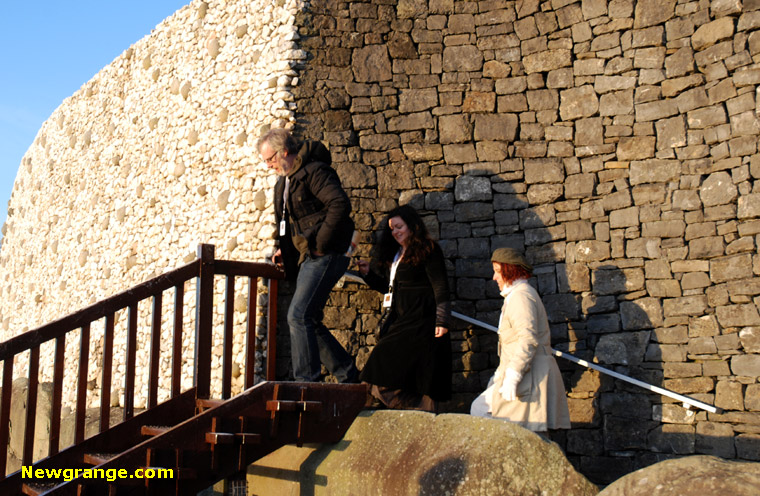
9:17am - Solstice Lottery Winners
emerge from the chamber.
emerge from the chamber.
| A closer view of Site Q. |
Newgrange has some stunning examples of megalithic art, including the beautifully
carved entrance stone, kerbstone 1, and kerbstone 52. The famous triple spiral is
featured on the entrance stone and in the chamber.
Many finds have been made at Newgrange, including some curious items such as a
stone phallus and an iron wedge. One type of find which arouses the interest of
archaeologists are the Roman coins, many of which were reported to have been found
at Newgrange.
The Tuatha Dé Danann, who ruled Ireland in ancient mythology, were said to have
erected Newgrange as a burial place for their chief, Dagda Mór, and his three sons.
Newgrange was said to have been the place where the great mythical hero Cúchulainn
was conceived by his mother Dechtine. His spiritual father, Lugh, visited Dechtine in a
dream while she stayed at the Brugh.
Access to Newgrange is through the Brú na Bóinne Visitors' Centre at nearby Donore,
just across the river Boyne. In recent times, there have been as many as 200,000
visitors to Newgrange each year, making it the most visited archaeological monument in
Ireland.
A new book about Newgrange challenges the classification of the monument as a
"passage-grave" or "passage-tomb", and says there was no evidence that Newgrange
was used as any sort of dedicated repository for bodies, bones, burial artefacts or ash.
The most comprehensive collection of facts about Newgrange on the internet can be
found in our "101 Facts About Newgrange" section.
carved entrance stone, kerbstone 1, and kerbstone 52. The famous triple spiral is
featured on the entrance stone and in the chamber.
Many finds have been made at Newgrange, including some curious items such as a
stone phallus and an iron wedge. One type of find which arouses the interest of
archaeologists are the Roman coins, many of which were reported to have been found
at Newgrange.
The Tuatha Dé Danann, who ruled Ireland in ancient mythology, were said to have
erected Newgrange as a burial place for their chief, Dagda Mór, and his three sons.
Newgrange was said to have been the place where the great mythical hero Cúchulainn
was conceived by his mother Dechtine. His spiritual father, Lugh, visited Dechtine in a
dream while she stayed at the Brugh.
Access to Newgrange is through the Brú na Bóinne Visitors' Centre at nearby Donore,
just across the river Boyne. In recent times, there have been as many as 200,000
visitors to Newgrange each year, making it the most visited archaeological monument in
Ireland.
A new book about Newgrange challenges the classification of the monument as a
"passage-grave" or "passage-tomb", and says there was no evidence that Newgrange
was used as any sort of dedicated repository for bodies, bones, burial artefacts or ash.
The most comprehensive collection of facts about Newgrange on the internet can be
found in our "101 Facts About Newgrange" section.
| This dramatic view of Newgrange from the west shows how the mound sits on a ridge overlooking the Boyne. To the left (North) of Newgrange is Site R, while near the right of the image are the ceremonial ponds which may have been created for the Whooper Swans which winter there. |
| Another image with Newgrange in the background, and also satellite sites A (left of centre) and B (near river). |
| Newgrange and the Boyne, again showing the ceremonial ponds near the river. Almost invisible in this photo is the circular Site P, to the left of the ponds. |
| This dramatic picture shows the monumental landscape overlooking the Bend of the Boyne at Rosnaree and Crewbane, with the multi-faceted Knowth complex dominating, flanked by Site N, a very dramatic platformed ring-fort overlooking a steep bank down to the Boyne and (left behind Knowth) site M, which has been excavated in recent years. |
| The Knowth complex, which took nearly 40 years to excavate, was in use from the Neolithic right down to Norman and later-mediæval times. It is a massive site with a huge amount of "artwork" on its giant kerbstones. |
| A few miles downstream from Newgrange is the town of Drogheda. Here, the early 19th century Martello tower and mound of Millmount occupy a dominant position overlooking the Boyne. Millmount is a probable passage tomb, adapted as a motte by the Normans. It has topographical alignments with the Hills of Tara and Slane. |
| One of the biggest monuments of the Boyne Valley is the giant embanked enclosure known as Site Q. Aligned on Summer Solstice sunrise, it probably dates to the Bronze Age and is like a gladiatorial arena in scale. |
| Even the standing stones show up on Google Earth. |
| Dowth, one of the three great mounds of the Bend of the Boyne, with the huge crater in its top caused by primitive excavations in the 1840s. |
| A closer view of Site Q. |
| ********** |
| Newgrange, County Meath Before it was excavated www.irishmegaliths.org.uk/zOldNewgrange.htm |
| A nineteenth-century photograph taken before modern interference. |
| A view of the entrance just before excavation and the subsequent "restoration". |
| A picture taken in the early 1950s. |
| Boyne Valley Ancient Sites Map For a clickable version, click here. |
