
 |  |  |  |
| Answer to Quiz #73 - August 20, 2006 |
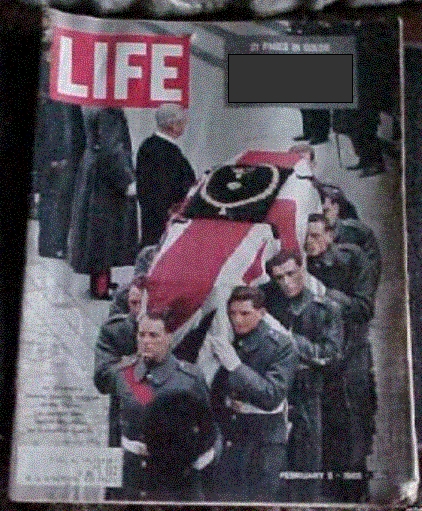
| 1. What date was this photograph taken? 2. What specific event is pictured? |


| ********** |
| Answers: 1. 30 January 1965 2. The funeral of Sir Winston Churchill |


| The picture was taken by Stephen Goldblatt of Paris Match. The Grenadier Guards carrying his coffin have just passed in front of Prime Minister Harold MacMillan. On top of the coffin is the Insignia of the Garter. |

| ********** |
Sir Winston Leonard Spencer-Churchill, KG, OM,
CH, TD, FRS, PC(Can) (30 November 1874 – 24
January 1965) was an English politician and author,
best known as Prime Minister of the United
Kingdom during the Second World War. Well
known as orator, strategist, diplomat, and politician,
Churchill was one of the most important leaders in
modern British and world history. He won the 1953
Nobel Prize in Literature for his many books on
English and world history. In 1963 the US Congress
conferred on him honorary American citizenship.
During his life, he served no less than six British
monarchs: Queen Victoria, Edward VII, George IV,
Edward VIII, George VI and Elisabeth II. Sir
Winston Churchill was voted the Greatest-ever
Briton in the 2002 BBC poll the 100 Greatest Britons.
CH, TD, FRS, PC(Can) (30 November 1874 – 24
January 1965) was an English politician and author,
best known as Prime Minister of the United
Kingdom during the Second World War. Well
known as orator, strategist, diplomat, and politician,
Churchill was one of the most important leaders in
modern British and world history. He won the 1953
Nobel Prize in Literature for his many books on
English and world history. In 1963 the US Congress
conferred on him honorary American citizenship.
During his life, he served no less than six British
monarchs: Queen Victoria, Edward VII, George IV,
Edward VIII, George VI and Elisabeth II. Sir
Winston Churchill was voted the Greatest-ever
Briton in the 2002 BBC poll the 100 Greatest Britons.


| Sir Winston Churchill Nov. 30, 1874 - Jan. 24, 1965 |
| ********** |

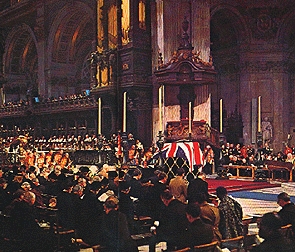
| Churchill's State Funeral in St Paul's Cathedral 30th January 1965 |
The first since the death of the
Duke of Wellington.
It was attended by six thousand
people, six Sovereigns and fifteen
Heads of State.
His 12 pall bearers at St Paul's
Cathedral comprised four prime
ministers, Attlee, Eden, Macmillan
and Menzies of Australia; three
field marshals, Templer, Slim and
Alexander; three great servants of
the Crown (two of them Cabinet
secretaries), Bridges, Ismay and
Normanbrook; a Marshal of the
RAF, Portal; and an Admiral of
the Fleet, Mountbatten.
The Funeral ended with the
sounding of the Last Post and
Reveille by a trumpeter high up in
the Whispering Gallery.
The coffin was then taken by
barge along the Thames to
Waterloo Station and thence by
train to the Parish Church at
Bladon.
Duke of Wellington.
It was attended by six thousand
people, six Sovereigns and fifteen
Heads of State.
His 12 pall bearers at St Paul's
Cathedral comprised four prime
ministers, Attlee, Eden, Macmillan
and Menzies of Australia; three
field marshals, Templer, Slim and
Alexander; three great servants of
the Crown (two of them Cabinet
secretaries), Bridges, Ismay and
Normanbrook; a Marshal of the
RAF, Portal; and an Admiral of
the Fleet, Mountbatten.
The Funeral ended with the
sounding of the Last Post and
Reveille by a trumpeter high up in
the Whispering Gallery.
The coffin was then taken by
barge along the Thames to
Waterloo Station and thence by
train to the Parish Church at
Bladon.
| 321,360 people filed by Churchill's catafalque http://www.churchill-society-london.org.uk/1965Txt.html |
| Churchill's State Funeral in St Paul's Cathedral 30th January 1965 http://www.churchill-society-london.org.uk/1965Txt.html |
| ********** |
| Read original newspaper article: January 24, 1965: Winston Churchill dies http://news.bbc.co.uk/onthisday/hi/dates/stories/january/24/newsid_2506000/2506493.stm |
| ********** |
| On This Day January 30, 1965: Last farewell to Churchill http://news.bbc.co.uk/onthisday/hi/dates/stories/january/30/newsid_2505000/2505981.stm |
Thousands of people have paid their last respects to Britain's greatest wartime leader Sir
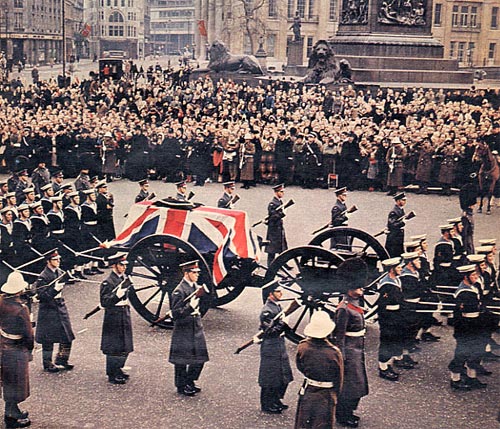
Winston Churchill who was buried today after a full state funeral. Silent crowds lined
the streets to watch the gun carriage bearing Sir Winston's coffin leave Westminster
Hall as Big Ben struck 0945. The procession travelled slowly through central London to
St Paul's cathedral for the funeral service.
Sir Winston died six days ago, following a stroke earlier in the month from which he
never regained consciousness.
Winston Churchill who was buried today after a full state funeral. Silent crowds lined
the streets to watch the gun carriage bearing Sir Winston's coffin leave Westminster
Hall as Big Ben struck 0945. The procession travelled slowly through central London to
St Paul's cathedral for the funeral service.
Sir Winston died six days ago, following a stroke earlier in the month from which he
never regained consciousness.
A total of 321,360 people filed past the
catafalque during the three days of
lying-in-state.
World watches funeral
Today, millions around the world watched
the funeral procession at home and abroad
as television pictures were beamed from 40
BBC cameras placed along the route.
The mourners were led by Sir Winston's
wife, Lady Clementine Churchill, his son
| Thousands of people line the route of the funeral procession. http://www.37.co.yu/vexphoto/default.asp?page=gb&photo=13 |
Randolph and daughters Mary Soames and Lady Sarah Audley. The Queen and other
members of the royal family, the Prime Minister, Harold Wilson, and representatives of
112 countries packed into the cathedral for the service.
The funeral cortege was accompanied by a 19-gun salute and an RAF fly-past as it
began the journey to Sir Winston's final resting place. At Tower Hill, the coffin was
piped aboard the launch Havengore for the voyage up the Thames.
members of the royal family, the Prime Minister, Harold Wilson, and representatives of
112 countries packed into the cathedral for the service.
The funeral cortege was accompanied by a 19-gun salute and an RAF fly-past as it
began the journey to Sir Winston's final resting place. At Tower Hill, the coffin was
piped aboard the launch Havengore for the voyage up the Thames.

Coffin route
From Waterloo, it was placed onto a train
drawn by a Battle of Britain locomotive named
Winston Churchill. Thousands gathered to pay
tribute at wayside stations. At many football
matches a two-minute silence was observed.
Sir Winston was finally laid to rest in the
Oxfordshire parish churchyard of Bladon, close
to Blenheim Palace where he was born 90 years
before, with only family members present.
From Waterloo, it was placed onto a train
drawn by a Battle of Britain locomotive named
Winston Churchill. Thousands gathered to pay
tribute at wayside stations. At many football
matches a two-minute silence was observed.
Sir Winston was finally laid to rest in the
Oxfordshire parish churchyard of Bladon, close
to Blenheim Palace where he was born 90 years
before, with only family members present.
| Sir Winston Churchill's Final Resting Place http://www.churchill-society-london.org.uk/1965Txt.html |
| ********** |
| The Story Behind the Funeral Operation Hope Not: 40th anniversary of Sir Winston Churchill´s funeral http://www.nationalarchives.gov.uk/news/stories/56.htm |
30 January [2005] will mark the 40th anniversary of the State
funeral held for Sir Winston Churchill, six days after he peacefully
passed away at his London home.
Within hours of Churchill´s passing on 24 January 1965, the
government revealed a Lying-in-State at Westminster Hall, a
funeral procession through London, and State funeral service at St
Paul´s Cathedral to commemorate his remarkable life. The speed
with which all the funeral arrangements were announced was
simply a result of turning into reality twelve years of confidential
planning - affectionately code-named ´Operation Hope Not´.
funeral held for Sir Winston Churchill, six days after he peacefully
passed away at his London home.
Within hours of Churchill´s passing on 24 January 1965, the
government revealed a Lying-in-State at Westminster Hall, a
funeral procession through London, and State funeral service at St
Paul´s Cathedral to commemorate his remarkable life. The speed
with which all the funeral arrangements were announced was
simply a result of turning into reality twelve years of confidential
planning - affectionately code-named ´Operation Hope Not´.

| Queen's Letter 1953 |
Over the years planning became more elaborate; measures were even
drawn up should Sir Winston die whilst on holiday abroad. As
contingencies became more detailed, more people became involved.
Arrangements were made with undertakers and embalmers. Broadcast
coverage was organised with the BBC and Independent Television.
Commonwealth High Commissioners and certain Ambassadors were
also briefed in ´general terms´ of the funeral preparations, but details
were always marked Confidential.
On 21 March 1958, the first draft of the master paper on ´Procedure

| First Draft 1958 |
on the Death of Sir Winston Churchill´ was produced. This paper was revised at least
eight times before the final version of 2 November 1964, which was the one in force
when Sir Winston died on 24 January 1965.
eight times before the final version of 2 November 1964, which was the one in force
when Sir Winston died on 24 January 1965.
In February 1958, contingency arrangements covering the death of
Sir Winston Churchill became more urgent when he became ill while
on holiday in France, and were extended to cover the possibility of his
dying abroad. Anthony Montague-Browne gave advance warning of
Churchill´s foreign travels so that plans could be revised accordingly.
This note outlines the procedures to cover the death of Sir Winston
whilst abroad.
On 21 March 1958, Sir Norman Brook had sounded out the Director
General of the BBC, Sir Ian Jacob, about plans for broadcast on the
occasion of Sir Winston´s death.

| Contingency Plans 1958 |
In February 1958, contingency arrangements covering the death of Sir Winston
Churchill became more urgent when he became ill while on holiday in France, and were
extended to cover the possibility of his dying abroad. Anthony Montague-Browne gave
advance warning of Churchill´s foreign travels so that plans could be revised
accordingly. This note outlines the procedures to cover the death of Sir Winston whilst
abroad.
On 21 March 1958, Sir Norman Brook had sounded out the Director General of the
Churchill became more urgent when he became ill while on holiday in France, and were
extended to cover the possibility of his dying abroad. Anthony Montague-Browne gave
advance warning of Churchill´s foreign travels so that plans could be revised
accordingly. This note outlines the procedures to cover the death of Sir Winston whilst
abroad.
On 21 March 1958, Sir Norman Brook had sounded out the Director General of the
BBC, Sir Ian Jacob, about plans for broadcast
on the occasion of Sir Winston´s death.
In December 1959, after it was thought that the
plans could be filed away, Sir Winston ensured
that the plans were not shelved for long. He
changed his mind about his final resting place.
From 1960, plans for the funeral (including
ceremonial and order of service) were laid with
very little alteration before the event in 1965.
Speeches for the Prime Minister paying
on the occasion of Sir Winston´s death.
In December 1959, after it was thought that the
plans could be filed away, Sir Winston ensured
that the plans were not shelved for long. He
changed his mind about his final resting place.
From 1960, plans for the funeral (including
ceremonial and order of service) were laid with
very little alteration before the event in 1965.
Speeches for the Prime Minister paying


| Change of Plans 1959 |
| BBC Broadcast Plans 1958 |
tribute to Churchill were regularly drafted from 1960. Even funeral invitations were
printed in advance, with the final date left off so that it could be added by hand. In fact,
because of all the advanced preparations, when the news broke in January 1965 only
six days, instead of the expected seven, were needed to finalise all the funeral
arrangements – including sending out the invitations.
Since 1960, the speech for the Prime Minister´s television tribute to Sir Winston
printed in advance, with the final date left off so that it could be added by hand. In fact,
because of all the advanced preparations, when the news broke in January 1965 only
six days, instead of the expected seven, were needed to finalise all the funeral
arrangements – including sending out the invitations.
Since 1960, the speech for the Prime Minister´s television tribute to Sir Winston

| Final Draft 1960 |
Italy where newspaper editorials were littered with complaints
that the government took particular offence at being restricted to
only one representative. Oliver Wright, Private Secretary to the
Prime Minister Harold Wilson, wrote at the top ´typically Italian´.
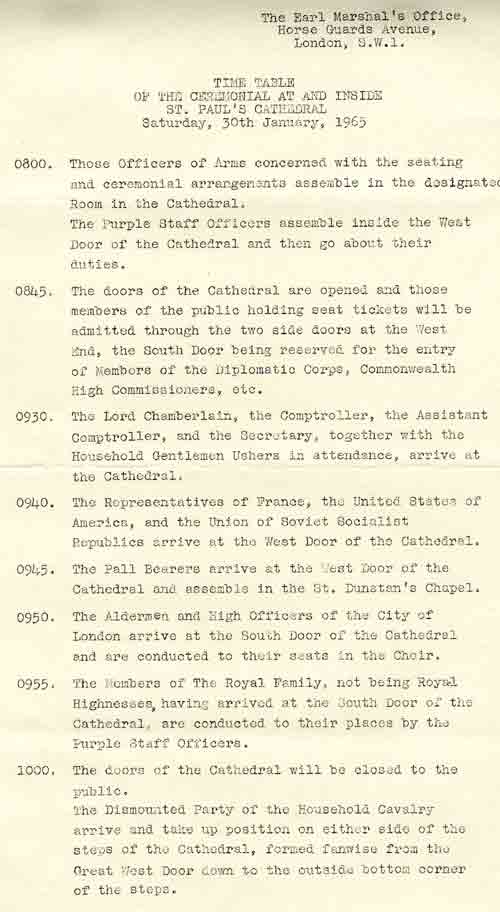
The final funeral plans show the military precision of ´Operation
Hope Not´. Produced the day before the funeral, they give a
minute-by-minute account of the funeral procession.
Despite the crisp January weather, over 320,000 members of the
public queued to file past Churchill´s coffin as it lay in State in
Westminster Hall from 27 to 30 January. Even more people
spilled onto the streets for the funeral procession from
Westminster to St Paul´s.
After the funeral service at St Paul´s, Churchill´s coffin was taken
to Tower Pier and loaded onto a Port of London authority launch
to cruise along the River Thames to Festival Pier, and then onto
Waterloo station. As the launch left Tower Pier, the Royal Air
Force gave their final salute to the once wartime leader with a ´fly
past´, only to be equalled by the London´s dockers lowering their
cranes one by one as the launch sailed past.
that the government took particular offence at being restricted to
only one representative. Oliver Wright, Private Secretary to the
Prime Minister Harold Wilson, wrote at the top ´typically Italian´.
The final funeral plans show the military precision of ´Operation
Hope Not´. Produced the day before the funeral, they give a
minute-by-minute account of the funeral procession.
Despite the crisp January weather, over 320,000 members of the
public queued to file past Churchill´s coffin as it lay in State in
Westminster Hall from 27 to 30 January. Even more people
spilled onto the streets for the funeral procession from
Westminster to St Paul´s.
After the funeral service at St Paul´s, Churchill´s coffin was taken
to Tower Pier and loaded onto a Port of London authority launch
to cruise along the River Thames to Festival Pier, and then onto
Waterloo station. As the launch left Tower Pier, the Royal Air
Force gave their final salute to the once wartime leader with a ´fly
past´, only to be equalled by the London´s dockers lowering their
cranes one by one as the launch sailed past.

| Italian Complaint |
| Funeral Schedule |
As Churchill´s coffin left Waterloo station for its final resting place near Blenheim
Palace - on a train pulled by a Battle of Britain class steam locomotive the ´Winston
Churchill´ - the State funeral, and twelve years of precise military planning, came to an
end.
Palace - on a train pulled by a Battle of Britain class steam locomotive the ´Winston
Churchill´ - the State funeral, and twelve years of precise military planning, came to an
end.
| ********** |
Trivia:
Because the funeral took place on 30 January, people in the United States marked it by
paying tribute to his friendship with Roosevelt because it was the anniversary of FDR's
birth. The tributes were led by Roosevelt's children.
This was the first state funeral for a non-royal family member since 1914, and no one
other of its kind has been held since.
Because the funeral took place on 30 January, people in the United States marked it by
paying tribute to his friendship with Roosevelt because it was the anniversary of FDR's
birth. The tributes were led by Roosevelt's children.
This was the first state funeral for a non-royal family member since 1914, and no one
other of its kind has been held since.
| ********** |
| For a full biography of Sir Winston Churchill, see http://en.wikipedia.org/wiki/Winston_Churchill For a compilation of quotes from Winston Churchill, see http://en.wikiquote.org/wiki/Winston_Churchill |
| ********** |
| Comments from Our Readers |
I don't ordinarily do the quiz, but this time I thought I would give it a try. I have to
confess to cheating -- I am an admirer of Sir Winston Churchill, and I have a copy of
that issue of LIFE magazine as a keepsake. Bob Drusse
I remember Churchill’s funeral, and many other ‘state funerals’ about that same time, it
seemed like every other day a dignitary was dying. Of course, I was a young person
(not a kid, but, not interested in world events) and those mid 1960’s years seemed to
have a lot of funerals all at one time. Chuchill was quite an interesting man. I was
astounded to find that his was the only Commoner state funeral since the Duke of
Wellington. Amazing. Also, it seems to me that there is a State funeral planned for
Margaret Thatcher. It sure would seem strange to be alive, and have people planning an
elaborate ‘celebration’ at one’s death. Makes one almost wish they could be there, eh?
Kelly Fetherlin
Based on the flag on the coffin, I guessed that it was Churchill's funeral. So I googled
<"Winston Churchill" funeral> and got the date, which matched pretty well the February
5 196? date on the magazine. I looked for the image in Google images, but didn't see
this specific image.
I didn't find the picture you posted until I Googled <"Winston Churchill" funeral "Life
magazine"> - then I found the picture on Ebay. Randy Seaver
confess to cheating -- I am an admirer of Sir Winston Churchill, and I have a copy of
that issue of LIFE magazine as a keepsake. Bob Drusse
I remember Churchill’s funeral, and many other ‘state funerals’ about that same time, it
seemed like every other day a dignitary was dying. Of course, I was a young person
(not a kid, but, not interested in world events) and those mid 1960’s years seemed to
have a lot of funerals all at one time. Chuchill was quite an interesting man. I was
astounded to find that his was the only Commoner state funeral since the Duke of
Wellington. Amazing. Also, it seems to me that there is a State funeral planned for
Margaret Thatcher. It sure would seem strange to be alive, and have people planning an
elaborate ‘celebration’ at one’s death. Makes one almost wish they could be there, eh?
Kelly Fetherlin
Based on the flag on the coffin, I guessed that it was Churchill's funeral. So I googled
<"Winston Churchill" funeral> and got the date, which matched pretty well the February
5 196? date on the magazine. I looked for the image in Google images, but didn't see
this specific image.
I didn't find the picture you posted until I Googled <"Winston Churchill" funeral "Life
magazine"> - then I found the picture on Ebay. Randy Seaver
| ********** |
| Congratulations to Our Winners Mary Fraser David Lepitre Pat Snyder Stan Read Fred Stuart Rick Norman Richard Seidel Allie Guidry Jim Berry Rick Mackinney Patrick Carney Sandy Fahrnbruch Robert A. Drusse Debbie Sterbinsky Jim Kiser Carol Haueter Susan Fortune Delores Martin Lynne Perez Vicki Hilb Frank Nollette Gwen Upton Evan Hindman Eva Royal Anna Farris Randy Seaver Emily Aulicino Kelly Fetherlin Elizabeth Mackie Richard Seidel Dale Niesen William Hughes Edee Scott Michele Bender Marty Guidry If your name has been omitted from our list of winners, please let us know. It was unintentional. |
| ********** |
If you have a picture you'd like us to feature a picture in a future quiz, please
email it to us at CFitzp@aol.com. If we use it, you will receive a free analysis of
your picture. You will also receive a free Forensic Genealogy CD or a 10%
discount towards the purchase of the Forensic Genealogy book.
email it to us at CFitzp@aol.com. If we use it, you will receive a free analysis of
your picture. You will also receive a free Forensic Genealogy CD or a 10%
discount towards the purchase of the Forensic Genealogy book.
| If you enjoy our quizzes, don't forget to order our books! Click here. |

Although the Queen instructed her top civil servants in 1953 to arrange Sir Winston´s
funeral, ´on a scale befitting his position in history´, no solid plans were drawn up until
1957 after the then Prime Minister, Harold Macmillan, expressed some anxiety over the
issue.
A letter was sent from The Queen´s Private Secretary, Sir Alan Lascelles, to the Cabinet
Secretary, Sir Norman Brook, instructing her top civil servants to arrange a funeral
similar to that organised for the Duke of Wellington´s funeral in 1852.
Planning for ´Hope Not´ was restricted to the upper echelons of government, with one
man responsible for coordinating the funeral - Earl Marshal. Nevertheless, the wishes of
the family were always considered; Lady Churchill and Sir Winston´s Private Secretary,
Anthony Montague-Browne, were regularly consulted on the arrangements covering the
funeral - Sir Winston himself was said to be ´unwilling to address his mind to the
subject.
funeral, ´on a scale befitting his position in history´, no solid plans were drawn up until
1957 after the then Prime Minister, Harold Macmillan, expressed some anxiety over the
issue.
A letter was sent from The Queen´s Private Secretary, Sir Alan Lascelles, to the Cabinet
Secretary, Sir Norman Brook, instructing her top civil servants to arrange a funeral
similar to that organised for the Duke of Wellington´s funeral in 1852.
Planning for ´Hope Not´ was restricted to the upper echelons of government, with one
man responsible for coordinating the funeral - Earl Marshal. Nevertheless, the wishes of
the family were always considered; Lady Churchill and Sir Winston´s Private Secretary,
Anthony Montague-Browne, were regularly consulted on the arrangements covering the
funeral - Sir Winston himself was said to be ´unwilling to address his mind to the
subject.
Churchill had been regularly updated. This was the final draft, used
by Harold Wilson during his television address on 24 January 1965.
In total, 113 countries were invited to send one representative to the
funeral, with the exception of the United States, France and Russia,
who were allowed to invite an additional two. Among the world
leaders that came to attend were four kings and a queen, five other
heads of state and 16 prime ministers. Yet the decision to restrict
representatives was not welcomed by all; Italian newspapers reported
that the limitations caused some commotion.
The decision to restrict national representatives was not welcomed in
by Harold Wilson during his television address on 24 January 1965.
In total, 113 countries were invited to send one representative to the
funeral, with the exception of the United States, France and Russia,
who were allowed to invite an additional two. Among the world
leaders that came to attend were four kings and a queen, five other
heads of state and 16 prime ministers. Yet the decision to restrict
representatives was not welcomed by all; Italian newspapers reported
that the limitations caused some commotion.
The decision to restrict national representatives was not welcomed in
| Quiz #73 Results |


 |  |  |  |