
 |  |  |  |
| Answer to Quiz #58 - April 29, 2006 What? Where? What rare event happened in this country on March 29, 2006? Why did the stars come out for this event? |

| ********** |

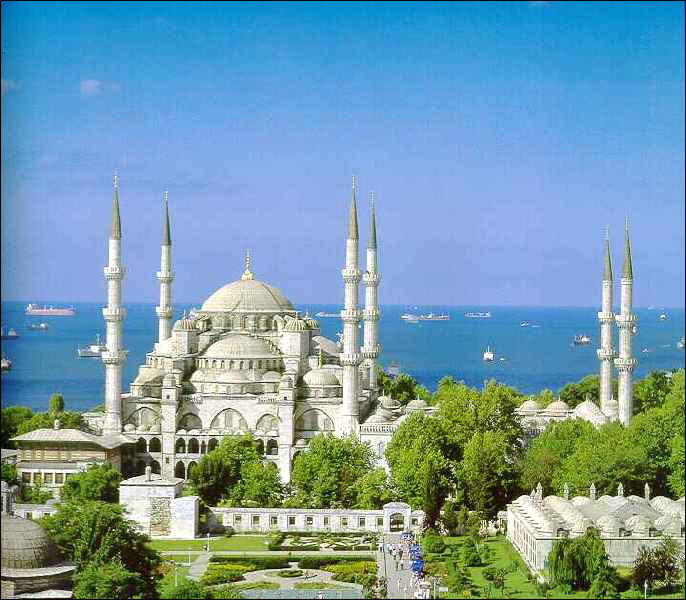
| Answers: The Blue Mosque, Istanbul, Turkey A total solar eclipse The sky gets dark when the sun is blocked so you can see the stars and planets. |
| ********** |
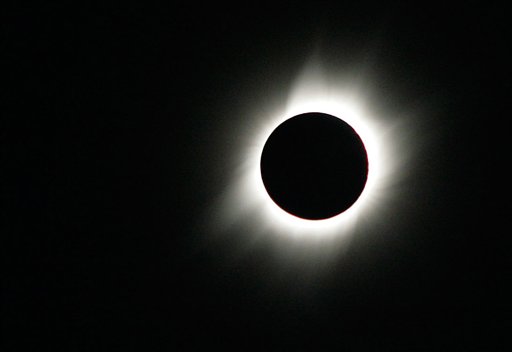
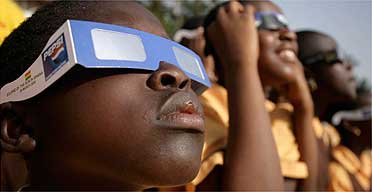
| Güneş Tutulması (Total Solar Eclipse) |

From the NASA Eclipse Home Page at
http://sunearth.gsfc.nasa.gov/eclipse/SEmono/TSE2006/TSE2006.html
On Wednesday, 2006 March 29, a total eclipse of the Sun [was] visible from within a
narrow corridor which traverses half the Earth. The path of the Moon's umbral shadow
begins in Brazil and extends across the Atlantic, northern Africa, and central Asia where
it ends at sunset in western Mongolia. A partial eclipse will be seen within the much
broader path of the Moon's penumbral shadow, which includes the northern two thirds
of Africa, Europe, and central Asia.
For a magnificent streaming video of the eclipse, see
http://www.exploratorium.edu/eclipse/2006/index.html#
http://sunearth.gsfc.nasa.gov/eclipse/SEmono/TSE2006/TSE2006.html
On Wednesday, 2006 March 29, a total eclipse of the Sun [was] visible from within a
narrow corridor which traverses half the Earth. The path of the Moon's umbral shadow
begins in Brazil and extends across the Atlantic, northern Africa, and central Asia where
it ends at sunset in western Mongolia. A partial eclipse will be seen within the much
broader path of the Moon's penumbral shadow, which includes the northern two thirds
of Africa, Europe, and central Asia.
For a magnificent streaming video of the eclipse, see
http://www.exploratorium.edu/eclipse/2006/index.html#


| Path of Totality |

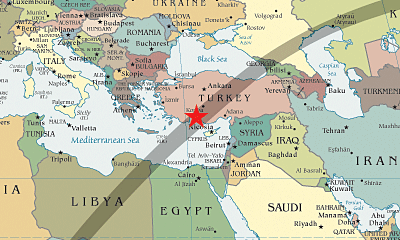
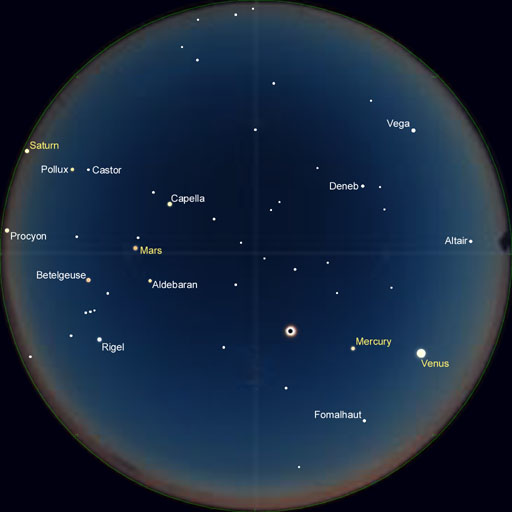
A total solar eclipse occurs when the moon passes
between the earth and the sun, completely blocking our
view of the sun. The shadow cast by the moon touches
down on the earth at one end of the path of totality, and
travels across the earth at a high speed, lifting off the earth
at the other end of the path of totality. The closer the
moon is to the earth, the longer an eclipse lasts, with
totality lasting the longest at points along the path where
the moon is closest to the earth.
between the earth and the sun, completely blocking our
view of the sun. The shadow cast by the moon touches
down on the earth at one end of the path of totality, and
travels across the earth at a high speed, lifting off the earth
at the other end of the path of totality. The closer the
moon is to the earth, the longer an eclipse lasts, with
totality lasting the longest at points along the path where
the moon is closest to the earth.
A partial solar eclipse occurs when moon blocks only part of the sun. The moon might
not pass directly overhead, or it might be too far away to cover the whole sun at one
time. This last type of eclipse is called an annular eclipse.
| Phenomena Observed During an Eclipse |
A sunspot is a region on the Sun's surface (the 500 km thick photosphere) that is
marked by a lower temperature than its surroundings and intense magnetic activity.
marked by a lower temperature than its surroundings and intense magnetic activity.
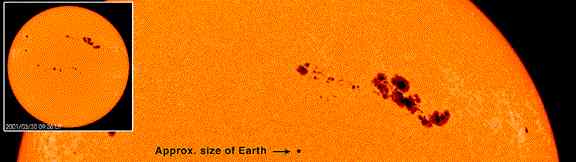
This inhibits convection, forming areas
with temperatures as low as 3,500
degrees. Although they are blindingly
bright, at temperatures of roughly
4000-4500 K, the contrast with the
surrounding material at some 5700 K
with temperatures as low as 3,500
degrees. Although they are blindingly
bright, at temperatures of roughly
4000-4500 K, the contrast with the
surrounding material at some 5700 K
leaves them clearly visible as dark spots. Sunspots can be as large as 50,000 km
across. The number of sunspots increases and decreases in an 11-yr cycle called the
Schwabe cycle. See http://en.wikipedia.org/wiki/Sun_spots.
across. The number of sunspots increases and decreases in an 11-yr cycle called the
Schwabe cycle. See http://en.wikipedia.org/wiki/Sun_spots.
| ********** |
Near the beginning and end of
total solar eclipse, the thin slice
of the Sun visible appears
broken up into beads of light.
These lights are called 'Baily's
Beads' after the British
astronomer Francis Baily who
discovered them. They occur
total solar eclipse, the thin slice
of the Sun visible appears
broken up into beads of light.
These lights are called 'Baily's
Beads' after the British
astronomer Francis Baily who
discovered them. They occur

because the edge of the Moon is not smooth but jagged with mountain peaks. The lunar
topography is non-smooth (mountains, craters, valleys, etc.). The lunar limb profile is
also known accurately from grazing occultations of stars. So in advance of the eclipse
we have a fairly good idea which mountains and valleys will cause the beads to appear.
topography is non-smooth (mountains, craters, valleys, etc.). The lunar limb profile is
also known accurately from grazing occultations of stars. So in advance of the eclipse
we have a fairly good idea which mountains and valleys will cause the beads to appear.
| ********** |
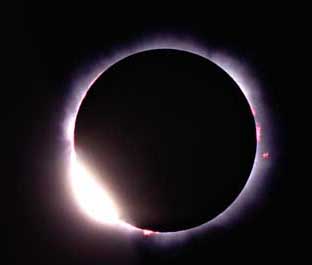
As the last bit of photosphere disappears,
you see something called the "diamond
ring effect"—the beautiful inner corona
forming a ring around the moon with a
brilliant white jewel of light.
http://en.wikipedia.org/wiki/Bailey%27s_Beads
you see something called the "diamond
ring effect"—the beautiful inner corona
forming a ring around the moon with a
brilliant white jewel of light.
http://en.wikipedia.org/wiki/Bailey%27s_Beads
| ********** |
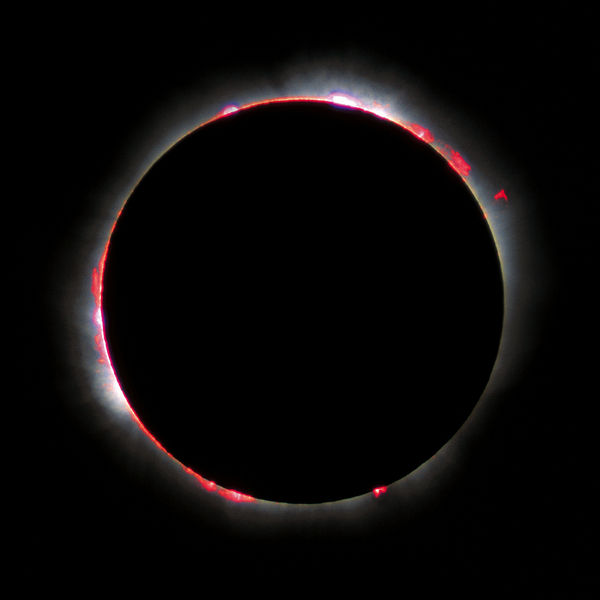
The chromosphere (literally, "color sphere") is a thin layer of the Sun's atmosphere
just above the photosphere, roughly 10,000 kilometers deep (approximating to, if a little
less than, the diameter of the Earth). The chromosphere is more visually transparent
than the photosphere.
just above the photosphere, roughly 10,000 kilometers deep (approximating to, if a little
less than, the diameter of the Earth). The chromosphere is more visually transparent
than the photosphere.
Without special equipment the Sun's
chromosphere cannot be seen due to its being
washed out by the overwhelming brightness of
the photosphere, but its reddish colour can be
seen during a total solar eclipse or in filtered light
such as H-alpha.
Solar prominences rise up through the
chromosphere from the photosphere, sometimes
reaching altitudes of 150,000 kilometers. These
gigantic plumes of gas are the most spectacular
of solar phenomena, aside from the less frequent
solar flares.
| ********** |
Once the sun is completely hidden, you
can see the full glory of the solar corona.
The Sun's corona is much hotter (by a
factor of nearly 200) than the visible
surface of the Sun: the photosphere's
average temperature is 5800 kelvins
compared to the corona's one to three
million kelvins. The corona is 10−12 as
dense as the photosphere, however, and
so produces about one-millionth as much
visible light. The corona is separated from
the photosphere by the relatively shallow
chromosphere.
The corona is about the same brightness
as the full moon. You don't normally see it
can see the full glory of the solar corona.
The Sun's corona is much hotter (by a
factor of nearly 200) than the visible
surface of the Sun: the photosphere's
average temperature is 5800 kelvins
compared to the corona's one to three
million kelvins. The corona is 10−12 as
dense as the photosphere, however, and
so produces about one-millionth as much
visible light. The corona is separated from
the photosphere by the relatively shallow
chromosphere.
The corona is about the same brightness
as the full moon. You don't normally see it
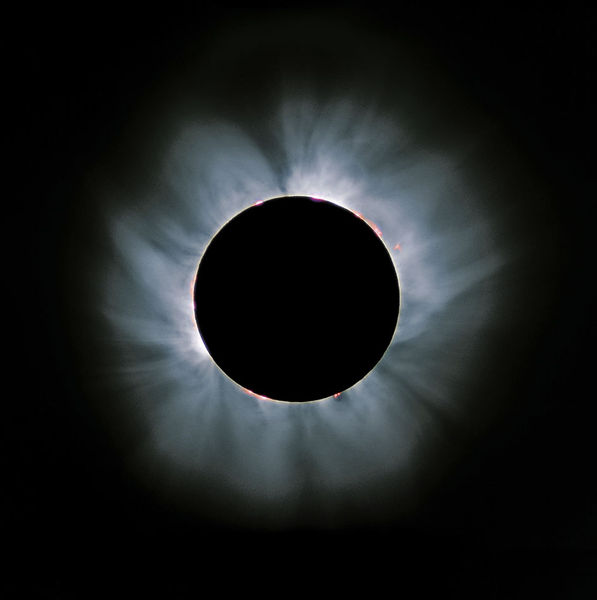
because of the blue sky. If you were in orbit above the atmosphere, you would only
have to block the bright portion of the sun to see the corona. This is what orbiting solar
observatories do. They can create artificial eclipses with occulting disks and observe
the corona whenever needed, and for as long as is necessary.
have to block the bright portion of the sun to see the corona. This is what orbiting solar
observatories do. They can create artificial eclipses with occulting disks and observe
the corona whenever needed, and for as long as is necessary.
| ********** |
| Upcoming Eclipses |
|


| Click on link in the Type column to see an animated map of the shadow pass over the earth. |
| *Cool Stuff That I Betcha You Didn't Know: Saros Number |
The periodicity and recurrence of eclipses is governed by the saros cycle, a period of
approximately 6,585.3 days (18 years 11 days 8 hours). It was known to the Chaldeans
as a period when lunar eclipses seem to repeat themselves, but the cycle is applicable to
solar eclipses as well.
When two eclipses are separated by a period of one Saros, they share a very similar
geometry. The eclipses occur at the same node with the Moon at nearly the same
distance from Earth and at the same time of year. Thus, the Saros is useful for
organizing eclipses into families or series. Each series typically lasts 12 to 13 centuries
and contains 70 or more eclipses. Every saros series begins with a number of partial
eclipses near one of Earth's polar regions. The series will then produce several dozen
[total] eclipses before ending with a group of partial eclipses near the opposite pole.
Because the saros period is not equal to a whole number of days, its biggest drawback
is that subsequent eclipses are visible from different parts of the globe. The extra 1/3
day displacement means that Earth must rotate an additional ~8 hours or ~120º with
each cycle. For solar eclipses, this results in the shifting of each successive eclipse path
by ~120º westward. Thus, a saros series returns to about the same geographic region
every 3 saroses (54 years and 34 days). A saros series doesn't last indefinitely because
the three lunar months are not perfectly commensurate with one another.
Since there are two to five solar eclipses every year, there are approximately forty
different saros series in progress at any one time. For instance, during the later half of
the twentieth century, there are 41 individual series and 26 of them are producing
central eclipses. As old series terminate, new ones are beginning and take their places.
The eclipse on 29 Mary 2006 is a member of Saros 139. The series began with a partial
eclipse in the northern hemisphere on 1501 May 17. The series will end with a partial
eclipse in the southern hemisphere on 2763 Jul 03. The total duration of Saros series
139 is 1262.11 years.
approximately 6,585.3 days (18 years 11 days 8 hours). It was known to the Chaldeans
as a period when lunar eclipses seem to repeat themselves, but the cycle is applicable to
solar eclipses as well.
When two eclipses are separated by a period of one Saros, they share a very similar
geometry. The eclipses occur at the same node with the Moon at nearly the same
distance from Earth and at the same time of year. Thus, the Saros is useful for
organizing eclipses into families or series. Each series typically lasts 12 to 13 centuries
and contains 70 or more eclipses. Every saros series begins with a number of partial
eclipses near one of Earth's polar regions. The series will then produce several dozen
[total] eclipses before ending with a group of partial eclipses near the opposite pole.
Because the saros period is not equal to a whole number of days, its biggest drawback
is that subsequent eclipses are visible from different parts of the globe. The extra 1/3
day displacement means that Earth must rotate an additional ~8 hours or ~120º with
each cycle. For solar eclipses, this results in the shifting of each successive eclipse path
by ~120º westward. Thus, a saros series returns to about the same geographic region
every 3 saroses (54 years and 34 days). A saros series doesn't last indefinitely because
the three lunar months are not perfectly commensurate with one another.
Since there are two to five solar eclipses every year, there are approximately forty
different saros series in progress at any one time. For instance, during the later half of
the twentieth century, there are 41 individual series and 26 of them are producing
central eclipses. As old series terminate, new ones are beginning and take their places.
The eclipse on 29 Mary 2006 is a member of Saros 139. The series began with a partial
eclipse in the northern hemisphere on 1501 May 17. The series will end with a partial
eclipse in the southern hemisphere on 2763 Jul 03. The total duration of Saros series
139 is 1262.11 years.
| Characteristics of Saros 139 First Eclipse = 1501 May 17 03:24:36 UT Last Eclipse = 2763 Jul 03 09:13:17 UT Duration of Saros 139 = 1262.11 Years During Saros 139, Earth experiences 71 solar eclipses Longest Total Solar Eclipse: 2186 Jul 16 Duration = 07m29s Shortest Total Solar Eclipse: 1627 Aug 11 Duration = 00m01s Largest Partial Solar Eclipse: 2619 Apr 06 Magnitude = 0.9778 Smallest Partial Solar Eclipse: 2763 Jul 03 Magnitude = 0.0578 |
| ********** |
| A Personal Note |
As I told several of our Quizmasters, I am an incurable eclipse chaser. I have been to
six total solar eclipses since 1984, and one high magnitude annular eclipse. Thanks to
frequent flyer miles and connections at the Middle Eastern Technical University
(METU) in Ankara, Andy and I were able to go to the eclipse in Turkey in March of
this year. Andy used to live in Ankara. I visited Turkey in 1999 when I went there to
see the first eclipse.
six total solar eclipses since 1984, and one high magnitude annular eclipse. Thanks to
frequent flyer miles and connections at the Middle Eastern Technical University
(METU) in Ankara, Andy and I were able to go to the eclipse in Turkey in March of
this year. Andy used to live in Ankara. I visited Turkey in 1999 when I went there to
see the first eclipse.
The eclipses I have traveled to are:
30 May 1984 New Orleans Annular
11 July 1991 Hawaii, Hawaii Total
3 Nov 1994 Atacama Desert, N. Chile Total
26 Feb 1998 Galapagos Is., Equador Total
11 Aug 1999 Bardon, N. Turkey Total
21 Jun 2001 Chinchuru, Zimbabwe Total
29 Mar 2006 Nevshevir, Turkey Total
30 May 1984 New Orleans Annular
11 July 1991 Hawaii, Hawaii Total
3 Nov 1994 Atacama Desert, N. Chile Total
26 Feb 1998 Galapagos Is., Equador Total
11 Aug 1999 Bardon, N. Turkey Total
21 Jun 2001 Chinchuru, Zimbabwe Total
29 Mar 2006 Nevshevir, Turkey Total

| We are planning to go to the eclipse in 2009 in China, and 2010 on Easter Island! For a list of central [total] eclipses from 1801 to 220, see http://sunearth.gsfc.nasa.gov/eclipse/solar.html |
| ********** |
| The Blue Mosque |

The Sultan Ahmed Mosque (in Turkish
Sultanahmet Camii, in English commonly
called the Blue Mosque) is a mosque in
Istanbul, the largest city in Turkey and the
capital of the Ottoman Empire from 1453 to
1923. It is regarded as one of the greatest
masterpieces of Islamic architecture.
The mosque was built between 1609 and
1616 by order of the Sultan Ahmed I, after
whom it is named. He is buried in the
mosque's precincts. It is located in the oldest
Sultanahmet Camii, in English commonly
called the Blue Mosque) is a mosque in
Istanbul, the largest city in Turkey and the
capital of the Ottoman Empire from 1453 to
1923. It is regarded as one of the greatest
masterpieces of Islamic architecture.
The mosque was built between 1609 and
1616 by order of the Sultan Ahmed I, after
whom it is named. He is buried in the
mosque's precincts. It is located in the oldest
| The Blue Mosque, Istanbul |
part of Istanbul, in what was before 1453 the centre of Constantinople, the capital of
the Byzantine Empire. It is next to the site of the ancient Hippodrome, and a short
distance from the great Christian Church of the Holy Wisdom (Hagia Sophia).
The mosque was built between 1609 and 1616 by order of the Sultan Ahmed I, after
whom it is named. He is buried in the mosque's precincts. It is located in the oldest part
of Istanbul, in what was before 1453 the centre of Constantinople, the capital of the
Byzantine Empire. It is next to the site of the ancient Hippodrome, and a short distance
from the great Christian Church of the Holy Wisdom (Hagia Sophia).
Today Hagia Sophia is a museum, but the Mosque of Sultan Ahmed is still a place of
Islamic worship. The mosque is closed to non-Muslims during prayer times, and certain
the Byzantine Empire. It is next to the site of the ancient Hippodrome, and a short
distance from the great Christian Church of the Holy Wisdom (Hagia Sophia).
The mosque was built between 1609 and 1616 by order of the Sultan Ahmed I, after
whom it is named. He is buried in the mosque's precincts. It is located in the oldest part
of Istanbul, in what was before 1453 the centre of Constantinople, the capital of the
Byzantine Empire. It is next to the site of the ancient Hippodrome, and a short distance
from the great Christian Church of the Holy Wisdom (Hagia Sophia).
Today Hagia Sophia is a museum, but the Mosque of Sultan Ahmed is still a place of
Islamic worship. The mosque is closed to non-Muslims during prayer times, and certain
areas are reserved for private prayer by
Muslims. Visitors are expected to dress
modestly and women to cover their heads. (As
is the case in most Istanbul mosques, visitors
can for a nominal fee rent cloth wraps at the
entrance to cover their heads or bare limbs.)
Shoes must be removed before entering.
Although admission is free, all visitors are asked
to make a donation on leaving to support the
maintenance of the mosque.
http://en.wikipedia.org/wiki/Blue_Mosque
Muslims. Visitors are expected to dress
modestly and women to cover their heads. (As
is the case in most Istanbul mosques, visitors
can for a nominal fee rent cloth wraps at the
entrance to cover their heads or bare limbs.)
Shoes must be removed before entering.
Although admission is free, all visitors are asked
to make a donation on leaving to support the
maintenance of the mosque.
http://en.wikipedia.org/wiki/Blue_Mosque
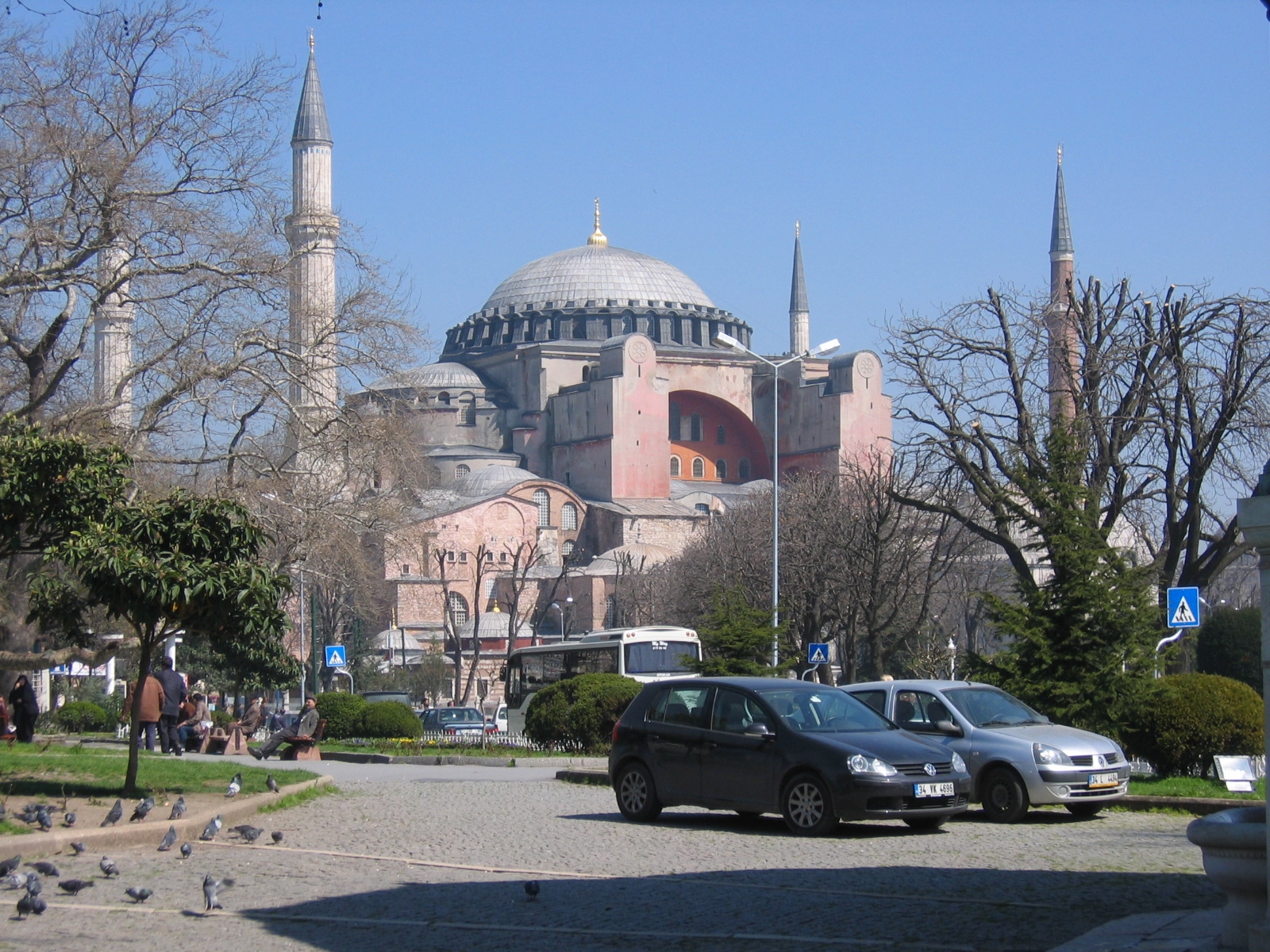
| Haggia Sophia, Istanbul |
| ********** |

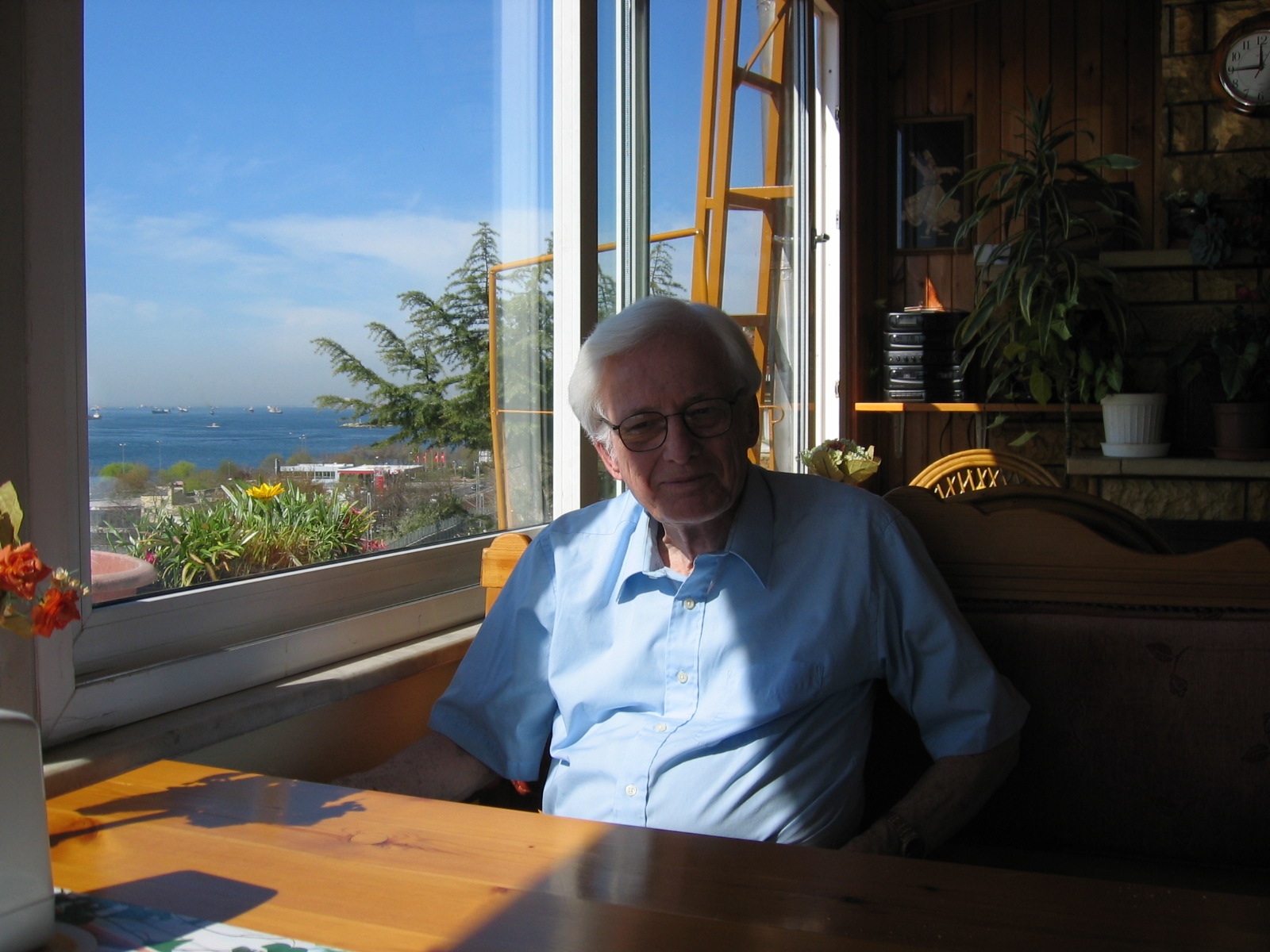
Turkey is a beautiful country
and we hope you all get to visit
it sometime!
Colleen and Andy
and we hope you all get to visit
it sometime!
Colleen and Andy
| ********** |
| Congratulations to Our Winners! Dick Cleaveland Stan Read John Chulick Mike Pfister Rick McKinney Pinky Palladino Grace Hertz Anthony Smart Loren Godburn Delores Martin Neil Ferguson Raymond Cathcart Peter St. Wecker Carol Wilson Dale Niesen Sue Edminster Mary Fraser Maureen O'Connor Mark D. Brzys, aka Rudolph Jenko Don Schulteis Elaine C. Hebert Kelly Fetherlin Eva Royal Dawn Carlisle Randy Seaver If your name has been omitted from our list of winners, please let me know. It was unintentional. |
| If you enjoy our quizzes, don't forget to order our books! Click here. |
If you have a picture you'd like us to feature a picture in a future quiz, please
email it to us at CFitzp@aol.com. If we use it, you will receive a free analysis of
your picture. You will also receive a free Forensic Genealogy CD or a 10%
discount towards the purchase of the Forensic Genealogy book.
email it to us at CFitzp@aol.com. If we use it, you will receive a free analysis of
your picture. You will also receive a free Forensic Genealogy CD or a 10%
discount towards the purchase of the Forensic Genealogy book.


| Quiz #58 Results |


 |  |  |  |