
 |  |  |  |
| Quiz #55 Results - April 6, 2006 1. What types (not necessarily models) of cameras are shown in this picture? 2. How many cameras did the photographer probably own? Optional Bonus Question: You can have 10 extra points if you can identify the device to the bottom left. |


| Photo courtesy of Duane Canaday |
| ********** |
| Answers: 1. The camera on the left is a folding view camera, the one on the right is either a large format view camera. 2. The photographer had at least three cameras. How else could he have taken a picture of the other two? Bonus question: A platen jobber's hand fed letter press, probably for printing stationary or handbills. |

| ********** |
Research Tip: A good way to research the cameras in this quiz was to search on
www.eBay.com for cameras that looked similar, or to search on Google Images
www.google.com using the words "Antique Cameras", or "Vintage Cameras". Another
way to find cameras that matched the ones in the picture was to go to
www.wikipedia.com and search under "types of cameras". You would find a list of
links to pages describing different kinds of cameras.
www.eBay.com for cameras that looked similar, or to search on Google Images
www.google.com using the words "Antique Cameras", or "Vintage Cameras". Another
way to find cameras that matched the ones in the picture was to go to
www.wikipedia.com and search under "types of cameras". You would find a list of
links to pages describing different kinds of cameras.

| ********** |
| The Folding Camera |
A folding camera is a camera that can be folded to a compact
and rugged package when not in use. The camera objective is
sometimes attached to a hinged mechanism (called a
pantograph), in which the lid is usually a component. The
objective extends to give correct focus when unfolded. A
cloth or leather bellows keeps the light out. When folded, the
camera has an excellent physical size to film size ratio. This
feature was very appealing when the only film formats
available were large or medium format films. The use of
folding cameras began to decline after WWII with the
development of the 35mm film format, which allowed the
construction of small-sized cameras without use of a bellows.
http://en.wikipedia.org/wiki/Folding_camera
and rugged package when not in use. The camera objective is
sometimes attached to a hinged mechanism (called a
pantograph), in which the lid is usually a component. The
objective extends to give correct focus when unfolded. A
cloth or leather bellows keeps the light out. When folded, the
camera has an excellent physical size to film size ratio. This
feature was very appealing when the only film formats
available were large or medium format films. The use of
folding cameras began to decline after WWII with the
development of the 35mm film format, which allowed the
construction of small-sized cameras without use of a bellows.
http://en.wikipedia.org/wiki/Folding_camera


| ********** |
| The View Camera |
A view camera offers more degrees of freedom
than a folding camera to focus the image on the
film plane. The view camera is a light-tight
assembly comprised of a flexible mid-section, or
bellows, attached to a device that holds a film sheet,
photo plate or digital imager at one end (the rear
standard) and a similar one that holds the lens at the
other end (the front standard). The front and rear
standards are not fixed relative to each other (unlike
most cameras). Movement of the front and rear
standards allows the photographer to move the lens
than a folding camera to focus the image on the
film plane. The view camera is a light-tight
assembly comprised of a flexible mid-section, or
bellows, attached to a device that holds a film sheet,
photo plate or digital imager at one end (the rear
standard) and a similar one that holds the lens at the
other end (the front standard). The front and rear
standards are not fixed relative to each other (unlike
most cameras). Movement of the front and rear
standards allows the photographer to move the lens

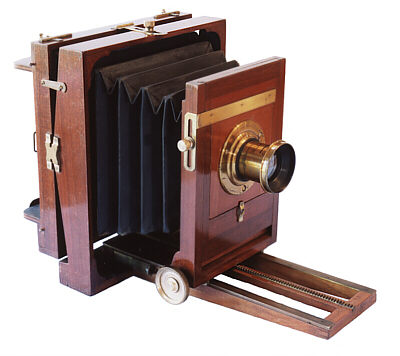
| A typical view camera. |
and film plane independently for precise control of the image's focus, depth of field and
perspective.
perspective.
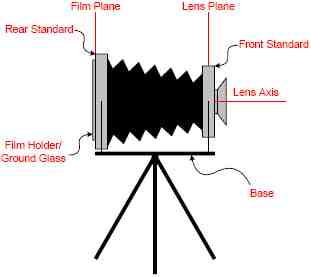
| Parts of a view camera. |
| View camera adjustments. |


| Not pictured: Back Tilt and Swing. |
| The Operation of a View Camera |
To take a photo using a view camera, the photographer opens the shutter on the lens to
compose and focus the image on a ground glass plate on the rear standard. As the
ground glass image is sometimes difficult to view in bright light, he may need a "dark
cloth" to cover the rear of the camera to do this. To take the photograph, the ground
glass, held within a metal frame, is displaced using springs and a film holder is inserted.
The shutter is then closed and cocked, the shutter speed and aperture set, and the
darkslide of the film holder removed, revealing the sheet of film. The shutter is then
triggered, the exposure made, and the darkslide replaced into the film holder.
compose and focus the image on a ground glass plate on the rear standard. As the
ground glass image is sometimes difficult to view in bright light, he may need a "dark
cloth" to cover the rear of the camera to do this. To take the photograph, the ground
glass, held within a metal frame, is displaced using springs and a film holder is inserted.
The shutter is then closed and cocked, the shutter speed and aperture set, and the
darkslide of the film holder removed, revealing the sheet of film. The shutter is then
triggered, the exposure made, and the darkslide replaced into the film holder.
| ********** |
| Examples of View Cameras |


| Flammang Front Focusing Revolving Back http://www.antiquewoodcameras.com/flr ear01.htm |
| Flammang Rear Focusing Revolving Back http://www.antiquewoodcameras.com/flfront1.htm |
| Flammang Rear Revolving Mechanism |


These two Flammang cameras differ according to whether the front or the back
standard could be moved to focus the image. It accommodated a reversible plate
holder, which could be rotated for either portrait or landscape operation. The single
swing front focusing model shown on the left above sold for $40 in 1892 ($758 in
2000 dollars).The double swing rear focusing model shown in the center above sold for
$45 in 1888 ($853 in 2000 dollars).
standard could be moved to focus the image. It accommodated a reversible plate
holder, which could be rotated for either portrait or landscape operation. The single
swing front focusing model shown on the left above sold for $40 in 1892 ($758 in
2000 dollars).The double swing rear focusing model shown in the center above sold for
$45 in 1888 ($853 in 2000 dollars).
The Star View Camera was
offered in single (horizontal) and
double (horizontal and vertical)
swing versions in formats
ranging from 4 x 5 to 11 x 14
inches. The version shown here
sold for $36 in 1892, or about
$683 in year 2000 dollars. Three
design improvements can be
found on the Star View Camera
offered in single (horizontal) and
double (horizontal and vertical)
swing versions in formats
ranging from 4 x 5 to 11 x 14
inches. The version shown here
sold for $36 in 1892, or about
$683 in year 2000 dollars. Three
design improvements can be
found on the Star View Camera


(1) Brass posts replace the heavier wood front standard, (2) A thinner "English" style
ground glass assembly is used, and (3) Inclusion of a three-section bed with removable
front section when using wide-angle lenses.
ground glass assembly is used, and (3) Inclusion of a three-section bed with removable
front section when using wide-angle lenses.

The Rochester Optical Peerless Camera was made
from 1887 - 94 in formats ranging from 3-1/4 x 4-1/4 to
8 x 10. It is a front focusing view camera with a highly
polished mahogany body, cherry bed, and nickel trim.
The back is non-reversing and has a single swing. This
is an early 4 x 5 model with R.O.Co. 4 x 5 brass lens.
http://www.antiquewoodcameras.com/peerless.htm
from 1887 - 94 in formats ranging from 3-1/4 x 4-1/4 to
8 x 10. It is a front focusing view camera with a highly
polished mahogany body, cherry bed, and nickel trim.
The back is non-reversing and has a single swing. This
is an early 4 x 5 model with R.O.Co. 4 x 5 brass lens.
http://www.antiquewoodcameras.com/peerless.htm
The St. Louis Reversible
Back Camera is a 5 x 7
format camera. It is a front
focusing, cone bellows
design that incorporates
Flammang's patent hinges
and single swing back. The
5 x 7 single swing model
shown here sold for $32 in
1888, or about $607 in year
2000 dollars.
Back Camera is a 5 x 7
format camera. It is a front
focusing, cone bellows
design that incorporates
Flammang's patent hinges
and single swing back. The
5 x 7 single swing model
shown here sold for $32 in
1888, or about $607 in year
2000 dollars.


The Ajax was first advertised in 1899 for $12.00 ($245 in 2000 dollars). It allowed 4 to
28 exposures to be made on a single plate. Multiple exposures are made by sliding the
lens panel into various positions in accordance to the appropriate registration marks on
the brass frame. Four separate walnut panels act as a type of wooden bellows.
A removable holder (shown on the right above) with mask inserts determines the size
and number of pictures to be made. Without a mask, four 2 x 3 inch images could be
made. The mask shown above was used to make twenty 3/4 x 1 inch exposures in a
four by five array. See http://www.antiquewoodcameras.com/ajax.htm.
28 exposures to be made on a single plate. Multiple exposures are made by sliding the
lens panel into various positions in accordance to the appropriate registration marks on
the brass frame. Four separate walnut panels act as a type of wooden bellows.
A removable holder (shown on the right above) with mask inserts determines the size
and number of pictures to be made. Without a mask, four 2 x 3 inch images could be
made. The mask shown above was used to make twenty 3/4 x 1 inch exposures in a
four by five array. See http://www.antiquewoodcameras.com/ajax.htm.
| ********** |
| Platen Jobber Printing Press Mid 19th - Mid 20th Centuries |
In the mid-19th century, George Phineas
Gordon developed, patented and marketed
the first successful platen jobber. Probably
the single most important advancement in
the history of the printing press since
Gutenberg, the platen jobber represented a
total redesign of the printing press utilizing
new mechanical principals made possible
by the industrial revolution. Gone was
great screw and bar that provided leverage
to create an impression, and to replace it a
great iron hinge pressing paper to ink. In
the platen jobber, a foot treadle operates a
crank shaft that is a attached to well
balanced flywheel, once in motion, the
press is capable of great impression.
Gordon developed, patented and marketed
the first successful platen jobber. Probably
the single most important advancement in
the history of the printing press since
Gutenberg, the platen jobber represented a
total redesign of the printing press utilizing
new mechanical principals made possible
by the industrial revolution. Gone was
great screw and bar that provided leverage
to create an impression, and to replace it a
great iron hinge pressing paper to ink. In
the platen jobber, a foot treadle operates a
crank shaft that is a attached to well
balanced flywheel, once in motion, the
press is capable of great impression.

| Earlier Types of Printing Presses |

| Common Press Mid 15th - early 19th cent http://www.handpress.org/P ressHistory/CommonPress/ CommonPress_1.htm |
A jobber is a press that prints less than a full sheet. The term described work such as
billheads, stationary, handbills and personal stationary. In the days of the common
press, work was optimally combined in order to fill up the larger sheet. Production
would be slow and inefficient for smaller work. In 1818 David Treadwell of Boston
began building experimental presses that used treadle power. Another Bostonian,
Stephen P. Ruggles by 1830 began working on the concept of a small jobber press and
in 1851 had essentially resolved most of the problems with earlier version and
introduced his Card and Billhead press. Advances in this period that made the platen
jobber possible include, the rotating ink disk and ink rollers for fast and even automatic
ink distribution. Additionally, advances in mechanics that allowed the hinged press to
close the bed against the platen in parallel for good impressions, and in the vertical
position to eliminate problems with type loosening and falling into the mechanism.
http://www.handpress.org/PressHistory/PlatenJobber/PlatenJobber_1.htm.
For an online museum dedicated to letter press enthusiasts, see the Briar Press website
at http://www.oneart.com/briarpress/index.shtml. The site offers a great collection of
images of letter presses, classified ads, a directory of letterpress services and
organizations, and much more!

| Iron Hand Press Early to mid 19th century http://www.handpress.org/PressHistory/IronHandPress/Iron HandPress_1.htm |
| ******** |
| Comments from Our Readers |
David Lepitre
The printing press in the bottom left is a small hand-fed platen press. The photographer
probably used it to imprint his photo mounts and perhaps his own stationary. Do you
suppose that the press is on the south side of the room? Most of the skylight
arrangements were north-facing when possible were they not? For better quality light.
Leslie Compton
Curses! I am spending more time on this quiz than my own puzzlers. :) The cameras
are bellows cameras, but I don't know who the manufacturer might have been. I
haven't been studying the cameras very long, and I find the numerous varieties with
their subtle differences a mind-boggling amount of information to absorb. I can't wait
to see if someone knows if they are Anthony's, Rochester, etc., or customized. The
photographer probably has 3 cameras--the two shown in the photograph plus the one
used to make the photograph. The device in the bottom left is a printing press. It is a
clamshell platen letterpress. As to manufacturer, I don't know. You may have seen the
Briar Press website already, but here's the link:
http://www.oneart.com/briarpress/index.shtml
Click on the museum link. It's fantastic! There are tons of great photographs to see if
you click on browse by type in the taupe area at the top of the museum page. Also, in
the quiz photo, in the right corner it looks as if this is maybe a roll of paper to use with
the press and some printed items are arranged on a table above it.
The printing press in the bottom left is a small hand-fed platen press. The photographer
probably used it to imprint his photo mounts and perhaps his own stationary. Do you
suppose that the press is on the south side of the room? Most of the skylight
arrangements were north-facing when possible were they not? For better quality light.
Leslie Compton
Curses! I am spending more time on this quiz than my own puzzlers. :) The cameras
are bellows cameras, but I don't know who the manufacturer might have been. I
haven't been studying the cameras very long, and I find the numerous varieties with
their subtle differences a mind-boggling amount of information to absorb. I can't wait
to see if someone knows if they are Anthony's, Rochester, etc., or customized. The
photographer probably has 3 cameras--the two shown in the photograph plus the one
used to make the photograph. The device in the bottom left is a printing press. It is a
clamshell platen letterpress. As to manufacturer, I don't know. You may have seen the
Briar Press website already, but here's the link:
http://www.oneart.com/briarpress/index.shtml
Click on the museum link. It's fantastic! There are tons of great photographs to see if
you click on browse by type in the taupe area at the top of the museum page. Also, in
the quiz photo, in the right corner it looks as if this is maybe a roll of paper to use with
the press and some printed items are arranged on a table above it.
| ******** |
| Congratulations to our winners! Kelly Fetherlin Rick Mackinney Stan Read David Lepitre Judy Pfaff Leslie Compton Dale Niesen Eva Royal Carol Epp If your name has been omitted from our list of winners, please let me know. It was unintentional. |
| If you enjoy our quizzes, don't forget to order our books! Click here. |
If you have a picture you'd like us to feature a picture in a future quiz, please
email it to us at CFitzp@aol.com. If we use it, you will receive a free analysis of
your picture. You will also receive a free Forensic Genealogy CD or a 10%
discount towards the purchase of the Forensic Genealogy book.
email it to us at CFitzp@aol.com. If we use it, you will receive a free analysis of
your picture. You will also receive a free Forensic Genealogy CD or a 10%
discount towards the purchase of the Forensic Genealogy book.

| Quiz #55 Results |


 |  |  |  |