
 |  |  |  |
| Answer to Quiz #30- October 7, 2005 What kind of photographs are these? Who invented this kind of photography? Why is it impossible that this picture was taken in Sapphire Co., NC as it says? |
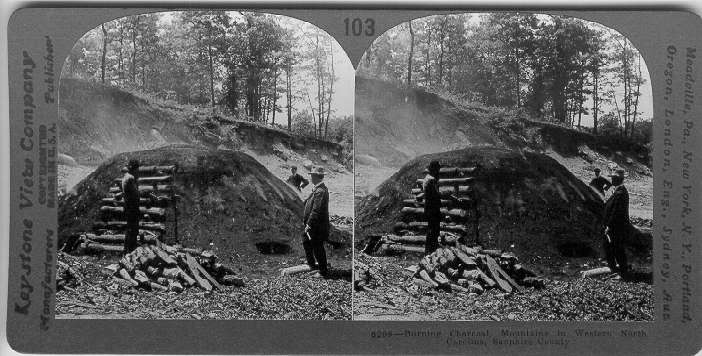


| Submitted by Gail Garwood. Click on thumbnail to see larger image. |
| Answers: The pictures are the two images in a stereoview. Sir Charles Wheatstone (U.K.) - 1838 Oliver Wendell Holmes and Joseph Bates (U.S.) - 1862 There is no Sapphire Co., NC. There is a town called Sapphire in Transylvania Co. |

| ********** |

| Stereoviews |
From http://en.wikipedia.org/wiki/Stereoview
Stereoscopy, stereoscopic imaging or 3-D (three-dimensional) imaging is any technique
capable of recording three-dimensional visual information or creating the illusion of
depth in an image. Often the illusion of depth in a photograph, movie, or other
two-dimensional image is created by presenting a slightly different image to each eye.
Many 3D Displays use this method to convey images. It was first invented by Sir
Charles Wheatstone in 1838.
Traditional stereoscopic photography consists of creating a 3-D illusion starting from a
pair of 2-D images. The easiest way to create depth perception in the brain is to
provide to the eyes of the viewer two different images, representing two perspectives of
the same object, with a minor deviation similar to the perspectives that both eyes
naturally receive in binocular vision. Modern industrial three dimensional photography
may use laser or other advanced techniques to detect and record 3 dimensional
information.
Going Cross-Eyed
Stereoviews can be viewed in a number of ways. A stereoviewer can be used, which
presents a separate image to each eye, allowing the brain to combine them into a 3-D
image. Stereoviews can also be created by switching the right and left images, and then
viewing them cross-eyed. Here is one you can experiment with:
Stereoscopy, stereoscopic imaging or 3-D (three-dimensional) imaging is any technique
capable of recording three-dimensional visual information or creating the illusion of
depth in an image. Often the illusion of depth in a photograph, movie, or other
two-dimensional image is created by presenting a slightly different image to each eye.
Many 3D Displays use this method to convey images. It was first invented by Sir
Charles Wheatstone in 1838.
Traditional stereoscopic photography consists of creating a 3-D illusion starting from a
pair of 2-D images. The easiest way to create depth perception in the brain is to
provide to the eyes of the viewer two different images, representing two perspectives of
the same object, with a minor deviation similar to the perspectives that both eyes
naturally receive in binocular vision. Modern industrial three dimensional photography
may use laser or other advanced techniques to detect and record 3 dimensional
information.
Going Cross-Eyed
Stereoviews can be viewed in a number of ways. A stereoviewer can be used, which
presents a separate image to each eye, allowing the brain to combine them into a 3-D
image. Stereoviews can also be created by switching the right and left images, and then
viewing them cross-eyed. Here is one you can experiment with:

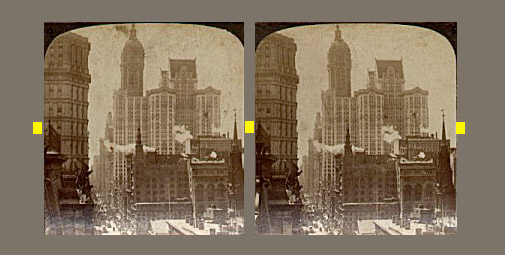
Here are the instructions from Wikipedia for viewing this stereoview this way:
To view the crossed-eye view shown here:
1) Move slightly back from your normal viewing distance and place your viewpoint on
a line perpendicular to the center of the image,
2) Place a finger halfway between your eyes and the image, and look at your finger,
not the images.
3) The three bright spots between the pictures should become four spots, and the
two images become three.
4) Allow the focus of your eyes to drift to the surface of the screen without
uncrossing them.
A three dimensional depth illusion will appear in the central image. You can now remove
your finger from view.
A viewer may find that the extra side images disappear once in-depth view of the
central image is stable. This is a popular way of presenting images on computers but it
is difficult to learn and for many viewers the method is not comfortable enough for
extended viewing. Without the use of viewing equipment, the size of a stereoscopic
image viewable is significantly limited by one's eye-spacing and the inability of one's
eyes to diverge. With cross-eye viewing, the images can be substantially larger. This is
the major advantage of this method.
The ViewMaster
A popular way of viewing stereoviews is with the ViewMaster a toy invented by
William Gruber and first introduced at the New York World's Fair in 1939. The
Viewmaster is a member of the National Toy Hall of Fame. (See
http://www.strongmuseum.org/NTHoF/NTHoF.html.)
The ViewMaster 65th Anniversary Viewmaster Collector Set is available at
Greandparent's Toy Village at http://www.playthingspast.com/fp-g5314.html
The official ViewMaster website is
http://www.fisher-price.com/fp.aspx?t=page&a=go&s=viewmaster&p=landing_flash&s
ite=us.
Wiggle Stereoscopy
By alternating the left and right images on a screen, you can view a 3-D image without
a stereoscope. This does not create a true 3-D image, since the left and right image are
never viewed simultaneously and the effect is a little different. A few weeks ago, Dale
Niesen sent in an interesting stereoview of the Gunboat Mendota that we were planning
to feature in an upcoming contest. By creating a mini-movie alternating the two images,
Dale created a three-D image that you can see in real time.
To view the crossed-eye view shown here:
1) Move slightly back from your normal viewing distance and place your viewpoint on
a line perpendicular to the center of the image,
2) Place a finger halfway between your eyes and the image, and look at your finger,
not the images.
3) The three bright spots between the pictures should become four spots, and the
two images become three.
4) Allow the focus of your eyes to drift to the surface of the screen without
uncrossing them.
A three dimensional depth illusion will appear in the central image. You can now remove
your finger from view.
A viewer may find that the extra side images disappear once in-depth view of the
central image is stable. This is a popular way of presenting images on computers but it
is difficult to learn and for many viewers the method is not comfortable enough for
extended viewing. Without the use of viewing equipment, the size of a stereoscopic
image viewable is significantly limited by one's eye-spacing and the inability of one's
eyes to diverge. With cross-eye viewing, the images can be substantially larger. This is
the major advantage of this method.
The ViewMaster
A popular way of viewing stereoviews is with the ViewMaster a toy invented by
William Gruber and first introduced at the New York World's Fair in 1939. The
Viewmaster is a member of the National Toy Hall of Fame. (See
http://www.strongmuseum.org/NTHoF/NTHoF.html.)
The ViewMaster 65th Anniversary Viewmaster Collector Set is available at
Greandparent's Toy Village at http://www.playthingspast.com/fp-g5314.html
The official ViewMaster website is
http://www.fisher-price.com/fp.aspx?t=page&a=go&s=viewmaster&p=landing_flash&s
ite=us.
Wiggle Stereoscopy
By alternating the left and right images on a screen, you can view a 3-D image without
a stereoscope. This does not create a true 3-D image, since the left and right image are
never viewed simultaneously and the effect is a little different. A few weeks ago, Dale
Niesen sent in an interesting stereoview of the Gunboat Mendota that we were planning
to feature in an upcoming contest. By creating a mini-movie alternating the two images,
Dale created a three-D image that you can see in real time.


| Back and front of a Civil War era stereoview of the Gunboat Mendota Dale's stereoview movie: |
| (Hope you can run this in your browser.) |
Many thanks to Dale Niesen for sending in the following links to places where
steroviews might be purchased:
http://www.antiquephotographics.com/stereos.htm
http://www.stereoviews.com/civilwar.html
http://www.stereoviews.com/fotosfs.html
For the Stereoviews Illustrated Magazine site:
http://www.tecsolv.com/stereoview/home.html
For an exhibit of stereoviews at the San Diego Historical Society:
http://www.sandiegohistory.org/collections/stereocards/stereocard.htm
For more info on the Mendota:
http://www.history.navy.mil/photos/sh-usn/usnsh-m/mendota.htm
For info on how the stereoview works:
http://www.hitl.washington.edu/scivw/EVE/III.A.1.b.StereoscopicViewing.html
steroviews might be purchased:
http://www.antiquephotographics.com/stereos.htm
http://www.stereoviews.com/civilwar.html
http://www.stereoviews.com/fotosfs.html
For the Stereoviews Illustrated Magazine site:
http://www.tecsolv.com/stereoview/home.html
For an exhibit of stereoviews at the San Diego Historical Society:
http://www.sandiegohistory.org/collections/stereocards/stereocard.htm
For more info on the Mendota:
http://www.history.navy.mil/photos/sh-usn/usnsh-m/mendota.htm
For info on how the stereoview works:
http://www.hitl.washington.edu/scivw/EVE/III.A.1.b.StereoscopicViewing.html
| The Invention of the Stereoview |
Charles Wheatstone (1802-1875) is considered to be the inventor of the stereoscope in
1832, presented at the Royal Society of London in 1838. With his mirror stereoscope
one could observe geometrical drawings in three dimensions. The device was a bulky
and complicated contraption that utilized a system of mirrors to view a series of pairs
of crude drawings.In 1844 a technique for taking stereoscopic photographs was
demonstrated in Germany, and a much smaller and simpler viewer that utilized
prismatic lenses was developed in Scotland by David Brewster.
After Queen Victoria took a fancy to the stereoscope at the Crystal Palace
Exposition in 1851, stereo viewing became all the rage in Britain. The United
States trailed behind for some years, but in 1862 Oliver Wendell Holmes and
Joseph Bates came out with the Holmes stereopticon, which soon dominated the
world market and became the standard stereoscopic device for decades (and is
still being produced in limited numbers).
1832, presented at the Royal Society of London in 1838. With his mirror stereoscope
one could observe geometrical drawings in three dimensions. The device was a bulky
and complicated contraption that utilized a system of mirrors to view a series of pairs
of crude drawings.In 1844 a technique for taking stereoscopic photographs was
demonstrated in Germany, and a much smaller and simpler viewer that utilized
prismatic lenses was developed in Scotland by David Brewster.
After Queen Victoria took a fancy to the stereoscope at the Crystal Palace
Exposition in 1851, stereo viewing became all the rage in Britain. The United
States trailed behind for some years, but in 1862 Oliver Wendell Holmes and
Joseph Bates came out with the Holmes stereopticon, which soon dominated the
world market and became the standard stereoscopic device for decades (and is
still being produced in limited numbers).
| About the mistaken location of Sapphire Co., NC |
Thanks to Leah Mangue for discovering the source of the mistaken location. She
found the original version of the stereoview at:
http://www.lib.unc.edu/ncc/pcoll/43stereo/43.101.1.jpg
found the original version of the stereoview at:
http://www.lib.unc.edu/ncc/pcoll/43stereo/43.101.1.jpg


Front and back of original
stereoview from which
this week's quiz photo
was copied. Note
description below the
images on the front:
Making charcoal in the
Mountains of Western
North Carolina.
stereoview from which
this week's quiz photo
was copied. Note
description below the
images on the front:
Making charcoal in the
Mountains of Western
North Carolina.
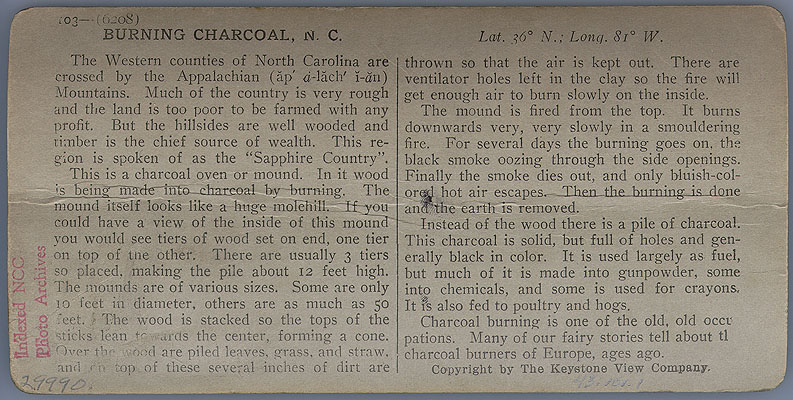
Leah points out two inconsistencies between our quiz photo and the one on the UNC
site above.
1) The locations listed for the Keystone Co. on our quiz photo are Meadville, PA; New
York, NY; Portland, OR; London, Eng.; Sydney, Aus. The UNC University Libraries
photo gives them as Meadville, PA; New York, NY; Chicago, IL; London, Eng.
2) Our quiz photo says: 6209 - Burning Charcoal Mountains in Western North Carolina,
Sapphire County. The UNC Libraries photo says 6208 - Making Charcoal in the
Mountains of Western North Carolina.
Since stereographs were often printed several times over a period of time there would
be different printings with slightly different information. This time they added
information which was mis-typed making it very wrong and probably causing a little
confusion.
BTW the Keystone View Company was founded in 1892 by B.L. Singley in Meadville,
Pa. By the 1920's it had become the largest publisher of stereographs.
site above.
1) The locations listed for the Keystone Co. on our quiz photo are Meadville, PA; New
York, NY; Portland, OR; London, Eng.; Sydney, Aus. The UNC University Libraries
photo gives them as Meadville, PA; New York, NY; Chicago, IL; London, Eng.
2) Our quiz photo says: 6209 - Burning Charcoal Mountains in Western North Carolina,
Sapphire County. The UNC Libraries photo says 6208 - Making Charcoal in the
Mountains of Western North Carolina.
Since stereographs were often printed several times over a period of time there would
be different printings with slightly different information. This time they added
information which was mis-typed making it very wrong and probably causing a little
confusion.
BTW the Keystone View Company was founded in 1892 by B.L. Singley in Meadville,
Pa. By the 1920's it had become the largest publisher of stereographs.
| Charcoal Burning |
From the back of the UNC stereoview card:
Burning Charcoal, N.C Lat 36° N; Long 81 W
The western counties of North Carolina are crossed by the Appalachian (ap'a-lach'i-an)
Mountains. Much of the country is very rough and the land is too poor to be farmed
with any profit. But the hillsides are well wooded and timber is the chief source of
wealth. this region is spoken of as the "Sapphire Country" This is a charcoal oven or
mound. In it wood is being made into charcoal by burning. The mound itself looks like
a huge mole hill. If you could have a view of the inside of this mound you would see
tiers of wood set on end, one tier on top of the others. There are usually 3 tiers so
placed. Making the pile about 12 feet high. The mounds are of various sizes. Some are
only 10 feet in diameter, others are as much as 50 feet. The wood is stacked so the
tops of the sticks lean towards the center, forming a cone. Over the wood are piled
leaves, grass and straw, and out of these several inches of dirt are thrown so that the
air is kept out. There are ventilator holes left in the clay so the fire will get enough air to
burn slowly on the inside. The mound is fired from the top. It burns downwards very,
very slowly in a smoldering fire. For several days the burning goes on, the black smoke
oozing through the side openings. Finally the smoke dies out, and only bluish-colored
hot air escapes. Then the burning is done and the earth is removed. Instead of the wood
there is a pile of charcoal. The charcoal is solid, but full of holes and generally black in
color. It is used largely as fuel, but much of it is made into gunpowder some into
chemicals and some is used for crayons. It is also fed to poultry and hogs. Charcoal
burning is one of the old, old occupations. Many of our fairy stories tell about the
charcoal burners of Europe, ages ago. Copyright by the Keystone View Company.
Burning Charcoal, N.C Lat 36° N; Long 81 W
The western counties of North Carolina are crossed by the Appalachian (ap'a-lach'i-an)
Mountains. Much of the country is very rough and the land is too poor to be farmed
with any profit. But the hillsides are well wooded and timber is the chief source of
wealth. this region is spoken of as the "Sapphire Country" This is a charcoal oven or
mound. In it wood is being made into charcoal by burning. The mound itself looks like
a huge mole hill. If you could have a view of the inside of this mound you would see
tiers of wood set on end, one tier on top of the others. There are usually 3 tiers so
placed. Making the pile about 12 feet high. The mounds are of various sizes. Some are
only 10 feet in diameter, others are as much as 50 feet. The wood is stacked so the
tops of the sticks lean towards the center, forming a cone. Over the wood are piled
leaves, grass and straw, and out of these several inches of dirt are thrown so that the
air is kept out. There are ventilator holes left in the clay so the fire will get enough air to
burn slowly on the inside. The mound is fired from the top. It burns downwards very,
very slowly in a smoldering fire. For several days the burning goes on, the black smoke
oozing through the side openings. Finally the smoke dies out, and only bluish-colored
hot air escapes. Then the burning is done and the earth is removed. Instead of the wood
there is a pile of charcoal. The charcoal is solid, but full of holes and generally black in
color. It is used largely as fuel, but much of it is made into gunpowder some into
chemicals and some is used for crayons. It is also fed to poultry and hogs. Charcoal
burning is one of the old, old occupations. Many of our fairy stories tell about the
charcoal burners of Europe, ages ago. Copyright by the Keystone View Company.
| ********** |
| Congratulations to our winners! Marilyn Hamill-Stewart Mary Grindol Leah Mangue Gary Rice Stan Read Polly Kimmitt Robert McKenna Linda Dean Kelly Fetherlin |
| If you enjoy our quizzes, don't forget to order our book! Click here. |
If you have a picture you'd like us to feature a picture in a future quiz, please
email it to us at CFitzp@aol.com. If we use it, you will receive a free analysis of
your picture. You will also receive a free Forensic Genealogy CD or a 10%
discount towards the purchase of the Forensic Genealogy book.
email it to us at CFitzp@aol.com. If we use it, you will receive a free analysis of
your picture. You will also receive a free Forensic Genealogy CD or a 10%
discount towards the purchase of the Forensic Genealogy book.
| Answer to Quiz #30 |


 |  |  |  |