
 |  |  |  |
| Answer to Quiz #25 - September 3, 2005 What do these three Indian chiefs have in common? What is the name of the third chief? |
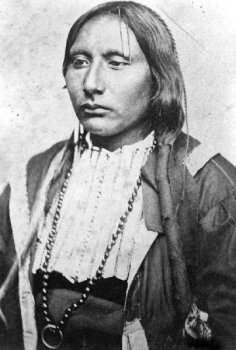


| Big Tree |
| Iron Tail |

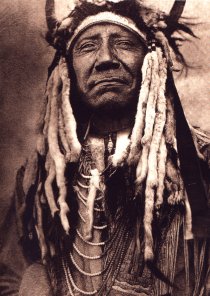

| Name? |

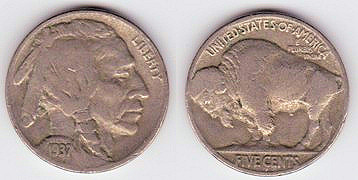
| Answers 1. They were used as models for the Indian on the buffalo nickel. 2. Two Moons. |
| THE BUFFALO NICKEL (1913-1938) http://www.answers.com/topic/nickel-u-s-coin |
American sculptor James Earle Fraser began designing the Indian Buffalo nickel in
1911. Fraser said the portrait on the "head's" side was a composite of three American
Indians - Iron Tail, Big Tree and Two Moons. James Earle Fraser had the opportunity
to study and photograph them when they stopped in New York on their way to
Washington to visit President Theodore Roosevelt. By borrowing features from each
individual, Fraser was able to sketch the "ideal" portrait for the nickel.
The model for the "tail's" side of the coin was a buffalo named Black Diamond, a
resident of New York's Bronx Zoo. He was born of stock donated by the Barnum and
Bailey circus. In his prime, Black Diamond's coat was unusually dark, and he weighed
more than 1500 pounds.
James Earle Fraser stood for hours, trying to catch his form and mood in clay. But
Black Diamond stubbornly refused to show his side view, and faced the artist most of
the time. Only by bribing a zoo attendant to distract the animal was Fraser finally able to
capture the likeness he wanted.
President William Howard Taft approved the artwork, and the first Buffalo nickels were
produced in February of 1913. When the Buffalo nickel finally made its debut, many
hailed it as a true work of art. Many critics agreed, and in 1951 the American Academy
of Arts and Letters presented Fraser with a gold medal honoring a lifetime of
distinguished achievement. (Fraser also crafted the famous End of the Trail sculpture.
James Earle Fraser died on October 11, 1953.
Two Moons died in 1917, and Iron Tail and Big Tree in the 1920s. In the 1960s, a
second Big Tree appeared at coin shows and claimed to be the Native American on the
nickel. Although he claimed to have celebrated his 100th birthday in 1962, later records
indicated he was actually only 87.
1911. Fraser said the portrait on the "head's" side was a composite of three American
Indians - Iron Tail, Big Tree and Two Moons. James Earle Fraser had the opportunity
to study and photograph them when they stopped in New York on their way to
Washington to visit President Theodore Roosevelt. By borrowing features from each
individual, Fraser was able to sketch the "ideal" portrait for the nickel.
The model for the "tail's" side of the coin was a buffalo named Black Diamond, a
resident of New York's Bronx Zoo. He was born of stock donated by the Barnum and
Bailey circus. In his prime, Black Diamond's coat was unusually dark, and he weighed
more than 1500 pounds.
James Earle Fraser stood for hours, trying to catch his form and mood in clay. But
Black Diamond stubbornly refused to show his side view, and faced the artist most of
the time. Only by bribing a zoo attendant to distract the animal was Fraser finally able to
capture the likeness he wanted.
President William Howard Taft approved the artwork, and the first Buffalo nickels were
produced in February of 1913. When the Buffalo nickel finally made its debut, many
hailed it as a true work of art. Many critics agreed, and in 1951 the American Academy
of Arts and Letters presented Fraser with a gold medal honoring a lifetime of
distinguished achievement. (Fraser also crafted the famous End of the Trail sculpture.
James Earle Fraser died on October 11, 1953.
Two Moons died in 1917, and Iron Tail and Big Tree in the 1920s. In the 1960s, a
second Big Tree appeared at coin shows and claimed to be the Native American on the
nickel. Although he claimed to have celebrated his 100th birthday in 1962, later records
indicated he was actually only 87.


| THE THREE INDIAN CHIEFS http://www.axel-jacob.de/main_chief.html#menuchief |

Big Tree. Kiowa sub chief.
Made prisoner of war at
Fort Sill in 1871 by
Sherman. Sent to Fort
Richardson, TX. 4th US
Cav. took him and
Santanta. Both were tried,
convicted, and sentenced to
be hung for participation in
the Salt Creek massacre.
Sentence commuted by
Governor Davis and he was
released in 1881, after
being confined at Huntsville
Penitentiary, TX.
Made prisoner of war at
Fort Sill in 1871 by
Sherman. Sent to Fort
Richardson, TX. 4th US
Cav. took him and
Santanta. Both were tried,
convicted, and sentenced to
be hung for participation in
the Salt Creek massacre.
Sentence commuted by
Governor Davis and he was
released in 1881, after
being confined at Huntsville
Penitentiary, TX.
| Big Tree |
c. 1850-1916. Iron Tail
fought under Sitting Bull at
the Battle of the Little
Bighorn (1876). During the
1880s, he traveled with
Buffalo Bill Cody's Wild
West Show, visiting Europe
with the troupe in 1889.
Early in the twentieth
century, Iron Tail's visage
became well known
accross the United States as
one of three models for the
Indian head nickel.
fought under Sitting Bull at
the Battle of the Little
Bighorn (1876). During the
1880s, he traveled with
Buffalo Bill Cody's Wild
West Show, visiting Europe
with the troupe in 1889.
Early in the twentieth
century, Iron Tail's visage
became well known
accross the United States as
one of three models for the
Indian head nickel.

| Iron Tail |

1847-1917. The nephew of Two Moon, this
Cheyenne leader led his people in the Battle of
the Little Bighorn. Later, in 1898, his account
of the battle appeared in McClure's magazine.
After the battle with Custer, General Nelson
A. Miles convinced Two Moons to surrender.
He later became a U.S. Army scout. In this
role, Two Moons conducted LITTLE
CROW's Cheyenne band to Fort Keough.
Two Moons later served as chief of the
reservation Northern Cheyenne and traveled
to Washington, D.C., to advance their cause.
He met with President Woodrow Wilson in
1914. Two Moons died three years later at his
home in Montana.
Cheyenne leader led his people in the Battle of
the Little Bighorn. Later, in 1898, his account
of the battle appeared in McClure's magazine.
After the battle with Custer, General Nelson
A. Miles convinced Two Moons to surrender.
He later became a U.S. Army scout. In this
role, Two Moons conducted LITTLE
CROW's Cheyenne band to Fort Keough.
Two Moons later served as chief of the
reservation Northern Cheyenne and traveled
to Washington, D.C., to advance their cause.
He met with President Woodrow Wilson in
1914. Two Moons died three years later at his
home in Montana.
| Two Moons |
| JAMES FRASER (1876 - 1953) |
James Earle Fraser (November 4, 1876 – October 11, 1953) was an American
sculptor, born in Winona, Minnesota. Fraser's father was an engineer working for the
railroads as they expanded across the American West. As a result young James was
exposed to the frontier life and particularly to the natives who were being ever pushed
further west or being confined to reservations. These early memories were to find
expression in his work as an artist, particularly in two of his best known works, the
powerful and often copied, "End of the Trail" and the Indian Head/Buffalo nickel.
sculptor, born in Winona, Minnesota. Fraser's father was an engineer working for the
railroads as they expanded across the American West. As a result young James was
exposed to the frontier life and particularly to the natives who were being ever pushed
further west or being confined to reservations. These early memories were to find
expression in his work as an artist, particularly in two of his best known works, the
powerful and often copied, "End of the Trail" and the Indian Head/Buffalo nickel.
Thomas Fraser, James' father, being one
of the Anglo-Americans closest to the
event (he was surveying Yellowstone at the
time), was part of a group sent out to
recover the remains of the 7th Cavalry
following General George Armstrong
Custer's debacle at Little Bighorn on June
15, 1876, just a few months before
Fraser's birth.
of the Anglo-Americans closest to the
event (he was surveying Yellowstone at the
time), was part of a group sent out to
recover the remains of the 7th Cavalry
following General George Armstrong
Custer's debacle at Little Bighorn on June
15, 1876, just a few months before
Fraser's birth.
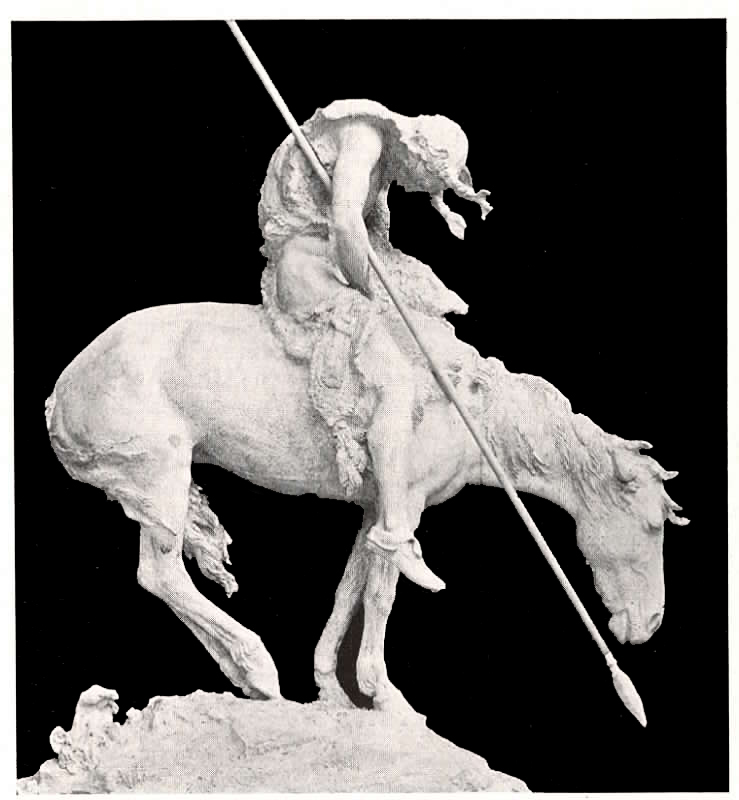
For more information, including images of some of
Fraser's other sculptures, see:
http://www.answers.com/topic/fraser-james-earle
Fraser's other sculptures, see:
http://www.answers.com/topic/fraser-james-earle
| End of the Trail |
| ******** |
| If you enjoy our quizzes, don't forget to order our book! Click here. |
| Congratulations to out winners! Gail Garwood Ken Smith Marilyn Hamill-Stewart Diane Levine Mary Grindol Patricia Bunning Mary South Deborah Hinz Robert McKenna Rick McKinney Stan Read Jerry Cole Judy Cook Lynne M. Barnes Mary Fraser Don Haase Judy Swan Leah Mangue If your name has been left off our winner's list, please let me know. It was unintentional! |
| If you enjoy our quizzes, don't forget to order our book! Click here. |
If you have a picture you'd like us to feature a picture in a future quiz, please
email it to us at CFitzp@aol.com. If we use it, you will receive a free analysis of
your picture. You will also receive a free Forensic Genealogy CD or a 10%
discount towards the purchase of the Forensic Genealogy book.
email it to us at CFitzp@aol.com. If we use it, you will receive a free analysis of
your picture. You will also receive a free Forensic Genealogy CD or a 10%
discount towards the purchase of the Forensic Genealogy book.
 |  |  |  |
| Quiz #25 Answer |


| | | |