| The Poetry for Young People series adds Lewis Carroll, edited by Edward Mendelson, illus. by Eric Copeland. All the favorites can be found, from "The Walrus and the Carpenter" to the classic "Jabberwocky," and annotations supply definitions for challenging vocabulary. Copeland, meanwhile, works against the indelible John Tenniel images with robustly colored art, the realistic grounding of which throws the absurd elements into droll relief. From Publishers Weekly |
long, long gone.
The initial letter of the surname Liddell is spelled out in the the chapter 'Looking Glass
Insects' in the wood where things have no names.
"This must be the wood," she said thoughtfully to herself, "where things have no
names. I wonder what'll become of my name when I go in? I shouldn't like to lose it at
all ..." She stood silent for a minute, thinking: then she suddenly began again. "Then it
really has happened, after all! And now, who am I? I will remember, if I can! I'm
determined to do it!" But being determined didn't help her much, and all she could say,
after a great deal of puzzling, was, "L, I know it begins with L."
Alice also gets a mention in the last two lines that introduces Through the
Looking-Glass.
Besides Lewis Carroll and the three Liddell sisters, they were also accompanied on their
The initial letter of the surname Liddell is spelled out in the the chapter 'Looking Glass
Insects' in the wood where things have no names.
"This must be the wood," she said thoughtfully to herself, "where things have no
names. I wonder what'll become of my name when I go in? I shouldn't like to lose it at
all ..." She stood silent for a minute, thinking: then she suddenly began again. "Then it
really has happened, after all! And now, who am I? I will remember, if I can! I'm
determined to do it!" But being determined didn't help her much, and all she could say,
after a great deal of puzzling, was, "L, I know it begins with L."
Alice also gets a mention in the last two lines that introduces Through the
Looking-Glass.
Besides Lewis Carroll and the three Liddell sisters, they were also accompanied on their

 |  |  |  |
| If you have a picture you'd like us to feature a picture in a future quiz, please email it to us at CFitzp@aol.com. If we use it, you will receive a free analysis of your picture. You will also receive a free Forensic Genealogy CD or a 10% discount towards the purchase of the Forensic Genealogy book. |


 |  |  |  |
| ********** |
| ********** |

| If you enjoy our quizzes, don't forget to order our books! Click here. |

| Quiz #251 Results |
Alice Pleasance Liddell (1852-1934) was the fourth of ten
siblings and the middle of the three daughters of Dean
Liddell (Dr Henry Liddell, former head of Westminster
School, Dean of Christ Church, Oxford). In 1880 she
married Reginald Hargreaves. Alice was a distant relative
of Queen Elisabeth II, her great-grandfather was brother
of the ninth Earl of Strathmore, from whom Elizabeth II is
directly descended.
Alice Liddell was the original Alice of both Alice's
Adventures in Wonderland and Through the
Looking-Glass.
At the time of her birth, Liddell's father was the
Headmaster of Westminster School but was soon after
siblings and the middle of the three daughters of Dean
Liddell (Dr Henry Liddell, former head of Westminster
School, Dean of Christ Church, Oxford). In 1880 she
married Reginald Hargreaves. Alice was a distant relative
of Queen Elisabeth II, her great-grandfather was brother
of the ninth Earl of Strathmore, from whom Elizabeth II is
directly descended.
Alice Liddell was the original Alice of both Alice's
Adventures in Wonderland and Through the
Looking-Glass.
At the time of her birth, Liddell's father was the
Headmaster of Westminster School but was soon after
Alice Liddell was born 4th of May 1852, later christened at Westminster Cathedral.
Alice Liddell's birthday is mentioned or alluded to twice in Alice's Adventures in
Wonderland.
The first occasion was in 'Pig and Pepper' on meeting the Cheshire Cat.
Alice Liddell's birthday is mentioned or alluded to twice in Alice's Adventures in
Wonderland.
The first occasion was in 'Pig and Pepper' on meeting the Cheshire Cat.
| Alice Liddell, age 7, photographed by Charles Dodgson (Lewis Carroll) in 1860. |
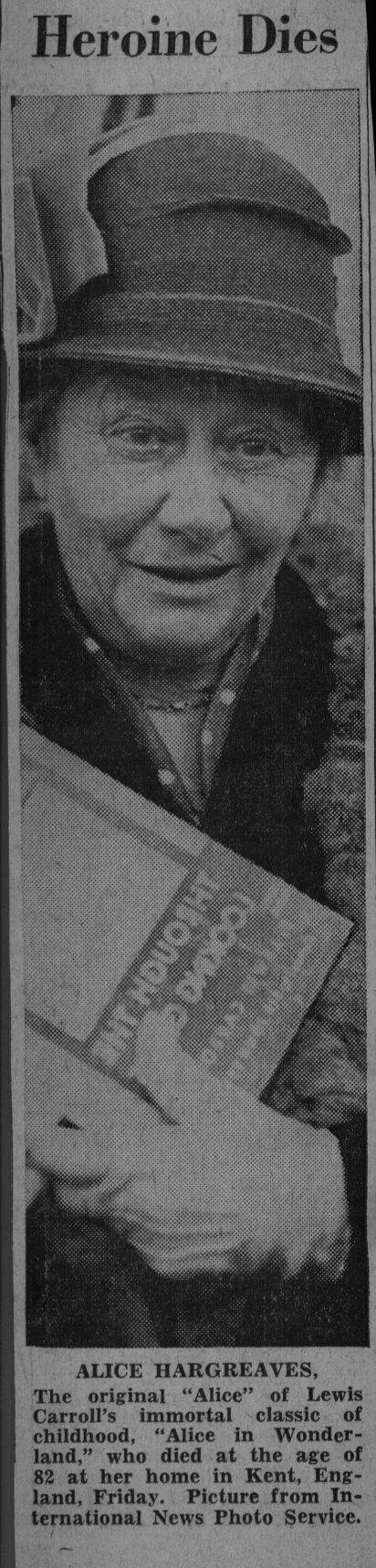
| Alice Liddel Hargreaves (04 May 1852–16 November 1934) The Model for Alice in Wonderland |
| Information Charles Dodgson (Lewis Carroll) Hid in His Two Stories http://mural.uv.es/anma/bioalice.htm |
appointed to the deanery of Christ Church, Oxford. The Liddell family moved to
Oxford in 1856. Soon after this move, she met Charles Lutwidge Dodgson, who
encountered the family while he was photographing the cathedral on 25 April 1856. He
became a close friend of the Liddell family in subsequent years.
Alice Liddell married Reginald Hargreaves on 15 September 1880, at the age of 28 in
Oxford in 1856. Soon after this move, she met Charles Lutwidge Dodgson, who
encountered the family while he was photographing the cathedral on 25 April 1856. He
became a close friend of the Liddell family in subsequent years.
Alice Liddell married Reginald Hargreaves on 15 September 1880, at the age of 28 in
| ********** |
Westminster Abbey. They had three sons: Alan Knyveton
Hargreaves and Leopold Reginald "Rex" Hargreaves (both
were killed in action in World War I); and Caryl Liddell
Hargreaves, who survived to have a daughter of his own.
Liddell denied that the name 'Caryl' was in any way
associated with Charles Dodgson's pseudonym. Reginald
Hargreaves inherited a considerable fortune, and Alice
became a noted society hostess.
On 4 July 1862, Oxford Mathematics Lecturer, the Rev
Charles Lutwidge Dodgson, took Alice and her two
sisters, on a boating trip on The Isis from Folly Bridge,
Oxford to Godstow. To keep them amused, he told a
delightful tale involving Alice and a White Rabbit. Alice
Hargreaves and Leopold Reginald "Rex" Hargreaves (both
were killed in action in World War I); and Caryl Liddell
Hargreaves, who survived to have a daughter of his own.
Liddell denied that the name 'Caryl' was in any way
associated with Charles Dodgson's pseudonym. Reginald
Hargreaves inherited a considerable fortune, and Alice
became a noted society hostess.
On 4 July 1862, Oxford Mathematics Lecturer, the Rev
Charles Lutwidge Dodgson, took Alice and her two
sisters, on a boating trip on The Isis from Folly Bridge,
Oxford to Godstow. To keep them amused, he told a
delightful tale involving Alice and a White Rabbit. Alice
asked Dodgson to write the story down for her. That Christmas it was presented to
her as A Christmas Gift to a Dear Child in Memory of a Summer Day, later published
as Alice's Adventures in Wonderland (1865) with illustrations by Sir John Tenniel, the
original version was illustrated by Lewis Carroll.
her as A Christmas Gift to a Dear Child in Memory of a Summer Day, later published
as Alice's Adventures in Wonderland (1865) with illustrations by Sir John Tenniel, the
original version was illustrated by Lewis Carroll.
Q: The Mad Hatter has a card on his hat which says
'10/6'. What does it mean?
A: The card is a price tag in 'old' English money:
pounds, shillings and pennies, which was then
written as l/s/d.
Lewis Carroll has explained the meaning of the tag in
his 'Nursery Alice':
'10/6'. What does it mean?
A: The card is a price tag in 'old' English money:
pounds, shillings and pennies, which was then
written as l/s/d.
Lewis Carroll has explained the meaning of the tag in
his 'Nursery Alice':
The Hatter used to carry about hats to sell: and even
the one that he's got on his head is meant to be sold.
You see it's got its price marked on it - a "10" and a
"6" - that means "ten shillings and sixpence."
Ten shillings and six pennies (expressed in
conversation as "Ten-and-Six") was quite a large
sum in the mid-1800's.
Chris Somerville emailed me and amplificated:
The actual amount was significant also.
Professional people (doctors, lawyers, architects
etc) all charged fees, not in pounds but in Guineas.
One Guinea was one pound plus one shilling. And
while pounds were the currency of trade, Guineas
were the currency of the professions. We used to
have a gold coin called, and valued at a Guinea, and
a smaller gold coin, a half Guinea, valued at ten and
six (10/6). The pound, however was merely a paper
note, as was the half-pound or ten shillings.
So the hat worn by the Mad Hatter was priced at
half-a-Guinea, signifying its superior style.
the one that he's got on his head is meant to be sold.
You see it's got its price marked on it - a "10" and a
"6" - that means "ten shillings and sixpence."
Ten shillings and six pennies (expressed in
conversation as "Ten-and-Six") was quite a large
sum in the mid-1800's.
Chris Somerville emailed me and amplificated:
The actual amount was significant also.
Professional people (doctors, lawyers, architects
etc) all charged fees, not in pounds but in Guineas.
One Guinea was one pound plus one shilling. And
while pounds were the currency of trade, Guineas
were the currency of the professions. We used to
have a gold coin called, and valued at a Guinea, and
a smaller gold coin, a half Guinea, valued at ten and
six (10/6). The pound, however was merely a paper
note, as was the half-pound or ten shillings.
So the hat worn by the Mad Hatter was priced at
half-a-Guinea, signifying its superior style.
| ********** |
I feel as though I should pass this quiz since I got interested in Alice after reading a
review of Benjamin's book. I decided to go for it anyway even though I basically
knew the answer before I started. I went to a book signing on Tues night and the
bookstore had signed copies of Alice Have I Been. Even though I already have it on my
Kindle I couldn't pass it up. I spend an awful lot of money on books.
Milene Rawlinson
*****
I'd always heard the story of how Lewis Carroll was a little too interested in young
girls, but never read about it in detail before. Strange! Thanks for an interesting quiz.
Nicole Blank
*****
Ha - that would have been a good AmEx commercial. I think the only two quizzes I
gave up on were the U.S. Mint one and the New Year's Island; I don't like to give up on
things so I was glad for the hints. Would never have guessed Alice in Wonderland in
1000 guesses; I was convinced she was a war heroine. Nicole Blank
*****
Below are two links showing photos of the child, Alice Liddell who was the inspiration
for the tale. The 2nd link is a series of lectures by professional photographer who
teaches at the College of DuPage near Chicago. Listening to some of these lessons
reminded me of the first time I heard Colleen Fitzpatrick at an Ontario Genealogical
Conference. The topics were photo-analysis and history. To solve this I used the Tin
Eye website to discover the name of the bridge - The Folly Bridge in London UK. A
search for “folly bridge girl story” led me to the answer.
http://people.virginia.edu/~ds8s/carroll/ela-1.html
http://photohistory.jeffcurto.com (Photo History Intersession – January 14)
Don Draper
*****
What a fascinating story. I had no idea of its history. Jocelyn Thayer
*****
YEA!! THE QUIZKIDS ACE A BIG ONE...MARCH MADNESS WITH MR. STAN...
AND THANKS TO MR. RICK TAKING MRS R TO THE MOVIES...and knowing Mr.
rick it was probably a cheap drive in movie place at the swap shop!
Mr. Rick and the Quiz Kids
*****
The first story that came to mind was Alice in Wonderland by Lewis Carroll (Charles
Dodgson). I could not find this particular picture of Alice Liddell (Hargreaves), nor any
connection to the English Bridge, but with the tentative connection that Lewis Carroll
took most of the childhood pictures I found of Alice Liddell, I submit this as my
answer. http://en.wikipedia.org/wiki/File:Alice_Liddell_2.jpg Deena Proctor
*****
For extra credit, the name of the bridge is the Folly Bridge in Oxford England.
Daniel E. Jolley
*****
The reason I know [the answer]is because I am a teacher at a school here in Australia
and we are doing Disney's Alice In Wonderland for our school production this year. I
teach music, so made it my business to find out as much as I could about Alice in
Wonderland. Jacky Casey
*****
Ahhhhh, it came to me in a dream Thursday night from a hookah smoking caterpillar.
(No, .....NOT Really!!!) Colleen-Great Quiz !!!!, Have a great week!!!!!
Robert W. Steinmann, Jr.
review of Benjamin's book. I decided to go for it anyway even though I basically
knew the answer before I started. I went to a book signing on Tues night and the
bookstore had signed copies of Alice Have I Been. Even though I already have it on my
Kindle I couldn't pass it up. I spend an awful lot of money on books.
Milene Rawlinson
*****
I'd always heard the story of how Lewis Carroll was a little too interested in young
girls, but never read about it in detail before. Strange! Thanks for an interesting quiz.
Nicole Blank
*****
Ha - that would have been a good AmEx commercial. I think the only two quizzes I
gave up on were the U.S. Mint one and the New Year's Island; I don't like to give up on
things so I was glad for the hints. Would never have guessed Alice in Wonderland in
1000 guesses; I was convinced she was a war heroine. Nicole Blank
*****
Below are two links showing photos of the child, Alice Liddell who was the inspiration
for the tale. The 2nd link is a series of lectures by professional photographer who
teaches at the College of DuPage near Chicago. Listening to some of these lessons
reminded me of the first time I heard Colleen Fitzpatrick at an Ontario Genealogical
Conference. The topics were photo-analysis and history. To solve this I used the Tin
Eye website to discover the name of the bridge - The Folly Bridge in London UK. A
search for “folly bridge girl story” led me to the answer.
http://people.virginia.edu/~ds8s/carroll/ela-1.html
http://photohistory.jeffcurto.com (Photo History Intersession – January 14)
Don Draper
*****
What a fascinating story. I had no idea of its history. Jocelyn Thayer
*****
YEA!! THE QUIZKIDS ACE A BIG ONE...MARCH MADNESS WITH MR. STAN...
AND THANKS TO MR. RICK TAKING MRS R TO THE MOVIES...and knowing Mr.
rick it was probably a cheap drive in movie place at the swap shop!
Mr. Rick and the Quiz Kids
*****
The first story that came to mind was Alice in Wonderland by Lewis Carroll (Charles
Dodgson). I could not find this particular picture of Alice Liddell (Hargreaves), nor any
connection to the English Bridge, but with the tentative connection that Lewis Carroll
took most of the childhood pictures I found of Alice Liddell, I submit this as my
answer. http://en.wikipedia.org/wiki/File:Alice_Liddell_2.jpg Deena Proctor

*****
For extra credit, the name of the bridge is the Folly Bridge in Oxford England.
Daniel E. Jolley
*****
The reason I know [the answer]is because I am a teacher at a school here in Australia
and we are doing Disney's Alice In Wonderland for our school production this year. I
teach music, so made it my business to find out as much as I could about Alice in
Wonderland. Jacky Casey
*****
Ahhhhh, it came to me in a dream Thursday night from a hookah smoking caterpillar.
(No, .....NOT Really!!!) Colleen-Great Quiz !!!!, Have a great week!!!!!
Robert W. Steinmann, Jr.
| Epilogue |
The twenty-one letters of Alice Pleasance Liddell are spelled out in the twenty-one lines
of the Epilogue to Through the Looking-Glass, a mournful reminisce of a summer day,
long, long gone.
of the Epilogue to Through the Looking-Glass, a mournful reminisce of a summer day,
long, long gone.
| Comments from Our Readers |
A boat, beneath a sunny sky,
Lingering onward dreamily
In an evening of July -
Children three that nestle near,
Eager eye and willing ear,
Pleased a simple tale to hear -
Long has paled that sunny sky:
Echoes fade and memories die:
Autumn frosts have slain July.
She still haunts me, phantomwise,
Alice moving under skies
Never seen by waking eyes.
Children yet, the tale to hear,
Eager eye and willing ear,
Lovingly shall nestle near.
In Wonderland they lie,
Dreaming as the days go by,
Dreaming as the summers die:
Ever drifting down the stream -
Lingering in the golden gleam -
Life, what is it but a dream?
Lingering onward dreamily
In an evening of July -
Children three that nestle near,
Eager eye and willing ear,
Pleased a simple tale to hear -
Long has paled that sunny sky:
Echoes fade and memories die:
Autumn frosts have slain July.
She still haunts me, phantomwise,
Alice moving under skies
Never seen by waking eyes.
Children yet, the tale to hear,
Eager eye and willing ear,
Lovingly shall nestle near.
In Wonderland they lie,
Dreaming as the days go by,
Dreaming as the summers die:
Ever drifting down the stream -
Lingering in the golden gleam -
Life, what is it but a dream?
| ********** |
| ********** |
| Epilogue to Through the Looking-Glass |
| ********** |
| Answer to Quiz #251 April 4, 2010 |
| ********** |
| Mr. Rick and the Quiz Kids Are they good or whaaaaattt? Milene Rawlinson Nicole Blank Rebecca Bare Nicole Blank Karen Petrus Deborah Campisano Carole Cropley Debbie Johnson Randy Whited Alan Lenn Tamura Jones Jessica Jolley John Chulick Sandra McConathy Randy Whited Don Draper Jocelyn Thayer Carl Blessing Deena Proctor Jacky Casey Debbie Sterbinsky Ben Truwe Betty Chambers Edee Scott Joshua Kreitzer Daniel E. Jolley Elaine C. Hebert Gary Sterne Judy Pfaff Diane Burkett Robert W. Steinmann Jr. Karen Kay Bunting Marilyn Hamill |


| This woman was the inspiration for a famous story when she was a little girl. 1. What is the name of the story? 2. Send a link to a picture of her as a little girl. 3. Who wrote the story (and probably took the picture you are sending in)? Please ask for a hint if you need one. |
| Suggested by long time Quizmaster Stan Read, PhD. |
| Congratulations to Our Winners |
| Answers 1. Alice in Wonderland. 2. See below. 3. Charles Dodgson, aka Lewis Carroll The woman is Alice Liddell Hargreaves. The bridge is the Folly Bridge over the River Thames. |
| ********** |


| The Mad Hatter 1865 Wood engraving by Dalziel Illustration for the seventh chapter of Lewis Carroll's Alice in Wonderland http://www.victorianweb.org/art/illustration/tenniel/alice/7.2.html |


| Read Pig and Pepper Click here. |
"I've seen hatters before," she said to
herself; "the March Hare will be much the
most interesting, and perhaps, as this is
herself; "the March Hare will be much the
most interesting, and perhaps, as this is
May, it won't be raving mad - at least not so mad as it was in March."
The second was at the Mad Hatters Tea-Party in 'A Mad Tea-Party'.
The Hatter was the first to break the silence. "What day of the month is it?" he said,
turning to Alice: he had taken his watch out of his pocket, and was looking at it uneasily
... Alice considered a little, and then said, "The fourth."
At the Mad Hatters Tea Part both Alice and her sisters are woven into the story, that is
in addition to the presence of Alice as herself, when the Dormouse tries to tell the tale
of the three little sisters.
"Once upon a time there were three little sisters," the Dormouse began in a great hurry;
The second was at the Mad Hatters Tea-Party in 'A Mad Tea-Party'.
The Hatter was the first to break the silence. "What day of the month is it?" he said,
turning to Alice: he had taken his watch out of his pocket, and was looking at it uneasily
... Alice considered a little, and then said, "The fourth."
At the Mad Hatters Tea Part both Alice and her sisters are woven into the story, that is
in addition to the presence of Alice as herself, when the Dormouse tries to tell the tale
of the three little sisters.
"Once upon a time there were three little sisters," the Dormouse began in a great hurry;

"and their names were Elsie, Lacie, and Tillie; and they lived
at the bottom of a well ..."
The eldest of the Liddell sisters was Lorina Charlotte, initials
L C, Alice the middle (try anagram), and Edith the youngest
was affectionately known to her sisters as Tillie.
The twenty-one letters of Alice Pleasance Liddell are spelled
out in the twenty-one lines of the Epilogue to Through the
Looking-Glass, a mournful reminisce of a summer day,
at the bottom of a well ..."
The eldest of the Liddell sisters was Lorina Charlotte, initials
L C, Alice the middle (try anagram), and Edith the youngest
was affectionately known to her sisters as Tillie.
The twenty-one letters of Alice Pleasance Liddell are spelled
out in the twenty-one lines of the Epilogue to Through the
Looking-Glass, a mournful reminisce of a summer day,
There are at least three direct links to Liddell in the two books. First,
he set them on 4 May (Liddell's birthday) and 4 November (her
"half-birthday"), and in Through the Looking-Glass the fictional Alice
declares that her age is "seven and a half exactly", the same as Liddell
on that date. Second, he dedicated them "to Alice Pleasance Liddell".
Third, there is an acrostic poem at the end of Through the
Looking-Glass. Reading downward, taking the first letter of each line,
spells out Liddell's full name. The poem has no title in Through the
Looking-Glass, but is usually referred to by its first line, "A Boat
Beneath a Sunny Sky". (See section below).
he set them on 4 May (Liddell's birthday) and 4 November (her
"half-birthday"), and in Through the Looking-Glass the fictional Alice
declares that her age is "seven and a half exactly", the same as Liddell
on that date. Second, he dedicated them "to Alice Pleasance Liddell".
Third, there is an acrostic poem at the end of Through the
Looking-Glass. Reading downward, taking the first letter of each line,
spells out Liddell's full name. The poem has no title in Through the
Looking-Glass, but is usually referred to by its first line, "A Boat
Beneath a Sunny Sky". (See section below).
| The Mad Hatter's riddle: why is a raven like a writing desk? In a new preface that Carroll wrote for the 1896 edition of Alice, he gave what he considered to be the best answer to the Mad Hatter's riddle. This is what he wrote: "Enquiries have been so often addressed to me, as to whether any answer to the Hatter’s Riddle can be imagined, that I may as well put on record here what seems to me to be a fairly appropriate answer, viz: "Because it can produce a few notes, tho they are very flat; and it is nevar put with the wrong end in front!" This, however, is merely an afterthought; the Riddle as originally invented, had no answer at all." Note the spelling of "never" as "nevar" (discovered by Denis Crutch). Carroll intended to spell "raven" backwards. The word was corrected to "never" in all later printings, perhaps by an editor who thought he had found a printer's error. Because Carroll died soon after this "correction" had destroyed the ingenuity of his answer, the original spelling was never restored. Whether Carroll was aware of the damage done to his clever answer is not known. Many readers have invented their own answers ever since, including the most famous "because Poe wrote on both", and my personal favorite "because there's a B in both and an N in neither". |
| Chess Pieces |
| ||||||||||||||||||||||||||||||||||||||||||||||||||||||||||||||||||||||||||||||||||||||||||
| Alice (The one in the book) |

|
| The grave of Alice Hargreaves in the graveyard of the church of St. Michael & All Angels, Lyndhurst |

boat trip by Canon Duckworth. They all make
an appearance towards the end of the second
chapter, 'The Pool of Tears', in Alice's
Adventures in Wonderland.
It was high time to go, for the pool was
getting quite crowded with all the birds and
animals that had fallen into it: there were a
Duck and a Dodo, a Lory and an Eaglet, and
several other curious creatures. Alice led the
way and the whole party swam to the shore.
an appearance towards the end of the second
chapter, 'The Pool of Tears', in Alice's
Adventures in Wonderland.
It was high time to go, for the pool was
getting quite crowded with all the birds and
animals that had fallen into it: there were a
Duck and a Dodo, a Lory and an Eaglet, and
several other curious creatures. Alice led the
way and the whole party swam to the shore.
The Duck was Canon Duckworth, Dodo Do-do-Dodgson (who sometimes spoke with
a st-st-stammer), Lory Lorina, and Eaglet Edith.
Many of the verses were parodies of the prevailing verse for children or mocked their
regimented rote learning, something his young audience would have understood and
appreciated.
... for she had read several nice little histories about children who had got burnt, and
eaten up by wild beasts and other unpleasant things, all because they would not
remember the simple rules their friends had taught them ...
a st-st-stammer), Lory Lorina, and Eaglet Edith.
Many of the verses were parodies of the prevailing verse for children or mocked their
regimented rote learning, something his young audience would have understood and
appreciated.
... for she had read several nice little histories about children who had got burnt, and
eaten up by wild beasts and other unpleasant things, all because they would not
remember the simple rules their friends had taught them ...
| Edith, Lorina, and Alice Liddell circa 1859 (photo by Lewis Carroll) |
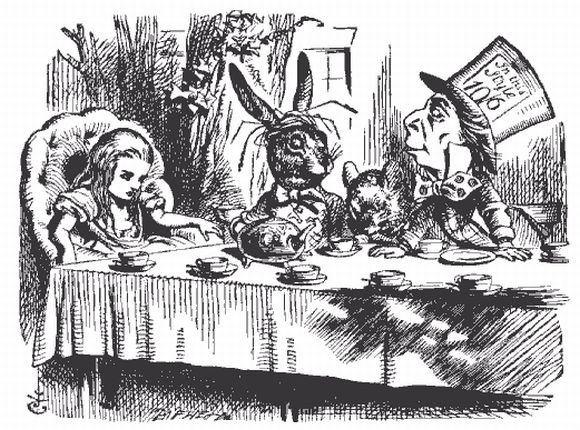
The original Alice as depicted by John
Tenniel in the 1865 edition of Alice in
Wonderland. The extent to which
Dodgson's Alice may be identified with
Liddell is controversial. The two Alices
are clearly not identical, and though it was
long assumed that the fictional Alice was
based very heavily on Liddell, recent
research has contradicted this assumption.
Dodgson himself claimed in later years
that his Alice was entirely imaginary and
Tenniel in the 1865 edition of Alice in
Wonderland. The extent to which
Dodgson's Alice may be identified with
Liddell is controversial. The two Alices
are clearly not identical, and though it was
long assumed that the fictional Alice was
based very heavily on Liddell, recent
research has contradicted this assumption.
Dodgson himself claimed in later years
that his Alice was entirely imaginary and
not based upon any real child at all.
There was a rumour that Dodgson sent Tenniel a photo of one of his other
child-friends, Mary Hilton Badcock, suggesting that he used her as a model,[9] but
attempts to find documentary support for this theory have proved fruitless. Dodgson's
own drawings of the character in the original manuscript of Alice's Adventures under
Ground show little resemblance to Liddell. Biographer Anne Clark suggests that
Dodgson might have used Edith Liddell as a model for his drawings.
There was a rumour that Dodgson sent Tenniel a photo of one of his other
child-friends, Mary Hilton Badcock, suggesting that he used her as a model,[9] but
attempts to find documentary support for this theory have proved fruitless. Dodgson's
own drawings of the character in the original manuscript of Alice's Adventures under
Ground show little resemblance to Liddell. Biographer Anne Clark suggests that
Dodgson might have used Edith Liddell as a model for his drawings.
| ********** |
| The 1951 Walt Disney Alice |
| Read Alice in Wonderland and Through the Looking Glass Click here. |

| often regarded as some of the finest work in Disney studio history, despite the lackluster, even hostile, reviews it originally received, especially in the United Kingdom. |
| The Original 1865 Alice |
Thirteenth in the Walt Disney Animated
Classics series, the film was released in
New York City and London on July 26,
1951 by RKO Radio Pictures. The film
features the voices of Kathryn Beaumont
as Alice (also voice of Wendy Darling in
the later Disney feature film, Peter Pan)
and Ed Wynn as the Mad Hatter. Made
under the supervision of Walt Disney
himself, this film and its animation are
Classics series, the film was released in
New York City and London on July 26,
1951 by RKO Radio Pictures. The film
features the voices of Kathryn Beaumont
as Alice (also voice of Wendy Darling in
the later Disney feature film, Peter Pan)
and Ed Wynn as the Mad Hatter. Made
under the supervision of Walt Disney
himself, this film and its animation are
| ********** |
| American McGee's 2000 Alice http://en.wikipedia.org/wiki/American_McGee%27s_Alice |
American McGee's Alice is a third-person action
game released for PC on October 6, 2000. The
game, developed by Rogue Entertainment and
published by Electronic Arts, is set in the universe
of Lewis Carroll's Alice in Wonderland. Alice
was designed by American McGee and features
music composed by Chris Vrenna.
In marked contrast to most computer games,
Alice has grown in value and become a collector's
item since its release, with new copies selling for
$100-200 on auction sites and used copies selling
for close to $100.
game released for PC on October 6, 2000. The
game, developed by Rogue Entertainment and
published by Electronic Arts, is set in the universe
of Lewis Carroll's Alice in Wonderland. Alice
was designed by American McGee and features
music composed by Chris Vrenna.
In marked contrast to most computer games,
Alice has grown in value and become a collector's
item since its release, with new copies selling for
$100-200 on auction sites and used copies selling
for close to $100.
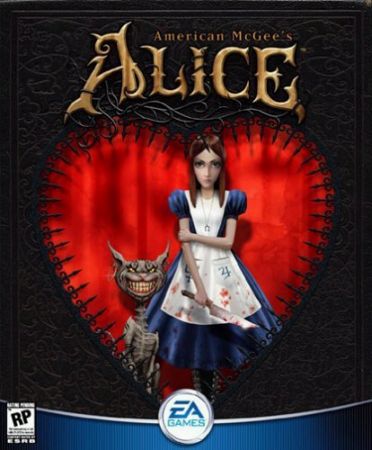
Shortly after her second adventure, Alice's house is burned down by an accidental fire,
killing her family, and leaving her as the only survivor. Due to her survivor's guilt, she
tries to commit suicide (bandages can be seen on her wrists), and becomes catatonic.
She is institutionalized in Rutledge Asylum, where she remains insane and is
consistently mistreated by the workers. Ten years later, the White Rabbit summons
Alice to aid a radically altered Wonderland, which became a twisted version of itself as
it came under the despotic rule of the Queen of Hearts. The Cheshire Cat serves as
Alice's companion throughout the game, frequently appearing to guide her with cryptic
comments.
killing her family, and leaving her as the only survivor. Due to her survivor's guilt, she
tries to commit suicide (bandages can be seen on her wrists), and becomes catatonic.
She is institutionalized in Rutledge Asylum, where she remains insane and is
consistently mistreated by the workers. Ten years later, the White Rabbit summons
Alice to aid a radically altered Wonderland, which became a twisted version of itself as
it came under the despotic rule of the Queen of Hearts. The Cheshire Cat serves as
Alice's companion throughout the game, frequently appearing to guide her with cryptic
comments.
| ********** |

Jessie Willcox Smith (September 6, 1863 –
May 3, 1935) was a United States illustrator
famous for her work in magazines such as
Ladies Home Journal and for her
illustrations for children's books.
Born in the Mount Airy neighborhood of
Philadelphia, Pennsylvania, Smith studied at
the Pennsylvania Academy of the Fine Arts
under Thomas Eakins in Philadelphia,
graduating in 1888. A year later, she started
working in the production department of the
Ladies' Home Journal, for five years. She
May 3, 1935) was a United States illustrator
famous for her work in magazines such as
Ladies Home Journal and for her
illustrations for children's books.
Born in the Mount Airy neighborhood of
Philadelphia, Pennsylvania, Smith studied at
the Pennsylvania Academy of the Fine Arts
under Thomas Eakins in Philadelphia,
graduating in 1888. A year later, she started
working in the production department of the
Ladies' Home Journal, for five years. She
| 1923 Jesse Wilcox Smith Illustration http://en.wikipedia.org/wiki/Jessie_Willcox_Smith |
left to take classes under Howard Pyle, first at Drexel and then at the Brandywine
School.
She was a prolific contributor to books and magazines during the late nineteenth and
early twentieth centuries, illustrating stories and articles for clients such as Century,
Collier's Weekly, Leslie's Weekly, Harper's, McClure's, Scribners, and the Ladies' Home
Journal.
School.
She was a prolific contributor to books and magazines during the late nineteenth and
early twentieth centuries, illustrating stories and articles for clients such as Century,
Collier's Weekly, Leslie's Weekly, Harper's, McClure's, Scribners, and the Ladies' Home
Journal.
| ********** |

| Mia Wasikowska http://www.imdb.com/media/rm1141147648/nm1985859 |
| 2010 Tim Burton's Alice |
Alice Kingsleigh (Mia Wasikowska) is the daughter
of Charles Kingsleigh (Marton Csokas), a wealthy
man who planned to find profitable shipping routes
through the world in the 19th century. When she
tells him of her adventures in Wonderland (later to
be revealed as 'Underland'), he declares her mad,
but that all the best people are. However, many
years afterward, Charles has passed away, and
Alice misses his playful attitude.
Alice, an unpretentious and individual 19-year-old,
is betrothed to a dunce of an English nobleman. At
her engagement party, she escapes the crowd to
consider whether to go through with the marriage
and falls down a hole in the garden after spotting
of Charles Kingsleigh (Marton Csokas), a wealthy
man who planned to find profitable shipping routes
through the world in the 19th century. When she
tells him of her adventures in Wonderland (later to
be revealed as 'Underland'), he declares her mad,
but that all the best people are. However, many
years afterward, Charles has passed away, and
Alice misses his playful attitude.
Alice, an unpretentious and individual 19-year-old,
is betrothed to a dunce of an English nobleman. At
her engagement party, she escapes the crowd to
consider whether to go through with the marriage
and falls down a hole in the garden after spotting
an unusual rabbit. Arriving in a strang and surreal place called "Underland," she finds
herself in a world that resembles the nightmares she had as a child, filled with talking
animals, villainous queens and knights, and frumious bandersnatches. Alice realizes that
she is there for a reason--to conquer the horrific Jabberwocky and restore the rightful
queen to her throne. http://www.imdb.com/title/tt1014759/synopsis
herself in a world that resembles the nightmares she had as a child, filled with talking
animals, villainous queens and knights, and frumious bandersnatches. Alice realizes that
she is there for a reason--to conquer the horrific Jabberwocky and restore the rightful
queen to her throne. http://www.imdb.com/title/tt1014759/synopsis
| ********** |
| Pictures of Alice by Charles Dodgson aka Lewis Carroll (The real one) http://www.alice-in-wonderland.biz/backgroundliddell.htm |

| Alan Lemm Discusses His Solution with the Quizmaster General |


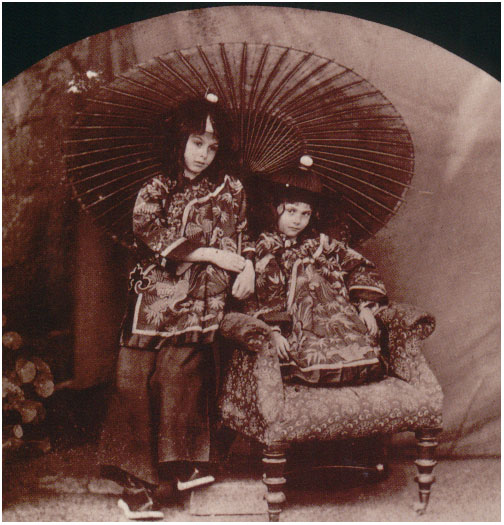

| Lorina and Alice in Chinese Costume |
| Alice and Lorina Liddell on a see-saw in the Deanery Garden at Christ Church |
| 1. Alice's adventures in Wonderland. 2. http://en.wikipedia.org/wiki/File:Alice_Liddell.jpg 3. Charles Dodgson, AKA Lewis Carroll Note: What does the picture of the bridge have to do with this quiz? -- Alan Lemm I put the picture of the Folly Bridge because it was while boating on the Thames near this bridge that Alice Liddell and her sibs asked Charles Dodson to tell them a story. He did, and it eventually became the Alice in Wonderland we know today. I didn't think that the readers would be able to identify the woman just by that picture, so I wanted to offer a sideways hint. How did you get it without the bridge? -- Quizmaster General Lucky guess. The obit says "Heroine Dies". When a newspaper calls someone a "heroine", it's usually only to talk about why she's a heroine, not that she died ("Heroine Saves Drowning Man", "Heroine Rescues Children From a Burning Building", etc.). So I figured "heroine", in this case, meant "female lead character", probably in a work of fiction. Since we are talking about a real person, while she's also a "heroine", my first guess was Alice in Wonderland, since that is probably the most famous fictional character to be directly inspired by a real person. I verified this by Googling "Heroin Dies" and "Alice in Wonderland", and the first result was for Alice Hargreaves, which contained a replica of your photo. -- Alan Lemm |