agreement that preserved the spirit of Ordinance 222 by requiring African Americans to
load the buses from back to front and whites from front to back but prohibiting blacks
from sitting with or in front of white passengers. However, it also reserved the two
front seats for white passengers and the long back seat for African Americans.
Rev. Jemison broke the news to a mass meeting held at Memorial Stadium. While some
African Americans wanted to continue the boycott and push for the end of segregated
seating on the buses, the majority applauded the deal.
On 24 June 1953, the protest ended. Although short lived, the Baton Rouge bus boycott
served as a template for similar protests throughout the South, including the 1955
Montgomery Bus Boycott.
load the buses from back to front and whites from front to back but prohibiting blacks
from sitting with or in front of white passengers. However, it also reserved the two
front seats for white passengers and the long back seat for African Americans.
Rev. Jemison broke the news to a mass meeting held at Memorial Stadium. While some
African Americans wanted to continue the boycott and push for the end of segregated
seating on the buses, the majority applauded the deal.
On 24 June 1953, the protest ended. Although short lived, the Baton Rouge bus boycott
served as a template for similar protests throughout the South, including the 1955
Montgomery Bus Boycott.
| Rosa Parks is booked at the Montgomery Sheriff's Office February 22, 1956 http://www.montgomeryboycott.com/a rticle_overview.htm |
city-parish council and asked its members to end the practice of reserved seating on the
city's buses. At its February 25 meeting, the council voted to amend the city's seating
code to allow African Americans to sit in the front seats of the buses if they did not
occupy the same seat as or sit in front of a white passenger. It abolished reserved
seating but required African Americans to board the buses from back to front and white
passengers from front to back. The race with the majority of riders determined where
the line of segregation began. The council passed the new seating law, Ordinance 222,
without a dissenting vote and ordered it to go into effect on March 19.
However, the new law went unenforced. For nearly three months, the front ten bus
seats remained reserved for white passengers, even on routes going through black
neighborhoods. In early June 1953, African Americans demanded enforcement of the
city's buses. At its February 25 meeting, the council voted to amend the city's seating
code to allow African Americans to sit in the front seats of the buses if they did not
occupy the same seat as or sit in front of a white passenger. It abolished reserved
seating but required African Americans to board the buses from back to front and white
passengers from front to back. The race with the majority of riders determined where
the line of segregation began. The council passed the new seating law, Ordinance 222,
without a dissenting vote and ordered it to go into effect on March 19.
However, the new law went unenforced. For nearly three months, the front ten bus
seats remained reserved for white passengers, even on routes going through black
neighborhoods. In early June 1953, African Americans demanded enforcement of the
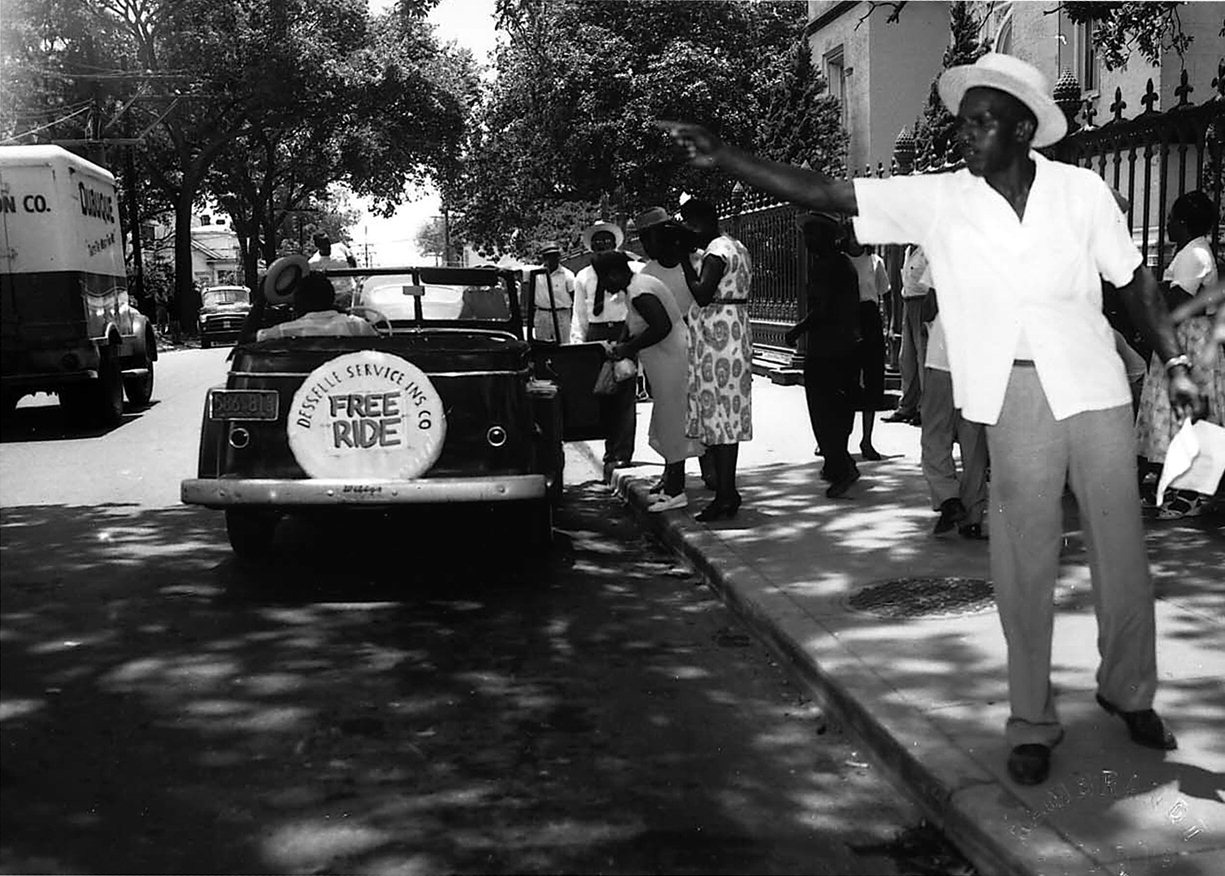
| Well, again, I think it helps to have been a history major.., and I know you like to try to tie quizzes to the calendar if possible, and with the MLK holiday tomorrow, I figured that this was tied to civil rights history. Seeing the picture, and the sign on the back of the car, I knew that this was probably relate to MLK and the bus boycott of 1955. (I was only about 2 at the time, so I don't have first-hand memories of the events, though.) However, looking at the folks in the photos, I knew that this probably wasn't the Montgomery boycott, which started in December. Those folks would probably have been in jackets or coats. Granted the boycott ran a year, but I thought it likely that was photographed early on during the boycott. Photos of Rosa Parks show her wearing a coat, and these ladies appear to be in summer dresses, so the time of year is not the same... Believe it or not, I googled for "precursor to bus boycott" - and the first hit to that (http://en.wikipedia.org/wiki/T._J._Jemison) is a bio of T.J. Jemison, which mentions that he led a successful bus Boycott in Baton Rouge in 1953. Aha! Colleen's from the area-- I bet this is it. A link at the bottom of that article led to this site - http://www.lib.lsu.edu/special/exhibits/boycott/index.html which has your photo at the bottom. I honestly didn't even use the insurance company clue! Mary Fraser |
challenging segregation on Baton Rouge buses. Reed and a local clergyman, the Rev.
T.J. Jemison, were the leaders of the bus boycott, which began June 20, 1953.
In 1953, 80 percent of bus riders were black -- and Reed knew that a boycott would
send an economic message.
"Historians believe it was one of the first times blacks in the South organized to
challenge segregation," Elliott says. "Yet most people here -- even the African-American
bus drivers -- don't know about the Baton Rouge bus boycott."
Jemison, now 84, says he got involved in the boycott 50 years ago after watching
T.J. Jemison, were the leaders of the bus boycott, which began June 20, 1953.
In 1953, 80 percent of bus riders were black -- and Reed knew that a boycott would
send an economic message.
"Historians believe it was one of the first times blacks in the South organized to
challenge segregation," Elliott says. "Yet most people here -- even the African-American
bus drivers -- don't know about the Baton Rouge bus boycott."
Jemison, now 84, says he got involved in the boycott 50 years ago after watching
Fifty years ago in Baton Rouge, La., black citizens
banded together to fight the segregated seating system
on city buses. They quit riding for eight days, staging
what historians believe was the first bus boycott of the
budding Civil Rights movement.
The Baton Rouge episode inspired the Montgomery,
Ala., bus boycott led by the Rev. Martin Luther King,
but was largely forgotten. But as NPR's Debbie Elliott
reports, organizers of a commemoration of the original
bus boycott this week hope to change that.
Willis Reed, 88, publisher of the Baton Rouge Post,
now takes a seat at the front of the bus that stops at the
newspaper offices. The World War II veteran says
doing that 50 years ago would have meant trouble.
"They'd put me in jail," he tells Elliott. "And it's wrong.
Definitely wrong." Reed was the founder of a group
banded together to fight the segregated seating system
on city buses. They quit riding for eight days, staging
what historians believe was the first bus boycott of the
budding Civil Rights movement.
The Baton Rouge episode inspired the Montgomery,
Ala., bus boycott led by the Rev. Martin Luther King,
but was largely forgotten. But as NPR's Debbie Elliott
reports, organizers of a commemoration of the original
bus boycott this week hope to change that.
Willis Reed, 88, publisher of the Baton Rouge Post,
now takes a seat at the front of the bus that stops at the
newspaper offices. The World War II veteran says
doing that 50 years ago would have meant trouble.
"They'd put me in jail," he tells Elliott. "And it's wrong.
Definitely wrong." Reed was the founder of a group

 |  |  |  |
| If you enjoy our quizzes, don't forget to order our books! Click here. |
| If you have a picture you'd like us to feature a picture in a future quiz, please email it to us at CFitzp@aol.com. If we use it, you will receive a free analysis of your picture. You will also receive a free Forensic Genealogy CD or a 10% discount towards the purchase of the Forensic Genealogy book. |

| Quiz #144 Results |


 |  |  |  |
| ********** |
| Answers: 1. Baton Rouge, LA 2. The 8-day Bus Boycott, June 15-23, 1953 3. The Year-long Bus Boycott in Montgomery, AL in 1955 |
| ********** |
| Answer to Quiz #144 - January 20, 2008 |
| ********** |
| The Baton Rouge Bus Boycott and the Birth of the Civil Rights Movement http://www.lib.lsu.edu/special/exhibits/boycott/background.html |
In early 1953, the Baton Rouge
city-parish council voted to raise
fares on the city's buses. This
increase angered black bus
passengers who made up more
than 80 percent of the system's
riders. Although they paid full
fare, the African-American men
and women who used public
transportation were forced to sit
or stand in the backs of buses
while the front ten seats, reserved
for whites, remained empty. The
fight over reserved seating began
quietly on February 11, 1953,
when Reverend T. J. Jemison,
the pastor of Mt. Zion Baptist
Church and a relative newcomer
to Baton Rouge, denounced the
fare increase at a meeting of the
city-parish council voted to raise
fares on the city's buses. This
increase angered black bus
passengers who made up more
than 80 percent of the system's
riders. Although they paid full
fare, the African-American men
and women who used public
transportation were forced to sit
or stand in the backs of buses
while the front ten seats, reserved
for whites, remained empty. The
fight over reserved seating began
quietly on February 11, 1953,
when Reverend T. J. Jemison,
the pastor of Mt. Zion Baptist
Church and a relative newcomer
to Baton Rouge, denounced the
fare increase at a meeting of the
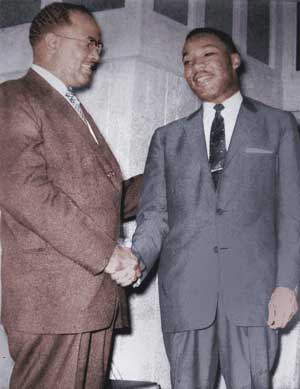
| Rev. Theodore Jefferson JemisonOrganizer of the Baton Rouge Bus Boycott of 1953 and Dr. Martin Luther King c. 1954 http://lsm.crt.state.la.us/post-ed8.htm |
reserved for whites.
"I thought that was just out of order, that was just cruel," he tells Elliott.
After eight days of boycotting the buses, the Baton Rouge City Council agreed to a
compromise that opened all seats -- except for the front two, which would be for
"I thought that was just out of order, that was just cruel," he tells Elliott.
After eight days of boycotting the buses, the Baton Rouge City Council agreed to a
compromise that opened all seats -- except for the front two, which would be for
| Hear an interview with Rev. Jemison Click here. |
buses pass by his church and seeing
black people standing in the aisles, not
allowed by law to sit down in seats
black people standing in the aisles, not
allowed by law to sit down in seats
| African American newspapers across the country covered the Baton Rouge boycott, as did the New York Times. Douglas Brinkley, who wrote a biography of Rosa Parks, says Parks and NAACP activist E.D. Nixon “monitored the boycott obsessively, thrilled that Louisiana blacks had so quickly mobilized en masse for equal rights, held rousing rallies eight thousand strong, created a car- pool system that worked, and most important, sent a message to America via peaceful civil disobedience that Plessy v. Ferguson was profoundly antidemocratic.” As Baton Rouge boycott leader Rev. T.J. Jemison put it, “I think our contribution said to Martin Luther King in Montgomery that it could be done, because we had done it. I think it gave them the feeling that it could happen, because we had done it.” Regardless of whether the Baton Rouge bus boycott is viewed as a success or failure, the boycott’s impact on the larger civil rights movement is indisputable. Not only did the boycott provide proof that African Americans could take a brave, unified, and peaceful stand against segregation, it also brought to light a specific, yet fundamental inequity suffered by most black Southerners, paying the same bus fare as whites, but having to stand up over empty seats, simply because they were black. |
| Johnnie Jones Lead attorney for Baton Rouge Bus Boycott media.www.south... |
| Baton Rouge Bus Boycott http://www.bitworx.net/brb/pages/history.html |
| In June 1953, the African American community of Baton Rouge broke new ground in the modern civil rights movement. Years before the Supreme Court’ s landmark Brown v. Board of Education decision, and the historic protest in Montgomery led by Dr. Martin Luther King, Jr., and Rosa Parks, leaders of the Baton Rouge African American community organized the 1953 Baton Rouge bus boycott to protest racial segregation, and to promote justice and equality. The signature innovation of the boycott was the indigenous free-ride network, which was later studied and borrowed by Dr. King during the seminal 1955 boycott in Montgomery, Alabama. While the Baton Rouge boycott lasted only two weeks, it broke new ground, and is increasingly recognized as a precedent-setting event in the history of the modern American civil rights movement. |
| The Fence as a Clue |
| 1. In what city was this photo taken? 2. During what eight day event was it taken? 3. To what yearlong event was it a precursor? Hint: First find out what kind of insurance company Mr. Desselle had. |
| Thanks to Joe Ruffner for submitting the idea for this quiz. This photo is part of the Ernest Ritchie Collection. http://www.lib.lsu.edu/special/exhibits/boycott/background.html |
| Rosa Parks is arrested in Montgomery, AL February 22, 1956 http://www.montgomeryboycott.com/article_overview.htm |
| ********** |
| Two of our Quizmasters specifically recognized the fence and used it as a clue to the location: I zeroed in on Baton Rouge by recognizing the wrought-iron fence at the old Capital Building which can be seen in the picture. I knew the license plate was pre-1960 so that helped. I thought it might be a voter registration drive or possibly a threat of a levee breaking. Jim Kiser I did use the insurance company as a clue and it lead to Baton Rouge but then I felt it was a dead end. I even searched Dubuque because of that name on the truck in the background,and that did not lead anywhere. When I started to look for historic building in Baton Rouge, it lead to a Louisiana historic website with digital photos. It wasn't until I searched the word "fence" that I saw an old photo of the State Capital building. Finally,what lead directly to the solution was simply googling "free ride" and then the boycott web page appeared. Until I solved this quiz I did not know the history of the Baton Rouge boycott. Dan Schlesinger |
| Old State Capitol Fence Baton Rouge, LA http://louisdl.louislibraries.org/cdm.... |
| ********** |
| How Mary Solved the Puzzle |
Thank you, again, for a wonderful puzzle. The best part of these puzzles is the
reintroduction to our own collective past. Jerry Vergeront
*****
Well, I’m not sure if it was too easy. The hint helped some, at least on focusing on the
“where,” but even before looking at the hint I was looking for “Desselle.” The tricky
thing is that I tried looking up the insurance company by the name it showed on the
sign, so initially I didn’t get anything. I also tried adding the term “free ride” which also
wasn’t helpful. Once I looked at the hint (I like trying to start without using the hint) I
decided I was trying to get too much of a focused search and just looked for “Desselle”
and “insurance” which came up with several varied hits, but many of them pointed to
Baton Rouge. Once I got the “where” it was fairly easy. Would I have gotten it
eventually without looking at the hint? Probably, but it would have taken a little while
for me to try the simplified search. That was a good puzzle though and very
appropriate for this weekend before MLK day. Brian Kemp
*****
I thought this was one of the easiest quizzes so far. My first thought was Haiti - but
then realized the "free ride" sign was in English (plus I don't think Haiti has middle class
neighborhoods) - and within about 30 seconds I went "Duh...!" because obviously it
was from one of the Civil Rights movement bus boycotts - so Googled "bus boycott"
and "eight days" and quickly came up with solution. Lots of interesting articles out
there about it too. Civil Rights era is an interesting area of American history to me
(almost all are, actually LOL and I'm old enough that I remember most of the events
from when I was a kid so it's barely "history") and I appreciated the MLK day tie-in.
Andy Hoh
*****
Whew...this one was a little tough. I never did find out what kind of insurance
company Desselle had but searches of "Desselle" turned up references in Baton Rouge.
Using "Baton Rouge" and "free ride" I found the photo on Google Images. I love these
quizzes!! Teresa Yu
*****
Since that was the only sign I could read, I did google it, and traced down the
insurance company and there are several things associated with that name now. All I
basically got from that was a location. Then I looked up old Baton Rouge photos and
history. I then stumbled on the bus thing. It was easy after that because I found the
photo along with several others and just read what had been said about it. It was a good
one though! Debbie Sterbinsky
*****
I did look up Desselle to get me to Baton Rouge. I used the 1949-1950 Willys "Free
Ride" car to get me to the decade. I then had trouble with the "event" because I
thought "celebration" rather than "event". Then I made the mistake of thinking
precursor meant "right" after rather than almost two years - that was my fault because
almost all references to the Baton Rouge bus boycott mentioned Montgomery - but I
kept looking in Baton Rouge until it dawned on me what you were really asking.
Thanks - this one was uncovered some things I wasn't familiar with...and was well
worth knowing. Dave Doucette
*****
I googled "Desselle Service Insurance" and found a Desselle Life Insurance in Baton
Rouge. Then, "Baton Rouge Free Ride." Oddly, I found a story on NPR (http://www.
npr.org/templates/story/story.php?storyId=1304163) that included a close up of Mr.
Desselle's car. It took me a little longer to make the connection to the Montgomery
boycott for some reason. My brain kept wanting to associate the Free Rides with the
celebration of MLK day because of the timing of the quiz. Deb Pritchard
*****
Actually, I didn't use the hint about the insurance company. I first thought the photo
was from the Montgomery bus boycott and started doing Google image searches based
on that before finding out that it was from a different bus boycott. Joshua Kreitzer
*****
There was a small article about you in the NRC*Next (http://en.wikipedia.
org/wiki/Nrc%E2%80%A2next). You might get more dutch visitors from now on :D. I
didn't use the hint at all. I was just searching for a eight day event with free rides.
Emiel Veersma
*****
To your question , yes. I used mapquest to to see if there was desselle insurance co. in
existence today. --- yes Baton Rouge, La Just now tried baton=rouge free=ride to come
up with site Baton Rouge boycott, the people. The big hint is the sign on back of car
--- ie 1953 Willys. The npr site has the complete answer when you use search terms
bus=boycott free=ride.
My first impression is that this weeks photo had something to do with civil rights as
Monday last was MLK Day and it was Rosa Parks who is associated with bus boycott
of Montgomery , Alabama. The national media has recently touted her name. Here
where I live, an arterial street in a residential neighborhood was suddenly and arbitrarily
changed from a well known name to hers, about a year ago: Rosa Parks Way.
Mike Dalton
*****
This was a good quiz because it was topical(MLK day) and taught us about a very
specific part of this Subject matter that we may not have known about.
Zach Chambers
reintroduction to our own collective past. Jerry Vergeront
*****
Well, I’m not sure if it was too easy. The hint helped some, at least on focusing on the
“where,” but even before looking at the hint I was looking for “Desselle.” The tricky
thing is that I tried looking up the insurance company by the name it showed on the
sign, so initially I didn’t get anything. I also tried adding the term “free ride” which also
wasn’t helpful. Once I looked at the hint (I like trying to start without using the hint) I
decided I was trying to get too much of a focused search and just looked for “Desselle”
and “insurance” which came up with several varied hits, but many of them pointed to
Baton Rouge. Once I got the “where” it was fairly easy. Would I have gotten it
eventually without looking at the hint? Probably, but it would have taken a little while
for me to try the simplified search. That was a good puzzle though and very
appropriate for this weekend before MLK day. Brian Kemp
*****
I thought this was one of the easiest quizzes so far. My first thought was Haiti - but
then realized the "free ride" sign was in English (plus I don't think Haiti has middle class
neighborhoods) - and within about 30 seconds I went "Duh...!" because obviously it
was from one of the Civil Rights movement bus boycotts - so Googled "bus boycott"
and "eight days" and quickly came up with solution. Lots of interesting articles out
there about it too. Civil Rights era is an interesting area of American history to me
(almost all are, actually LOL and I'm old enough that I remember most of the events
from when I was a kid so it's barely "history") and I appreciated the MLK day tie-in.
Andy Hoh
*****
Whew...this one was a little tough. I never did find out what kind of insurance
company Desselle had but searches of "Desselle" turned up references in Baton Rouge.
Using "Baton Rouge" and "free ride" I found the photo on Google Images. I love these
quizzes!! Teresa Yu
*****
Since that was the only sign I could read, I did google it, and traced down the
insurance company and there are several things associated with that name now. All I
basically got from that was a location. Then I looked up old Baton Rouge photos and
history. I then stumbled on the bus thing. It was easy after that because I found the
photo along with several others and just read what had been said about it. It was a good
one though! Debbie Sterbinsky
*****
I did look up Desselle to get me to Baton Rouge. I used the 1949-1950 Willys "Free
Ride" car to get me to the decade. I then had trouble with the "event" because I
thought "celebration" rather than "event". Then I made the mistake of thinking
precursor meant "right" after rather than almost two years - that was my fault because
almost all references to the Baton Rouge bus boycott mentioned Montgomery - but I
kept looking in Baton Rouge until it dawned on me what you were really asking.
Thanks - this one was uncovered some things I wasn't familiar with...and was well
worth knowing. Dave Doucette
*****
I googled "Desselle Service Insurance" and found a Desselle Life Insurance in Baton
Rouge. Then, "Baton Rouge Free Ride." Oddly, I found a story on NPR (http://www.
npr.org/templates/story/story.php?storyId=1304163) that included a close up of Mr.
Desselle's car. It took me a little longer to make the connection to the Montgomery
boycott for some reason. My brain kept wanting to associate the Free Rides with the
celebration of MLK day because of the timing of the quiz. Deb Pritchard
*****
Actually, I didn't use the hint about the insurance company. I first thought the photo
was from the Montgomery bus boycott and started doing Google image searches based
on that before finding out that it was from a different bus boycott. Joshua Kreitzer
*****
There was a small article about you in the NRC*Next (http://en.wikipedia.
org/wiki/Nrc%E2%80%A2next). You might get more dutch visitors from now on :D. I
didn't use the hint at all. I was just searching for a eight day event with free rides.
Emiel Veersma
*****
To your question , yes. I used mapquest to to see if there was desselle insurance co. in
existence today. --- yes Baton Rouge, La Just now tried baton=rouge free=ride to come
up with site Baton Rouge boycott, the people. The big hint is the sign on back of car
--- ie 1953 Willys. The npr site has the complete answer when you use search terms
bus=boycott free=ride.
My first impression is that this weeks photo had something to do with civil rights as
Monday last was MLK Day and it was Rosa Parks who is associated with bus boycott
of Montgomery , Alabama. The national media has recently touted her name. Here
where I live, an arterial street in a residential neighborhood was suddenly and arbitrarily
changed from a well known name to hers, about a year ago: Rosa Parks Way.
Mike Dalton
*****
This was a good quiz because it was topical(MLK day) and taught us about a very
specific part of this Subject matter that we may not have known about.
Zach Chambers
| Comments from Our Readers |
| Congratulations to our Winners! Mary Fraser Gina Hudson Mary Osmar Brian Kemp Sharon Martin Betty Chambers Judy Pfaff Debbie Sterbinsky Dan Schlesinger Teresa Yu Mike Swiercweski Zach Chambers Dave Doucette Deb Pritchard Karen Kay Bunting Diane Burkett Andy Hoh Marty Guidry Gary Sterne Kelly Fetherlin Grace Hertz Mike Dalton Jim Kiser Joshua Kreitzer Marjorie Wilser Tom Tollefsen Anna Farris N. van der Wiel Beth Long Sandy Thompson Emiel Veersma |
| Forensic Genealogy salutes Dr. Martin Luther King and the Civil Rights Movement |
whites, and the back two, for black riders.
That wasn't good enough for some protesters, but Jemison called
off the boycott anyway, arguing they had achieved what they set
out to do.
"When we started we didn't start to end segregation on buses,"
he tells Elliott, "we just started to get seats."
Marc Sternberg, who is 30 years old and white, grew up in Baton
Rouge but found out about the boycott by accident, reading an
account of the action in a book about King's success in
Montgomery. Sternberg organized two days of events to
highlight the 50-year anniversary of the Baton Rouge boycott.
"Before Dr. King had a dream, before Rosa kept her seat, and
before Montgomery took a stand, Baton Rouge played its part,"
Sternberg says.
That wasn't good enough for some protesters, but Jemison called
off the boycott anyway, arguing they had achieved what they set
out to do.
"When we started we didn't start to end segregation on buses,"
he tells Elliott, "we just started to get seats."
Marc Sternberg, who is 30 years old and white, grew up in Baton
Rouge but found out about the boycott by accident, reading an
account of the action in a book about King's success in
Montgomery. Sternberg organized two days of events to
highlight the 50-year anniversary of the Baton Rouge boycott.
"Before Dr. King had a dream, before Rosa kept her seat, and
before Montgomery took a stand, Baton Rouge played its part,"
Sternberg says.
| The First Civil Rights Bus Boycott NPR Radio Broadcast June 19, 2003 http://www.npr.org/templates/story/story.php?storyId=1304163 |
| Louisiana Public Broadcasting Signposts to Freedom The Baton Rouge Bus Boycott http://www.lpb.org/programs/brbusboycott/background.html |


| ********** |


| Read about the Montgomery Bus Boycott and the arrest of Rosa Parks Click here. |
incident, bus company officials ordered their drivers to comply with Ordinance 222.
Elated by the enforcement decision, black leaders printed a flier that outlined the
provisions of the ordinance and advised black passengers not to give up their seats if
ordered to by the drivers. Jemison decided to test the bus company's directive himself.
When a driver ordered him to move, he refused. The driver drove the bus directly to
the police station, and an officer boarded the bus. The officer sided with the black
minister over the white driver. Other incidents followed. Challenges like Jemison's to
their authority angered the drivers, and on June 15, 1953, they went on strike to protest
against Ordinance 222. Four days later, the state's attorney general declared the law
unconstitutional because it violated existing segregation legislation. Elated, the drivers
returned to work.
However, the ruling angered African Americans, and they decided to take action. They
formed the United Defense League (UDL). On 19 June 1953, Jemison and Raymond
Elated by the enforcement decision, black leaders printed a flier that outlined the
provisions of the ordinance and advised black passengers not to give up their seats if
ordered to by the drivers. Jemison decided to test the bus company's directive himself.
When a driver ordered him to move, he refused. The driver drove the bus directly to
the police station, and an officer boarded the bus. The officer sided with the black
minister over the white driver. Other incidents followed. Challenges like Jemison's to
their authority angered the drivers, and on June 15, 1953, they went on strike to protest
against Ordinance 222. Four days later, the state's attorney general declared the law
unconstitutional because it violated existing segregation legislation. Elated, the drivers
returned to work.
However, the ruling angered African Americans, and they decided to take action. They
formed the United Defense League (UDL). On 19 June 1953, Jemison and Raymond

Scott, a black tailor, went to radio station WLCS
and announced that a boycott of the bus system
would begin the next morning. Scott urged all
African Americans to stay off the buses and
promised that free rides would be given to boycott
participants. By the end of the following day, no
black passengers rode the buses; all took advantage
of the free ride vehicles or walked to work.
The sense of community created by the boycott
grew stronger as thousands attended the nightly
meetings sponsored by the UDL and held in various
locations, first in churches and, as the crowds
grew bigger, in larger venues. Money was
collected at these meetings to pay for gasoline for
automobiles used in the free ride system. Horatio
Thompson, a black businessman and the owner of
several service stations, sold gasoline at cost to the
drivers.
At the same time, black and white leaders
negotiated an end to the boycott. After several days
of meetings, the two groups of leaders reached an
and announced that a boycott of the bus system
would begin the next morning. Scott urged all
African Americans to stay off the buses and
promised that free rides would be given to boycott
participants. By the end of the following day, no
black passengers rode the buses; all took advantage
of the free ride vehicles or walked to work.
The sense of community created by the boycott
grew stronger as thousands attended the nightly
meetings sponsored by the UDL and held in various
locations, first in churches and, as the crowds
grew bigger, in larger venues. Money was
collected at these meetings to pay for gasoline for
automobiles used in the free ride system. Horatio
Thompson, a black businessman and the owner of
several service stations, sold gasoline at cost to the
drivers.
At the same time, black and white leaders
negotiated an end to the boycott. After several days
of meetings, the two groups of leaders reached an
law after a bus driver
manhandled a black woman who
tried to sit in one of the
"reserved" seats. Because of this
manhandled a black woman who
tried to sit in one of the
"reserved" seats. Because of this
| ********** |
