Hundreds of black and white photographs by Berenice Abbott (1898-1991) from her
Changing New York Works Progress Administration/ Federal Art Project. The Library's
collection holds about 80% of the project's 302 images; this presentation includes
variant and discarded images, plus other work Abbott produced as a project employee.
The Library's Changing New York archive contains more than 2,200 duplicate and
variant prints representing about three-quarters of the 302 images contained in Abbott's
definitive version of the project. The Library's holding also contains images that
continue the project's negative numbering but fall outside its scope. These anomalous
images are included here for historical and pictorial purposes. The Library's archive
contains contact and enlarged prints, primarily from the 1930s, from several sources
within NYPL that were united in 1989, supplemented by occasional purchases and
generous gifts beginning in 1988.
Changing New York Works Progress Administration/ Federal Art Project. The Library's
collection holds about 80% of the project's 302 images; this presentation includes
variant and discarded images, plus other work Abbott produced as a project employee.
The Library's Changing New York archive contains more than 2,200 duplicate and
variant prints representing about three-quarters of the 302 images contained in Abbott's
definitive version of the project. The Library's holding also contains images that
continue the project's negative numbering but fall outside its scope. These anomalous
images are included here for historical and pictorial purposes. The Library's archive
contains contact and enlarged prints, primarily from the 1930s, from several sources
within NYPL that were united in 1989, supplemented by occasional purchases and
generous gifts beginning in 1988.

 |  |  |  |
| Quiz #137 Results |


 |  |  |  |
| Quiz #137 - December 2, 2007 |
| ********** |
| 1. Where was this picture taken? 2. What date was it taken on? 3. Who took it? |
| Thanks to Stan Read for suggesting this quiz. |

| Answers: 1. Blossom Restaurant, 103 Bowery, Manhattan, New York 2. Either October 03 or October 24, 1935 3. Berenice Abbott |
While the last 2 or 3 didn't inspire me to do them, this one was really neat because it led
to some wonderful work and a great website. Thanks for the excuse to escape my
"box" for a little while each week! I tend to overfocus on my own stuff and forget
there's a broader history lurking out there :) Marjorie Wilser
I don't think I would want to let that barber ("Jimmy") loose on my face with a straight
razor. In that rough area, he could probably cut someone's throat he did not like and get
way with it<g>. Bill Utterback
While the last 2 or 3 didn't inspire me to do them, this one was really neat because it led
to some wonderful work and a great website. Thanks for the excuse to escape my
"box" for a little while each week! I tend to overfocus on my own stuff and forget
there's a broader history lurking out there :) Marjorie Wilser
When Bob first looked at this picture he thought it would be difficult although he did
guess the correct decade. I decided to check out Blossom Restaurant and found all the
answers on my first search. Venita and Bob Wilson
Wow! Was this one easy to find! I am in shock. Carol Haueter
I thought this would be very difficult...turns out I just googled "Blossom Restaurant"
and the whole story tumbled out in one of the first couple of hits. I did take some time
to learn about Berenice Abbott, which was very interesting. Mary Osmar
I had a hard time finding this one until finally I searched "Blossom Restaurant" along
with the street number, 103 -- then up popped the photo! Sarah Jane Herbener
After further review: I speculate that the gentleman standing in the stairwell ane
wearing a smock over a jacket is in fact "Jimmy the Barber" who can provide you with
a shave including hot towel for ten cents. Of course it could be Sammy, or Tommy but
not Toney. Jim Kiser
to some wonderful work and a great website. Thanks for the excuse to escape my
"box" for a little while each week! I tend to overfocus on my own stuff and forget
there's a broader history lurking out there :) Marjorie Wilser
I don't think I would want to let that barber ("Jimmy") loose on my face with a straight
razor. In that rough area, he could probably cut someone's throat he did not like and get
way with it<g>. Bill Utterback
While the last 2 or 3 didn't inspire me to do them, this one was really neat because it led
to some wonderful work and a great website. Thanks for the excuse to escape my
"box" for a little while each week! I tend to overfocus on my own stuff and forget
there's a broader history lurking out there :) Marjorie Wilser
When Bob first looked at this picture he thought it would be difficult although he did
guess the correct decade. I decided to check out Blossom Restaurant and found all the
answers on my first search. Venita and Bob Wilson
Wow! Was this one easy to find! I am in shock. Carol Haueter
I thought this would be very difficult...turns out I just googled "Blossom Restaurant"
and the whole story tumbled out in one of the first couple of hits. I did take some time
to learn about Berenice Abbott, which was very interesting. Mary Osmar
I had a hard time finding this one until finally I searched "Blossom Restaurant" along
with the street number, 103 -- then up popped the photo! Sarah Jane Herbener
After further review: I speculate that the gentleman standing in the stairwell ane
wearing a smock over a jacket is in fact "Jimmy the Barber" who can provide you with
a shave including hot towel for ten cents. Of course it could be Sammy, or Tommy but
not Toney. Jim Kiser
| Comments from Our Readers |
| If you enjoy our quizzes, don't forget to order our books! Click here. |
| If you have a picture you'd like us to feature a picture in a future quiz, please email it to us at CFitzp@aol.com. If we use it, you will receive a free analysis of your picture. You will also receive a free Forensic Genealogy CD or a 10% discount towards the purchase of the Forensic Genealogy book. |

| ********** |
| Berenice Abbott Jul 17, 1898 –Dec 9, 1991 http://en.wikipedia.org/wiki/Berenice_Abbott http://digitalgallery.nypl.org/nypldigital/explore... http://www.cosmopolis.ch/english/cosmo30... |
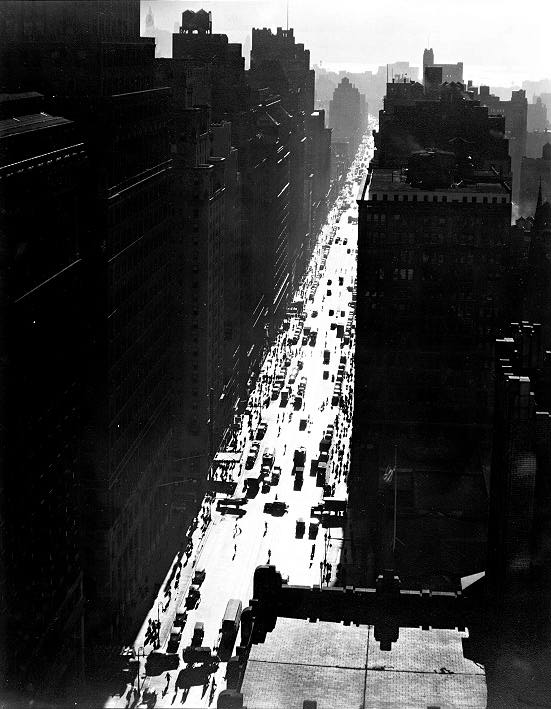
| Seventh Avenue looking south from 35th Street Dec. 5, 1935 http://www.nypl.org/research/chss/spe/art/photo/... |
metropolitan area, plus the State Library in Albany. Throughout the project, exhibitions
of the work took place in New York and elsewhere. After decades of lapse, the
founding of the National Endowment of the Arts in 1965 revived the FAP's ideals.
To see more of Berenice Abbott's photographs, go to
digitalgallery.nypl.org/nypldigital/explore/dgexplore.cfm?col_id=160 and
www.cosmopolis.ch/english/cosmo30/berenice_abbott.htm
of the work took place in New York and elsewhere. After decades of lapse, the
founding of the National Endowment of the Arts in 1965 revived the FAP's ideals.
To see more of Berenice Abbott's photographs, go to
digitalgallery.nypl.org/nypldigital/explore/dgexplore.cfm?col_id=160 and
www.cosmopolis.ch/english/cosmo30/berenice_abbott.htm
corporate executives. She found her subjects
dislikable. In 1932, she was forced to leave her
expensive studio. Despite her financial troubles, she
gained a reputation in New York too and found
support from a group of young Harvard alumni
who patronized modern art, especially
from Lincoln Kirstein and Julian Levy. In
November 1930, her photographs were shown in
an exhibition at the Harvard Society for
Contemporary Art, organized by Kristein. In 1932,
her work was shown at the Albright Art Gallery in
Buffalo and the Brooklyn Museum.
From 1934-58, she also taught photography at the
New School. During 1935-39, Abbott worked as a
"supervisor" for the Federal Art Project to create
Changing New York (her free-lance work and New
School teaching commitment made her ineligible
for unemployment relief) .
dislikable. In 1932, she was forced to leave her
expensive studio. Despite her financial troubles, she
gained a reputation in New York too and found
support from a group of young Harvard alumni
who patronized modern art, especially
from Lincoln Kirstein and Julian Levy. In
November 1930, her photographs were shown in
an exhibition at the Harvard Society for
Contemporary Art, organized by Kristein. In 1932,
her work was shown at the Albright Art Gallery in
Buffalo and the Brooklyn Museum.
From 1934-58, she also taught photography at the
New School. During 1935-39, Abbott worked as a
"supervisor" for the Federal Art Project to create
Changing New York (her free-lance work and New
School teaching commitment made her ineligible
for unemployment relief) .
Photographer Berenice Abbott proposed Changing
New York, her grand project to document New
York City, to the Federal Art Project (FAP) in
1935. The FAP was a Depression-era government
program for unemployed artists and workers in
related fields such as advertising, graphic design,
illustration, photofinishing, and publishing. A
changing staff of more than a dozen participated as
darkroom printers, field assistants, researchers and
clerks on this and other photographic efforts.
Abbott's efforts resulted in a book in 1939, in
advance of the World's Fair in Flushing Meadow
NY, with 97 illustrations and text by Abbott's
fellow WPA employee (and life companion), art
critic Elizabeth McCausland (1899-1965). At the
project's conclusion, the FAP distributed complete
sets of Abbott's final 302 images to high schools,
libraries and other public institutions in the
New York, her grand project to document New
York City, to the Federal Art Project (FAP) in
1935. The FAP was a Depression-era government
program for unemployed artists and workers in
related fields such as advertising, graphic design,
illustration, photofinishing, and publishing. A
changing staff of more than a dozen participated as
darkroom printers, field assistants, researchers and
clerks on this and other photographic efforts.
Abbott's efforts resulted in a book in 1939, in
advance of the World's Fair in Flushing Meadow
NY, with 97 illustrations and text by Abbott's
fellow WPA employee (and life companion), art
critic Elizabeth McCausland (1899-1965). At the
project's conclusion, the FAP distributed complete
sets of Abbott's final 302 images to high schools,
libraries and other public institutions in the
Bernice Abbott, born Bernice Abbott,
was an American photographer best
known for her black-and-white
photography of New York City
architecture and urban design of the
1930s.
Abbott was born in Springfield, Ohio, on
July 17, 1898 as Bernice. It was only in
Paris in the early 1920s that she adopted
the French spelling Berenice. In an
autobiographical sketch Abbott writes
about an unhappy childhood spent with
her divorced mother, separated from her
father and five siblings.
In early 1918 she left Ohio State
following her friends James Light and
Susan Jenkins to New York City where
she shared a room with them and
became part of the Greenwich Village
bohemia. She played parts in Eugene
O'Neill's plays and, according to Bonnie
Yochelson, was adopted as "the
daugher" of Hippolyte Havel, a legendary
anarchist.
In the winter of 1919, she almost died of
the influenza that took the lives of some
twelve thousand New Yorkers. Upon her
recovery, she moved out of the common
apartment. Abbott's first intention was to
study journalism at Columbia University.
Disappointed by the classes she had
attended she abandoned her plan to
become a writer and changed to
sculpture. She supported herself with
"odd jobs"
By 1920 she had befriended Dadaists
Marcel Duchamp and Man Ray. It was
the time of prohibition, illegal
speakeasies and real estate speculation.
Abbott like other aspiring artists who
had come to Greenwich Village to
escape America's increasing
commercialism felt alienated. Many left
for Europe. Berenice Abbott joined the
exodus in the spring of 1921, where she
spent two years studying sculpture in
Paris and Berlin.
Abbott's first became involved with
photography in 1923, when Man Ray,
looking for somebody who knew
nothing about photography and thus
would do as he said, hired her as a
darkroom assistant at his portrait studio
in Montparnasse.
Later she would write: "I took to
photography like a duck to water. I
never wanted to do anything else." Ray
was impressed by her darkroom work
and allowed her to use his studio to take
her own photographs. Quickly, her
reputation rivaled his. Already while
working with Man Ray,she had managed
to establish herself as one of the leading
portraitists of intellectuals and artists.
She portrayed Eugène Atget, Jean
Cocteau, Janet Flanner, André Gide,
Peggy Guggenheim and James Joyce.
was an American photographer best
known for her black-and-white
photography of New York City
architecture and urban design of the
1930s.
Abbott was born in Springfield, Ohio, on
July 17, 1898 as Bernice. It was only in
Paris in the early 1920s that she adopted
the French spelling Berenice. In an
autobiographical sketch Abbott writes
about an unhappy childhood spent with
her divorced mother, separated from her
father and five siblings.
In early 1918 she left Ohio State
following her friends James Light and
Susan Jenkins to New York City where
she shared a room with them and
became part of the Greenwich Village
bohemia. She played parts in Eugene
O'Neill's plays and, according to Bonnie
Yochelson, was adopted as "the
daugher" of Hippolyte Havel, a legendary
anarchist.
In the winter of 1919, she almost died of
the influenza that took the lives of some
twelve thousand New Yorkers. Upon her
recovery, she moved out of the common
apartment. Abbott's first intention was to
study journalism at Columbia University.
Disappointed by the classes she had
attended she abandoned her plan to
become a writer and changed to
sculpture. She supported herself with
"odd jobs"
By 1920 she had befriended Dadaists
Marcel Duchamp and Man Ray. It was
the time of prohibition, illegal
speakeasies and real estate speculation.
Abbott like other aspiring artists who
had come to Greenwich Village to
escape America's increasing
commercialism felt alienated. Many left
for Europe. Berenice Abbott joined the
exodus in the spring of 1921, where she
spent two years studying sculpture in
Paris and Berlin.
Abbott's first became involved with
photography in 1923, when Man Ray,
looking for somebody who knew
nothing about photography and thus
would do as he said, hired her as a
darkroom assistant at his portrait studio
in Montparnasse.
Later she would write: "I took to
photography like a duck to water. I
never wanted to do anything else." Ray
was impressed by her darkroom work
and allowed her to use his studio to take
her own photographs. Quickly, her
reputation rivaled his. Already while
working with Man Ray,she had managed
to establish herself as one of the leading
portraitists of intellectuals and artists.
She portrayed Eugène Atget, Jean
Cocteau, Janet Flanner, André Gide,
Peggy Guggenheim and James Joyce.
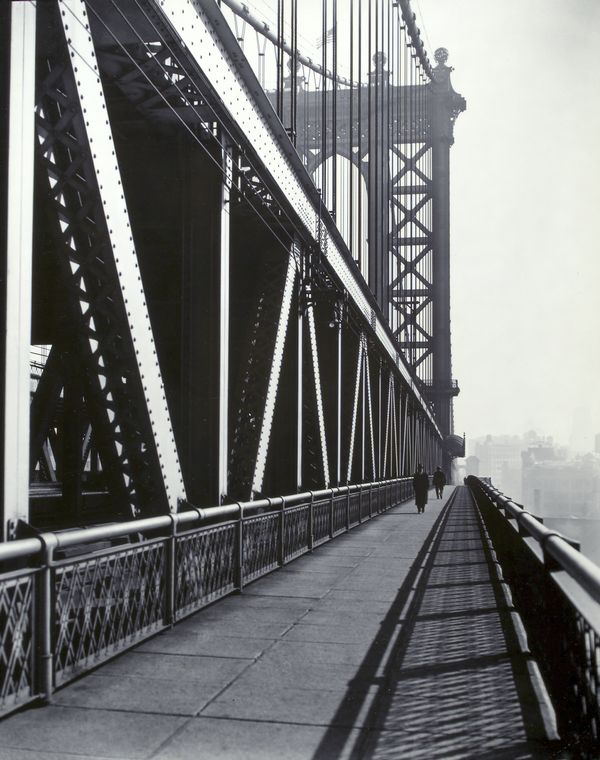
| Manhattan Bridge, Manhattan digitalgallery.nypl.org/nypldigital/dgkeysearchdetail.cfm?strucID. .... |
| ********** |
| Quiz #129 October 7, 2007 Addie Card |
| The building at 103 Bowery was built prior to 1904. Many of the city's transient labor population as well as single men on relief frequented the Bowery. The prices clearly displayed by the restaurant and barber shop are in keeping with the cost of 30 cents for a night's lodging in the hotel above them. The Blossom Restaurant occupied the ground floor, and Jimmy's Barber Shop, occupied the basement of the Boston Hotel, a flophouse at this address in the Bowery, a neighborhood famous as a refuge for the downtrodden. The restaurant, which had sawdust on the floors and eight wireback chairs to each marble-topped table, was called a "hash house" by its proprietor Morris Gordon. The hotel, at 103 and 105 Bowery, contained 249 small doorless rooms, each fit with a narrow cot and locker (with lock). The rooms, which cost 30 cents a night, were steam-heated but without light fixtures. As a child, Al Smith, governor of New York from 1919 to 1928, lived at 105 Bowery when it was a lodging house. |
old before it was torn down and recording new construction.
Many friends thought she was crazy to give up her successful portraiture business and
reputation. Shortly after her return to NYC, the stock market crashed. Americans were
reluctant to pay $50 for a portrait photograph. Her financial outlook was grim. Through
the recommendation of Bourke-White, Abbott was hired by Fortune magazine to portray
Many friends thought she was crazy to give up her successful portraiture business and
reputation. Shortly after her return to NYC, the stock market crashed. Americans were
reluctant to pay $50 for a portrait photograph. Her financial outlook was grim. Through
the recommendation of Bourke-White, Abbott was hired by Fortune magazine to portray
In 1926, she had her first solo exhibition (in the gallery "Au Sacre du Printemps") and
started her own studio on the rue du Bac. After a short time studying photography in
Berlin, she returned to Paris in 1927 and started a second studio, on the rue Servandoni.
In January 1929, Abbott visited New York City, supposedly to find a publisher for
Eugène Atget's photographs. Atget was a French photographer who Abbott admired
and part of whose collection she had bought
after his death. During the eight years of
Abbott's absence from New York, the city
had experienced its second skyscraper
building boom which had dramatically
transformed the Big Apple's skyline. She was
intrigued by the contrasts between old and
new. She had only planned a short visit to
NYC, instead, Abbott took a new artistic
direction to tackle the scope (if not the scale)
in New York City of Atget's achievement in
Paris . During 1929-38, she photographed
urban material culture and the built
environment of New York, documenting the
after his death. During the eight years of
Abbott's absence from New York, the city
had experienced its second skyscraper
building boom which had dramatically
transformed the Big Apple's skyline. She was
intrigued by the contrasts between old and
new. She had only planned a short visit to
NYC, instead, Abbott took a new artistic
direction to tackle the scope (if not the scale)
in New York City of Atget's achievement in
Paris . During 1929-38, she photographed
urban material culture and the built
environment of New York, documenting the
| 103 Bowery, Manhattan, NY 1935 http://www.richterphotogallery.com/inventory... http://www.mcny.org/collections/abbott/a026.htm |
| Congratulations to Our Winners >> Jina and Ashley, Mr. Rick's Quiz Angels! << YOU GO GIRLS! Marjorie Wilser Margaret Waterman Justin Campoli Christopher Tennant Mark Ream Bill Utterback Anna Farris Cari Thomas Deb Pritchard Eric McElroy Elaine C. Hebert Zach Chambers Andy Hoh Don Haase Dave Doucette Sheri Fenley Carl Blessing Venita & Bob Wilson Edee Scott Carol Hauter Tom Tollefsen Randy Seaver Greg Webster Alison Lillie Edee Scott Carol Hauter Tom Tollesfen Dorothy Oksner Mary Osmar Sarah Herbener Mike Dalton Beth Long Caryn Jeffrey Joshua Kreitzer Phyllis Barrattia John Chulick Jancin Stweart Mary Beth Emmerichs Pinky Palladino Lindsay Mackenzie Mark Browning Ellis Nienhaus Betty Chambers Rick Norman Corey Wisneski Dave Richardson JoAnne Craig Gary Sterne Pamela Hoffman Dennis Brann Paula Harris Mary South Debbie Sterbinski Donald Schulteis Judy Pfaff Sandy Thompson Sharon Martin Mike Swierczewski Brian Kemp Dawn Carlile Fred Stuart Gina Hudson Leigh Rigozzi Kevin Greenlee Dawn Colket Margaret Tull Linda Gloss John Newmark Corey Condit Patrick Mundt Donna Pointcouski Karen Petrus Kelly Fetherlin Jim Kiser Mark Ream Joe Ruffner Dave Town Grace Hertz Delores Martin Susan Roberts |
| ********** |
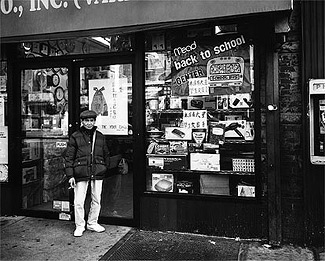
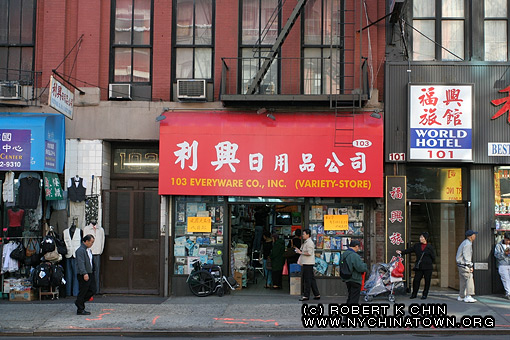
| Everyware, Co., Inc. Manhattan, 1998 103 Bowery bet Grand & Hester Sts Submitted by Mark Ream |
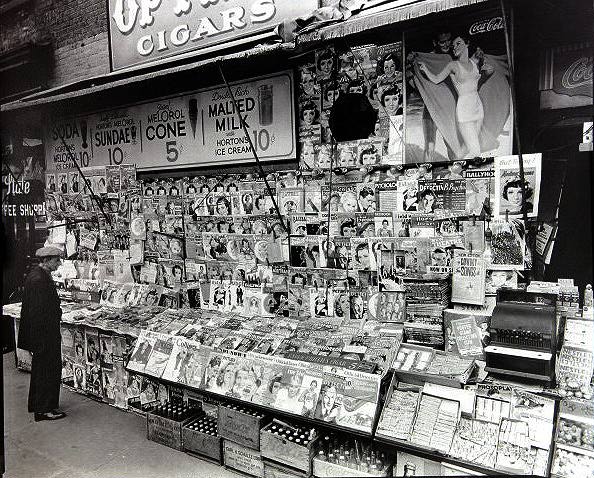
| Newstand; 32nd Street and Third Avenue. Nov. 19, 1935 http://www.nypl.org/research/chss/..... |
| Changing New York: Photographs by Berenice Abbott, 1935-1938 http://digitalgallery.nypl.org/nypldigital/explore/dgexplore.cfm?col_id=160 |
From 1939-60, Abbott photographed scientific subjects, concluding with her notable
illustrations for the MIT-originated Physical Sciences Study Committee's revolutionary
high school physics course. In 1954, she photographed along the length of US 1; the
work never found a publisher. In 1968, Abbott sold the Atget archive to the Museum of
Modern Art in New York, and moved permanently to her home in central Maine
(bought in 1956 and restored over several decades) .
1970 saw Abbott's first major retrospective exhibition, at the Museum of Modern Art.
Her first retrospective portfolio appeared in 1976, and she received the International
Center of Photography's Lifetime Achievement Award in 1989. She died at home in
Monson, Maine in December 1991.
illustrations for the MIT-originated Physical Sciences Study Committee's revolutionary
high school physics course. In 1954, she photographed along the length of US 1; the
work never found a publisher. In 1968, Abbott sold the Atget archive to the Museum of
Modern Art in New York, and moved permanently to her home in central Maine
(bought in 1956 and restored over several decades) .
1970 saw Abbott's first major retrospective exhibition, at the Museum of Modern Art.
Her first retrospective portfolio appeared in 1976, and she received the International
Center of Photography's Lifetime Achievement Award in 1989. She died at home in
Monson, Maine in December 1991.
| ********** |
| ********** |
| According to one website (http://www.ibiblio. org/fiddlers/GEO_GH.htm), the place was once a tavern owned by "Owney Geogheghan, a New York City saloon operator in the mid-1800’s. His establishment, '…at 103 Bowery…was one of the scurviest joints along that extensive and crowded avenue. It was a hangout much esteemed by unprincipled beggars, who know they could discard their superfluous glasses and crutches in that understanding environment, and it was so regularly the scene of gang brawls that Geogheghan, a thoughtful host, kept a large supply of police clubs on hand, to pass out among his steady patrons in the event of a skirmish. This disorderly tradition was maintained right up to and throughout Owney’s funeral, a ceremony enlivened by the presence of two Mrs. Geogheghans, each of whom, unaware until then of the existence of the other, sought to assume what she though was her rightful spot in the funeral procession. All the way from the Bowery to Calvary Cemetery, two hacks bearing the rival widow Geogheghans jockeyed for a position directly behind the hearse, while their tearful occupants exchanged ringing maledictions.' (E.J. Khan, Jr., The Merry Partners: The Age and Stage of Harrigan and Hart, Random House, 1955, pgs. 130-131)." ************** Also from the Brooklyn Eagle: 7 April 1885 THE REPORTER'S NOTEBOOK Incidents of Minor Importance in Brooklyn and Vicinity. ... CLARA ERNST RETURNS HOME Found in a Bowery Dive by Her Father and Detective Ennis: Clara ERNST, the 17 year old girl who disappeared from her home in Walton street, Eastern District, on the 1st of April, was found last night and returned to her home. A young man, who did not give his name, went to Mr. ERNST's house on Wednesday night and said that he believed his daughter was in a dive at 103 Bowery, New York, where she was employed as a waitress. He had read a description of the missing girl in the papers and was positive that it was she. Detective ENNIS went over on Sunday night, but failed to find her. He went again last night in company with her father and, after waiting an hour or so, they saw Clara entering the place with some companions. When confronted with her father she expressed penitence and consented to return home. She says that the reason she left her father's house was that he was only earning $7 a week, and that this was not enough to support them both. She concluded to go out and seek work and made the acquaintance of an elderly woman who induced her to go to the saloon on the Bowery." Interesting glimpses in to the history of what would otherwise seem an ordinary place today. Mark Ream |
| The Jim Rose Murder, 1878 103 Bowery, New York, NY Submitted by Mark Ream The Bowery Shooting Affray The New York Times January 15, 1878 Click here. Owen Geoghegan Discharged The New York Times January 22, 1878 Click here. |
| ********** |
| 1998 Submitted by Mark Ream |
| 2002-2006 Photo by RK Chin www.nychinatown.org Submitted by Mark Ream |
| Interesting Stories about 103 Bowery Submitted by Mark Ream |
