entirely from the YMCA. It was a somewhat grudging accommodation by the Brass.
The YMCA in Canada seized on this opportunity to extend its mission. Soon YMCA
Captains were steadily being posted to Canadian army units at home, at training bases in
England and at the front.
Merton Plunkett, 25, resigned his position as Social Director at the Toronto Central
YMCA and gave up his studies at a music school in Toronto in mid-1915 and
volunteered for YMCA war service. "Mert" had grown up in Orillia, a town of 4000
people about 70 miles north of Toronto, and from the age of 13 been a volunteer with
the Social Committee there. By the age of 20 he was director of the 50 member male
chorus, trombone player in the Y orchestra, ran "Goodnight Singing Services" every
night at 9:30, led and was tenor in the Y's "Maple Leaf Quartette" and, with his four
younger brothers, was a sought after garden party entertainer as the "Plunkett Quintet".
His efforts had forced the YMCA to renovate a large meeting room into a permanent
music room to accommodate his programs. When he left for Toronto to develop his
talent late in 1913 an unprecedented send-off was organized for him by the YMCA.
In 1916 the YMCA posted him to the large Canadian army training base in Bramshot
England where the 35th Battalion, made up of boys from Orillia, was training, preparing
The YMCA in Canada seized on this opportunity to extend its mission. Soon YMCA
Captains were steadily being posted to Canadian army units at home, at training bases in
England and at the front.
Merton Plunkett, 25, resigned his position as Social Director at the Toronto Central
YMCA and gave up his studies at a music school in Toronto in mid-1915 and
volunteered for YMCA war service. "Mert" had grown up in Orillia, a town of 4000
people about 70 miles north of Toronto, and from the age of 13 been a volunteer with
the Social Committee there. By the age of 20 he was director of the 50 member male
chorus, trombone player in the Y orchestra, ran "Goodnight Singing Services" every
night at 9:30, led and was tenor in the Y's "Maple Leaf Quartette" and, with his four
younger brothers, was a sought after garden party entertainer as the "Plunkett Quintet".
His efforts had forced the YMCA to renovate a large meeting room into a permanent
music room to accommodate his programs. When he left for Toronto to develop his
talent late in 1913 an unprecedented send-off was organized for him by the YMCA.
In 1916 the YMCA posted him to the large Canadian army training base in Bramshot
England where the 35th Battalion, made up of boys from Orillia, was training, preparing
Prior to World War I the military took little responsibility for the recreation of the
troops when they were not on active duty or training. Trouble in the training camps
developed when the mass of bored men sitting in their tents found alcohol. As its
contribution to the war effort the YMCA took on the responsibility of providing
recreational activities (sports, education classes, etc), writing rooms, dry canteens,
spiritual support and counseling, and many other services to the troops starting on a
small scale in the US Civil War, Crimean War and Boer War. It was in the Great War
of 1914-18 where the YMCA became a significant player in the military machine.
troops when they were not on active duty or training. Trouble in the training camps
developed when the mass of bored men sitting in their tents found alcohol. As its
contribution to the war effort the YMCA took on the responsibility of providing
recreational activities (sports, education classes, etc), writing rooms, dry canteens,
spiritual support and counseling, and many other services to the troops starting on a
small scale in the US Civil War, Crimean War and Boer War. It was in the Great War
of 1914-18 where the YMCA became a significant player in the military machine.
One of several Canadian Army concert parties
in France during WWI, the original Dumbells
were drawn from the 3rd Division by Merton
W. Plunkett at Ferfay, France, in 1917 and
included Jack Ayre (pianist and musical
director), Elmer A. Belding, Ted Charters, and
Allan Murray. Taking their name from the 3rd
Division's insignia, a red dumbell, the group
entertained front-line soldiers with popular
songs and collectively conceived skits about
army life.
Plunkett began by putting on amateur,
impromptu camp shows at Canadian Army
encampments in France on behalf of the
YMCA, and then proposed to his commander
that certain talented men be seconded from
their various units to form an entertainment
unit, the purpose of which would be to boost
in France during WWI, the original Dumbells
were drawn from the 3rd Division by Merton
W. Plunkett at Ferfay, France, in 1917 and
included Jack Ayre (pianist and musical
director), Elmer A. Belding, Ted Charters, and
Allan Murray. Taking their name from the 3rd
Division's insignia, a red dumbell, the group
entertained front-line soldiers with popular
songs and collectively conceived skits about
army life.
Plunkett began by putting on amateur,
impromptu camp shows at Canadian Army
encampments in France on behalf of the
YMCA, and then proposed to his commander
that certain talented men be seconded from
their various units to form an entertainment
unit, the purpose of which would be to boost
I started my whole YMCA history project when I found
a trunk of memorabilia in the Y basement that had been
submerged in a flood and left there for 10 years, never
opened, until I found it. It was a cloud of black mould,
ugh! After 3 years I cleaned every piece by hand,
catalogued it all and created an archive. Then I scoured
the community for new artifacts, read every newspaper
on microfiche from 1899 to 1955 and began
interviewing locals who had stories to tell (that was
fun!). I've put up a series of displays in the Y foyer of
our Y's history and am now writing a book. Mert
Plunkett gets three of the 52 chapters.
a trunk of memorabilia in the Y basement that had been
submerged in a flood and left there for 10 years, never
opened, until I found it. It was a cloud of black mould,
ugh! After 3 years I cleaned every piece by hand,
catalogued it all and created an archive. Then I scoured
the community for new artifacts, read every newspaper
on microfiche from 1899 to 1955 and began
interviewing locals who had stories to tell (that was
fun!). I've put up a series of displays in the Y foyer of
our Y's history and am now writing a book. Mert
Plunkett gets three of the 52 chapters.

 |  |  |  |
| If you enjoy our quizzes, don't forget to order our books! Click here. |
| If you have a picture you'd like us to feature a picture in a future quiz, please email it to us at CFitzp@aol.com. If we use it, you will receive a free analysis of your picture. You will also receive a free Forensic Genealogy CD or a 10% discount towards the purchase of the Forensic Genealogy book. |

| Qui #134 Results |


 |  |  |  |
| ********** |
| First Some Background on This Week's Quiz Photo from David Town |
| ********** |
| Answer to Quiz #134 - November 11, 2007 |
| ********** |
the morale of the fighting men. Major-General L.J. Lipsett, commander of the Canadian
Army's Third Division, understood that an army's morale is as important as its
equipment and rations, and quickly gave permission. His instructions to Plunkett were
simple: "Be ready to put on a show any place, any time." (The Legionary, January
1965).
Ironically, the soldier audience did not look forward to the first show, and at first
actually threw things at the stage. But female impersonator Ross Hamilton ("Marjorie")
Army's Third Division, understood that an army's morale is as important as its
equipment and rations, and quickly gave permission. His instructions to Plunkett were
simple: "Be ready to put on a show any place, any time." (The Legionary, January
1965).
Ironically, the soldier audience did not look forward to the first show, and at first
actually threw things at the stage. But female impersonator Ross Hamilton ("Marjorie")
| Meet the Dumbells |
| When I first looked at these pictures I had no idea. I then noticed the uniform was Canadian and the top picture identified Coliseum, London. First I looked up "coliseum, london" which didn't give me much help other than to provide some tidbits about the building (over time); existed during WW I. I then looked up "coliseum london canadian troupe" and in the list of possible sites, found several entries for Dumbells. In readng one decided this has to be it ("drag"). Looked at the military picture again and noticed the person in question had an ensignia on his lower right arm. Could have looked up what it signified but I didn't. The article identified Merton (Wesley) Plunkett organized the Dumbells, first 10 men later 16 men, and he was given an honorary rank of Captain. Don Schulteis |
| The Dumbells http://www.thecanadianencyclopedia.com/index.cfm?PgNm=TCE&Params=A1ARTA0002440 http://www.collectionscanada.gc.ca/gramophone/m2-1007.1-e.html |
| How Don Solved the Puzzle |
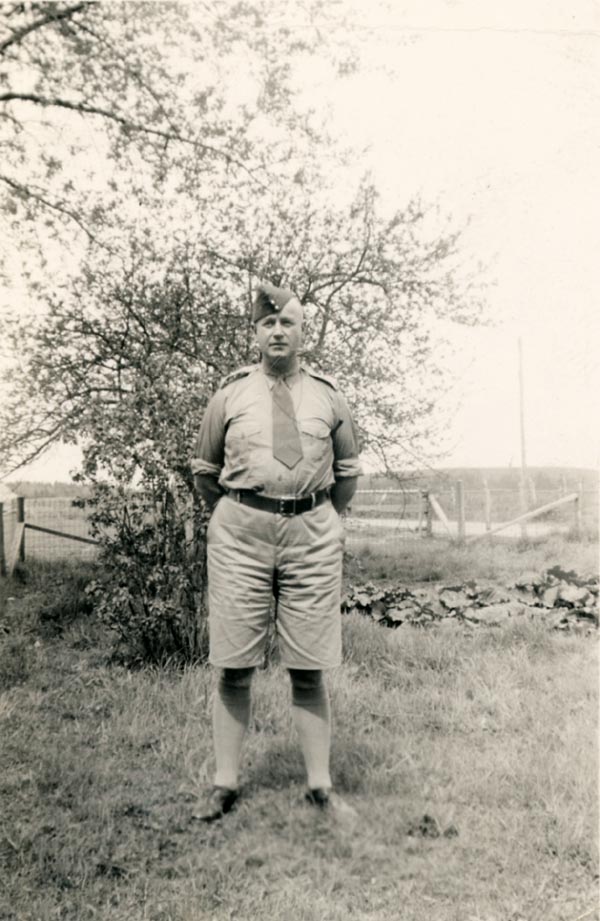
| Mert Plunkett Notice Canadian maple leaf on his cap. |
The "Orillia Day" gathering photo I dug out of the scrapbooks kept by a prominent
Orillian of that era stored at the county archives. I had a very fun day going through
their collections and learning about creating an archive. They also told me how to
salvage all the artifacts in the trunk. It took all of 2 years to putter away at cleaning
(taking over the basement in my mother's house). Every day it was like discovering a
new treasure, I couldn't tell what any item was before I started cleaning. Nothing was
newer than 1935. Dave Town
Orillian of that era stored at the county archives. I had a very fun day going through
their collections and learning about creating an archive. They also told me how to
salvage all the artifacts in the trunk. It took all of 2 years to putter away at cleaning
(taking over the basement in my mother's house). Every day it was like discovering a
new treasure, I couldn't tell what any item was before I started cleaning. Nothing was
newer than 1935. Dave Town
| (WWI: 1914-1918) 'The Dumbells' Concert Party. Formed from 3rd Canadian Division in France. The entire company in their closing number of the show. MIKAN No.: 3194831 Library and Archives Canada http://mikan3.archives.ca/pam/public_mikan/index... |
I liked the clue "...he remains an Englishman". It helped me find the answer to this
quiz. I really liked this week's quiz Colleen. I have learned more than I though I have in
the past year from looking at old photos and coming up with a list of clues to track
down and tell the story. Thank you for my continuing education and great fun. I truly
look forward to the next weekly quiz! Hugs. Sheri Fenley
Well, you are getting difficult quizes again! I did not actually find the pictures you
displayed, but if the Dumbells are not that troop, they are another just like it.
Maureen O'Connor
Whew! You didn't let us have three easy weeks in a row did you? Great! This one took
me a while. Pamela Hoffman
Super fun quiz. The fact that he claimed to be an Englishman although not from Great
Britain came from the Song of the same name performed in the musical comedy "HMS
Pinafore". Jim Kiser
I am dancing a jig and singing a dity -- what a fun quiz on a gloomy day in Michigan. What a
fun set of photos for the quiz. Judy Pfaff
Wow, this was pretty tough for me. I'm not at all familiar with army fatigues, so I had
to have my husband help me with this one. Jen Paolilli
This was a really interesting one. Love the Veteran's Day connection.
Rhonda Taylor
I never knew they had such units in WWI. Mary South
For me, that particular puzzle was not too difficult to track down, because of the
uniforms. They were certainly Canadian, and they had to be an acting troupe, given the
costume photo, so I went from there. Bill Utterback
From burton to merton.. I originally thought wwII and was led to Welsh born actor
Richard Burton who served in RAF during WWII. A second look: key in words "he
remains an englishman" = from play HMS Pinafore circa 1878 by Gilbert and Sullivan.
A second look at uniforms: more likely from WWI era. So I then keyed in "HMS
Pinafore" "World War I" Coliseum and came up with the answer. Mike Dalton
You had my wife and I barking up the wrong tree with this one! The "man" looked so
familiar that we were sure he was someone very famous. In the midst of our mistake,
we accidentally came upon the Dumbells. Mike Swierczewski
I was stumped by this one although I spent quite a bit of time learning about the
Coliseum in London and Gilbert & Sullivan's HMS Pinafore (from whence the phrase
"he remains an Englishman" is found). I also checked out the Royal Fusiliers and the
Lafayette Escadrilles, both groups that served in WWI. It's been an interesting journey
and now I'll be waiting to see the actual answer. Venita Wilson
What fun! I bet I'll end up learning some new information about the Dumbbells as this
goes on. I decided to see how I would have solved this puzzle and it took me about 25
minutes googoling combinations of "army canada entertainment show coliseum" etc
until I hit the Dumbells site that answered all the questions neatly.
Dave Town
(Submitter of this week's quiz photo)
quiz. I really liked this week's quiz Colleen. I have learned more than I though I have in
the past year from looking at old photos and coming up with a list of clues to track
down and tell the story. Thank you for my continuing education and great fun. I truly
look forward to the next weekly quiz! Hugs. Sheri Fenley
Well, you are getting difficult quizes again! I did not actually find the pictures you
displayed, but if the Dumbells are not that troop, they are another just like it.
Maureen O'Connor
Whew! You didn't let us have three easy weeks in a row did you? Great! This one took
me a while. Pamela Hoffman
Super fun quiz. The fact that he claimed to be an Englishman although not from Great
Britain came from the Song of the same name performed in the musical comedy "HMS
Pinafore". Jim Kiser
I am dancing a jig and singing a dity -- what a fun quiz on a gloomy day in Michigan. What a
fun set of photos for the quiz. Judy Pfaff
Wow, this was pretty tough for me. I'm not at all familiar with army fatigues, so I had
to have my husband help me with this one. Jen Paolilli
This was a really interesting one. Love the Veteran's Day connection.
Rhonda Taylor
I never knew they had such units in WWI. Mary South
For me, that particular puzzle was not too difficult to track down, because of the
uniforms. They were certainly Canadian, and they had to be an acting troupe, given the
costume photo, so I went from there. Bill Utterback
From burton to merton.. I originally thought wwII and was led to Welsh born actor
Richard Burton who served in RAF during WWII. A second look: key in words "he
remains an englishman" = from play HMS Pinafore circa 1878 by Gilbert and Sullivan.
A second look at uniforms: more likely from WWI era. So I then keyed in "HMS
Pinafore" "World War I" Coliseum and came up with the answer. Mike Dalton
You had my wife and I barking up the wrong tree with this one! The "man" looked so
familiar that we were sure he was someone very famous. In the midst of our mistake,
we accidentally came upon the Dumbells. Mike Swierczewski
I was stumped by this one although I spent quite a bit of time learning about the
Coliseum in London and Gilbert & Sullivan's HMS Pinafore (from whence the phrase
"he remains an Englishman" is found). I also checked out the Royal Fusiliers and the
Lafayette Escadrilles, both groups that served in WWI. It's been an interesting journey
and now I'll be waiting to see the actual answer. Venita Wilson
What fun! I bet I'll end up learning some new information about the Dumbbells as this
goes on. I decided to see how I would have solved this puzzle and it took me about 25
minutes googoling combinations of "army canada entertainment show coliseum" etc
until I hit the Dumbells site that answered all the questions neatly.
Dave Town
(Submitter of this week's quiz photo)
| Comments from Our Readers |
are remembered for their unique army version of Gilbert and Sullivan's H.M.S. Pinafore.
The Dumbells continued to play shows as Canadian troops were reorganized and
returned to England and Canada. The Army, recognizing the calibre of the Dumbells'
individual and collective talents, offered them the opportunity to tour Canada for the
Red Cross. Again, the men declined an attractive offer; they had already decided to tour
in Canada as professional entertainers, not as soldiers. Finally, in 1919, Al Plunkett,
The Dumbells continued to play shows as Canadian troops were reorganized and
returned to England and Canada. The Army, recognizing the calibre of the Dumbells'
individual and collective talents, offered them the opportunity to tour Canada for the
Red Cross. Again, the men declined an attractive offer; they had already decided to tour
in Canada as professional entertainers, not as soldiers. Finally, in 1919, Al Plunkett,
| Congratulations to Our Winners! Maureen O'Connor Dave Richardson Mike Swierczewski Tim Brixius Karen Kay Bunting Rhonda Taylor Suzan Farris Brian Kemp Barbara Battles Kitty Huddleston Pamela Hoffman Jen Paolili Donald Schulteis Tom Tollefsen JoAnn Craig Judy Pfaff Mary South Stan Read Fred Stuart Sheri Fenley Bill Utterback Jim Kiser Gary Sterne Mike Dalton Kelly Fetherlin Karen Petrus Tim Brixius Dave Richardson Mike Swierczewski Sue Roberts |
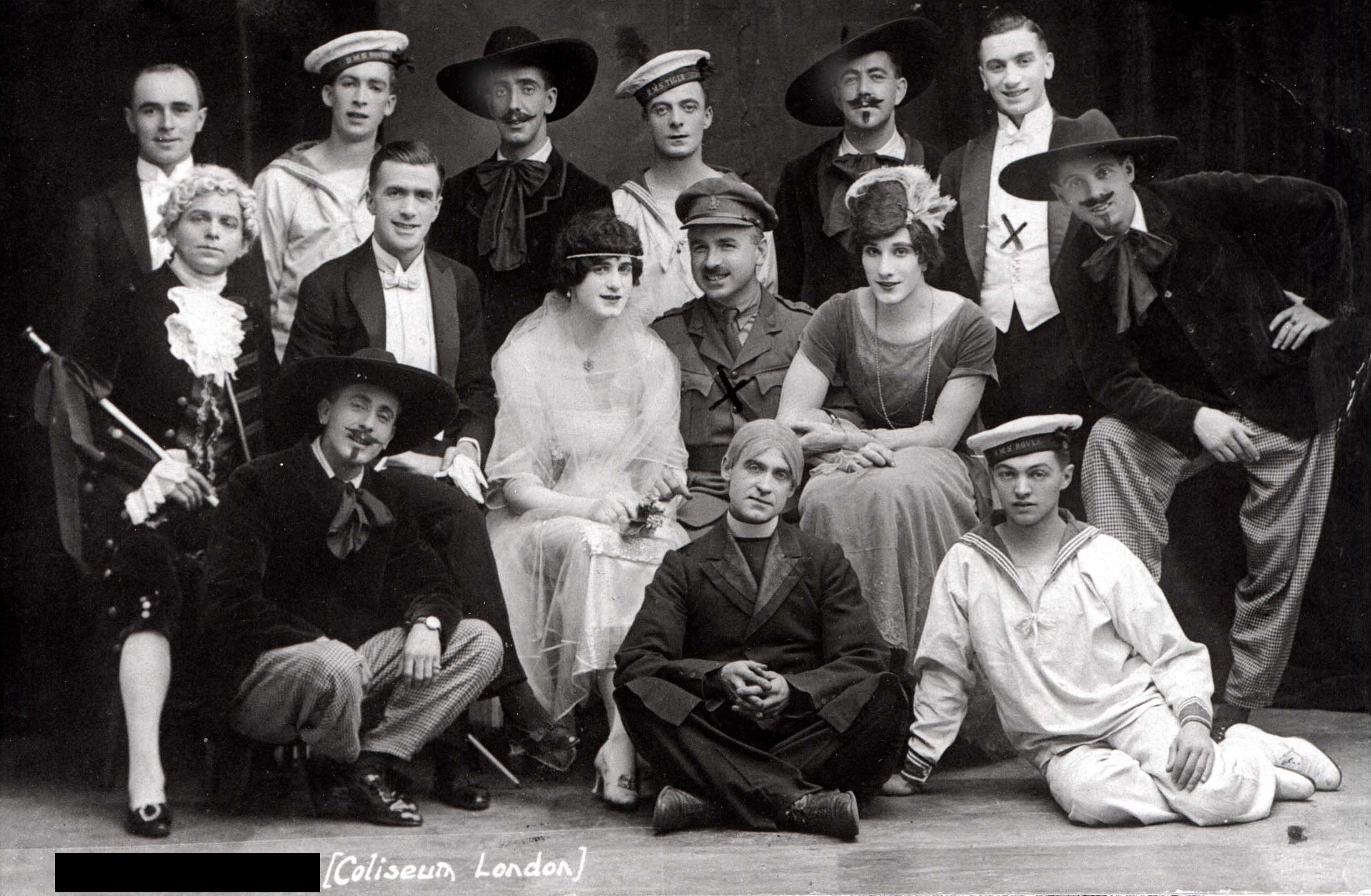
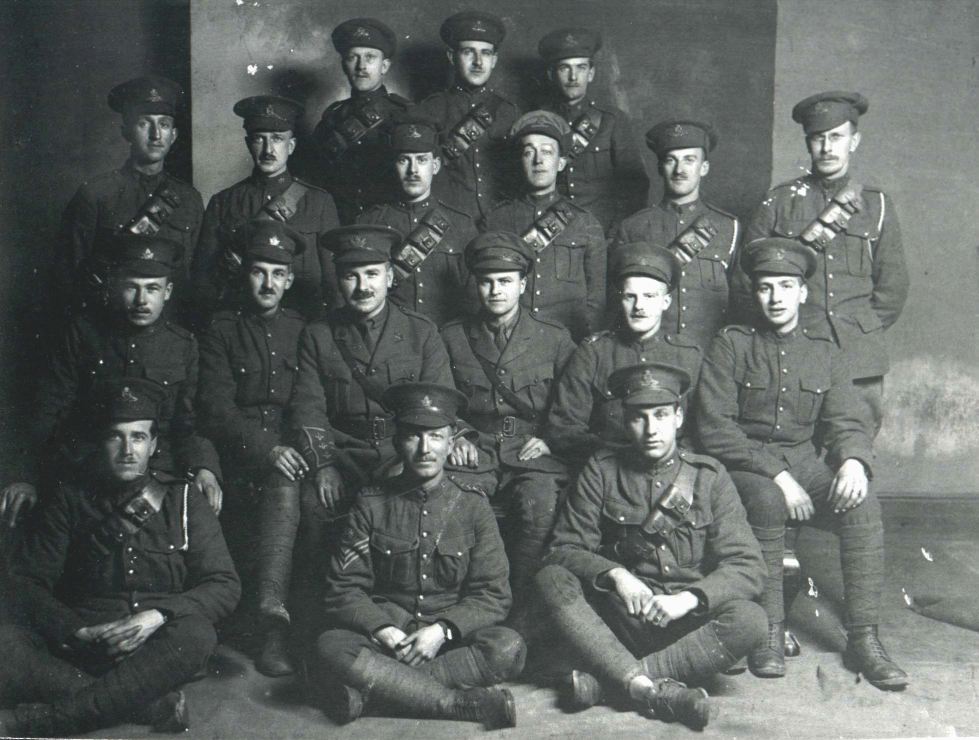
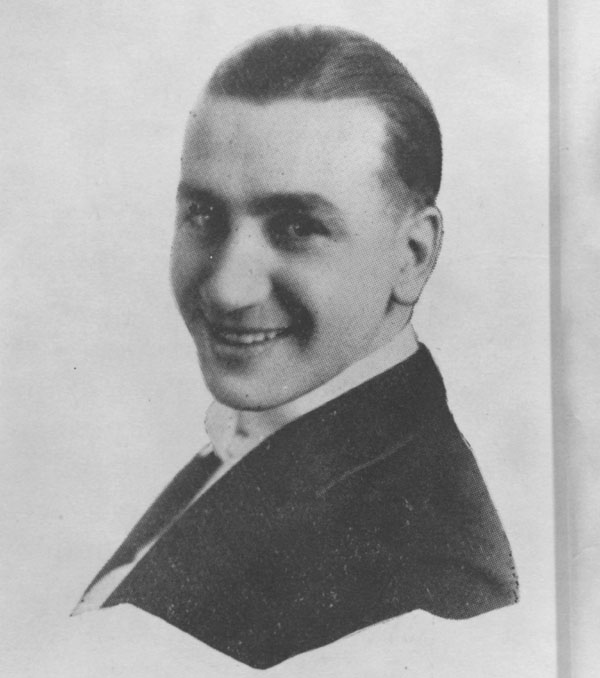
The man seated between the two "women" in the top picture is the same as the
man third from the left, second row in the bottom picture. At times, he said that
he remains an Englishman even though he was not in fact from Great Britain.
man third from the left, second row in the bottom picture. At times, he said that
he remains an Englishman even though he was not in fact from Great Britain.
| Many thanks to Dave Town for submitting this week's photo and to Greg Webster for helping to prepare the quiz. |
| 1. What country is the group from? 2. Why are they in drag in the top photo? 3. What was the nickname of the group? Bonus: What is the man's name? |
| Answers: 1. Canada 2. They are dressed to perform Gilbert & Sulivan's H.M.S. Pinafore. 3. The Dumbells Bonus: Mert Plunkett |
| ********** |
Jack Ayre, Ross Hamilton and
Bill Tennent boarded ship for
home, and gave one last show
during the crossing before their
days as an army concert party
ended. Mert Plunkett followed in
June, and immediately began
setting up the Dumbells' next act,
the national tour which was to
bring them even greater success.
In June 1919, Plunkett returned
to Canada, borrowed $18 000,
and created a civilian version of
the Dumbells which included
Merton Plunkett (the impresario),
Jack Ayre (musical director) and
Allan Murray from the 3rd
Division, and others from the
London tour and the H.M.S.
Pinafore production: Hamilton,
Bert Langley, W.L. Tennent,
Allan, Newman, MacLean, Fred
Fenwick, and Al Plunkett.
Immensely popular, the Dumbells
toured Canada, the U.S., and
England with Biff, Bing, Bang
(1919, revised 1921), which
played twelve weeks at the
Ambassador in New York and
was the first "all-Canadian" show
Bill Tennent boarded ship for
home, and gave one last show
during the crossing before their
days as an army concert party
ended. Mert Plunkett followed in
June, and immediately began
setting up the Dumbells' next act,
the national tour which was to
bring them even greater success.
In June 1919, Plunkett returned
to Canada, borrowed $18 000,
and created a civilian version of
the Dumbells which included
Merton Plunkett (the impresario),
Jack Ayre (musical director) and
Allan Murray from the 3rd
Division, and others from the
London tour and the H.M.S.
Pinafore production: Hamilton,
Bert Langley, W.L. Tennent,
Allan, Newman, MacLean, Fred
Fenwick, and Al Plunkett.
Immensely popular, the Dumbells
toured Canada, the U.S., and
England with Biff, Bing, Bang
(1919, revised 1921), which
played twelve weeks at the
Ambassador in New York and
was the first "all-Canadian" show

| Josephine: He, humble, poor, and lowly born, he meanest in the port division The butt of epauletted scorn The mark of quarter-deck derision Has dared to raise his wormy eyes Above the dust to which you'd mould him, In manhood's glorious pride to rise, He is an Englishman, behold him! Ralph: I, humble, poor, and lowly born, The meanest in the port division The butt of epauletted scorn The mark of quarter-deck derision Have dared to raise my wormy eyes Above the dust to which you'd mould me, In manhood's glorious pride to rise, I am an Englishman, behold me! All: He is an Englishman! Boatswain: He is an Englishman! For he himself has said it, And it's greatly to his credit, That he is an Englishman! All: That he is an Englishman! Boatswain: For he might have been a Roosian, A French, or Turk, or Proosian, Or perhaps Itali-an! All: Or perhaps Itali-an! Boatswain: But in spite of all temptations To belong to other nations, He remains an Englishman! He remains an Englishman! All: For in spite of all temptations To belong to other nations, He remains an Englishman! He remains an Englishman! http://math.boisestate.edu/GaS/pinafore/web_oper a/pin18.html |
This is a photo taken in France in 1916 of YMCA Captain Mert
Plunkett with the soldiers from Orillia gathered for a weekly "Orillia
Day" banquet get-together. Plunkett can be seen sitting at the centre
of the front row beside the French officer, grinning
broadly. Photo and description
courtesy of Dave Town
Plunkett with the soldiers from Orillia gathered for a weekly "Orillia
Day" banquet get-together. Plunkett can be seen sitting at the centre
of the front row beside the French officer, grinning
broadly. Photo and description
courtesy of Dave Town
| The Lyrics |
| N.B. A Concert Party is the collective name for a group of travelling entertainers in Great Britain, usually in music hall. The Princess Pats, the Dumbells, and 30 other such troupes in France proved to be a potent factor in maintaining troop morale. Immensely popular before the Second World War, concert parties were also formed by several countries armed forces during the war itself. Other forms of entertainment (particularly television) and the decline of variety in general meant that the concept largely died out from the 1950s onwards. en.wikipedia.org/wiki/Concert_Party_(entertainment) and www.collectionscanada.gc.ca/gramophone/m2-1007.1-e.html |

| Dumbells Maple Leaf Concert Party in France, September, 1917 (courtesy National Archives of Canada/PA-002039). |

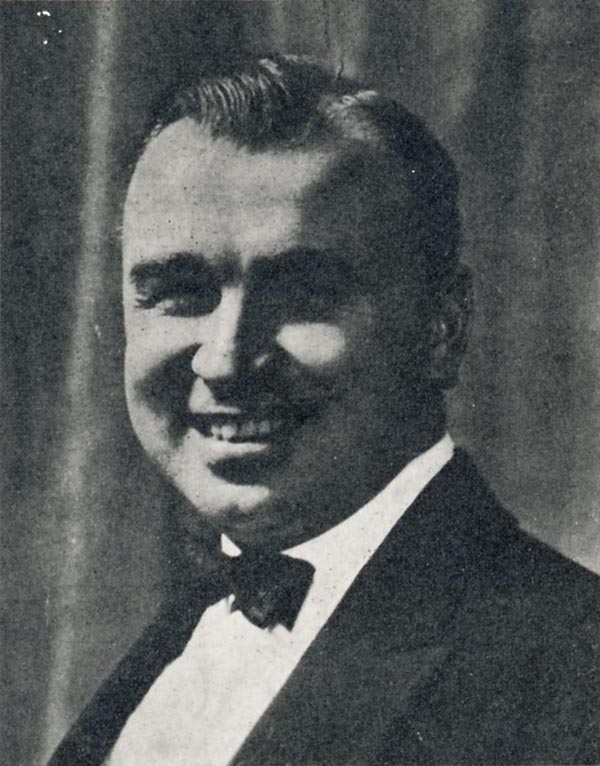
| Capt. Mert Plunkett 1888-1966 http://www.collectionscanada.ca/gramophone/m2-1025-e.html |
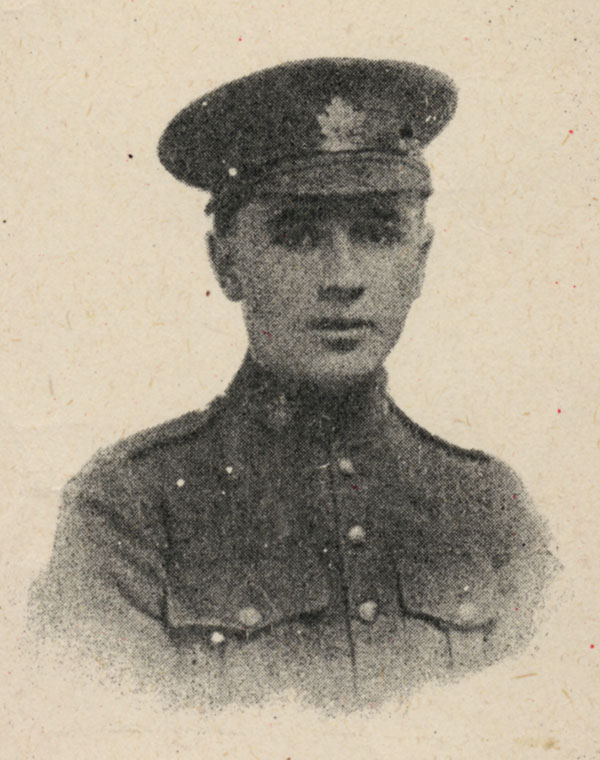
| Ivor (Jack) Ayre abt. 1894-1977 http://www.collectionscanada.ca/gramophone/m2-1002-e.html |
| Albert Plunkett 1898-1957 http://www.collectionscanada.ca/gramophone/m2-1024-e.html |
| Albert (Red) Newman 1887-1952 http://www.collectionscanada.ca/gramophone/m2-1019-e.html |
| Ross Hamilton 1889-1965 http://www.collectionscanada.ca/gramophone/m2-1011-e.html |

| ********** |

gave them their first
glimpse of a lady -- even
though not a real one -- in
months, singing "Hello My
Dearie" in a falsetto
soprano voice, and quickly
won them over. Al
Plunkett, costumed in top
hat and silk tailcoat, was
also successful with his
rendition of the popular
American song "Those
Wild Wild Women Are
Making a Wild Man of
Me."
The Dumbells performed
glimpse of a lady -- even
though not a real one -- in
months, singing "Hello My
Dearie" in a falsetto
soprano voice, and quickly
won them over. Al
Plunkett, costumed in top
hat and silk tailcoat, was
also successful with his
rendition of the popular
American song "Those
Wild Wild Women Are
Making a Wild Man of
Me."
The Dumbells performed
wherever the troops were. This meant they were constantly on the move across
France, wherever Canadian forces were fighting, including the front lines and trenches.
Among the properties and equipment they transported with them was their battered
upright piano. Several strong soldiers would be assigned to tote the piano to the stage.
The troupe members did everything from building a temporary stage, to unpacking and
hanging the curtains (the Princess Pat's Comedy Company used curtains of burlap),
making costumes, and installing makeshift footlights.
At first the Dumbells improvised for sets, props, and costumes. Early shows were lit
France, wherever Canadian forces were fighting, including the front lines and trenches.
Among the properties and equipment they transported with them was their battered
upright piano. Several strong soldiers would be assigned to tote the piano to the stage.
The troupe members did everything from building a temporary stage, to unpacking and
hanging the curtains (the Princess Pat's Comedy Company used curtains of burlap),
making costumes, and installing makeshift footlights.
At first the Dumbells improvised for sets, props, and costumes. Early shows were lit
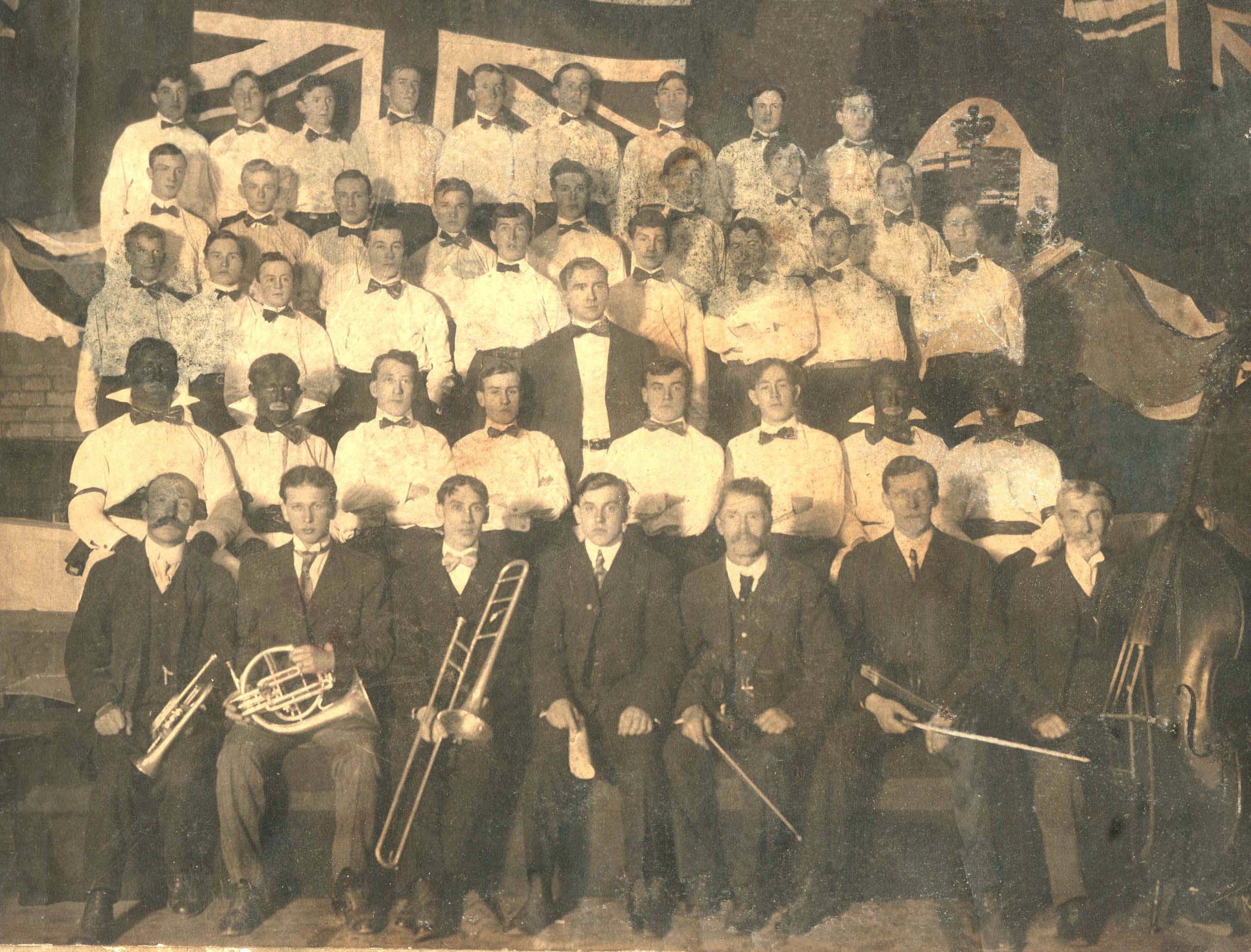
| Orillia YMCA Male Chorus c.1905. Standing 4th row, 4th from the left is Mert Plunkett, age 16. This photo is barely holding together and mouldy. My wife, Leslie, did a lot of photoshopping to fill in the areas around the edges that lost the emulsion and to remove some of the mould stains. Luckily Mert's head did not need any work. I thought it was an interesting photo until I realized that was Plunkett in there, now its a treasure! |
| ********** |

| A Dumbell's skit "Marjorie and the Boys" http://data2.collectionscanada.ca/ap/a/a005737.jpg |

by footlights made of candles in biscuit tins. Later,
they had electric spotlights made from machine-gun
parts. They made their wigs of horsehair and rope;
beards were of cowhide. As their khaki vaudeville act
became a permanent touring fixture, they
endeavoured to improve their presentation. They
wrote to British actresses to request old costumes for
"Marjorie" and the other female characters, and got
them. The Dumbells were constantly searching for
new material for their shows. Members who went to
London on leave brought back the newest music and
ideas from London stage shows such as Chu Chin
Chow, and added them to the Dumbells' routines.
At first, Captain Plunkett handled other concert
parties too, including the Y Emmas and the Maple
they had electric spotlights made from machine-gun
parts. They made their wigs of horsehair and rope;
beards were of cowhide. As their khaki vaudeville act
became a permanent touring fixture, they
endeavoured to improve their presentation. They
wrote to British actresses to request old costumes for
"Marjorie" and the other female characters, and got
them. The Dumbells were constantly searching for
new material for their shows. Members who went to
London on leave brought back the newest music and
ideas from London stage shows such as Chu Chin
Chow, and added them to the Dumbells' routines.
At first, Captain Plunkett handled other concert
parties too, including the Y Emmas and the Maple
| Capt. Mert and the "girls" http://data2.collectionscanada.ca/ap/a/a005735.jpg |
Leafs, and was often unable to tour with the Dumbells. Sergeant Ted Charter took over
as leader during his absence.
After these early shows, the members of the Dumbells were scheduled to return to their
units, but on a recommendation from Lieutenant-Colonel Hamilton Gault, General
Lipsett indicated he would be pleased if the men could be attached indefinitely to the
as leader during his absence.
After these early shows, the members of the Dumbells were scheduled to return to their
units, but on a recommendation from Lieutenant-Colonel Hamilton Gault, General
Lipsett indicated he would be pleased if the men could be attached indefinitely to the

vital work of building the troops' morale. The
members of the Dumbells did not return to the front
lines except as entertainers, but did on occasion carry
stretchers to help the wounded. Members of other
concert parties were not always so lucky. Members
of the Princess Pat's Comedy Company, for example,
were called back to the lines in June 1917 and several
were seriously wounded, including Leonard Young,
who lost a leg but returned to work with the
Dumbells after convalescing.
In the summer of 1918, after recruiting Ben Allan
from the 16th Battalion's Party, "Red" Newman and
Charlie MacLean from the Y-Emmas, and Ross
"Marjorie" Hamilton from the Maple Leaf Concert
Party, Plunkett brought the Dumbells to London
where they performed at the YMCA's Beaver Hut, the
members of the Dumbells did not return to the front
lines except as entertainers, but did on occasion carry
stretchers to help the wounded. Members of other
concert parties were not always so lucky. Members
of the Princess Pat's Comedy Company, for example,
were called back to the lines in June 1917 and several
were seriously wounded, including Leonard Young,
who lost a leg but returned to work with the
Dumbells after convalescing.
In the summer of 1918, after recruiting Ben Allan
from the 16th Battalion's Party, "Red" Newman and
Charlie MacLean from the Y-Emmas, and Ross
"Marjorie" Hamilton from the Maple Leaf Concert
Party, Plunkett brought the Dumbells to London
where they performed at the YMCA's Beaver Hut, the
| Ross Hamilton as "Marjorie" http://data2.collectionscanada.ca/ap/a/a005735.jpg |

| Private Allan Murray as Marie http://data2.collectionscanada.ca/ap/a/a005743.jpg |
Victoria Palace, and the London Coliseum before returning to France.
The Dumbells' run in London was so successful -- they were more popular than the
famed Russian Ballet under Sergei Diaghilev -- that theatre companies offered several of
the soldier-singers contracts; but, to a man, they preferred to stay with their unit. The
complete group therefore returned to the front, this time the Hindenburg Line, where
Canadian troops were fighting. The considerable profits they had made in London
The Dumbells' run in London was so successful -- they were more popular than the
famed Russian Ballet under Sergei Diaghilev -- that theatre companies offered several of
the soldier-singers contracts; but, to a man, they preferred to stay with their unit. The
complete group therefore returned to the front, this time the Hindenburg Line, where
Canadian troops were fighting. The considerable profits they had made in London
financed their shows during the remaining months of
the war.
At Armistice, November 11, 1918, the Dumbells
underwent a further amalgamation when they were
merged with the Princess Pat's Comedy Company
into one large company to provide entertainment
during the lengthy demobilization. It was at that time
that Jack MacLaren and Fred Fenwick joined the
Dumbells. Captain Plunkett set the enlarged group to
rehearsing a new project, his humorous adaptation of
Gilbert and Sullivan's HMS Pinafore. They presented
the musical at Mons, Belgium, that same month, and
also in Brussels for King Albert of Belgium, who
presented Captain Plunkett with a medal in recognition
of the troupe's charity performances. The Dumbells
became the elite Canadian concert party in Europe and
the war.
At Armistice, November 11, 1918, the Dumbells
underwent a further amalgamation when they were
merged with the Princess Pat's Comedy Company
into one large company to provide entertainment
during the lengthy demobilization. It was at that time
that Jack MacLaren and Fred Fenwick joined the
Dumbells. Captain Plunkett set the enlarged group to
rehearsing a new project, his humorous adaptation of
Gilbert and Sullivan's HMS Pinafore. They presented
the musical at Mons, Belgium, that same month, and
also in Brussels for King Albert of Belgium, who
presented Captain Plunkett with a medal in recognition
of the troupe's charity performances. The Dumbells
became the elite Canadian concert party in Europe and
on Broadway, The Dumbells Revue of 1922; Carry On (1922); Cheerio (1923); Oh,
Yes and Aces High (1924); Lucky 7 (1925); Three Bags Full, Joy Bombs, That's That
and Let'er Go (1926); Oo! La! La! (1927); Why Worry? (1928), which introduced
women into the show, Here 'Tis and Come Eleven (1929); Happy Days (1930), the last
show with women; As You Were (1931); and The Dumbells (1933).
The Depression killed touring and ended the theatrical careers of the Dumbells.
Nevertheless, the reputation the group earned during the war and on their professional
tours earned them a special place in Canada's memory and in 1977 The Legend of the
Dumbells was devised and staged by Alan Lund at the Charlottetown Festival.
The Dumbells' shows provided something for every soldier, from funny skits to
sentimental ballads, and a style that ranged from rowdy to suave. Al Plunkett later
explained the Dumbells phenomenon: "The cast of Dumbells were not the usual type of
showmen that one would expect to find in show business. They were not 'born in a
trunk' …. They were ordinary individuals having some gift or talent which had been
brought forward as a result of the entertainment demands of wartime." (Al Plunkett:
The Famous Dumbell, p. 77) Their story was later recreated in a stage musical, The
Legend of The Dumbells, which the Charlottetown Festival mounted in 1977. To
Canadians who remembered the Great War, the Dumbells ranked alongside the poppy
as the most important reminders of the efforts of Canadian soldiers in Europe.
Yes and Aces High (1924); Lucky 7 (1925); Three Bags Full, Joy Bombs, That's That
and Let'er Go (1926); Oo! La! La! (1927); Why Worry? (1928), which introduced
women into the show, Here 'Tis and Come Eleven (1929); Happy Days (1930), the last
show with women; As You Were (1931); and The Dumbells (1933).
The Depression killed touring and ended the theatrical careers of the Dumbells.
Nevertheless, the reputation the group earned during the war and on their professional
tours earned them a special place in Canada's memory and in 1977 The Legend of the
Dumbells was devised and staged by Alan Lund at the Charlottetown Festival.
The Dumbells' shows provided something for every soldier, from funny skits to
sentimental ballads, and a style that ranged from rowdy to suave. Al Plunkett later
explained the Dumbells phenomenon: "The cast of Dumbells were not the usual type of
showmen that one would expect to find in show business. They were not 'born in a
trunk' …. They were ordinary individuals having some gift or talent which had been
brought forward as a result of the entertainment demands of wartime." (Al Plunkett:
The Famous Dumbell, p. 77) Their story was later recreated in a stage musical, The
Legend of The Dumbells, which the Charlottetown Festival mounted in 1977. To
Canadians who remembered the Great War, the Dumbells ranked alongside the poppy
as the most important reminders of the efforts of Canadian soldiers in Europe.
| ********** |
| ********** |
| ********** |
| - Mert Plunkett and the Y - How It All Got Started Information and photos courtesy Dave Town |
The first YMCA men followed
the First Canadian Division to
England in December 1914.
When this Division crossed the
Channel to France in early 1915
the YMCA men (4 of them), with
no official permission, slipped in
with the men (with a wink from
the junior officers) and set up
their recreation tents near the
front. The Battalion Command-
ers were so impressed with the
good effect the Y men had on the
troops they lobbied the War
Office to officially recognize
them. In the Summer of 1915
the War Office created the rank
of "YMCA Captain" to be filled by
men designated by the YMCA
National Office of each particip-
ating country. The Y Captains
were to be governed by full milit-
ary discipline but receive salaries
and financial support
the First Canadian Division to
England in December 1914.
When this Division crossed the
Channel to France in early 1915
the YMCA men (4 of them), with
no official permission, slipped in
with the men (with a wink from
the junior officers) and set up
their recreation tents near the
front. The Battalion Command-
ers were so impressed with the
good effect the Y men had on the
troops they lobbied the War
Office to officially recognize
them. In the Summer of 1915
the War Office created the rank
of "YMCA Captain" to be filled by
men designated by the YMCA
National Office of each particip-
ating country. The Y Captains
were to be governed by full milit-
ary discipline but receive salaries
and financial support
to join the fray in
France. He soon
discovered there
that the Canadian
troops were denied
many of the
amenities of life by
the local
merchants. The
Canadian army paid
its men $1.10 a
day, a rate twice
what the British
soldiers got. The
France. He soon
discovered there
that the Canadian
troops were denied
many of the
amenities of life by
the local
merchants. The
Canadian army paid
its men $1.10 a
day, a rate twice
what the British
soldiers got. The
merchants felt justified in charging the Canadians double for everything. The men
began buying all their personal supplies from Mert's YMCA canteen (at cost), draining
Mert's ready cash for other YMCA programs. Mert sent out a call to the Orillia YMCA
for help.
The Orillia YMCA turned to Mrs Grant, chair of the YMCA Ladies Auxiliary and chair
of the town's recruiting committee, to find some money for Mert, the well known local
YMCA man supporting their Orillia boys in Europe. In a remarkable feat of
fund-raising she began sending up to $100 a week directly to Mert and continued to do
this for the remaining two and a half years of the war. This was a considerable sum
(multiply by about 20 to get the equivalent today).
By the time the 35th Battalion was at the front in France late in 1916 the Orillia
newspaper reported "it was well known the (Canadian) Third Division was the best
looked after in all of France, and the Orillia boys were the best looked after in the Third
Division." With cash to spend Mert organized banquets and events other units never
saw. But his most significant contribution was his ability to foster camaraderie. At
every gathering (every week he hosted and "Orillia Night" banquet) he encourage men
to get up and sing or play a song or tell a joke. He purchased a piano which soldiers
lugged from place to place for him to create the festive musical atmosphere. He was
gifted in interpersonal relations, jovial, endearing and effusively positive. His reputation
spread as one of the best 'Y Caps' in France.
began buying all their personal supplies from Mert's YMCA canteen (at cost), draining
Mert's ready cash for other YMCA programs. Mert sent out a call to the Orillia YMCA
for help.
The Orillia YMCA turned to Mrs Grant, chair of the YMCA Ladies Auxiliary and chair
of the town's recruiting committee, to find some money for Mert, the well known local
YMCA man supporting their Orillia boys in Europe. In a remarkable feat of
fund-raising she began sending up to $100 a week directly to Mert and continued to do
this for the remaining two and a half years of the war. This was a considerable sum
(multiply by about 20 to get the equivalent today).
By the time the 35th Battalion was at the front in France late in 1916 the Orillia
newspaper reported "it was well known the (Canadian) Third Division was the best
looked after in all of France, and the Orillia boys were the best looked after in the Third
Division." With cash to spend Mert organized banquets and events other units never
saw. But his most significant contribution was his ability to foster camaraderie. At
every gathering (every week he hosted and "Orillia Night" banquet) he encourage men
to get up and sing or play a song or tell a joke. He purchased a piano which soldiers
lugged from place to place for him to create the festive musical atmosphere. He was
gifted in interpersonal relations, jovial, endearing and effusively positive. His reputation
spread as one of the best 'Y Caps' in France.
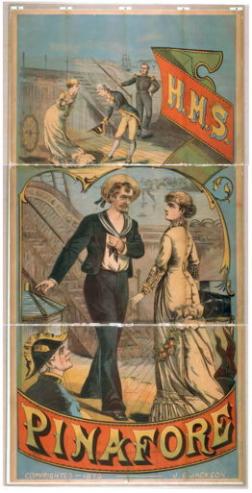
| H.M.S. Pinafore |
H.M.S. Pinafore, or The Lass that Loved a
Sailor, is a comic opera in two acts, with
music by Arthur Sullivan and libretto by
W. S. Gilbert. It is one of the Savoy
Operas, and the first big hit by Gilbert and
Sullivan. It opened at the Opera Comique in
London on May 25 1878 for a run of 571
performances, which was the second
longest run of any musical theatre piece up
to that time (after the operetta Les Cloches
de Corneville). H.M.S. Pinafore was
Gilbert and Sullivan's fourth operatic
collaboration.
Drawing on several of his earlier "Bab
Ballad" poems, Gilbert imbued H.M.S.
Pinafore with mirth and silliness to spare.
The opera's gentle satire reprises and builds
Sailor, is a comic opera in two acts, with
music by Arthur Sullivan and libretto by
W. S. Gilbert. It is one of the Savoy
Operas, and the first big hit by Gilbert and
Sullivan. It opened at the Opera Comique in
London on May 25 1878 for a run of 571
performances, which was the second
longest run of any musical theatre piece up
to that time (after the operetta Les Cloches
de Corneville). H.M.S. Pinafore was
Gilbert and Sullivan's fourth operatic
collaboration.
Drawing on several of his earlier "Bab
Ballad" poems, Gilbert imbued H.M.S.
Pinafore with mirth and silliness to spare.
The opera's gentle satire reprises and builds
on a theme introduced in The Sorcerer – love between members of different social
classes. The opera also pokes good-natured fun at the Royal Navy and, in themes to be
repeated in the later operas, parliamentary politics and the rise of unqualified people to
positions of authority. The title of the work itself is humorous, as it juxtaposes the
name of a little girl's garment, pinafore, with the symbol of a naval war ship.
The plot revolves around a naval captain's daughter who is in love with a lower-class
foremast hand (a common sailor, well below officer rank), even though her father
intends her to marry the First Lord of the Admiralty, the cabinet minister in charge of
the Royal Navy. As with most of the Gilbert and Sullivan operas, a surprise twist
changes everything dramatically near the end of the story. Read more....
classes. The opera also pokes good-natured fun at the Royal Navy and, in themes to be
repeated in the later operas, parliamentary politics and the rise of unqualified people to
positions of authority. The title of the work itself is humorous, as it juxtaposes the
name of a little girl's garment, pinafore, with the symbol of a naval war ship.
The plot revolves around a naval captain's daughter who is in love with a lower-class
foremast hand (a common sailor, well below officer rank), even though her father
intends her to marry the First Lord of the Admiralty, the cabinet minister in charge of
the Royal Navy. As with most of the Gilbert and Sullivan operas, a surprise twist
changes everything dramatically near the end of the story. Read more....
| ********** |


