correspondence courses.
At the New York World Fair in 1939, after limping into the Aquacade on sticks, she
swam the length of the pool to loud cheers. She claimed to be as strong and fast as
ever, but she would never swim competitively again. By the early 1940s she was
completely deaf, and was devoting much of her time to teaching deaf children to swim.
At the New York World Fair in 1939, after limping into the Aquacade on sticks, she
swam the length of the pool to loud cheers. She claimed to be as strong and fast as
ever, but she would never swim competitively again. By the early 1940s she was
completely deaf, and was devoting much of her time to teaching deaf children to swim.
Gertrude Ederle never made the money
that she ought to have done from her
fame, despite the countless offers that
came to her immediately after her
Channel swim. She made a film, Swim
Swim Swim, and for a time appeared
on the vaudeville stage. In 1928 she
had a nervous breakdown, exacerbated
by deafness.
Frightened, she retired from view and
in the summers of the next few years
worked as a swimming instructor. In
1933 she fell down steps outside her
apartment, dislocating a pelvic joint,
and injuring her spine. She spent the
next two years in a cast. Unable to
swim - doctors told her she never
would again - she contented herself
with making clothes, and taking

 |  |  |  |
| If you enjoy our quizzes, don't forget to order our books! Click here. |
| If you have a picture you'd like us to feature a picture in a future quiz, please email it to us at CFitzp@aol.com. If we use it, you will receive a free analysis of your picture. You will also receive a free Forensic Genealogy CD or a 10% discount towards the purchase of the Forensic Genealogy book. |

| Quiz #124 Results |


 |  |  |  |
| ********** |
| 1924 Olympics Women's Swimming |
| ********** |
| Answer to Quiz #124 - September 2, 2007 |
| As a teenager she won a gold medal in the 1924 Olympics, but her greatest triumph was on August 6, 1926, while coated with sheep grease. 1. Who was she? 2. What did she do? |
| ********** |
| Thanks to Stan Read for suggesting this quiz. |
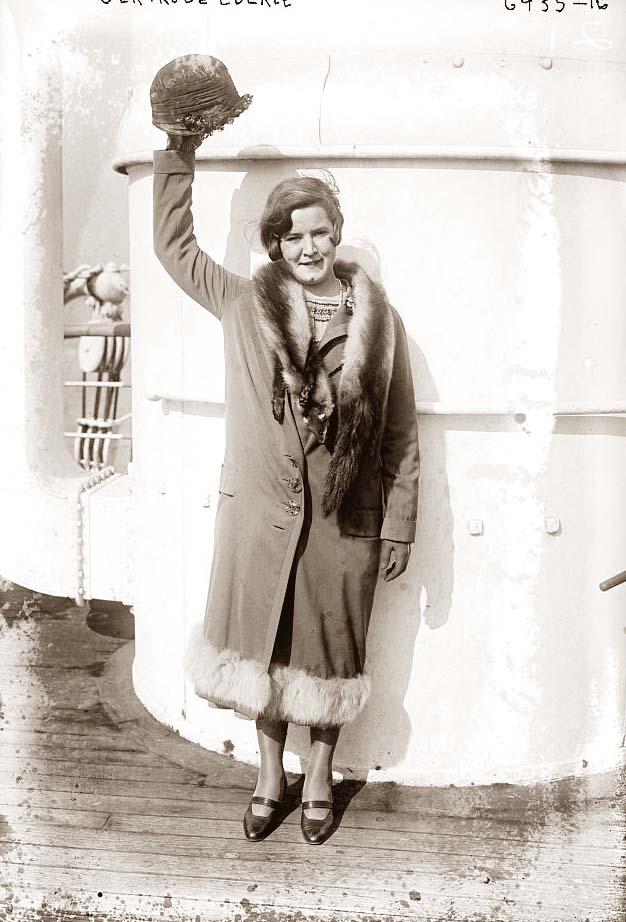
| 1. Gertrude Ederly 2. She was the frst woman to swm the English Channel. She beat the previous male record by more than 2 hours. |
| ********** |
| ********** |
| Congratulations to Our Winners Jina Yi Ashley Hicks Betty Ware Pinky Palladino Theresa White Beth Tafel Tom Pincince Ruth Govorchin Debbie Sterbinsky Elaine C. Hebert Margaret English Dave Doucette Debbie Sterbinsky Mike Dalton Dorothy Oksner Doyle Chastain Paule Harris Evan Hindman Bill Hurley Diane Wilson Wayne Douglas Kelly Fetherlin Debi Stewart Frank Nollette Edee Scott Marjorie Wilser Kristi Murdock Margaret Waterman John Chulick Grace Hertz Sharon Martin Judy Pfaff Dawn Carlile Ruth Jenkins Bob Witherspoon Sue Ediminster Jinny Collins Sandy Thompson Alan Cullinan Sandy Sterling Bill Burows Suzan Farris Bill Utterback Charles Nienhaus Susan Fortune Mary South Richard Cleaveland Anna Farris Raymond Cathcart Neil Ferguson Delores Martin Jim Kiser Sher Fenley Rick Mackinney Alice Hix Fred Stuart Carol Phillips Diane Burkett Andy Wold |
| Comments from Our Readers |
Wow!This was one I knew without any help from Google. Pinky Palladino
This was a lot of fun! As soon as I saw "sheep grease" I figured she was a channel
swimmer. I had no idea how many people have done this and, apparently, still do! I'm
surprised to learn that there's more than one Channel Swimming Federation and at least
one "travel agent" that will help you organize your swim if you're thinking of doing it!
I'm glad Gertrude got a ticker tape parade for her efforts! Cheers! Beth Tafel
Her name was Gertrude Caroline Ederle. She was the first woman to swim across the
English Channel. And to think she did all that just so she could get her hair bobbed!
What we women won't do for our hair! Debbie Sterbinky
Although I'm not so much of a men/women person, I do believe that women do so
many things so much better than men. We multi-task, and we can Usually stay
focused. Most women aren't so wound-up with who had the biggest 'whatever', that's
something for men. In the meantime, women are persistent, and that will take us
further than running the fastest race. If you want anything done, just ask a woman to
do the job - she'll find time to do it, and do it well. I don't know if it's in our
programming, but, we can do a lot of things better than a whole lot of men!
Kelly Fetherlin
(Thank God for Google and wikipedia, since I had NO IDEA who I was looking for.
First I googled 1924 Olympics, then looked under the sports with women, starting with
swimming. When I saw Ms. Ederle's name, it looked familiar, so I went to Wikipedia
and Voila!! There was my answer!) Elaine C. Hebert
Florence Chadwick was a role model for my mother; who in turn, taught my brother
and I how to swim. Her father learned how to swim in the Irish Sea. The waters
around the British Isles, ie the Gulf Current, make it sufficently comfortable for families
to swim in during summer months, many centuries ago, and now. Sportwise, all these
ladies mentioned, liked to swim because it was relaxing, not to prove a point or to
please someone. Gertrude Ederle had a bit of an edge with her lap swimming experience
in crossing the English Channel in less than ideal conditions. Too much exposure to
saltwater or chlorinated pool water can cause ear or eye problems, as occurred with
Gertrude. Mike Dalton
She was the first woman to accomplish this and her record of 14 hours and 39 minutes
stood as the women's record for 35 years. She was pretty, too! Paula Harris
Sheep Grease was a dead giveaway. Ewe should have known. Jim Kiser
The articles said she never married or had children... I wonder if there are descendents
of sisters or brothers or cousins who remember her as part of their family legends? I
hope so. Kristi Murdock
This was a lot of fun! As soon as I saw "sheep grease" I figured she was a channel
swimmer. I had no idea how many people have done this and, apparently, still do! I'm
surprised to learn that there's more than one Channel Swimming Federation and at least
one "travel agent" that will help you organize your swim if you're thinking of doing it!
I'm glad Gertrude got a ticker tape parade for her efforts! Cheers! Beth Tafel
Her name was Gertrude Caroline Ederle. She was the first woman to swim across the
English Channel. And to think she did all that just so she could get her hair bobbed!
What we women won't do for our hair! Debbie Sterbinky
Although I'm not so much of a men/women person, I do believe that women do so
many things so much better than men. We multi-task, and we can Usually stay
focused. Most women aren't so wound-up with who had the biggest 'whatever', that's
something for men. In the meantime, women are persistent, and that will take us
further than running the fastest race. If you want anything done, just ask a woman to
do the job - she'll find time to do it, and do it well. I don't know if it's in our
programming, but, we can do a lot of things better than a whole lot of men!
Kelly Fetherlin
(Thank God for Google and wikipedia, since I had NO IDEA who I was looking for.
First I googled 1924 Olympics, then looked under the sports with women, starting with
swimming. When I saw Ms. Ederle's name, it looked familiar, so I went to Wikipedia
and Voila!! There was my answer!) Elaine C. Hebert
Florence Chadwick was a role model for my mother; who in turn, taught my brother
and I how to swim. Her father learned how to swim in the Irish Sea. The waters
around the British Isles, ie the Gulf Current, make it sufficently comfortable for families
to swim in during summer months, many centuries ago, and now. Sportwise, all these
ladies mentioned, liked to swim because it was relaxing, not to prove a point or to
please someone. Gertrude Ederle had a bit of an edge with her lap swimming experience
in crossing the English Channel in less than ideal conditions. Too much exposure to
saltwater or chlorinated pool water can cause ear or eye problems, as occurred with
Gertrude. Mike Dalton
She was the first woman to accomplish this and her record of 14 hours and 39 minutes
stood as the women's record for 35 years. She was pretty, too! Paula Harris
Sheep Grease was a dead giveaway. Ewe should have known. Jim Kiser
The articles said she never married or had children... I wonder if there are descendents
of sisters or brothers or cousins who remember her as part of their family legends? I
hope so. Kristi Murdock
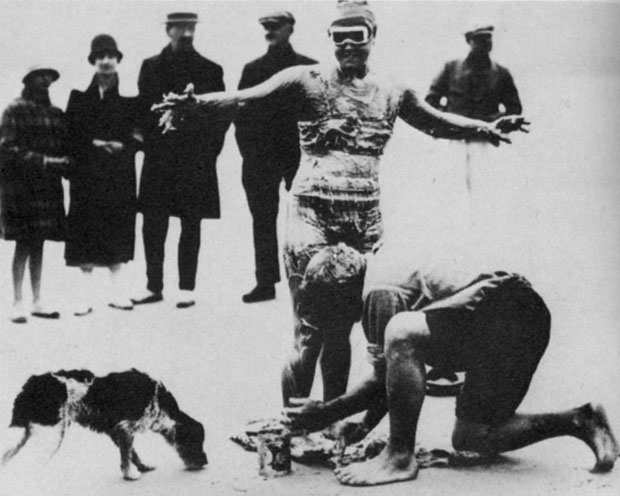

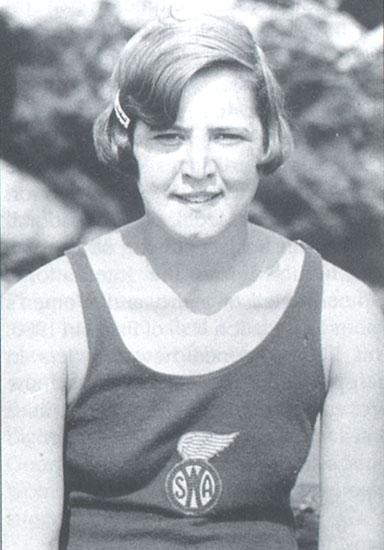
| Gertrude Caroline Ederle (Oct. 23, 1905-Nov. 30, 2003) http://davidmorrison.typepad.com/sed_contra/2003/12.... |
Only five men had swum the Channel when Gertrude
Ederle set off from Cap Gris-Nez on August 6 1926. All
the men had used breaststroke, as had Gertrude Ederle
during her failed attempt the previous year. This time,
aged 19, she decided that she would try a new stroke, the
crawl.
At 7.09 am she plunged into the water wearing a brassiere,
shorts, goggles, a rubber cap, and a coating of sheep's
grease. Her father, a German-born butcher, her sister, her
trainer and newspapermen followed in a tug.
Shortly after setting off, strong south-westerly winds and
heavy rain drove her wildly off course (by the time she
Ederle set off from Cap Gris-Nez on August 6 1926. All
the men had used breaststroke, as had Gertrude Ederle
during her failed attempt the previous year. This time,
aged 19, she decided that she would try a new stroke, the
crawl.
At 7.09 am she plunged into the water wearing a brassiere,
shorts, goggles, a rubber cap, and a coating of sheep's
grease. Her father, a German-born butcher, her sister, her
trainer and newspapermen followed in a tug.
Shortly after setting off, strong south-westerly winds and
heavy rain drove her wildly off course (by the time she
| Gertrude Ederle First Woman to Swim the English Channel |
finished she had been forced to swim 35 miles to complete the 21-mile crossing). At
noon and again at 6 pm, as the sea grew rough with white-capped waves, her trainer
yelled at her to give up; her sister shouted at her to keep on. Those on the tug (which
was fitted with a wireless) read her cables from her mother, some of them genuine,
others invented. She later said that she had kept going "for the United States and for
mother".
noon and again at 6 pm, as the sea grew rough with white-capped waves, her trainer
yelled at her to give up; her sister shouted at her to keep on. Those on the tug (which
was fitted with a wireless) read her cables from her mother, some of them genuine,
others invented. She later said that she had kept going "for the United States and for
mother".
At around noon they managed to feed her a little
chicken broth and chocolate; at 7.30 pm she had two
slices of pineapple. Her tongue had swollen from the
salt water and become very sore; every hour or so
she took a block of sugar into her mouth, which
seemed to help.
For three hours in the late evening she was caught in
the treacherous currents that beat round the English
shore. Even at so close a distance, a superhuman
effort was required to clear the tide and gain the
beach. Her time of 14-and-a-half hours was nearly
two hours faster than the fastest man, despite her
considerable diversion. Bonfires guided her on to the
beach near the lifeboat station at Kingsdown, where
a crowd of thousands cheered.
Gertrude Ederle was born on October 23 1905 in
New York City, one of six children. When Gertrude
was eight, while visiting her grandmother in
Germany, she fell into a pond and had to be pulled
out; the experience determined her to swim. Next
summer her father packed the family off to New
Jersey, where Gertrude learned the doggy-paddle
tethered to a rope. An early bout of measles had
damaged her hearing, and doctors told her it would
only get worse if she swam, but she loved it too
much.
chicken broth and chocolate; at 7.30 pm she had two
slices of pineapple. Her tongue had swollen from the
salt water and become very sore; every hour or so
she took a block of sugar into her mouth, which
seemed to help.
For three hours in the late evening she was caught in
the treacherous currents that beat round the English
shore. Even at so close a distance, a superhuman
effort was required to clear the tide and gain the
beach. Her time of 14-and-a-half hours was nearly
two hours faster than the fastest man, despite her
considerable diversion. Bonfires guided her on to the
beach near the lifeboat station at Kingsdown, where
a crowd of thousands cheered.
Gertrude Ederle was born on October 23 1905 in
New York City, one of six children. When Gertrude
was eight, while visiting her grandmother in
Germany, she fell into a pond and had to be pulled
out; the experience determined her to swim. Next
summer her father packed the family off to New
Jersey, where Gertrude learned the doggy-paddle
tethered to a rope. An early bout of measles had
damaged her hearing, and doctors told her it would
only get worse if she swam, but she loved it too
much.
| Gertrude get ready to swim. 1926 http://davidmorrison.typepad.com... and http://sportsillustrated.cnn.com/sif orwomen/top_100/42/ |
When she was 15, she beat 51 entrants, including the American national champion,
Helen Wainwright in a swim from Manhattan Beach to Brighton Beach, Brooklyn. In the
early 1920s she set women's freestyle and American freestyle records for distances
from 100 to 800 metres; in a single afternoon in 1922, she broke seven such records at
Brighton Beach. In all, she held 29 amateur national and world records between 1921
and 1925.
At the Paris Olympics in 1924, she won a gold medal in the 400-metre freestyle relay,
and bronze in the 100 m and 400 m individual freestyle events. This was disappointing,
Helen Wainwright in a swim from Manhattan Beach to Brighton Beach, Brooklyn. In the
early 1920s she set women's freestyle and American freestyle records for distances
from 100 to 800 metres; in a single afternoon in 1922, she broke seven such records at
Brighton Beach. In all, she held 29 amateur national and world records between 1921
and 1925.
At the Paris Olympics in 1924, she won a gold medal in the 400-metre freestyle relay,
and bronze in the 100 m and 400 m individual freestyle events. This was disappointing,


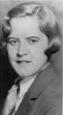
but she had had to cope with an injured knee,
and - having been put in a hotel miles away
from the city centre - fatigue, brought on by
having to travel for five to six hours each day
to the training pool.
After the Olympics she concentrated on the
Channel, which had first been swum by
Captain Matthew Webb in 1875, in 21 hours
and 45 minutes (he died in a subsequent
attempt to swim the Niagara rapids). In 1925
she made her first attempt, and completed 23
miles before her trainer grabbed her in the
mistaken belief that she was unconscious; she
was just resting, but as soon as she was
and - having been put in a hotel miles away
from the city centre - fatigue, brought on by
having to travel for five to six hours each day
to the training pool.
After the Olympics she concentrated on the
Channel, which had first been swum by
Captain Matthew Webb in 1875, in 21 hours
and 45 minutes (he died in a subsequent
attempt to swim the Niagara rapids). In 1925
she made her first attempt, and completed 23
miles before her trainer grabbed her in the
mistaken belief that she was unconscious; she
was just resting, but as soon as she was
| Gertrude swimming her way into the record books. She was voted by Sports Illustrated as #42 on the list of the greatest woman athletes of the century. http://sportsillustrated.cnn.com/siforwomen/top_100/42/ |
| They Said It: "People said women couldn't swim the Channel but I proved they could." --Gertrude Ederle |
| ********** |
touched, she was disqualified.
When Gertrude Ederle got home after her triumph the next year, there occurred the
wildest celebration that New York had ever given in honour of a single person. The
ticker tape that drifted into Broadway was miles longer, and the telephone-book snow
inches thicker, than that which fell upon Theodore Roosevelt, Marshal Foch, or
Lieutenant Commander Byrd. Tens of thousands of people cheered themselves hoarse.
When Gertrude Ederle got home after her triumph the next year, there occurred the
wildest celebration that New York had ever given in honour of a single person. The
ticker tape that drifted into Broadway was miles longer, and the telephone-book snow
inches thicker, than that which fell upon Theodore Roosevelt, Marshal Foch, or
Lieutenant Commander Byrd. Tens of thousands of people cheered themselves hoarse.
The Mayor of New York
compared her achievement with
Moses parting the Red Sea and
Caesar crossing the Rubicon.
But the next year Charles
Lindbergh flew across the
Atlantic. The celebrations were
on an altogether greater scale,
and the woman who had been
hailed as "the most popular
personage of her time" began her
journey into oblivion.
compared her achievement with
Moses parting the Red Sea and
Caesar crossing the Rubicon.
But the next year Charles
Lindbergh flew across the
Atlantic. The celebrations were
on an altogether greater scale,
and the woman who had been
hailed as "the most popular
personage of her time" began her
journey into oblivion.
| Gertrude is welcomed home. http://sportsillustrated.cnn.com/siforwomen/top_100/42/ |
| Gertrude's ticker tape parade. http://en.wikipedia.org/wiki/Image..... |
She lived quietly in Queens, and in an interview in
the 1950s described herself as "comfortable and
satisfied". She spent her final years in a nursing
home at Wycoff, New Jersey, surrounded by
swimming certificates and old photos. On a
pedestal stood the huge William Randolph Hearst
loving cup presented to her after her triumph.
The inscription read: "To Gertrude Ederle, First
Woman to Swim the English Channel, Acclaimed
by Popular Consent to be the Most Popular
the 1950s described herself as "comfortable and
satisfied". She spent her final years in a nursing
home at Wycoff, New Jersey, surrounded by
swimming certificates and old photos. On a
pedestal stood the huge William Randolph Hearst
loving cup presented to her after her triumph.
The inscription read: "To Gertrude Ederle, First
Woman to Swim the English Channel, Acclaimed
by Popular Consent to be the Most Popular
Personage of Her Time, This Trophy Is Presented on Behalf of the American Public in
Recognition of the Glorious Qualities of American Womanhood She Has So Nobly
Demonstrated."
She never married.
Recognition of the Glorious Qualities of American Womanhood She Has So Nobly
Demonstrated."
She never married.
| Gertrude Ederle and fellow swimmer Johnny Weissmuller. |
|
| ********** |
Gertrude Ederle was the first woman and sixth person to swim across the channel.She
beat the best time by more than two hours – breaking Argentine, Enrique Tiraboschi’s
record of 16 hours and 33 minutes. Her women’s record stood for 24 years until
Florence Chadwick swam the channel in 1950 in 13 hours and 20 minutes.
http://www.girlawhirl.com/girlawhirl/publish/the_first_woman_to_swim_the_English_channel.aspx?
md=3
beat the best time by more than two hours – breaking Argentine, Enrique Tiraboschi’s
record of 16 hours and 33 minutes. Her women’s record stood for 24 years until
Florence Chadwick swam the channel in 1950 in 13 hours and 20 minutes.
http://www.girlawhirl.com/girlawhirl/publish/the_first_woman_to_swim_the_English_channel.aspx?
md=3
| Gertrude's Accomplishment |
| ********** |


