| ********** |
stockade fence atop the grassy knoll during the shooting. He saw a total of four men in
the area between his tower and Elm Street: a middle-aged man and a younger man,
standing 10 to 15 feet (3 to 5 m) apart near the Triple Underpass, who did not seem to
know each other, and one or two uniformed parking lot attendants. In a 1966 interview,
Bowers clarified that the two men he saw were on the opposite side of the stockade
fence from him, and that no one was behind the fence at the time the shots were fired.
Meanwhile, Howard Brennan, a steamfitter who was sitting across the street from the
Texas School Book Depository, notified police that as he watched the motorcade go by,
he heard a shot come from above, and looked up to see a man with a rifle make another
shot from a corner window on the sixth floor. He had seen the same man minutes
earlier looking out the window. Brennan gave a description of the shooter, which was
broadcast to all Dallas police at 12:45 p.m., 12:48 p.m., and 12:55 p.m.
Of the 104 earwitnesses who would later give testimony as to the direction from which
the shots came, 56 (53.8%) thought that they came from the direction of the Texas
School Book Depository, 35 (33.7%) thought that they came from the area of the
grassy knoll or the Triple Underpass, 8 (7.7%) thought the shots came from a location
entirely distinct from the knoll or the Depository, and only 5 (4.8%) thought they heard
shots from two locations
the area between his tower and Elm Street: a middle-aged man and a younger man,
standing 10 to 15 feet (3 to 5 m) apart near the Triple Underpass, who did not seem to
know each other, and one or two uniformed parking lot attendants. In a 1966 interview,
Bowers clarified that the two men he saw were on the opposite side of the stockade
fence from him, and that no one was behind the fence at the time the shots were fired.
Meanwhile, Howard Brennan, a steamfitter who was sitting across the street from the
Texas School Book Depository, notified police that as he watched the motorcade go by,
he heard a shot come from above, and looked up to see a man with a rifle make another
shot from a corner window on the sixth floor. He had seen the same man minutes
earlier looking out the window. Brennan gave a description of the shooter, which was
broadcast to all Dallas police at 12:45 p.m., 12:48 p.m., and 12:55 p.m.
Of the 104 earwitnesses who would later give testimony as to the direction from which
the shots came, 56 (53.8%) thought that they came from the direction of the Texas
School Book Depository, 35 (33.7%) thought that they came from the area of the
grassy knoll or the Triple Underpass, 8 (7.7%) thought the shots came from a location
entirely distinct from the knoll or the Depository, and only 5 (4.8%) thought they heard
shots from two locations

 |  |  |  |
| If you enjoy our quizzes, don't forget to order our books! Click here. |
| If you have a picture you'd like us to feature a picture in a future quiz, please email it to us at CFitzp@aol.com. If we use it, you will receive a free analysis of your picture. You will also receive a free Forensic Genealogy CD or a 10% discount towards the purchase of the Forensic Genealogy book. |

| Quiz #110 Results |


 |  |  |  |
| Answer to Quiz #110 May 20, 2007 |


| ********** |
| ********** |
| Click here to see our reader's choice for Best Picture and the results of Survey #3, December 22, 2006. |
| ********** |
| See results of Survey #2 May 12-19, 2006 Click here. |
| See results of Survey #1 December 9-16, 2005 Click here. |
| Please put these photos in chronological order. |
| Dead Horse Update Click HERE to read Part 1 of our analysis of the picture published 4/1/2007 in the Sheboygan Press. Click HERE to read Part II published April 8, 2007 |




| 1 |
| 2 |
| 3 |
| 4 |
| 5 |
| 6 |
| 7 |
| Congratulations to Our Winners! Dorothy Oksner Marty Guidry Linda Williams Kitty Huddleston Kelly Fetherlin Debbie Sterbinsky Elaine C. Hebert Mary Fraser Fred Stuart Marilyn Giese Edee Scott Frank Nollette Betty Ware Theresa Hissong Robert McKenna Dawn Carlile Norma Longmire Lynda Snider Mike Dalton Tillie Van Sickle Jinny Collins Charles Nienhaus Alice & Pete Miles Stan Read Anna Farris Margaret English Sharon Martin Delores Martin Judy Pfaff Patty Kaliher Linda Willilams Bob Witherspoon Wayne Douglas Loren Godburn Linda LaValley & Ruth Govorchin William Hughes Rick Mackinney Carol Phillips Suzan Farris Sinika Garey Dennis Bussey Jim Kiser Evan Hindman |
| Comments from Our Readers |
I definitely remember that I was waiting for 10th grade chemistry class when JFK was
shot and remember watching the funeral on TV; however, I missed the live shooting of
Oswald on TV. Guess I was outdoors doing something. Marty Guidry
***************
That /was/ a tricky one! Since I was a freshman in high school at the time, I really
was shocked by having a president shot; "It can't happen here" kind of thing. Once I
was part of the evacuation of Memphis campuses when MLK was shot, I'd become a
bit more cynical? Less naive? Kitty Huddleston
***************
I remember the day he was shot so well. I was on a bowling team in Huntington
Beach. One of the girls came down and was telling everyone that the President had
been shot. Nobody really reacted. We all just sorta looked at each other.
I thought she meant the president of the bowling alley.........duh ! A little while later
she came back and announced that he had died. It was at that time I asked her, "
President of what ?" And she said, "President Kennedy of the United States"....then
pandemonium broke out. That was the end of the bowling. We all got our stuff and
went home. I cried all weekend. Such a tragedy . Edee Scott
***************
Remember the events vividly, while I was stationed at Nellis AFB, outside of Las
Vegas. First time the casinos shut-down since the death of President Franklin
Roosevelt - very eerie to see the 'Strip" and Fremont Street 'go dark' for one day/night.
Frank Nollette
***************
I remember watching this as it unfolded, I was PG with Ron at the time....thats how I
remembered how long ago it was....but its hard to believe it was over 40 years ago. I
can still remember where I was and what I was doing at that time as I'm sure many
others can too. Betty Ware
***************
I can determine what time of day Oswald was shot , picture 2. I was working on a
construction project in Huntsville, Alabama at the time. What an unbelieveable few days
in history! Bob McKenna
***************
I was in third grade when Kennedy was assassinated and I remember being released
from school early. I ran home to tell my parents the "good news" as they, especially my
Dad, complained about the President and I thought they would be happy he was gone.
They turned on me ferociously and couldn't believe I would say that about such a
wonderful man and President. The next year I bought a puzzle of Kennedy and kept it
for years. I thought he was such a handsome man. Dawn Carlile
***************
The pictures still touch me deeply, recalling those horrific days in Dallas & DC.
Lynda Snider
***************
Hi Colleen, that one was a reminder of what happened and when. I think I still have
some old newspapers about JFK. I'm a packrat. Alice Miles
***************
I remember watching these on the news and different specials over the years and on
the History Channel. Anna Farris
***************
You have to realize that I am old enough to remember all about the Kennedy
assasination (spelling?). Anyway that is a day I will never forget. I still have a book
called Four Days and have never been able to read it all the way through. It brings
back such sorrowful times. Jackie was so brave and when John-John saluted his
father's casket it just tore you apart. Sharon Martin
***************
I do so recall the events of that day. It was my senior year in high school. I had turned
17 on November 20. We had a new school building. We were the first class to spend
all 4 years in the building. It had a very good audio system throughout the building.
We were in gym class when the system was turned on, and we heard the messages
that the president had been shot in the motorcade. It was just before lunch. Two
hours later we were in a trigonometry class, when the system was turned on and the
national news broadcast declared that the President had died. This was a Friday
afternoon and our senior play was to have its debut that evening. An announcement
was soon made that the play was canceled. As I had a part in the play, this was
important news. It was later rescheduled for the following weekend.
For the next 3 days, our whole lives revolved around the TV set. We did go to church
on Sunday morning. We stopped at the local grocery on the way home to pick up
some items. I was standing at the meat counter and a TV was on. I watched the
whole incident of Jack Ruby shooting Lee Harvey Oswald. It was another most
astounding event. I saw a murder occur on the TV. I was a witness.
I associate my senior year in high school and my 17th birthday with this national
tragedy. It marks for me the end of my childhood. Judy Pfaff
***************
What a very sad time for our country at that time. Think of the wonderful things he
may have accomplished! Linda LaValley & Ruth Govorchin
***************
I remember sitting in my fourth-grade classroom, when the principal came over the
loudspeaker with the announcement. The speaker was old and statick-y, and at first
we all thought she had said that something had happened to John-John-- maybe
because of the recent death of the new Kennedy baby. Mary Fraser
***************
I tried this one from memory -Any American who was alive then has vivid memories of
that dreadful time. It was so sad and so much happened in three long days that the
sequence is a little blurred. Margaret Waterman
***************
Now, this is a hard one. Only someone who had lived this drama or a Kenedyanian
(new word?)could do this one easily; I am neither one. But I do remember the event. I
was only 22. Dorothy Oksner
shot and remember watching the funeral on TV; however, I missed the live shooting of
Oswald on TV. Guess I was outdoors doing something. Marty Guidry
***************
That /was/ a tricky one! Since I was a freshman in high school at the time, I really
was shocked by having a president shot; "It can't happen here" kind of thing. Once I
was part of the evacuation of Memphis campuses when MLK was shot, I'd become a
bit more cynical? Less naive? Kitty Huddleston
***************
I remember the day he was shot so well. I was on a bowling team in Huntington
Beach. One of the girls came down and was telling everyone that the President had
been shot. Nobody really reacted. We all just sorta looked at each other.
I thought she meant the president of the bowling alley.........duh ! A little while later
she came back and announced that he had died. It was at that time I asked her, "
President of what ?" And she said, "President Kennedy of the United States"....then
pandemonium broke out. That was the end of the bowling. We all got our stuff and
went home. I cried all weekend. Such a tragedy . Edee Scott
***************
Remember the events vividly, while I was stationed at Nellis AFB, outside of Las
Vegas. First time the casinos shut-down since the death of President Franklin
Roosevelt - very eerie to see the 'Strip" and Fremont Street 'go dark' for one day/night.
Frank Nollette
***************
I remember watching this as it unfolded, I was PG with Ron at the time....thats how I
remembered how long ago it was....but its hard to believe it was over 40 years ago. I
can still remember where I was and what I was doing at that time as I'm sure many
others can too. Betty Ware
***************
I can determine what time of day Oswald was shot , picture 2. I was working on a
construction project in Huntsville, Alabama at the time. What an unbelieveable few days
in history! Bob McKenna
***************
I was in third grade when Kennedy was assassinated and I remember being released
from school early. I ran home to tell my parents the "good news" as they, especially my
Dad, complained about the President and I thought they would be happy he was gone.
They turned on me ferociously and couldn't believe I would say that about such a
wonderful man and President. The next year I bought a puzzle of Kennedy and kept it
for years. I thought he was such a handsome man. Dawn Carlile
***************
The pictures still touch me deeply, recalling those horrific days in Dallas & DC.
Lynda Snider
***************
Hi Colleen, that one was a reminder of what happened and when. I think I still have
some old newspapers about JFK. I'm a packrat. Alice Miles
***************
I remember watching these on the news and different specials over the years and on
the History Channel. Anna Farris
***************
You have to realize that I am old enough to remember all about the Kennedy
assasination (spelling?). Anyway that is a day I will never forget. I still have a book
called Four Days and have never been able to read it all the way through. It brings
back such sorrowful times. Jackie was so brave and when John-John saluted his
father's casket it just tore you apart. Sharon Martin
***************
I do so recall the events of that day. It was my senior year in high school. I had turned
17 on November 20. We had a new school building. We were the first class to spend
all 4 years in the building. It had a very good audio system throughout the building.
We were in gym class when the system was turned on, and we heard the messages
that the president had been shot in the motorcade. It was just before lunch. Two
hours later we were in a trigonometry class, when the system was turned on and the
national news broadcast declared that the President had died. This was a Friday
afternoon and our senior play was to have its debut that evening. An announcement
was soon made that the play was canceled. As I had a part in the play, this was
important news. It was later rescheduled for the following weekend.
For the next 3 days, our whole lives revolved around the TV set. We did go to church
on Sunday morning. We stopped at the local grocery on the way home to pick up
some items. I was standing at the meat counter and a TV was on. I watched the
whole incident of Jack Ruby shooting Lee Harvey Oswald. It was another most
astounding event. I saw a murder occur on the TV. I was a witness.
I associate my senior year in high school and my 17th birthday with this national
tragedy. It marks for me the end of my childhood. Judy Pfaff
***************
What a very sad time for our country at that time. Think of the wonderful things he
may have accomplished! Linda LaValley & Ruth Govorchin
***************
I remember sitting in my fourth-grade classroom, when the principal came over the
loudspeaker with the announcement. The speaker was old and statick-y, and at first
we all thought she had said that something had happened to John-John-- maybe
because of the recent death of the new Kennedy baby. Mary Fraser
***************
I tried this one from memory -Any American who was alive then has vivid memories of
that dreadful time. It was so sad and so much happened in three long days that the
sequence is a little blurred. Margaret Waterman
***************
Now, this is a hard one. Only someone who had lived this drama or a Kenedyanian
(new word?)could do this one easily; I am neither one. But I do remember the event. I
was only 22. Dorothy Oksner
| ********** |
| Answer: |
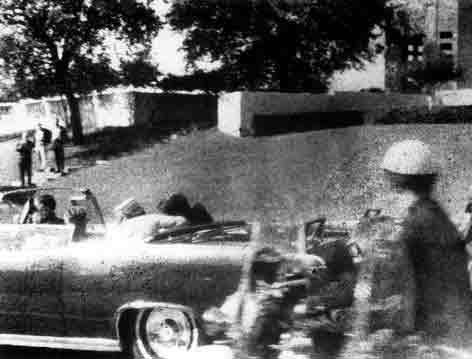
3. The Moorman Polaroid of the assassination
22 Nov 1963 ~12:30 pm CST.
22 Nov 1963 ~12:30 pm CST.
4. Secret Service Agents surround Kennedy's
limo at the hospital 22 Nov 1963 ~1:00 pm CST
limo at the hospital 22 Nov 1963 ~1:00 pm CST
5. Lyndon Johnson being sworn in on Air Force
One at Love Field 22 Nov 1963 at 2:38 pm CST
One at Love Field 22 Nov 1963 at 2:38 pm CST
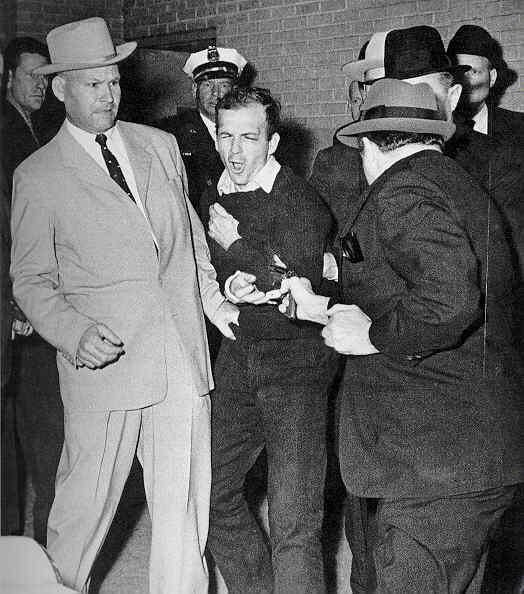
2. Lee Harvey Oswald shot 23 Nov 1963 11:21 am
CST
CST
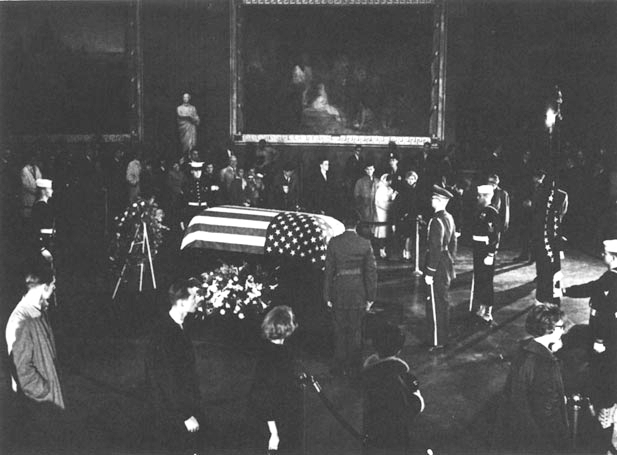
6. JFK's casket lies in state at the Capitol 24 Nov
1963 - Capitol Rotunda open to the public about 3 pm
EST (1 pm CST)
1963 - Capitol Rotunda open to the public about 3 pm
EST (1 pm CST)
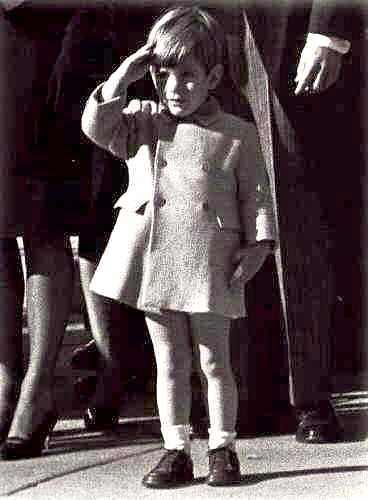
1. John Jr. salutes his father's casket moments after it was
carried out of the cathedral after the funeral 25 Nov 1963.
carried out of the cathedral after the funeral 25 Nov 1963.
7. Caisson carrying Kenney's remains enters
Arlington National Cemetery for burial 25 Nov
1963.
Arlington National Cemetery for burial 25 Nov
1963.
| ********** |

Dealey Plaza witness
Mary Moorman in the
office of the Dallas
Country Sheriff on the
afternoon of the
assassination.
http://mcadams.posc.mu.edu/images/moorman.htm
Mary Moorman in the
office of the Dallas
Country Sheriff on the
afternoon of the
assassination.
http://mcadams.posc.mu.edu/images/moorman.htm
This well-known Polaroid picture was being
taken at the moment of the assassination by
Mary Moorman who stood on the south side of
Elm Street. Blow-ups show two figures behind
the fence next to the Grassy Knoll resembling a
man with a rifle (The Black Dog Man) and a
police officer (The Badge Man). The two men
never have been found.
http://www.jfk-assassination.de/media/photos/moorman.php
taken at the moment of the assassination by
Mary Moorman who stood on the south side of
Elm Street. Blow-ups show two figures behind
the fence next to the Grassy Knoll resembling a
man with a rifle (The Black Dog Man) and a
police officer (The Badge Man). The two men
never have been found.
http://www.jfk-assassination.de/media/photos/moorman.php
Photo by Ike Altgens (at
Zapruder frame 255), which
Altgens said he took after
the first shot and before any
other shot.
http://upload.wikimedia.org/wikipedia/en/f/fa/Altgens_ma
ry_ferrell.jpg
Zapruder frame 255), which
Altgens said he took after
the first shot and before any
other shot.
http://upload.wikimedia.org/wikipedia/en/f/fa/Altgens_ma
ry_ferrell.jpg

The assassination of John F. Kennedy, the thirty-fifth
President of the United States, took place on Friday,
November 22, 1963, in Dallas, Texas, USA at 12:30 p.m.
CST (18:30 UTC). Kennedy was fatally wounded by
gunshots while riding with his wife Jacqueline in a
presidential motorcade through Dealey Plaza. The official
investigation by the Warren Commission was conducted
over a ten-month period, and its report was published in
September 1964. The Commission concluded that the
assassination was carried out solely by Lee Harvey
Oswald, an employee of the Texas School Book
Depository in Dealey Plaza. This conclusion initially met
with widespread support among the American public, but
polls, since the original 1966 Gallup poll, show a majority
of the public hold beliefs contrary to the Commission's
President of the United States, took place on Friday,
November 22, 1963, in Dallas, Texas, USA at 12:30 p.m.
CST (18:30 UTC). Kennedy was fatally wounded by
gunshots while riding with his wife Jacqueline in a
presidential motorcade through Dealey Plaza. The official
investigation by the Warren Commission was conducted
over a ten-month period, and its report was published in
September 1964. The Commission concluded that the
assassination was carried out solely by Lee Harvey
Oswald, an employee of the Texas School Book
Depository in Dealey Plaza. This conclusion initially met
with widespread support among the American public, but
polls, since the original 1966 Gallup poll, show a majority
of the public hold beliefs contrary to the Commission's
| The Kennedy Assassination |
findings. The United States House Select Committee on Assassinations (HSCA)
concluded in 1979 that Kennedy was assassinated by Oswald probably as a result of a
conspiracy. This conclusion was based on taped acoustic evidence which has since
been called into question. The assassination is still the subject of widespread
speculation, and has spawned a number of conspiracy theories.
concluded in 1979 that Kennedy was assassinated by Oswald probably as a result of a
conspiracy. This conclusion was based on taped acoustic evidence which has since
been called into question. The assassination is still the subject of widespread
speculation, and has spawned a number of conspiracy theories.
| ********** |
Just before 12:30 p.m. CST, Kennedy’s limousine entered Dealey Plaza and slowly
approached the Texas School Book Depository head-on, and then turned left 120-
degrees directly in front of the Depository, now only 65 feet (20 m) away.
When the Presidential limousine passed the Depository and continued down Elm Street,
shots were fired at Kennedy; the great majority of witnesses recalled hearing three
shots. There was hardly any reaction in the crowd to the first shot, many later saying
they thought they had heard a firecracker or the exhaust backfire of a vehicle.
approached the Texas School Book Depository head-on, and then turned left 120-
degrees directly in front of the Depository, now only 65 feet (20 m) away.
When the Presidential limousine passed the Depository and continued down Elm Street,
shots were fired at Kennedy; the great majority of witnesses recalled hearing three
shots. There was hardly any reaction in the crowd to the first shot, many later saying
they thought they had heard a firecracker or the exhaust backfire of a vehicle.
| ********** |

Just before 12:30 p.m. CST, Kennedy’s
limousine entered Dealey Plaza and
slowly approached the Texas School
Book Depository head-on, and then
turned left 120-degrees directly in front
of the Depository, now only 65 feet (20
m) away.
When the Presidential limousine passed
the Depository and continued down Elm
Street, shots were fired at Kennedy; the
great majority of witnesses recalled
hearing three shots. There was hardly
any reaction in the crowd to the first
shot, many later saying they thought
they had heard a firecracker or the
exhaust backfire of a vehicle.
Lee Bowers, a railroad switchman
sitting in a two-story tower, had an
unobstructed view of the rear of the
limousine entered Dealey Plaza and
slowly approached the Texas School
Book Depository head-on, and then
turned left 120-degrees directly in front
of the Depository, now only 65 feet (20
m) away.
When the Presidential limousine passed
the Depository and continued down Elm
Street, shots were fired at Kennedy; the
great majority of witnesses recalled
hearing three shots. There was hardly
any reaction in the crowd to the first
shot, many later saying they thought
they had heard a firecracker or the
exhaust backfire of a vehicle.
Lee Bowers, a railroad switchman
sitting in a two-story tower, had an
unobstructed view of the rear of the
Annotated map of
Dealey Plaza
showing route of
motocade.
http://en.wikipedia.org/wiki/Image:Dealey-plaza-an
notated.png
Dealey Plaza
showing route of
motocade.
http://en.wikipedia.org/wiki/Image:Dealey-plaza-an
notated.png
Only 8 minutes after the shooting (12:38 pm
CST) the limousine arrives at Parkland
Hospital. President Kennedy and Governor
Conally were immediately taken to Trauma
Room 1 and 2, and the doctors began their
work.
The staff at Parkland Hospital's Trauma Room
1 who treated Kennedy observed that his
condition was "moribund", meaning that he
had no chance of survival upon arriving at the
hospital. Dr. George Gregory Burkley, the
President's personal physician arrived at the
Parkland emergency room where the President
was located, five minutes after the President
CST) the limousine arrives at Parkland
Hospital. President Kennedy and Governor
Conally were immediately taken to Trauma
Room 1 and 2, and the doctors began their
work.
The staff at Parkland Hospital's Trauma Room
1 who treated Kennedy observed that his
condition was "moribund", meaning that he
had no chance of survival upon arriving at the
hospital. Dr. George Gregory Burkley, the
President's personal physician arrived at the
Parkland emergency room where the President
was located, five minutes after the President
Secret Service agents clean blood and
brain tissue from Kennedy's limousine.
Governor Conally's clothes were taken to
the laundry. This destroyed potential
blood stain evidence.
http://jfk.iefactory.com/hechos/parki.htm
brain tissue from Kennedy's limousine.
Governor Conally's clothes were taken to
the laundry. This destroyed potential
blood stain evidence.
http://jfk.iefactory.com/hechos/parki.htm
| Note from the Quizmaster General |
As we feel it is impossible to do justice to the complete subject of the Kennedy
assassination in the space we have available for the solution to the quiz, we have
limited our comments mostly to those pertaining to the quiz photos. See For Further
Reading for websites that have more comprehensive descriptions of the assassination,
the funeral, and subsequent investigations. Colleen Fitpatrick
Quizmaster General
assassination in the space we have available for the solution to the quiz, we have
limited our comments mostly to those pertaining to the quiz photos. See For Further
Reading for websites that have more comprehensive descriptions of the assassination,
the funeral, and subsequent investigations. Colleen Fitpatrick
Quizmaster General
| ********** |
arrived. Dr. Burkley observed both the head wound and a wound to the back of the
President, and determined the head wound was the cause of death. Dr. Burkley signed
President Kennedy's death certificate.
At 1:00 p.m., CST (19:00 UTC), after all heart activity had ceased and after a priest
administered the last rites, the President was pronounced dead. "We never had any hope
of saving his life," one doctor said.
The priest who administered the last rites to Kennedy told The New York Times that
the president was already dead by the time he had arrived at the hospital, and he had to
draw back a sheet covering the president's face to administer the sacrament of Extreme
Unction. Kennedy's death was officially announced by White House Acting Press
Secretary Malcolm Kilduff at 1:33 p.m. CST (19:33 UTC).
President, and determined the head wound was the cause of death. Dr. Burkley signed
President Kennedy's death certificate.
At 1:00 p.m., CST (19:00 UTC), after all heart activity had ceased and after a priest
administered the last rites, the President was pronounced dead. "We never had any hope
of saving his life," one doctor said.
The priest who administered the last rites to Kennedy told The New York Times that
the president was already dead by the time he had arrived at the hospital, and he had to
draw back a sheet covering the president's face to administer the sacrament of Extreme
Unction. Kennedy's death was officially announced by White House Acting Press
Secretary Malcolm Kilduff at 1:33 p.m. CST (19:33 UTC).
| ********** |
| The Last Salute: Civil and Military Funeral, 1921-1969, Ch. 23 B. C. Mossman and M W. Stark http://www.army.mil/cmh-pg/books/Last_Salute/Ch23.htm Wikipedia Articles http://en.wikipedia.org/wiki/State_funeral_of_John_F._Kennedy http://en.wikipedia.org/wiki/Kennedy_Assassination http://en.wikipedia.org/wiki/Lee_harvey_oswald Kennedy Assassination Home Page http://mcadams.posc.mu.edu John F. Kennedy Assassination Homepage http://www.jfk-assassination.de/articles/index.php Arlington National Cemetery Website http://www.arlingtoncemetery.net/jfk.htm |
A few minutes after 2:00 p.m. CST,
Kennedy's body was placed in a casket and
taken from Parkland Hospital and driven to
Air Force One. The casket was then loaded
aboard the airplane through the rear door,
where it remained at the rear of the
passenger compartment, in place of a
removed row of seats. The body was
removed before a forensic examination could
be conducted by the Dallas County coroner,
which violated Texas state law (the murder
was a state crime, and occurred under Texas
legal jurisdiction). At that time, it was not a
federal offense to kill the President.
Vice-President Johnson (who had been riding
two cars behind Kennedy in the motorcade
through Dallas, and was not injured) became
President of the United States up Kennedy's
death. At 2:38 p.m. Johnson took the oath of
Kennedy's body was placed in a casket and
taken from Parkland Hospital and driven to
Air Force One. The casket was then loaded
aboard the airplane through the rear door,
where it remained at the rear of the
passenger compartment, in place of a
removed row of seats. The body was
removed before a forensic examination could
be conducted by the Dallas County coroner,
which violated Texas state law (the murder
was a state crime, and occurred under Texas
legal jurisdiction). At that time, it was not a
federal offense to kill the President.
Vice-President Johnson (who had been riding
two cars behind Kennedy in the motorcade
through Dallas, and was not injured) became
President of the United States up Kennedy's
death. At 2:38 p.m. Johnson took the oath of
Lydon Johnson taking the oath of office at 2:38 p.m.
CDT in the conference room aboard Air Force One
at Love Field, Dallas, Texas. The oath is being
administered by Sarah T. Hughes, U.S. District
Judge, Northern District of Texas.
http://memory.loc.gov/ammem/pihtml/pioaths.html
CDT in the conference room aboard Air Force One
at Love Field, Dallas, Texas. The oath is being
administered by Sarah T. Hughes, U.S. District
Judge, Northern District of Texas.
http://memory.loc.gov/ammem/pihtml/pioaths.html
office on board Air Force One just before it departed Love Field.
| ********** |
The 1964 Warren Commission report on the John F.
Kennedy assassination concluded that at 12:30 p.m. on
November 22, 1963, Lee Harvey Oswald shot Kennedy
from a window on the sixth floor of the book
depository warehouse as the President's motorcade
passed through Dallas' Dealey Plaza. On the evening of
November 22, in an impromptu news conference,
Oswald denied shooting president Kennedy or officer J.
D. Tippit.
Oswald was seen by a co-worker alone on the sixth
floor of the Depository about 35 minutes before the
assassination. He was then seen leaving the school
depository as he passed his supervisor Roy Truly on the
stairwell of the building. He was the only depository
employee who left the building before it was sealed off
between 12:33 and 12:50 p.m.
Oswald was arrested an hour and 20 minutes after the
assassination for killing a Dallas police officer, J.D.
Tippit, who had stopped to question Oswald as he was
walking along a sidewalk. Oswald was captured in a
nearby movie theatre. Oswald resisted, attempting to
shoot the arresting officer with a pistol, and was
forcibly restrained by the police. He was charged with
murders of Tippit and Kennedy later that night. Oswald
denied shooting anyone and claimed he was a patsy.
At 11:21 am CST Sunday, November 24, while he was
handcuffed to Detective Leavelle and as he was about to
be taken to the Dallas County Jail, Oswald was shot and
Kennedy assassination concluded that at 12:30 p.m. on
November 22, 1963, Lee Harvey Oswald shot Kennedy
from a window on the sixth floor of the book
depository warehouse as the President's motorcade
passed through Dallas' Dealey Plaza. On the evening of
November 22, in an impromptu news conference,
Oswald denied shooting president Kennedy or officer J.
D. Tippit.
Oswald was seen by a co-worker alone on the sixth
floor of the Depository about 35 minutes before the
assassination. He was then seen leaving the school
depository as he passed his supervisor Roy Truly on the
stairwell of the building. He was the only depository
employee who left the building before it was sealed off
between 12:33 and 12:50 p.m.
Oswald was arrested an hour and 20 minutes after the
assassination for killing a Dallas police officer, J.D.
Tippit, who had stopped to question Oswald as he was
walking along a sidewalk. Oswald was captured in a
nearby movie theatre. Oswald resisted, attempting to
shoot the arresting officer with a pistol, and was
forcibly restrained by the police. He was charged with
murders of Tippit and Kennedy later that night. Oswald
denied shooting anyone and claimed he was a patsy.
At 11:21 am CST Sunday, November 24, while he was
handcuffed to Detective Leavelle and as he was about to
be taken to the Dallas County Jail, Oswald was shot and
| To see video about these two photographers, click here. |
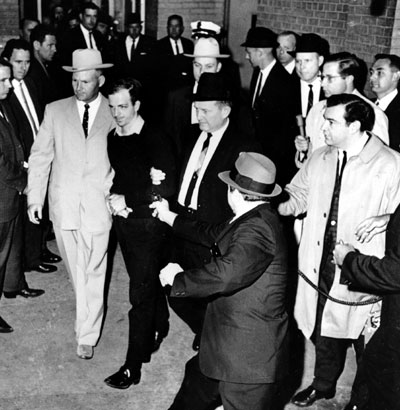
fatally wounded before live TV cameras in the basement of Dallas police headquarters
by Jack Ruby, a Dallas nightclub owner with many friends and acquaintances in the
Dallas Police and in the criminal underworld. Millions watched the shooting of Lee
Harvey Oswald, the first time a homicide was captured and shown publicly on live
television.
Unconscious, Oswald was put into an ambulance and rushed to Parkland Memorial
Hospital, the same hospital where JFK had died two days earlier. Doctors operated on
Oswald, but Ruby's single bullet had severed major abdominal blood vessels, and the
doctors were unable to repair the massive trauma. At 48 hours and 7 minutes after the
President's death, Oswald was pronounced dead. After a full autopsy, Oswald's body
was returned to his family.
by Jack Ruby, a Dallas nightclub owner with many friends and acquaintances in the
Dallas Police and in the criminal underworld. Millions watched the shooting of Lee
Harvey Oswald, the first time a homicide was captured and shown publicly on live
television.
Unconscious, Oswald was put into an ambulance and rushed to Parkland Memorial
Hospital, the same hospital where JFK had died two days earlier. Doctors operated on
Oswald, but Ruby's single bullet had severed major abdominal blood vessels, and the
doctors were unable to repair the massive trauma. At 48 hours and 7 minutes after the
President's death, Oswald was pronounced dead. After a full autopsy, Oswald's body
was returned to his family.
After the autopsy at Bethesda Naval
Hospital, Kennedy's body was prepared
for burial and returned to the White House
at about 04:30 a.m., Saturday, November
23. His casket was placed in the East
Room for 24 hours, as he lay in repose;
(then, the term "lying in repose" meant
private, as opposed to a public lying in
state).
A private Mass was said at 10:30 a.m.
EST November 24. After that, other
family members, friends, and other
government officials came to mourn.
There were specified times for members
of the family, top officials in the
Executive Branch, the Supreme Court,
Hospital, Kennedy's body was prepared
for burial and returned to the White House
at about 04:30 a.m., Saturday, November
23. His casket was placed in the East
Room for 24 hours, as he lay in repose;
(then, the term "lying in repose" meant
private, as opposed to a public lying in
state).
A private Mass was said at 10:30 a.m.
EST November 24. After that, other
family members, friends, and other
government officials came to mourn.
There were specified times for members
of the family, top officials in the
Executive Branch, the Supreme Court,
Kennedy lying in state in the Capitol rotunda,
between about 3 p.m. Sunday November 24,
1963 and about 9:00 a.m. Monday November
25, 1963.
http://en.wikipedia.org/wiki/Image:MournersPayRespectsToJFK.jpg
between about 3 p.m. Sunday November 24,
1963 and about 9:00 a.m. Monday November
25, 1963.
http://en.wikipedia.org/wiki/Image:MournersPayRespectsToJFK.jpg
Photos of Jack Ruby shooting
Lee Harvey Oswald taken by
Jack Beers (top), and Robert
Jackson (bottom). The pictures
were taken 1/6 sec apart.
Jackson won the Pulitzer prize
for his photo.
Lee Harvey Oswald taken by
Jack Beers (top), and Robert
Jackson (bottom). The pictures
were taken 1/6 sec apart.
Jackson won the Pulitzer prize
for his photo.
| ********** |
members of Congress, and members of the diplomatic corps to come to the White
House to pay their respects.After short eulogies by Senate Majority Leader Mike
Mansfield, Chief Justice Earl Warren, and Speaker of the House John W. McCormack,
mourners then left and after the rotunda was clear it was opened to the public.
In the only public viewing, hundreds of thousands lined up in near-freezing
temperatures to view the casket. Over the span of 18 hours, 250,000 people, some
waiting for as long as 10 hours in a line that stretched 40 blocks up to 10 persons wide,
personally paid their respects as Kennedy's body lay in state. Many of them were
weeping when they viewed the bier. Capitol police officers politely reminded mourners
to keep moving along in two lines that passed on either side of the casket and exited the
building on the west side facing the National Mall.
The doors were supposed to close at 9:00 p.m. and reopen for an hour at 9:00 the next
morning, However, because of the long lines, police and military authorities decided to
keep the doors open until 9:00 a.m. People began filing by the bier at 1400; a great
number were still waiting to enter when the rotunda was closed to the public at 09:00
a.m. on Monday, November 25.
House to pay their respects.After short eulogies by Senate Majority Leader Mike
Mansfield, Chief Justice Earl Warren, and Speaker of the House John W. McCormack,
mourners then left and after the rotunda was clear it was opened to the public.
In the only public viewing, hundreds of thousands lined up in near-freezing
temperatures to view the casket. Over the span of 18 hours, 250,000 people, some
waiting for as long as 10 hours in a line that stretched 40 blocks up to 10 persons wide,
personally paid their respects as Kennedy's body lay in state. Many of them were
weeping when they viewed the bier. Capitol police officers politely reminded mourners
to keep moving along in two lines that passed on either side of the casket and exited the
building on the west side facing the National Mall.
The doors were supposed to close at 9:00 p.m. and reopen for an hour at 9:00 the next
morning, However, because of the long lines, police and military authorities decided to
keep the doors open until 9:00 a.m. People began filing by the bier at 1400; a great
number were still waiting to enter when the rotunda was closed to the public at 09:00
a.m. on Monday, November 25.
Aerial view of JFKs funeral in St. Matthew's Cathedral, Monday, November
25, 1963.
http://en.wikipedia.org/wiki/Image:JFKFuneralSt.Matthew%27sCathedral.jpg
25, 1963.
http://en.wikipedia.org/wiki/Image:JFKFuneralSt.Matthew%27sCathedral.jpg
Approximately one million people lined the
route of the funeral procession, from the
Capitol back to the White House, then to St.
Matthew's Cathedral, and finally to Arlington
National Cemetery. Millions more across
America followed the funeral on television.
The television audience was particularly high,
as virtually the entire nation was at home
viewing the proceedings.
The procession began just before 11:00 a.m.,
when the coffin was carried out of the
rotunda and placed on the caisson, which
then made its way back to the White House.
Most of the music selected for the funeral
route of the funeral procession, from the
Capitol back to the White House, then to St.
Matthew's Cathedral, and finally to Arlington
National Cemetery. Millions more across
America followed the funeral on television.
The television audience was particularly high,
as virtually the entire nation was at home
viewing the proceedings.
The procession began just before 11:00 a.m.,
when the coffin was carried out of the
rotunda and placed on the caisson, which
then made its way back to the White House.
Most of the music selected for the funeral

procession, including "Hail to the Chief" was played at a
dirge-like speed.
At the White House, the procession resumed on foot to St.
Matthew's Cathedral, led by Kennedy's widow and his two
brothers, Attorney General Robert F. Kennedy and Senator
Edward M. Kennedy. The two Kennedy children rode in a
limousine behind them. The rest of the Kennedy Family, apart
from the president's father, Joseph P. Kennedy, Sr., who
was ill, waited at the cathedral.
Not since the funeral of Britain's King Edward VII in 1910,
had there been such a large gathering of presidents, prime
ministers, and royalty at a state funeral.
In all, 220 foreign dignitaries, including 19 heads of state and
government, and members of royal families, from 92
countries, including the Soviet Union, attended the funeral.
dirge-like speed.
At the White House, the procession resumed on foot to St.
Matthew's Cathedral, led by Kennedy's widow and his two
brothers, Attorney General Robert F. Kennedy and Senator
Edward M. Kennedy. The two Kennedy children rode in a
limousine behind them. The rest of the Kennedy Family, apart
from the president's father, Joseph P. Kennedy, Sr., who
was ill, waited at the cathedral.
Not since the funeral of Britain's King Edward VII in 1910,
had there been such a large gathering of presidents, prime
ministers, and royalty at a state funeral.
In all, 220 foreign dignitaries, including 19 heads of state and
government, and members of royal families, from 92
countries, including the Soviet Union, attended the funeral.
John Jr. says goodbye to
his father as his coffin
leaves St. Matthew's
Cathedral after the
funeral ceremony.
http://www.koelle.dk/funeral_8.html
his father as his coffin
leaves St. Matthew's
Cathedral after the
funeral ceremony.
http://www.koelle.dk/funeral_8.html
Most of the dignitaries passed unnoticed, strolling respectfully behind the former first
lady and the Kennedy family during the relatively short walk to the cathedral along
Connecticut Avenue. As the dignitaries marched, there was a heavy security presence
because of concerns for the potential assassination of so many world leaders.
The casket was borne again by caisson on the final leg to Arlington National Cemetery
for burial. Moments after the casket was carried down the front steps of the cathedral,
Jackie Kennedy whispered to her son, after which he saluted his father's coffin, a
gesture captured by the cameras and long remembered. The children were deemed to
be too young to attend the final burial service, so this was the point where the children
said goodbye to their father.
lady and the Kennedy family during the relatively short walk to the cathedral along
Connecticut Avenue. As the dignitaries marched, there was a heavy security presence
because of concerns for the potential assassination of so many world leaders.
The casket was borne again by caisson on the final leg to Arlington National Cemetery
for burial. Moments after the casket was carried down the front steps of the cathedral,
Jackie Kennedy whispered to her son, after which he saluted his father's coffin, a
gesture captured by the cameras and long remembered. The children were deemed to
be too young to attend the final burial service, so this was the point where the children
said goodbye to their father.
| ********** |
Virtually everyone else followed the caisson in a long line of black limousines passing
by the Lincoln Memorial and crossing the Potomac River. However, many of the
military units did not participate in the burial service. They left just after crossing the
Potomac.
A bugler played Taps, the notes cracking as if to express the deep emotion of the event.
At the end of the burial service, the widow lit an eternal flame to burn continuously
over his grave. At 3:34 p.m. EST, the mahogany casket containing his remains was
lowered into the earth. Kennedy thus became only the second president to be buried at
Arlington, after William Howard Taft.
by the Lincoln Memorial and crossing the Potomac River. However, many of the
military units did not participate in the burial service. They left just after crossing the
Potomac.
A bugler played Taps, the notes cracking as if to express the deep emotion of the event.
At the end of the burial service, the widow lit an eternal flame to burn continuously
over his grave. At 3:34 p.m. EST, the mahogany casket containing his remains was
lowered into the earth. Kennedy thus became only the second president to be buried at
Arlington, after William Howard Taft.
| References and For Further Reading |
JFK's coffin enters Arlington National
Cemetery.
Cemetery.
JFK is laid to rest in Arlington National Cemetery.
http://www.army.mil/cmh-pg/books/Last_Salute/Ch23.htm
http://www.army.mil/cmh-pg/books/Last_Salute/Ch23.htm
| ********** |


