Equipment Conveyor. Armstrong then jumped to the
ladder's third rung and climbed into the LM. After
transferring to LM life support, the explorers lightened
the ascent stage for return to lunar orbit by tossing out
their PLSS backpacks, lunar overshoes, one Hasselblad
camera, and other equipment. They then repressurised
the LM, and settled down to sleep.
While moving in the cabin Aldrin accidentally broke the
circuit breaker that armed the main engine for lift off
from the moon. There was initial concern this would
prevent firing the engine, which would strand them on
the moon. Fortunately a ball-point pen was sufficient to
activate the switch. Had this not worked, the Lunar
Module circuitry could have been reconfigured to allow
firing the ascent engine.
After about seven hours of rest, they were awakened
by Houston to prepare for the return flight. Two and a
half hours later, at 17:54 UTC, they lifted off in Eagle's
ascent stage, carrying 21.5 kilograms of lunar samples
with them, to rejoin CMP Michael Collins aboard
Columbia in lunar orbit.
After more than 2½ hours on the lunar surface, they
had left behind scientific instruments such as a
retroreflector array used for the Lunar Laser Ranging
Experiment. They also left an American flag and a
plaque (mounted on the LM Descent Stage ladder)
bearing two drawings of Earth (of the Western and
Eastern Hemispheres), an inscription, and signatures of
the astronauts and Richard Nixon. The inscription read
Here Men From The Planet Earth First Set Foot Upon
the Moon, July 1969 A.D. We Came in Peace For All
Mankind. http://en.wikipedia.org/wiki/Apollo_11
ladder's third rung and climbed into the LM. After
transferring to LM life support, the explorers lightened
the ascent stage for return to lunar orbit by tossing out
their PLSS backpacks, lunar overshoes, one Hasselblad
camera, and other equipment. They then repressurised
the LM, and settled down to sleep.
While moving in the cabin Aldrin accidentally broke the
circuit breaker that armed the main engine for lift off
from the moon. There was initial concern this would
prevent firing the engine, which would strand them on
the moon. Fortunately a ball-point pen was sufficient to
activate the switch. Had this not worked, the Lunar
Module circuitry could have been reconfigured to allow
firing the ascent engine.
After about seven hours of rest, they were awakened
by Houston to prepare for the return flight. Two and a
half hours later, at 17:54 UTC, they lifted off in Eagle's
ascent stage, carrying 21.5 kilograms of lunar samples
with them, to rejoin CMP Michael Collins aboard
Columbia in lunar orbit.
After more than 2½ hours on the lunar surface, they
had left behind scientific instruments such as a
retroreflector array used for the Lunar Laser Ranging
Experiment. They also left an American flag and a
plaque (mounted on the LM Descent Stage ladder)
bearing two drawings of Earth (of the Western and
Eastern Hemispheres), an inscription, and signatures of
the astronauts and Richard Nixon. The inscription read
Here Men From The Planet Earth First Set Foot Upon
the Moon, July 1969 A.D. We Came in Peace For All
Mankind. http://en.wikipedia.org/wiki/Apollo_11

 |  |  |  |
| Quiz #109 Results |


 |  |  |  |
| Answer to Quiz #109 May 14, 2007 |


| Click here to see our reader's choice for Best Picture and the results of Survey #3, December 22, 2006. |
| ********** |
| See results of Survey #2 May 12-19, 2006 Click here. |
| See results of Survey #1 December 9-16, 2005 Click here. |
| 1. What are the headlines referring to? 2. Who are these three men? 3. Where is this newspaper published? |
| Dead Horse Update Click HERE to read Part 1 of our analysis of the picture published 4/1/2007 in the Sheboygan Press. Click HERE to read Part II published April 8, 2007 |

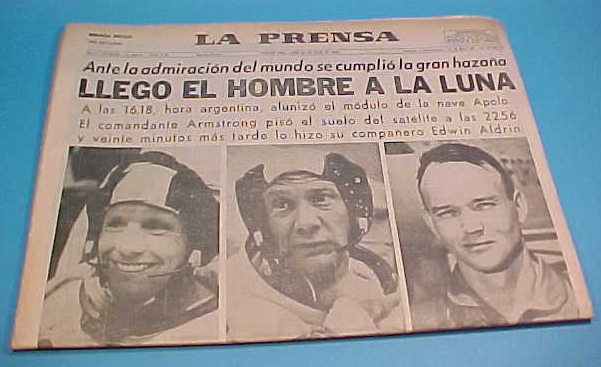
| Answers: 1. The landing of Apollo 11 on the moon, July 20, 1969 2. Neil Armstrong, Buzz Aldrin, Michael Collins, Crew of Apollo 11 3. Bueno Aires, Argentina |
| Homepage of La Prensa, Buenos Aires, Argentina http://www.laprensa.com.ar/ |
| Other photos we considered for this quiz: |
| MAN LANDS ON THE MOON At 4:18 p.m. Argentina time, a module of the Apollo ship landed on the moon. Commander Armstrong stepped onto the lunar surface at 10:56 and twenty minutes later, his colleague Edwin Aldrin followed him. |
| ********** |
| Comments from Our Readers |
| ********** |


| The crew of Apollo 11 in quarantine after returning from the moon. |

| Michael Collins, Neil Armstrong, and Buzz Aldrin with President Bush at the White House, 2004. |
| ********** |
| Congratulations to Our Winners! Patty Kaliher Mike Dalton Edee Scott Paula Harris Fred Stuart Marjorie Wilser Sharon Martin Donald Schulteis Elaine C. Hebert Margaret English Grace Hertz Kelly Fetherlin Pat Snyder Fred Stuart Alan Cullinan Linda Williams Wayne Douglas Lynda Snider Margaret Waterman Betty Ware Stan Read Don Haase Joel Amos Gordon Jim Kiser Paula Harris William Hughes Edee Scott Mike Dalton Bill Hurley Ruth Govorchin Judy Pfaff Mary Fraser Delores Martin Bob McKenna |
Ezequiel Paz retired in 1943, and Alberto Gainza Paz, son of the founder's daughter,
took over La Prensa. A revolution was going on which ended in the setting up of a de
facto Government headed by Juan Peron. Peron immediately established a centralized
office of information on official news and otherwise limited the activities of the press.
Journalists had to register with the Government or be barred from working.
La Prensa, anti-Peron, did not moderate its position. On April 26, 1944, Peron
suspended it for 5 days...
http://www.trivia-library.com/a/history-of-international-newspapers-la-prensa-in-argentina-part-2.htm
took over La Prensa. A revolution was going on which ended in the setting up of a de
facto Government headed by Juan Peron. Peron immediately established a centralized
office of information on official news and otherwise limited the activities of the press.
Journalists had to register with the Government or be barred from working.
La Prensa, anti-Peron, did not moderate its position. On April 26, 1944, Peron
suspended it for 5 days...
http://www.trivia-library.com/a/history-of-international-newspapers-la-prensa-in-argentina-part-2.htm
| About La Prensa |
| ********** |
| ********** |
I was a very recent high school graduate the year of the lunar landing, and just about a
month before Hurricane Camille devastated the Gulf Coast! Elaine C. Hebert
I can remember the news that we had landed on the Moon as if it was yesterday, just
as I remember the Kennedy Assassination like it was yesterday, and certainly 911!
How about you? I was working on calculus problems when the men landed on the
Moon. On 22 November 1963, I was sitting in history class when someone said that
the president had been assassinated. My first thoughts were that they were referring to
the Lincoln Assassination of nearly 100 years earlier – they weren’t! As for 911, I didn’
t turn-on the TV coverage until 9:30 AM, and I sat transfixed as things unfolded. I
couldn’t imagine what would come next! I’m sure that you can review all these same
moments in your head, too – just like it was yesterday! Kelly Fetherlin
On that date in 1969, I was at a National Guard Armory in city named after a famous
Indian Chief. Mike Dalton
The summer of 1969 holds a special significance and moon trip. My husband and I
were married on Friday 13, 1969. We took a 3/4 week honey moon through the west.
When we returned, all the news was of the Apollo 11 moon mission. The pictures of
the moon looked very much like northern Michigan sand dune walks. I remember
watching the live transmission at my inlaw's and all the discussions we had about the
momentous moments and the total awe that the event/project was happening. We were
living in incredible times. I think this was especially important because we had
experienced such sadness at the Kennedy deaths, the civil rights problems, felt that the
Soviets had bested us in technology, and we were in the Viet Nam War. This was such
a positive event for us. We were going to enter the 1970s on a high note.
Judy Pfaff
month before Hurricane Camille devastated the Gulf Coast! Elaine C. Hebert
I can remember the news that we had landed on the Moon as if it was yesterday, just
as I remember the Kennedy Assassination like it was yesterday, and certainly 911!
How about you? I was working on calculus problems when the men landed on the
Moon. On 22 November 1963, I was sitting in history class when someone said that
the president had been assassinated. My first thoughts were that they were referring to
the Lincoln Assassination of nearly 100 years earlier – they weren’t! As for 911, I didn’
t turn-on the TV coverage until 9:30 AM, and I sat transfixed as things unfolded. I
couldn’t imagine what would come next! I’m sure that you can review all these same
moments in your head, too – just like it was yesterday! Kelly Fetherlin
On that date in 1969, I was at a National Guard Armory in city named after a famous
Indian Chief. Mike Dalton
The summer of 1969 holds a special significance and moon trip. My husband and I
were married on Friday 13, 1969. We took a 3/4 week honey moon through the west.
When we returned, all the news was of the Apollo 11 moon mission. The pictures of
the moon looked very much like northern Michigan sand dune walks. I remember
watching the live transmission at my inlaw's and all the discussions we had about the
momentous moments and the total awe that the event/project was happening. We were
living in incredible times. I think this was especially important because we had
experienced such sadness at the Kennedy deaths, the civil rights problems, felt that the
Soviets had bested us in technology, and we were in the Viet Nam War. This was such
a positive event for us. We were going to enter the 1970s on a high note.
Judy Pfaff
| APOLLO 11 |
| The prime mission objective of Apollo 11 is stated simply: "Perform a manned lunar landing and return". |

| A speech titled "In Event of Moon Disaster" was prepared by William Safire for President Nixon to read on television in the event the Apollo 11 astronauts were stranded on the Moon. Following this address, radio communications with the moon would have been cut off, the astronauts left alone to die, while a clergyman was to commend their souls to "the deepest of the deep" in the fashion of a burial at sea. |
| Designed by Michael Collins Crew member of Apollo 11 |
| What If? |
| ******** |

| New York Times coverage of the Apollo 11 moon landing; outside of war it was possibly the only event of the 20th Century to make front-page headlines simultaneously in every newspaper around the world. |
The Apollo 11 mission was the first mission to
land on the Moon. It was the fifth human
spaceflight of the Apollo programs, and the
third human voyage to the moon. Launched on
July 16, 1969, it carried Commander Neil
Armstrong, Command Module Pilot Michael
Collins and Lunar Module Pilot Edwin 'Buzz'
Aldrin. On July 20, Armstrong and Aldrin
became the first humans to land on the Moon,
while Collins orbited above.
The mission fulfilled President John F.
Kennedy's goal of "landing a man on the moon
land on the Moon. It was the fifth human
spaceflight of the Apollo programs, and the
third human voyage to the moon. Launched on
July 16, 1969, it carried Commander Neil
Armstrong, Command Module Pilot Michael
Collins and Lunar Module Pilot Edwin 'Buzz'
Aldrin. On July 20, Armstrong and Aldrin
became the first humans to land on the Moon,
while Collins orbited above.
The mission fulfilled President John F.
Kennedy's goal of "landing a man on the moon
and returning him safely to the Earth"
by the end of the 1960s. Many
consider the landing one of the
defining moments of the 20th century.
In addition to one million people
crowding the highways and beaches
near the launch site, an estimated
audience of over 700 million people
viewed the launch of Apollo 11 on
television; a new record at that time.
President Nixon viewed the
proceedings from the Oval Office of
the White House. Saturn V launched
Apollo 11 from the Kennedy Space
Center on July 16, 1969 at 13:32 UTC
(9:32 A.M. local time).
Four days later on July 20, 1969 the
lunar module, called Eagle after the
eagle present on the insignia, separated
from the Command Module, named
Columbia after the columbiad cannon
used to launch moonships in Jules
Verne's novel From the Earth to the
Moon. Collins, alone aboard Columbia,
inspected Eagle as it pirouetted before
him to ensure the craft was not
by the end of the 1960s. Many
consider the landing one of the
defining moments of the 20th century.
In addition to one million people
crowding the highways and beaches
near the launch site, an estimated
audience of over 700 million people
viewed the launch of Apollo 11 on
television; a new record at that time.
President Nixon viewed the
proceedings from the Oval Office of
the White House. Saturn V launched
Apollo 11 from the Kennedy Space
Center on July 16, 1969 at 13:32 UTC
(9:32 A.M. local time).
Four days later on July 20, 1969 the
lunar module, called Eagle after the
eagle present on the insignia, separated
from the Command Module, named
Columbia after the columbiad cannon
used to launch moonships in Jules
Verne's novel From the Earth to the
Moon. Collins, alone aboard Columbia,
inspected Eagle as it pirouetted before
him to ensure the craft was not
damaged. Armstrong and Aldrin used Eagle's
descent engine to right themselves and
descend to the lunar surface.
As it guided the LM's descent, the LM
navigation and guidance computer reported
several unusual "program alarms", taking the
crew's attention from the scene outside as the
descent proceeded. In NASA's Mission
Control Center in Houston, Texas, controller
Steve Bales told the flight director that it was
safe to continue the descent in spite of the
alarms; the computer was merely reporting it
was overtasked and that nothing was wrong
with the spacecraft. Once Armstrong
descent engine to right themselves and
descend to the lunar surface.
As it guided the LM's descent, the LM
navigation and guidance computer reported
several unusual "program alarms", taking the
crew's attention from the scene outside as the
descent proceeded. In NASA's Mission
Control Center in Houston, Texas, controller
Steve Bales told the flight director that it was
safe to continue the descent in spite of the
alarms; the computer was merely reporting it
was overtasked and that nothing was wrong
with the spacecraft. Once Armstrong
returned his attention to the view outside it was apparent that the computer was guiding
them toward a large crater with rocks scattered around it. Armstrong took manual
control of the lunar module at that point, and with Aldrin's assistance, calling out data
from the radar and computer, guided it to a landing at 20:17 UTC on July 20 with about
30 seconds of fuel left.
them toward a large crater with rocks scattered around it. Armstrong took manual
control of the lunar module at that point, and with Aldrin's assistance, calling out data
from the radar and computer, guided it to a landing at 20:17 UTC on July 20 with about
30 seconds of fuel left.

Armstrong gave the name Tranquility
Base on the landing site immediately after
touchdown to the partiall confused staff
at Mission Control. Armstrong's first
words after landing were: "Houston,
Tranquility Base here. The Eagle has
landed."
Shortly after landing, before preparations
began for the EVA, Aldrin broadcast that:
This is the LM pilot. I'd like to take this
opportunity to ask every person listening
in, whoever and wherever they may be, to
pause for a moment and contemplate the
events of the past few hours and to give
thanks in his or her own way.
Base on the landing site immediately after
touchdown to the partiall confused staff
at Mission Control. Armstrong's first
words after landing were: "Houston,
Tranquility Base here. The Eagle has
landed."
Shortly after landing, before preparations
began for the EVA, Aldrin broadcast that:
This is the LM pilot. I'd like to take this
opportunity to ask every person listening
in, whoever and wherever they may be, to
pause for a moment and contemplate the
events of the past few hours and to give
thanks in his or her own way.
| Houston, Tranquility Base here. The Eagle has landed. |
At 2:56 UTC on July 20, Armstrong made his descent to the Moon's surface and spoke
his famous line "That's one small step for (a) man, one giant leap for mankind" exactly
six and a half hours after landing.[1] Aldrin joined him, saying, "Beautiful. Beautiful.
Magnificent desolation." Then for two-and-a-half hours, they took notes, photographed
what they saw, and drilled core samples.
his famous line "That's one small step for (a) man, one giant leap for mankind" exactly
six and a half hours after landing.[1] Aldrin joined him, saying, "Beautiful. Beautiful.
Magnificent desolation." Then for two-and-a-half hours, they took notes, photographed
what they saw, and drilled core samples.

| Neil Armstrong descends to the lunar surface, July 20, 1969. That's one small step for (a) man, one giant leap for mankind. |
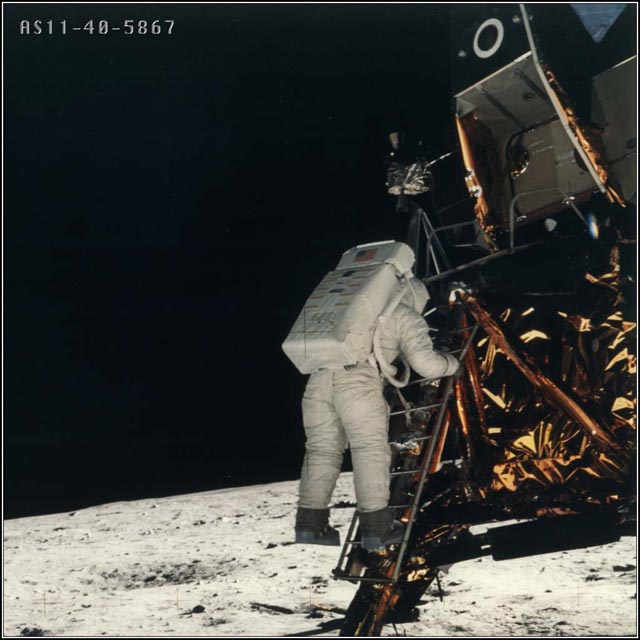
| Buzz Aldrin descending to the surface of the moon. Magnificent desolation. |
Armstrong had some initial difficulties
squeezing through the hatch with his
Portable Life Support System (PLSS).
According to veteran moonwalker John
Young, a redesign of the LM to incorporate
a smaller hatch was not followed by a
redesign of the PLSS backpack, so some of
the highest heart rates recorded from Apollo
astronauts occurred during LM egress and
ingress.
While climbing down the nine-rung ladder,
Armstrong pulled a D-ring to deploy the
Modular Equipment Stowage Assembly
(MESA) folded against Eagle's side and
activate the TV camera. Despite some
technical and weather difficulties, ghostly
black and white images of the first lunar
EVA were received and were immediately
broadcast to at least 600 million people on
Earth.
After describing the surface dust ("fine and
powdery ... I only go in a small fraction of
an inch, but I can see the footprints of my
boots"), Armstrong stepped off Eagle's
footpad and into history as the first human
to set foot on another world, famously
describing it as "one small step for (a) man,
one giant leap for mankind.". He reported
that moving in the Moon's gravity, one-sixth
of Earth's, was "even perhaps easier than
the simulations ... It's absolutely no trouble
to walk around".
squeezing through the hatch with his
Portable Life Support System (PLSS).
According to veteran moonwalker John
Young, a redesign of the LM to incorporate
a smaller hatch was not followed by a
redesign of the PLSS backpack, so some of
the highest heart rates recorded from Apollo
astronauts occurred during LM egress and
ingress.
While climbing down the nine-rung ladder,
Armstrong pulled a D-ring to deploy the
Modular Equipment Stowage Assembly
(MESA) folded against Eagle's side and
activate the TV camera. Despite some
technical and weather difficulties, ghostly
black and white images of the first lunar
EVA were received and were immediately
broadcast to at least 600 million people on
Earth.
After describing the surface dust ("fine and
powdery ... I only go in a small fraction of
an inch, but I can see the footprints of my
boots"), Armstrong stepped off Eagle's
footpad and into history as the first human
to set foot on another world, famously
describing it as "one small step for (a) man,
one giant leap for mankind.". He reported
that moving in the Moon's gravity, one-sixth
of Earth's, was "even perhaps easier than
the simulations ... It's absolutely no trouble
to walk around".
The astronauts then took a phone call from President Richard Nixon after planting the
U.S. flag together on the Moon's surface. They deployed the EASEP, which included a
passive seismograph and a laser ranging retroreflector. Then Armstrong loped about
120 m (400 ft) from the LM to snap photos at the rim of East Crater while Aldrin
collected two core tubes. He used the geological hammer to pound in the tubes - the
only time the hammer was used on Apollo 11. The astronauts then collected rock
samples using scoops and tongs on extension handles. Many of the surface activities
took longer than expected, so they had to stop documented sample collection halfway
through the allotted 34 min.
During this period Mission Control used a coded phrase to warn Armstrong that his
metabolic rates were high and that he should slow down. He was moving rapidly from
task to task as time ran out. Rates remained generally lower than expected for both
astronauts throughout the walk, however, so Mission Control granted the astronauts a
15-minute extension
U.S. flag together on the Moon's surface. They deployed the EASEP, which included a
passive seismograph and a laser ranging retroreflector. Then Armstrong loped about
120 m (400 ft) from the LM to snap photos at the rim of East Crater while Aldrin
collected two core tubes. He used the geological hammer to pound in the tubes - the
only time the hammer was used on Apollo 11. The astronauts then collected rock
samples using scoops and tongs on extension handles. Many of the surface activities
took longer than expected, so they had to stop documented sample collection halfway
through the allotted 34 min.
During this period Mission Control used a coded phrase to warn Armstrong that his
metabolic rates were high and that he should slow down. He was moving rapidly from
task to task as time ran out. Rates remained generally lower than expected for both
astronauts throughout the walk, however, so Mission Control granted the astronauts a
15-minute extension


In preparation for lunar
ascent and the return
home, Aldrin entered
Eagle first. With some
difficulty the astronauts
lifted film and two
sample boxes containing
more than 22 kg (48 lb)
of lunar surface material
to the LM hatch using a
flat cable pulley device
called the Lunar
ascent and the return
home, Aldrin entered
Eagle first. With some
difficulty the astronauts
lifted film and two
sample boxes containing
more than 22 kg (48 lb)
of lunar surface material
to the LM hatch using a
flat cable pulley device
called the Lunar
| Neil Armstrong (right) and Buzz Aldrin (right) aboard the LM. |
| Neil Armstrong can be seen reflected in Buzz Aldrin's helmet. |
| Buzz Aldrin |

| Here Men From The Planet Earth First Set Foot Upon the Moon, July 1969 A.D. We Came in Peace For All Mankind. |
| For Further Reading The Smithsonian Institution The Apollo Program http://www.nasm.si.edu/collections/imagery/apollo/AS11/a11.htm The Apollo 11 Mission Including Mission Highlights, as Described by the Apollo 11 Astronauts http://science.ksc.nasa.gov/history/apollo/apollo-11/apollo-11.html Apollo 11 http://en.wikipedia.org/wiki/Apollo_11 Biography of Neil Armstrong http://en.wikipedia.org/wiki/Neil_Armstrong Biography of Edwin Eugene (Buzz) Aldrin, Jr. http://en.wikipedia.org/wiki/Buzz_Aldrin Biography of Michael Collins http://en.wikipedia.org/wiki/Michael_Collins_%28astronaut%29 |
| ********** |
| If you enjoy our quizzes, don't forget to order our books! Click here. |
| If you have a picture you'd like us to feature a picture in a future quiz, please email it to us at CFitzp@aol.com. If we use it, you will receive a free analysis of your picture. You will also receive a free Forensic Genealogy CD or a 10% discount towards the purchase of the Forensic Genealogy book. |

| ********** |
